5 Drone Detection Myths That Cost Buyers Money
Aug 21 2026
What Buyers Get Wrong About Drone Detection
Drone detection is a young market, and young markets breed misconceptions. Sales brochures overstate capability. Online forums repeat half-truths. And buyers, facing a genuinely complex technical decision, reach for the explanation that sounds most reassuring. The result is a set of widely held beliefs about drone detection that are, at best, incomplete and, at worst, actively misleading.
This article walks through five of the most common ones, explains where each goes wrong, and points toward the reasoning that actually holds up when the drone shows up.
Myth 1: RF Detection Covers Everything
The claim: a radio frequency detection system that covers the right frequency bands will catch every drone. The reasoning feels sound. Drones use radio signals, so monitoring those signals should catch them all.
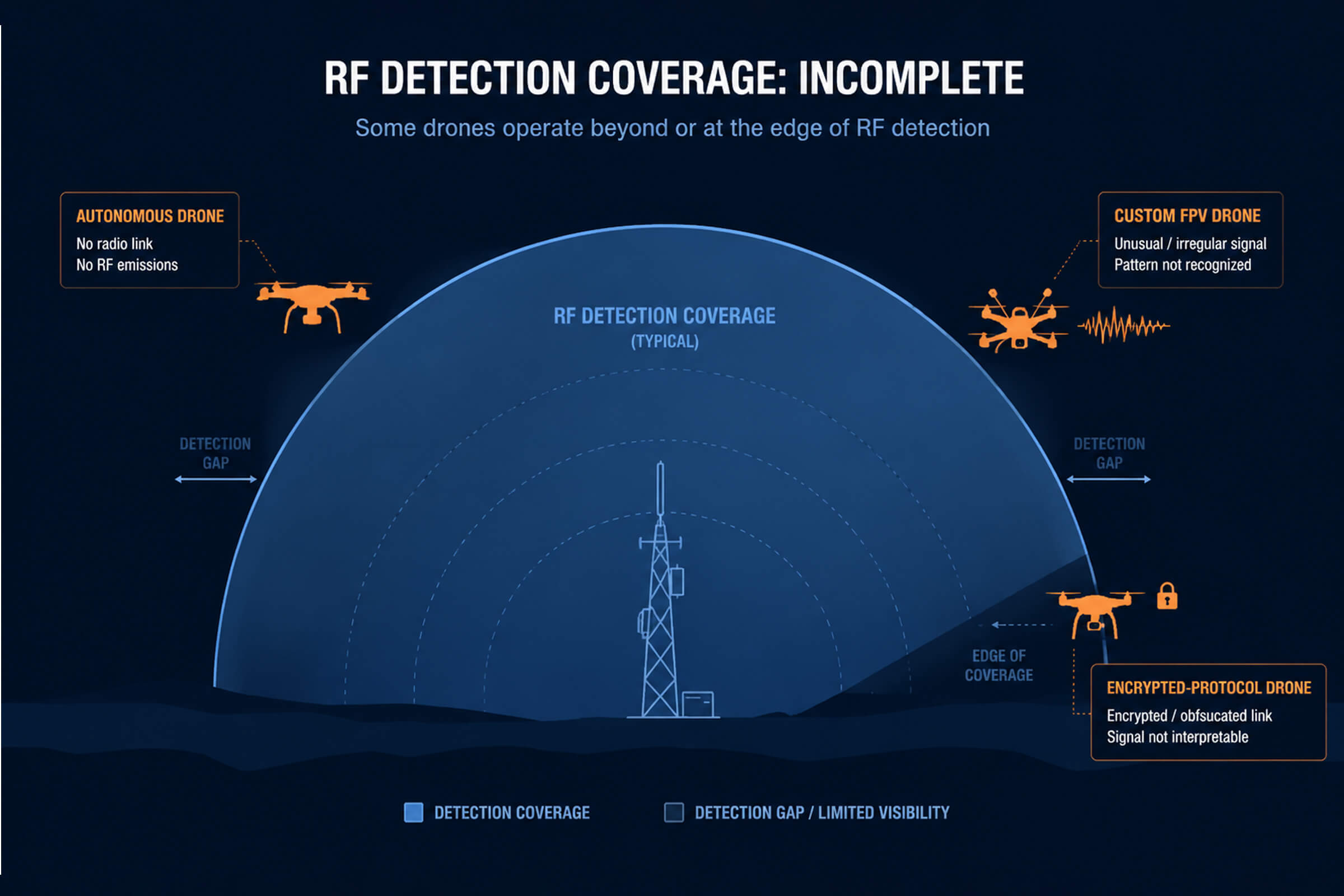
The reality is more limited. RF detection works by recognizing the radio signatures of known drone types. It is very good at identifying popular commercial models, the DJI and Autel aircraft that make up most of the drone population. Where it can fall short is with drones that do not use standard communication links: fully autonomous aircraft that fly a pre-programmed route without a live control link, drones using non-standard or encrypted protocols, and custom-built airframes with unusual signal patterns.
This does not mean RF detection is weak. It means RF detection is one layer. A robust system pairs RF detection with other sensing, radar for detecting non-emitting aircraft and electro-optical for visual confirmation, so that the gaps in one layer are covered by the others. Treating RF as the whole answer is the fastest way to be surprised by the drone it does not catch.
Myth 2: Radar Is Enough On Its Own
The claim: radar is the gold standard of airspace detection, so a radar unit solves the drone problem. It is a natural assumption. Radar has been the backbone of air defense for decades.
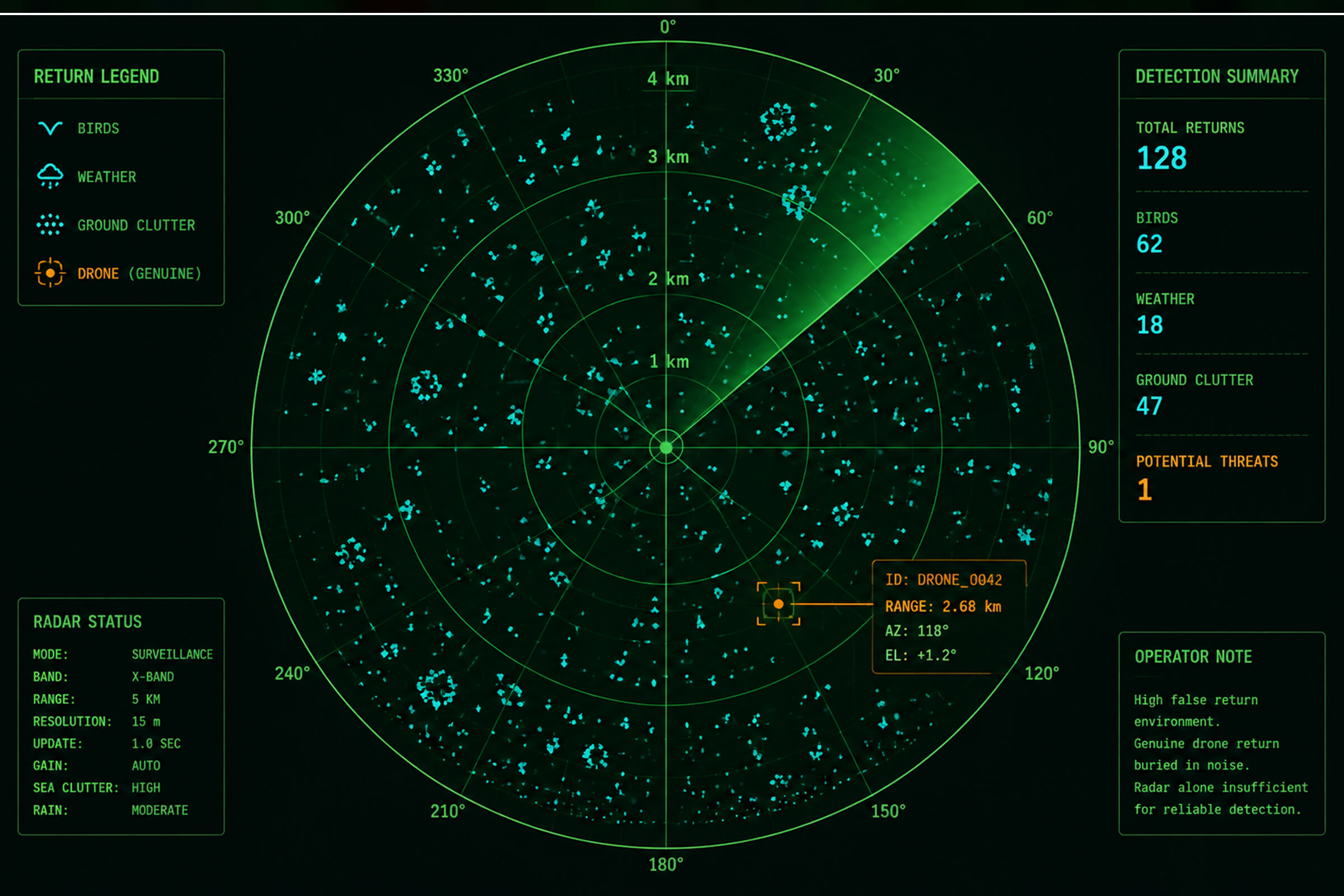
The problem is what radar was designed to detect. Traditional radar is built for large, fast, metallic aircraft. Drones are small, slow, and often made of plastic and composites. A consumer drone presents a radar cross-section that is a tiny fraction of an aircraft’s, which means radar either misses it entirely or flags so much clutter, birds, weather, and ground returns that the operator drowns in false alarms.
There is a second issue. Radar tells you that something is there and roughly where. It does not tell you what it is. For a drone detection system, identification matters: knowing whether a contact is a DJI quadcopter or a flock of birds is the difference between a useful alert and noise. Radar works best as one sensor in a fused system, providing a position for the RF and electro-optical layers to confirm and identify, not as a standalone answer.
Myth 3: A Handheld Detector Replaces a Fixed System
The claim: a handheld detection device is cheaper, portable, and does the same job as a fixed installation. On paper, it is an attractive trade, more flexibility for less money.
The reality is that handheld and fixed systems solve different problems. A handheld unit like the H3 Pro or HDJ 3.0 gives an operator on patrol the ability to detect and localize a drone in their immediate area. It is excellent for mobile teams, event security, and rapid response. But it is inherently limited by the operator: it only detects what it is pointed toward, it only works when someone is holding it and watching the screen, and it cannot maintain the continuous, around-the-clock coverage that a fixed installation provides.
A fixed system, by contrast, runs continuously, covers a defined area, and feeds a command platform that logs every contact. For a facility that needs persistent protection, an airport, a correctional institution, or an energy site, a handheld device is a supplement to a fixed system, not a substitute. The right comparison is not handheld versus fixed. It is the role each fills and whether the site needs continuous coverage or on-demand capability.
Myth 4: Jamming Is a Universal Solution
The claim: if you can jam a drone’s control signal, you have solved the problem. Just switch it on, and the drone falls out of the sky. It is the most seductive of the five myths because it sounds decisive.
The reality has three complications. First, jamming is not universally legal. In most countries, active jamming by private parties is restricted or prohibited because it interferes with the legitimate radio spectrum. A facility that buys a jammer it cannot legally use has bought a paperweight.
Second, jamming is not always effective. A drone flying a pre-programmed autonomous route does not need a live control link to complete its mission. Jam its signal, and it continues on its path. Drones with strong return-to-home logic will simply fly home. And the same jamming energy that disrupts a drone also disrupts legitimate communications nearby, a serious problem at a site that depends on its own wireless systems.
Third, jamming does not tell you anything. To jam a drone, you first have to know it is there, what it is, and where it is. That is exactly what the detection layer provides. Jamming is a response measure that depends entirely on detection. It is not a solution in itself. It is the last step in a chain that starts with detection and identification.
Myth 5: More Expensive Means Better Coverage
The claim: in drone detection, as in most things, you get what you pay for, and the highest-priced system must be the best. It is a comfortable assumption because it removes the burden of actually understanding the technology.
The reality is that coverage and capability do not track price in any simple way. A single expensive sensor placed at the center of a site still leaves the perimeter uncovered. A well-designed network of mid-range sensors, correctly spaced and properly fused, will outperform a single flagship unit every time. The value in drone detection is in the architecture, the placement, the overlap, the fusion, not in the price tag of any single component.
The better question to ask is not how much a system costs, but whether it covers the site’s actual geometry, whether it detects and identifies the drones that actually threaten the facility, and whether it feeds a command layer that turns detection into a response. A system that answers those questions well at a reasonable price is worth more than an expensive one that does not.
How to Evaluate a Vendor Without the Hype
Given how many claims float around this market, the practical question for a buyer is how to cut through them. Three questions do most of the work.
First, ask what the system does not detect. Every technology has limits, and a vendor who will not name theirs is either unaware of them or hoping you do not ask. A credible vendor can tell you, specifically, where their coverage drops off, which drone types are harder to see, and what terrain or clutter degrades performance.
Second, ask for a demonstration in your environment, not in a brochure. Drone detection performance is a function of the local RF environment, the terrain, and the specific threats you face. A system that performs well in a vendor’s clean test range may behave very differently at a site full of competing signals. A live test, against the drones you actually worry about, is worth more than any specification sheet.
Third, ask how the system scales. A detector that works as a single unit is one thing. A detector that networks cleanly with others, fuses into a command layer, and extends to cover a larger site over time is another. Buy the architecture, not just the box, because the drone threat is not going to get simpler.
A related misconception is that a drone over a facility is a single event to be handled once and forgotten. The operators who live with the problem know better. Drone incursions repeat. The same operator, the same airframe, the same route, over and over, testing the response each time. What changes the pattern is not a single interception. It is the operator’s growing certainty that the facility is watching, logging, and responding consistently.
This is where detection earns its keep as a deterrent, not just a sensor. A facility that reliably detects, records, and reports every incursion builds a reputation that spreads through the small community of people who fly drones where they should not. Word travels. A site that is known to document everything and respond every time attracts fewer repeat offenders than a site that is known to be asleep at the wheel.
There is a practical cost angle too. The comparison buyers should run is not the price of a detection system against nothing. It is the price of the system against the cost of one unmonitored incident: the operational downtime, the liability, the regulatory fine, the insurance premium increase, the reputational damage. For an airport, a single closed runway costs far more than a detection node. For an energy site, a single production interruption dwarfs the cost of a warning ring. Seen through that lens, detection is not an expense added to security. It is the cheapest layer of it.
What Actually Holds Up
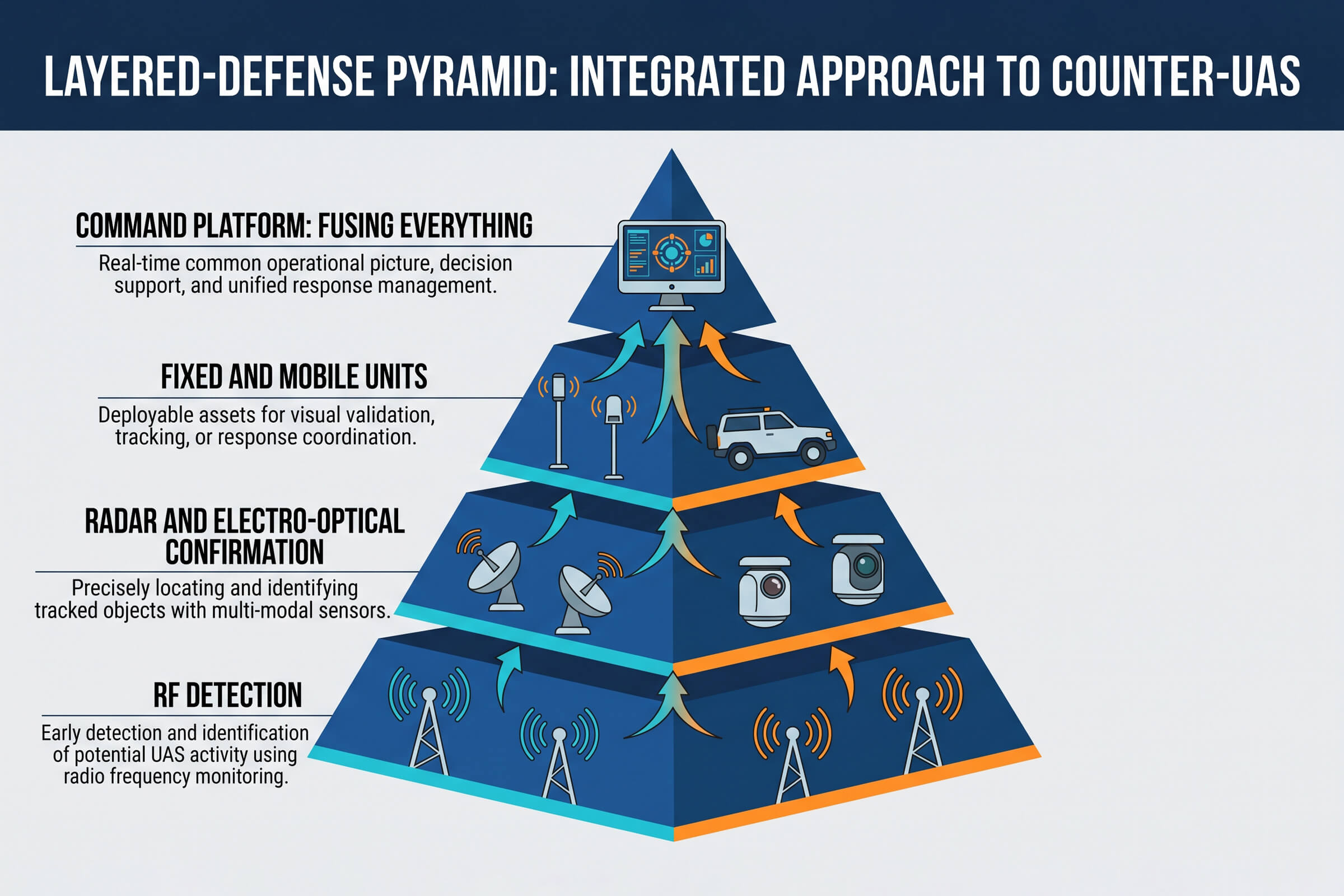
Step back from the myths, and a consistent principle emerges. Drone detection is a layered problem, and the layers reinforce each other. RF detection catches the radio-emitting majority. Radar and electro-optical layers catch what RF misses and confirm what RF flags. Fixed systems provide continuous coverage; handheld and mobile units provide on-demand capability where and when a fixed system cannot reach. And every layer, passive or active, depends on a command platform that fuses the feeds into a single coherent picture.
The buyers who succeed are the ones who resist the single-answer myth. They understand that no one sensor, no one frequency band, and no one technique catches every drone. They build systems the way the problem is actually structured, in layers, and they evaluate every purchase against one question: does this close a gap in my coverage, or does it just add another screen to watch? That question, asked honestly, is worth more than any brochure.
Connect with us
Ready to Secure Your Low-Altitude Airspace?