How to Choose Portable Drone Detection Equipment: A Practical Guide to H3 Pro and HD5
Jul 24 2026
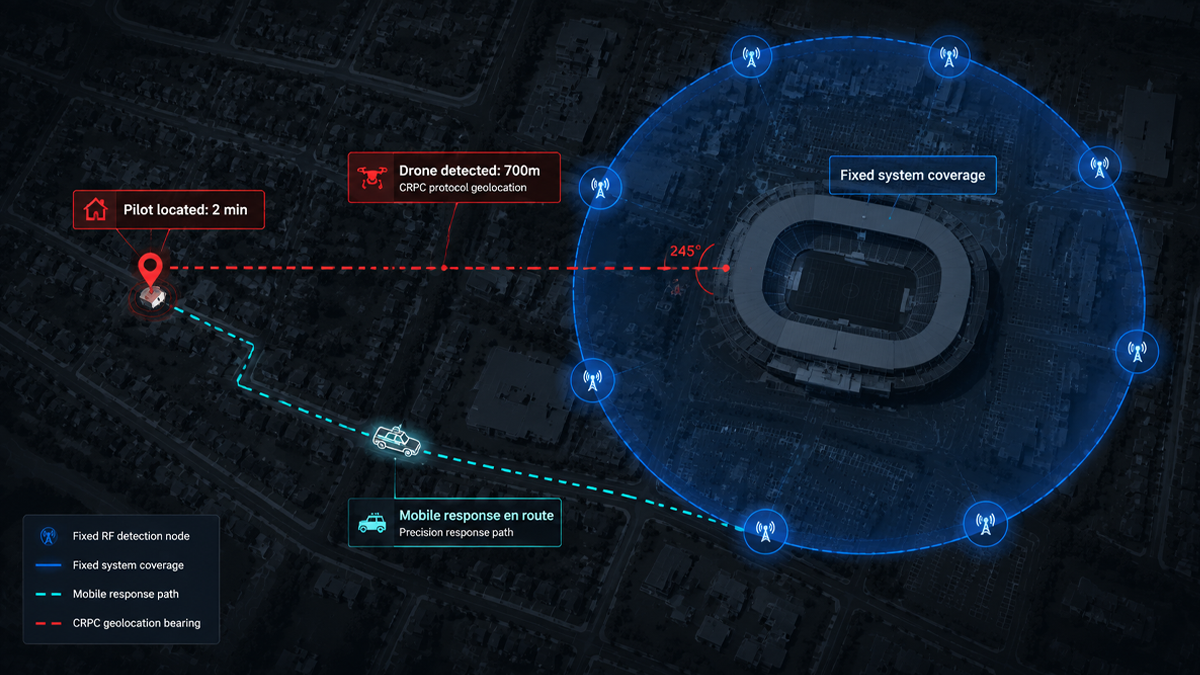
When a security team needs to find a drone that just appeared over their facility, they care about two things: where exactly the drone is, and who is flying it. A compass bearing that points toward the general direction of the signal is not enough. In a dense urban environment or a sprawling industrial site, a bearing angle could correspond to any building within a wide arc, spanning hundreds of meters of uncertainty.
This is where protocol-based drone detection makes a critical difference. LZ TECH’s portable detection devices do not rely on antenna arrays to estimate an angle of arrival. Instead, they receive and decode the drone’s own telemetry transmissions to extract precise GPS coordinates, serial number, model, altitude, and speed. The result is not a rough direction. It is an exact location and a confirmed identity.
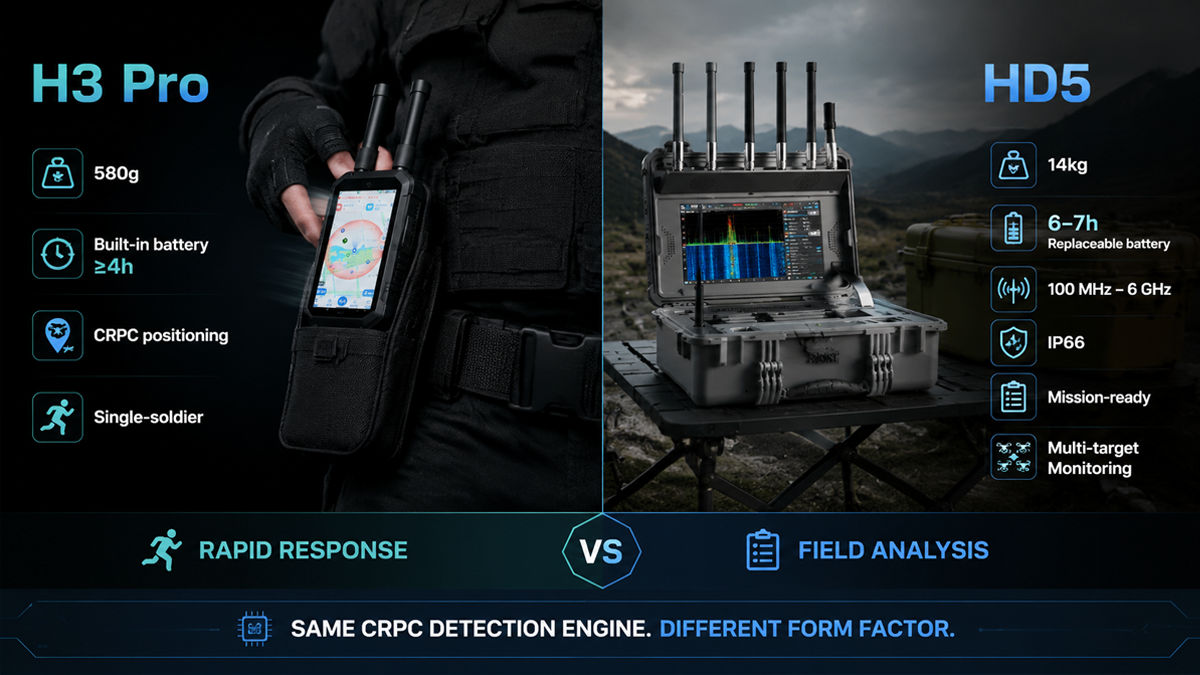
This guide compares two portable detection form factors from LZ TECH: the H3 Pro, a 580-gram single-soldier unit, and the HD5, a 14-kilogram portable system in a rugged case. Both use the same CRPC protocol decoding engine. The choice between them depends on the mission profile, not on detection capability. This article explains the technology, the specifications, and the operational factors that should guide the decision.
The Core Technology: Protocol Parsing Versus Direction Finding
To understand why protocol parsing matters, it helps to understand the alternative. Traditional drone detection systems use antenna arrays to measure the angle from which a radio signal arrives. By comparing the phase difference of a signal received across multiple antennas, the system can estimate a bearing. This technique is called direction finding, and it has been used in electronic warfare for decades.
Direction finding works reasonably well for strong, continuous signals in open terrain. But it has fundamental limitations when applied to drone detection. The bearing accuracy is typically 5 to 15 degrees. At a range of 1 kilometer, a 10-degree bearing error translates to an uncertainty zone roughly 175 meters wide. In an urban environment with buildings that reflect and scatter radio signals, the accuracy can degrade further due to multipath propagation.
Furthermore, a bearing angle tells you approximately where the drone is but nothing about what it is. You do not get the drone model, serial number, or the location of the remote controller. All you know is that a signal of a certain type is coming from a certain general direction. This is useful but incomplete information for a security response.
Protocol parsing works on a completely different principle. Modern drones continuously broadcast telemetry data during flight. This data includes the drone’s GPS position, altitude, speed, heading, battery level, serial number, and model identification. Some protocols also transmit the GPS position of the remote controller, which is the location of the pilot operating the drone.
This telemetry is transmitted through standard communication protocols. CRPC is a common drone communication protocol suite used by several major manufacturers. Remote ID (RID) is a regulatory requirement in many jurisdictions that mandates drones to broadcast identification and location data. DroneID is a proprietary protocol used by DJI for remote identification.
A detection device that can receive and decode these protocols can read the drone’s own navigation data directly from its transmissions. The device does not need to estimate anything from the signal angle. It simply reads what the drone is already broadcasting about itself.
The practical advantage is immediate and significant. Instead of a bearing angle that points somewhere within a large sector, the operator sees a dot on a map showing the drone’s current GPS position and, where available, the remote controller’s position. The device also displays the drone model, serial number, flight altitude, and speed. This is actionable intelligence that enables a directed response.
H3 Pro: The 580-Gram Tactical Single-Soldier Unit
Form Factor and Physical Specifications
The H3 Pro weighs 580 grams or less without the antenna, and approximately 46 grams per antenna module. With dimensions of 177 millimeters by 89 millimeters by 30 millimeters, it is roughly the size of a large smartphone or a small tablet. It fits in a cargo pocket, a small pouch on a plate carrier, or a compact equipment bag.
This is the lightest form factor in LZ TECH’s detection product line. For a dismounted soldier or a patrol officer who is already carrying body armor, a weapon, communications gear, and other equipment, every gram counts. A 580-gram detection device is negligible compared to the burden of carrying a tripod-mounted antenna array or a laptop-sized detection system.
The device features a 6-inch display screen for viewing the tactical map, drone list, and alert information. The screen is large enough to provide clear situational awareness at a glance while keeping the overall device compact enough for handheld or body-worn use.
Battery and Runtime
The H3 Pro uses a built-in lithium battery with a capacity of 12,000 milliampere-hours. Continuous runtime is 4 hours or more under normal operational conditions. The device supports charging while in use, so an operator can connect an external power bank during extended missions without powering down the device. The battery is internal and not designed to be swapped in the field. The charge-while-operating feature addresses the need for missions that exceed 4 hours.
This battery design is appropriate for the H3 Pro’s role as a lightweight personal device. A removable battery would add bulk, weight, and mechanical complexity. For the typical mission profile of a dismounted operator, 4 hours of runtime with the option to extend via external power covers the vast majority of operational scenarios.
Detection Specifications
Frequency coverage includes the 800 MHz and 900 MHz bands, 1.2 GHz, 2.4 GHz, 5.2 GHz and 5.8 GHz, and Wi-Fi bands. These discrete bands cover the most common drone communication frequencies used by commercial and consumer drones worldwide. The frequency selection is optimized for weight and power efficiency: it covers the bands where the vast majority of drones operate, without the power consumption and antenna complexity of full continuous spectrum coverage.
Detection range is up to 3 kilometers, depending on terrain, signal conditions, and the drone’s transmission power. In open terrain with line of sight to the drone, the full 3-kilometer range is achievable. In urban or obstructed environments, the practical range depends on signal propagation through buildings and other obstacles.
The device can simultaneously detect 15 or more drones and maintain trajectory tracking for 11 or more drones. Position accuracy is 3 meters RMS or better, with a response time of 5 seconds or less from signal detection to alert display.
The H3 Pro is a passive detection device. It receives signals only and emits nothing, making it electronically undetectable by the drone operator. There is no transmission that could reveal the operator’s position or trigger countermeasures.
It also supports analog FPV video transmission decoding, allowing the operator to view the drone’s own camera feed when the drone transmits analog video on standard frequencies. This provides an additional layer of situational awareness: the operator can see what the drone’s pilot sees, confirming the drone’s observation target and intent.
Deployment Model
The H3 Pro is designed for single-soldier use: one device per operator, providing personal situational awareness in the field. Each operator sees their own tactical display and can operate independently.
Through LZ TECH’s control platform, multiple H3 Pro units can collaborate as a networked detection grid. Each unit shares its detections with all other units on the network, enabling a team to build a common operating picture that shows every drone detected by any operator, regardless of which individual device received the signal. This networked mode turns a collection of individual devices into a distributed sensor network without requiring a central command post or vehicle-mounted server.
HD5: The 14-Kilogram Portable System in a Case
Form Factor and Physical Specifications
The HD5 is a different category of portable equipment. It weighs 14 kilograms including the battery and is housed in a rugged transport case measuring 470 millimeters by 357 millimeters by 176 millimeters when closed. The case carries an IP66 rating when closed, providing complete protection against dust ingress and powerful water jets from any direction.
This is not a handheld device. It is a portable system that one or two people can carry to a deployment site, set up in a few minutes, and operate from a fixed position or from inside a vehicle. The 14-kilogram weight includes everything needed for operation: the processing unit, the 13.3-inch touchscreen display, the antenna array, and the battery.
The HD5 features a foldable antenna interface for rapid deployment. The operator opens the case, unfolds the antennas, powers on the system, and the device is operational. The 13.3-inch touchscreen provides a large, detailed operator interface suitable for sustained monitoring over a full shift.
The modular design supports extension through additional hardware modules, allowing the system to be configured for specific mission requirements. The IP66 rating means the system can operate in rain, dust, and harsh outdoor conditions when the case is appropriately configured for deployment.
Battery and Power
The HD5 operates from either a built-in lithium battery or AC mains power at 110 to 240 volts. This dual power capability means it can run on battery for mobile or remote deployments, or plug into grid power for fixed-site or vehicle-based operations with unlimited runtime.
Battery runtime is 6 to 7 hours, covering a full operational shift. The battery uses a plug-in replaceable design: the operator can remove the battery pack and replace it with a charged spare unit. This is not a hot-swap mechanism. The system should be powered down before the battery is replaced. A team that maintains a charged spare battery can achieve near-continuous operation by swapping batteries between shifts or during planned downtime.
The 6-to-7-hour runtime is well-matched to the HD5’s role as a vehicle-mounted or fixed-position sensor. Unlike the H3 Pro operator who may be on the move for hours at a time, the HD5 operator is typically stationary, monitoring a screen, and can manage battery changes as a planned procedure rather than an emergency swap.
Detection Specifications
The HD5 covers a continuous frequency range from 100 MHz to 6 GHz, with particular sensitivity in the main drone communication bands: 433 MHz, 900 MHz, 1.4 GHz, 2.4 GHz, 5.2 GHz, and 5.8 GHz. This continuous coverage allows the HD5 to detect drones operating on less common frequencies outside the standard ISM bands, providing broader detection coverage than the H3 Pro’s discrete band approach.
Detection range is up to 5 kilometers for CRPC, RID, and DroneID protocol signals, depending on terrain and signal propagation conditions. The HD5 shares the same CRPC protocol parsing engine as the H3 Pro, providing the same capability to extract GPS coordinates, drone identity, and remote controller position from decoded telemetry data. The detection methodology is identical. The extended range comes from the HD5’s larger antenna array and more sensitive receiver front end.
How to Choose Between H3 Pro and HD5
The decision between these two devices is not about detection quality. Both use the same protocol decoding engine and provide the same fundamental capability: precise drone GPS coordinates and identity. The decision is about the mission profile and operational constraints.
Choose the H3 Pro When:
The operator is on foot and needs to minimize carried weight. A 580-gram device that fits in a pocket is the obvious choice for dismounted patrols, tactical teams moving quickly, or any situation where every gram matters. The 4-hour built-in battery with charge-while-operating support covers typical mission durations, and external power banks are widely available and inexpensive for extended operations. The H3 Pro is the right tool for a single operator who needs personal drone awareness while moving.
Choose the HD5 When:
The deployment is vehicle-mounted or at a fixed checkpoint or observation post. The 14-kilogram weight is irrelevant when the system sits on a vehicle’s passenger seat, on a desk inside a security post, or on a tripod at a fixed observation point. The larger 13.3-inch touchscreen provides a better operator experience for sustained monitoring over hours-long shifts. The 6-to-7-hour battery life covers a full shift without external power, and the plug-in replaceable battery design allows a team to maintain continuous coverage by swapping batteries. The IP66-rated case protects the equipment during transport and when deployed in adverse weather. The wider continuous frequency coverage from 100 MHz to 6 GHz provides detection capability for drones using non-standard frequencies.
What Both Devices Deliver: Coordinates, Not Bearings
Regardless of which form factor is chosen, both the H3 Pro and HD5 provide the same fundamental capability: precise drone location and identity through protocol decoding. An operator using either device does not get a vague compass bearing. They see the drone’s exact GPS coordinates plotted on a map, along with the remote controller’s position, the drone model, its serial number, and its flight altitude and speed.
This is the difference between knowing that a drone is somewhere to the northeast and knowing that a DJI Mavic 4 with serial number X is hovering at 120 meters altitude, 850 meters away at coordinates Y, while its pilot is standing 600 meters away at coordinates Z. The second scenario enables a directed response. The first scenario only enables a search. For a security team with limited personnel and time, the difference between a search and a response can be the difference between intercepting a threat and watching it complete its mission.
The protocol parsing approach also provides legal and operational benefits. Knowing the drone’s serial number and model provides evidence that can support prosecution or incident reporting. Knowing the remote controller’s position enables law enforcement to locate and detain the pilot, which is the only way to permanently neutralize a drone threat. Jamming or kinetic interception stops the drone in the moment. Locating the pilot stops the threat at its source.
Conclusion
Portable drone detection equipment has matured from experimental prototypes to production hardware available in multiple form factors. The technology that matters most is not the antenna design or the enclosure material. It is the ability to read drone telemetry data and provide coordinates rather than bearings. Both the H3 Pro and HD5 deliver this capability, at 580 grams and 14 kilograms respectively, for two different operational profiles.
For a patrol officer who needs to know what is flying overhead right now, the H3 Pro is the answer. It is light enough to carry all day, it provides 4 hours of runtime with the option to charge while operating, and it gives the operator exact drone positions and pilot locations on a map. For a checkpoint team or a vehicle-mounted sensor operator running a full shift, the HD5 provides more screen real estate, longer battery endurance, wider frequency coverage, and weatherproofing that the smaller device cannot match. The detection engine is the same. The choice is about how you carry it and how you use it.
Connect with us
Ready to Secure Your Low-Altitude Airspace?