Vehicle-Mounted Drone Defense: Mobile Protection for Convoys and Temporary Sites
Aug 07 2026
Most counter-drone systems are designed to sit in one place and protect a fixed perimeter. That works for airports, stadiums, prisons, and power plants. It does not work for anything that moves. A VIP convoy is driving between two cities. A temporary command post set up at a disaster response site. A mobile inspection team moving between remote infrastructure locations. In these scenarios, the protected asset does not have a fixed address. The counter-drone system needs to move with it.
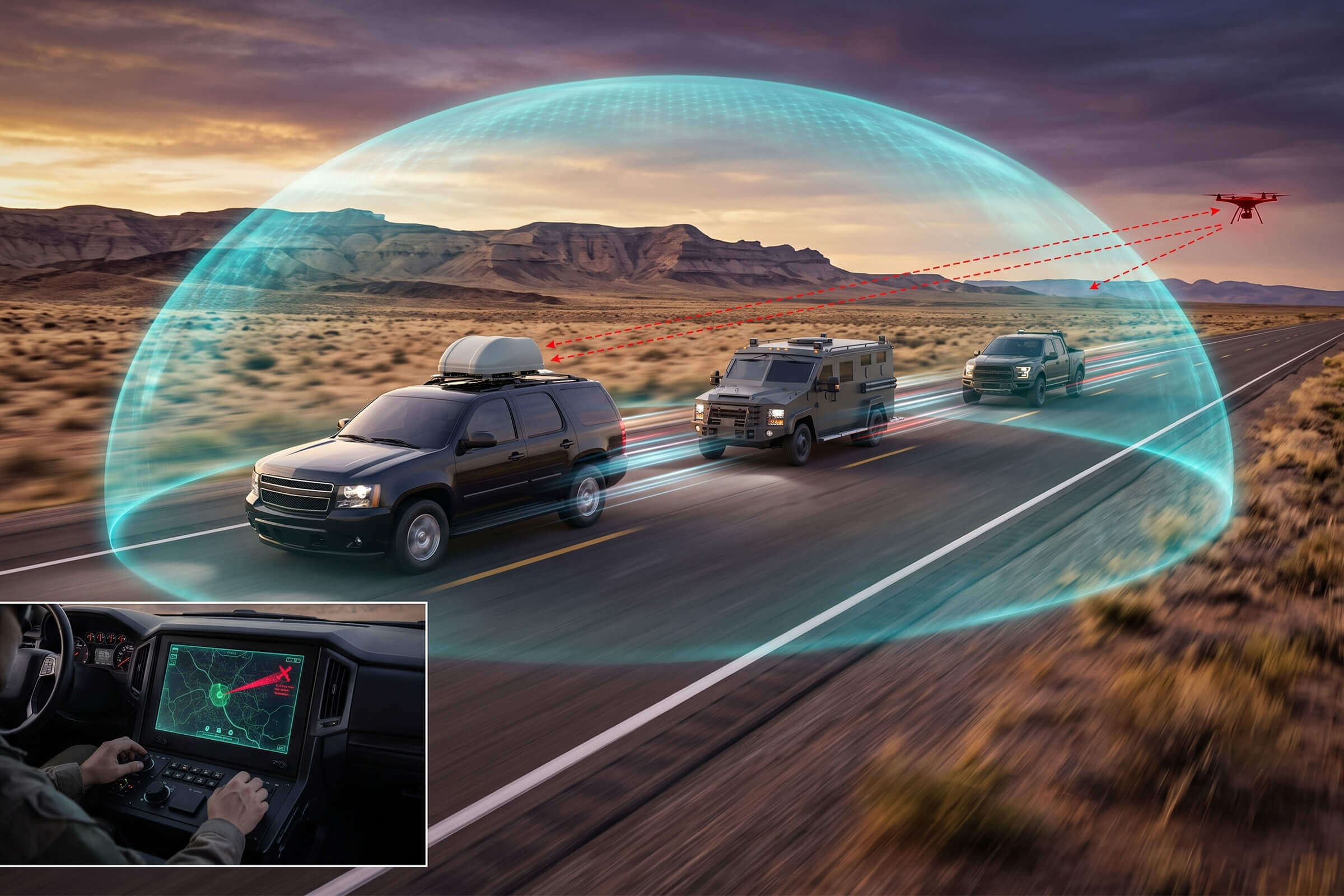
Vehicle-mounted drone defense solves this by putting detection and jamming capability on a vehicle that travels with the asset it protects. The concept is straightforward. A vehicle carries a sensor suite that scans for drone signals, identifies threats, and jams hostile drones, all while moving at highway speeds. The vehicle creates a protection bubble that moves with the convoy. When the vehicle stops, the protection bubble becomes a temporary fixed-site defense. When it moves, the bubble moves.
The physics of detecting drones from a moving vehicle
Detecting a drone from a stationary sensor is hard because of terrain, multipath, and signal attenuation. Detecting a drone from a vehicle moving at 80 kilometers per hour adds two more challenges. First, the vehicle’s own motion shifts the apparent angle of arrival of every signal it receives. The sensor is moving relative to both the drone and the remote controller, so the raw bearing data changes continuously even if the drone is stationary. Second, the vehicle itself is a noise source. Engine electronics, onboard communication systems, and the metal vehicle body all contribute to the electromagnetic environment the sensor must operate within.
The VM system addresses the motion challenge with signal processing that compensates for the vehicle’s movement in real time. It achieves direction-finding accuracy of 3 degrees RMS for a hovering target and 10 degrees RMS for a moving target, even while the vehicle is in motion. For comparison, these are the same accuracy specifications as LZ TECH’s fixed-site DF Series sensors. The vehicle’s speed, measured by its own GPS and inertial sensors, is subtracted from the incoming bearing data so the angle-of-arrival calculation reflects the drone’s true position rather than the sensor’s movement.
The detection band spans 30 MHz to 6 GHz, covering the same full range as the fixed-site systems. Detection range extends to 3 kilometers from the vehicle’s position. A drone approaching the convoy from 3 kilometers away is detected while the vehicle still has approximately two minutes of driving time before the drone closes the distance, assuming the drone is moving at 20 meters per second and the vehicle is traveling at 80 kilometers per hour.
Creating a moving protection bubble
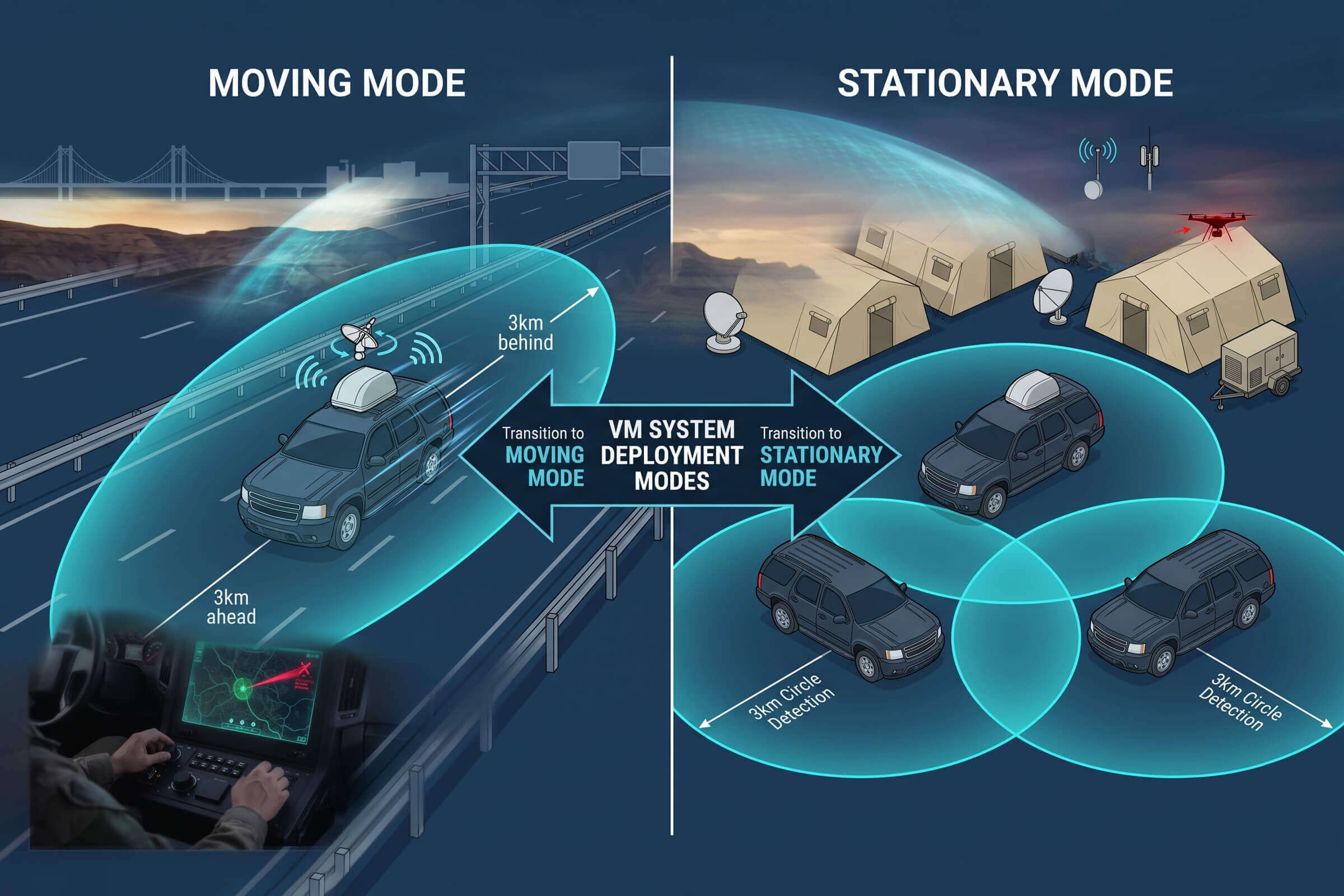
The protection bubble concept describes an area around the vehicle where the VM system detects, identifies, and can jam drones. The size of the bubble varies with speed, terrain, and the type of drone being detected. In open terrain at moderate speed, the detection bubble extends to roughly 3 kilometers. The jamming bubble is smaller, covering the immediate airspace above and around the protected asset. The vehicle’s motion extends the bubble in real time, so a convoy of vehicles with multiple VM systems creates overlapping bubbles that cover the entire convoy length.
The jamming capability is configured for the specific operational environment. The VM system outputs across eight bands: 400 MHz, 800 MHz, 900 MHz, 1.2 GHz, 1.4 GHz, 2.4 GHz, 5.2 GHz, and 5.8 GHz. Each band is individually configurable, so the operator can activate only the frequencies that the detected drone is using while leaving other bands clear for the convoy’s own communications. The jamming is omnidirectional from the vehicle, which means the bubble is a sphere around the vehicle rather than a directional beam. For a convoy moving through open terrain where collateral interference is not a concern, omnidirectional coverage is simpler and more reliable than directional jamming that must be constantly re-aimed as the vehicle turns and changes speed.
From convoy protection to temporary site defense
The same vehicle that protects a moving convoy becomes a fixed-site defense system the moment it parks. At a temporary command post, a disaster response staging area, or a field inspection site, the vehicle stops and the VM system continues operating. The detection bubble now covers a fixed circle around the parked vehicle. Multiple vehicles can be spaced to create overlapping coverage across a temporary site of any size.
This dual-mode capability reduces the logistics burden for organizations that need both mobile and temporary fixed-site protection. Instead of deploying a convoy protection vehicle for the drive and a separate fixed-site system for the destination, the same VM-equipped vehicle covers both phases of the operation. The system transitions from mobile to stationary operation with no reconfiguration. The detection algorithms adjust automatically when the vehicle’s GPS reports zero speed.
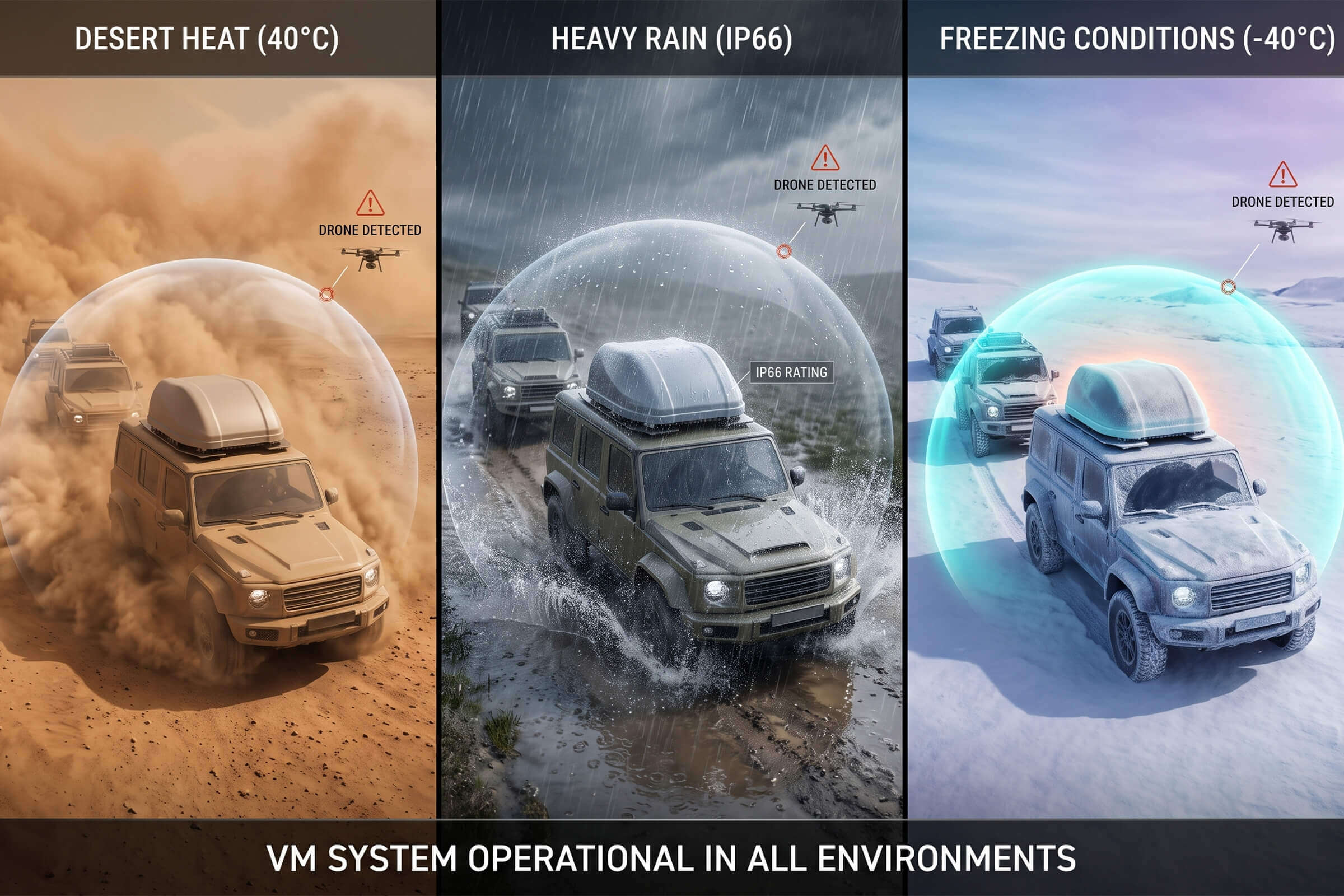
The VM system’s environmental specifications support this dual-use profile. It is rated IP66 for protection against dust and high-pressure water jets. The operating temperature range spans -40 to +60 degrees Celsius. These ratings are not marketing specifications. They mean the system can be deployed in desert heat, in heavy rain, and in freezing conditions, without taking the vehicle offline for weather. The same vehicle that drove through a sandstorm at 40 degrees Celsius continues to provide drone detection when it parks.
A typical convoy protection deployment
A representative deployment scenario illustrates how the pieces fit together. A three-vehicle convoy is moving from a headquarters building to a field inspection site 120 kilometers away. The lead vehicle carries a VM system with the detection and jamming suite integrated into a roof-mounted enclosure. The middle vehicle carries the protected principals. The trail vehicle provides rear security.
As the convoy departs the headquarters, the VM system begins scanning the 30 MHz to 6 GHz band. Two minutes into the drive, it detects an unknown drone signal at 2.4 GHz, approximately 2.5 kilometers ahead and slightly to the right of the convoy’s direction of travel. The detection data identifies the drone as a DJI Mavic 3, provides the drone’s GPS coordinates and altitude, and plots the remote controller position on a map. The convoy commander evaluates the information: the drone is at 120 meters altitude and its position suggests it is mapping a construction site adjacent to the highway, not tracking the convoy. The commander logs the detection and continues. The VM system records the encounter for post-mission analysis.
Twenty kilometers from the destination, a second detection appears. A smaller drone, identified as a custom FPV quadcopter, is approaching from the convoy’s left at 15 meters altitude, heading directly toward the middle vehicle. The convoy commander activates the jamming system on the 2.4 GHz and 5.8 GHz bands. The FPV drone loses its video and control link and falls to the ground 800 meters from the convoy. The convoy continues without stopping. The entire sequence, from detection to neutralization, takes under 30 seconds.
Where vehicle-mounted systems fit in the broader C-UAS field
Vehicle-mounted systems do not replace fixed-site installations. They complement them. A permanent facility that needs 24-hour protection is better served by a fixed grid of DF Series sensors, D5-B TDOA nodes, and electro-optical verification systems. A convoy, a temporary site, or a mobile inspection team that has no fixed address needs a system that moves. The VM fills that gap. Its specifications parallel the fixed-site product line in detection range, frequency coverage, and accuracy. The difference is the form factor and the motion compensation that makes mobile operation possible.
For organizations that operate across distributed sites connected by road, the combination of fixed-site protection at each facility and vehicle-mounted protection for the road segments between them closes the coverage gap. The drone threat does not respect the property line between the perimeter fence and the highway. A vehicle-mounted system ensures the protection extends to wherever the asset goes, not just to wherever the asset parks.
Connect with us
Ready to Secure Your Low-Altitude Airspace?