How Corrections Facilities Are Fighting Back Against Drone Smuggling
Aug 12 2026
A Growing Problem Above the Walls
In February 2026, Belgian authorities arrested a drone operator attempting to deliver drugs and a weapon into Lantin Prison — the third major incident of its kind in the country that year. Across Europe, North America, and Southeast Asia, the same pattern repeats: unmanned aerial vehicles are being used as delivery vehicles for contraband, moving narcotics, SIM cards, and sharp objects into facilities where detection from the ground has historically been nearly impossible.
The numbers back up the anecdote. A 2025 survey by the European Organisation of Prison and Correctional Services found that 43 percent of member facilities had experienced at least one confirmed drone incursion in the preceding twelve months, up from 27 percent in 2022. In the United Kingdom, HM Prison Service reported 178 drone-related incidents across its estate in 2025 alone — a figure that doubled in three years. Across the Atlantic, a South Carolina prison contraband ring broken up in March 2026 had used drones to drop packages containing narcotics, cell phones, and bladed instruments into multiple facilities over an 18-month period, generating more than $2 million in illicit sales before detection.
For corrections administrators, the question is no longer whether drone intrusions will happen. It is how to catch them before the package lands.
The variety of contraband moving through prison airspace reflects the financial incentives underwriting the drone supply chain. A single cell phone smuggled into a maximum-security facility can sell for ten to twenty times its retail price. Packages of synthetic drugs delivered by drone command premiums that make street-level dealing look low-margin by comparison. The economics will not reverse themselves — as long as inmates can pay, outside operators will find ways to deliver. The question for corrections security is not how to eliminate the demand, but how to make delivery too risky to attempt.
Why Drones Are Harder to Stop Than They Look
Most small commercial drones — including popular models from DJI. Operate at low altitudes, below the coverage of conventional perimeter security. They are quiet enough to blend with ambient noise. And they can be flown by someone outside the perimeter wall entirely, beyond the reach of in-house security staff.
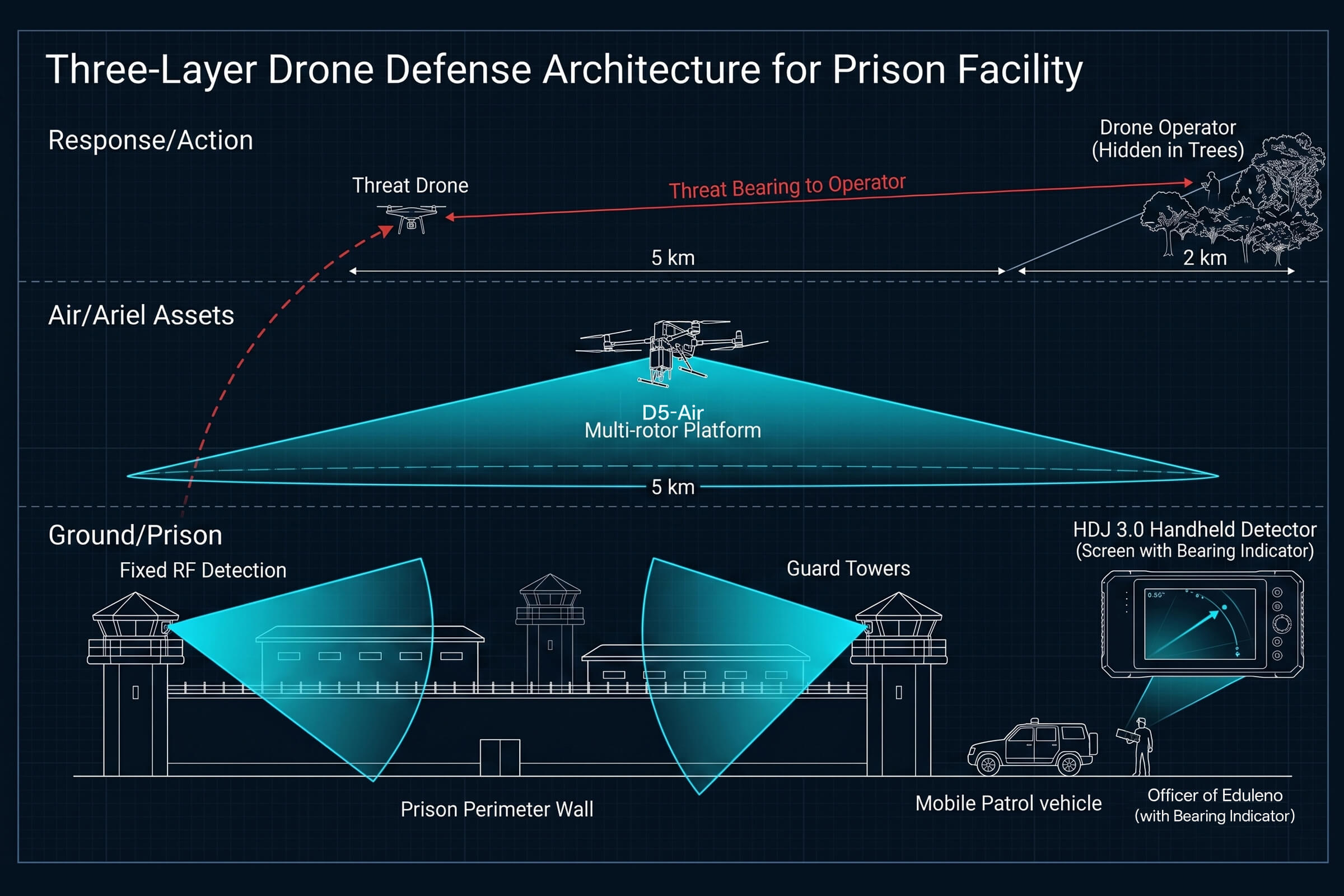
The solution is not one technology. It is a layered approach that starts with detection, moves to locating the operator, and ends with interdiction before landing.
This is where radio frequency detection has an edge over optical or radar-based systems in the corrections context: it can detect and classify a drone signal before the aircraft is visually identifiable, giving staff the reaction time they need.
Detection: Knowing a Drone Is There Before It Lands
Fixed-Site RF Detection — DF10 Max and D5-Air
The DF10 Max is a fixed-site direction-finding system that monitors radio frequencies from 100 MHz to 8 GHz — a range that covers the command-and-control links, video downlinks, and remote controller signals used by most commercial drones. Its detection range extends to 8 kilometers, with a direction-finding accuracy of 5 degrees RMS or better, allowing security staff to pinpoint a drone’s position and track its path in real time.
For facilities that need to cover large perimeters or irregular terrain, the D5-Air extends that capability into the air. Designed for mounting on UAV platforms, the D5-Air operates in the 400 MHz to 6 GHz band and achieves detection ranges of up to 5 kilometers. When paired with a ground-based DF system, it creates a three-dimensional picture of the airspace: the drone’s position on approach, the direction from which it was launched, and the probable operator location.
Both systems are passive — they receive signals without emitting anything, which means they can operate continuously without interfering with the facility’s own communications or triggering regulatory concerns.
Mobile Patrol — HDJ 3.0 for Field Deployment
Not every correction threat happens at the perimeter wall. Mobile patrol teams covering the outer grounds, visiting areas, or responding to incidents away from fixed infrastructure need a system that moves with them.
The HDJ 3.0 is a handheld detection and direction-finding unit built around a dual hot-swappable battery system that delivers more than three hours of continuous operation in the field. Its operating band spans 400 MHz to 6 GHz, covering the same drone frequency ranges as fixed-site equipment. A built-in 5.5-inch display provides real-time bearing information, giving patrol officers directional guidance toward an active drone threat. Direction-finding accuracy is rated at 10 degrees RMS or better, sufficient to track a moving aircraft to its approximate launch point.
The dual-battery design addresses a real operational pain point for corrections patrols: most handheld drone detectors run on internal batteries that cannot be swapped in the field. When the battery dies, the patrol loses detection coverage until the unit is recharged — a gap that can last hours. With HDJ 3.0’s hot-swappable packs, a patrol officer can carry a spare battery in a belt pouch, swap it in seconds, and maintain continuous coverage across a full eight-hour shift.
For facilities that run rotating patrol schedules across large sites, the HDJ 3.0 brings the same detection capability to mobile teams that fixed infrastructure provides to static positions.
From Detection to Interdiction
Detection only solves half the problem. Corrections administrators need a clear response protocol that distinguishes between a drone passing overhead — which may not be targeting the facility. And one that is descending toward a delivery point.
This distinction — overflight versus delivery — is operationally critical. Most drone incursions near prisons are overflights that never descend toward the facility. They may be hobbyists flying near a restricted zone, survey drones operating in the area, or commercial delivery drones on approved routes. Treating every overflight as a threat burns operator attention and response resources. A good detection system reduces false alarms by combining frequency classification — distinguishing a DJI consumer drone from a fixed-wing mapping UAV — with bearing data that shows whether the drone’s flight path is converging on the facility or simply crossing the surrounding airspace.
A layered system that combines RF detection with real-time mapping helps officers make that call faster. When the DF10 Max or D5-Air picks up a drone signature, the bearing data feeds directly into a facility’s command platform, overlaying the threat onto a map of the grounds. Officers can see the drone’s approach vector and determine whether it is consistent with a delivery attempt.
Where active interdiction is authorized and legally available, the next layer is jamming — disrupting the drone’s command-and-control link to bring the aircraft down in a controlled location. RF jamming systems work by overwhelming the frequency band the drone uses to communicate with its controller, forcing a loss of signal and triggering the aircraft’s return-to-home or landing protocol.
The legal framework for jamming varies by jurisdiction. In most countries, active jamming by private parties is restricted or prohibited. RF detection and operator location — the capabilities offered by the DF10 Max, D5-Air, and HDJ 3.0 — are widely permissible for facility security teams and law enforcement.
Building a Corrections C-UAS Response Plan
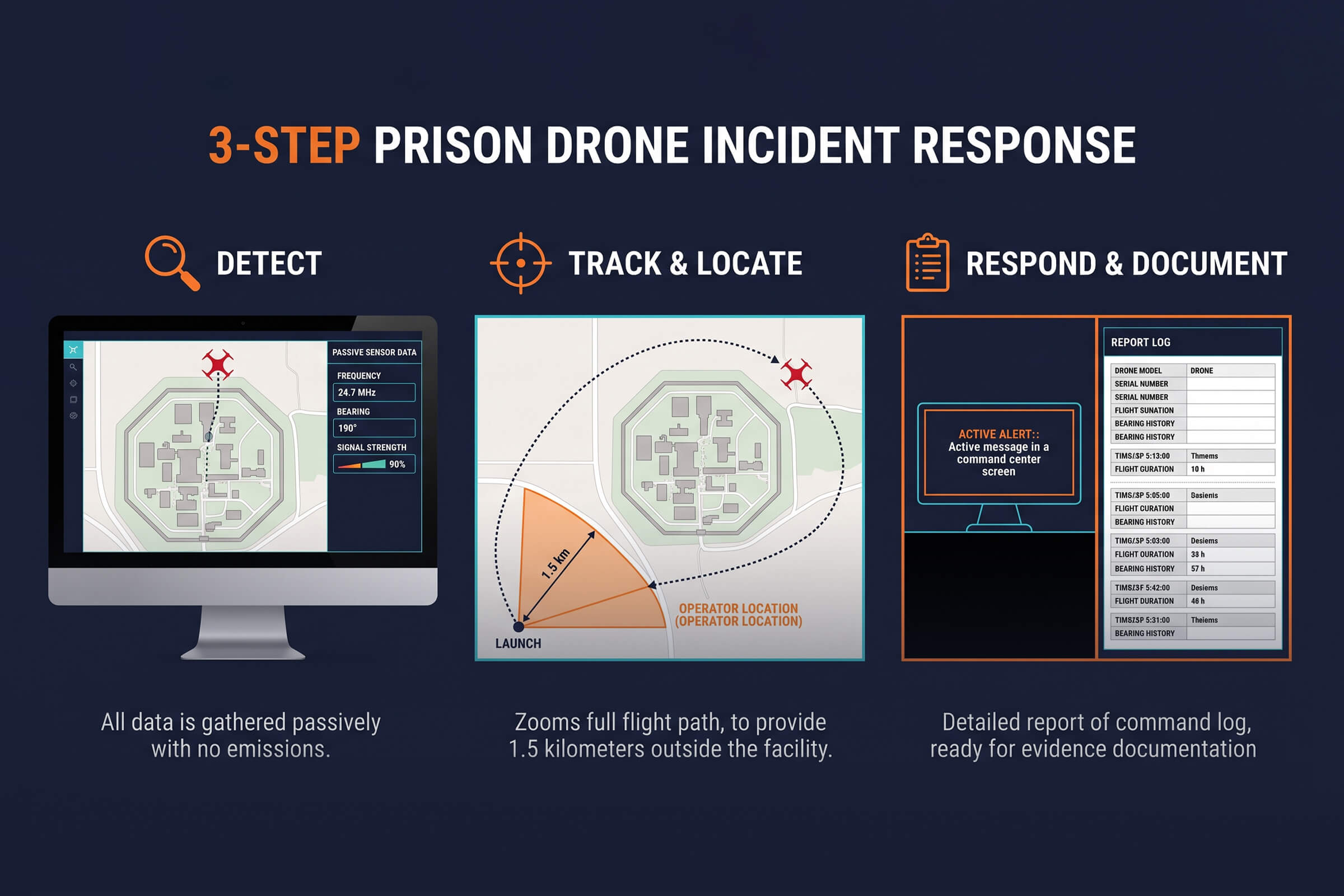
A drone incident response plan for a corrections facility should address three phases.
Phase 1: Detection and Classification (0–30 seconds)
RF detection systems identify the drone’s radio signature, classify it against a known drone database, and generate an alert. At this stage, the system is passive — no action is taken, and no signals are emitted.
Phase 2: Tracking and Operator Location (30 seconds–2 minutes)
Direction-finding data tracks the drone’s flight path and triangulates the likely operator position. This information goes to the command center and to field officers. If the drone is descending toward the facility, this is the decision window.
Phase 3: Response and Evidence Collection
Once a delivery attempt is confirmed, the response depends on local authorization. RF detection logs — including frequency, signal strength, bearing, and timestamps. Serve as evidence for subsequent prosecution. In jurisdictions where active countermeasures are authorized, the jamming system engages.
Across all three phases, the common thread is radio frequency intelligence. Optical confirmation comes second; the radio signature comes first.
What Corrections Facilities Need to Know Before Buying
The buying decision for a corrections facility is different from an airport or a stadium in one important respect: the perimeter is both the defense line and the target. At a stadium, a drone overflight is an intrusion. At a prison, the drone is there to make a delivery — it will intentionally cross the wall, descend into the yard, and drop a payload before climbing back out. The detection system needs to be sensitive enough to catch the drone on approach, not just on arrival. By the time a drone is visible above the yard, the package has already been released.
A few practical considerations come up repeatedly in conversations with corrections security teams.
Coverage geometry matters more than raw range. An 8-kilometer detection system mounted at a single point on a large perimeter will still have blind spots. The DF10 Max is best deployed at multiple points across a facility’s perimeter, with D5-Air airborne assets filling coverage gaps over irregular terrain.
Drone signature libraries need to stay current. The RF detection systems used in correctional environments should maintain an active database of commercial drone models — including DIY and FPV builds — to avoid false negatives. A database covering fewer than 200 models will miss a meaningful portion of the threats likely to appear at a modern corrections facility.
Integration with existing command platforms reduces response time. Systems that can push drone alerts into the same interface officers already use for camera feeds and perimeter alarms eliminate the context-switching that slows real-world responses.
The Regulatory Angle Is Still Developing
As of mid-2026, no country has a fully settled legal framework for drone interdiction in correctional environments. Several European jurisdictions have updated their civil aviation regulations to give prison authorities or law enforcement limited counter-drone powers. The United States has moved more slowly, with most active countermeasures still requiring law enforcement coordination.
What is consistent across jurisdictions is the legitimacy of passive detection. RF monitoring, direction finding, and operator location are widely accepted as lawful security measures for critical infrastructure and correctional facilities. This makes the detection and tracking layer — not the interdiction layer. The right starting point for any facility building out its C-UAS capability.
Getting Started: Three Priorities
For corrections administrators evaluating drone detection systems, the three most important near-term actions are:
First, map the airspace above and around the facility to understand current coverage gaps. Most facilities find that their camera systems and perimeter sensors leave the airspace above 10 meters largely unmonitored.
Second, establish a drone detection baseline with passive RF systems before adding active countermeasures. This gives the facility a documented detection record and a framework for evaluating future interdiction options.
Third, connect detection data to the existing command platform. A drone alert that requires an officer to open a separate application is a drone alert that arrives too late.
Connect with us
Ready to Secure Your Low-Altitude Airspace?