CCS vs CRPCS: Choosing the Right C-UAS Command and Control Platform
Aug 13 2026
The Software Layer That Turns Sensors Into a System
A drone detection network can have the best RF sensors on the market. But if the data from each sensor stays siloed on its own screen, the operator’s job does not get easier. It gets harder. Every extra display that a security officer has to monitor adds friction. In an incident, friction costs seconds that matter.
Command and control software is the layer that turns individual sensors into a coordinated defense. It takes raw detection data from multiple sources — RF direction finding, radar, electro-optical cameras. and fuses it into one unified picture of the airspace. That fusion is where the real value sits. A drone detected by the DF10 Max on one side of the facility should appear on the same screen as a camera feed from the VAR300 tracking the same aircraft.
LZ TECH offers two platforms that address this problem at different depths: CCS and CRPCS. They come from the same platform lineage and share the same integration philosophy — but they serve different operational environments. Choosing between them starts with understanding what each one actually does.
CCS: Unified Situational Awareness for Multi-Sensor Sites
CCS — short for Command and Control System — is designed to bring detection data from multiple sensor types into one interface. It integrates inputs from RF direction-finding systems such as the DF10 Max and DF5 Max, radar units, and electro-optical trackers like the VAR300 and T100, displaying live drone tracks on a geographic map of the protected site.
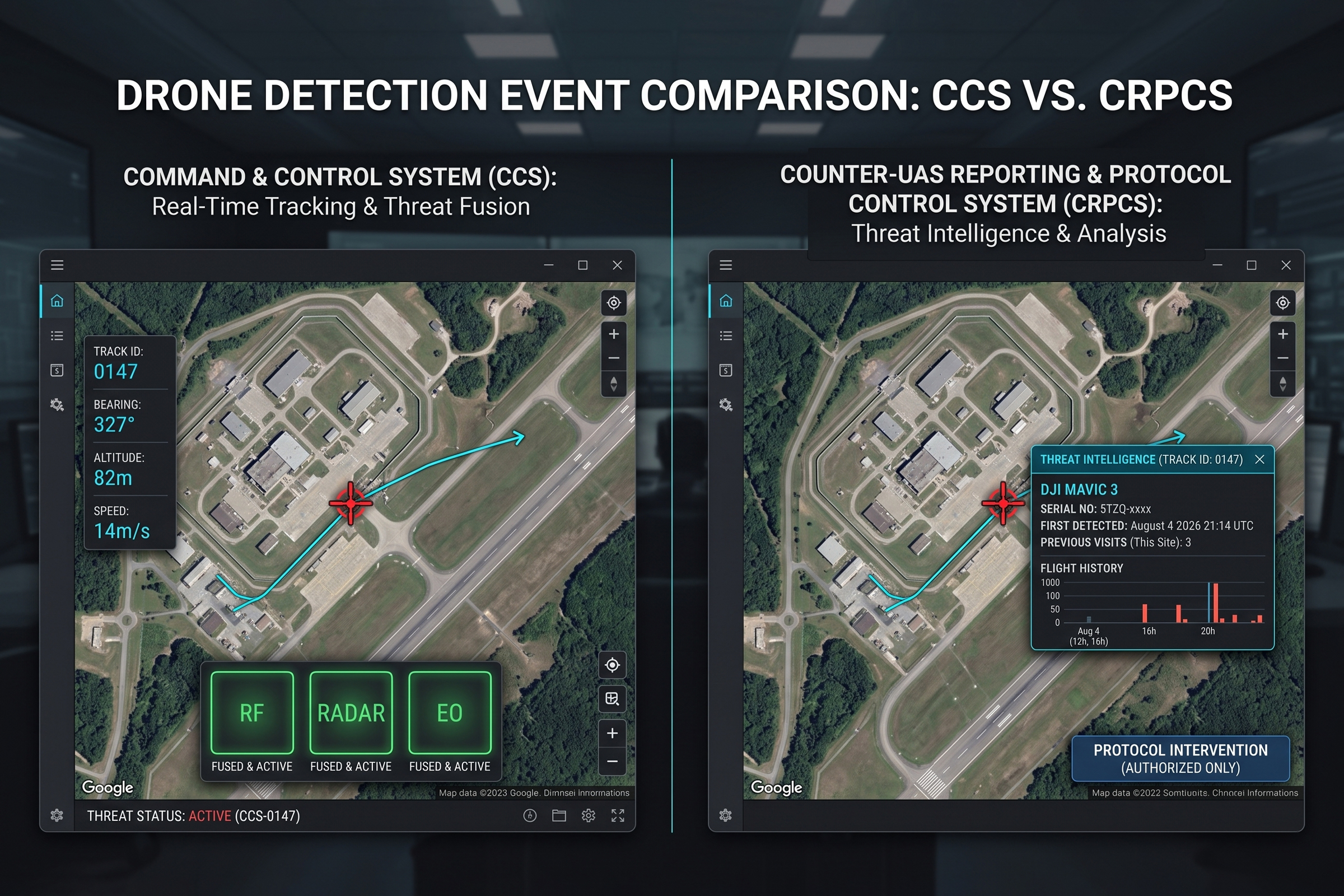
The core job of CCS is to reduce the sensor-to-decision gap. When a drone enters the detection zone, the alert appears on the CCS display. The operator can see the drone’s bearing, estimated position, and altitude. If visual confirmation is needed, the operator cues a nearby camera tracker from the same interface. All of this happens on one screen, without application switching.
CCS also supports real-time alerting workflows. When the system detects a new drone track, it can trigger audible alerts in the control room, push notifications to mobile devices, and log every detection event with timestamps, bearings, and signal parameters. The event log is important not just for operator awareness — it builds a threat history that the facility can use to justify expanded coverage or regulatory compliance reporting.
For a site with a single control room, two to six fixed sensors, and a dedicated security team, CCS provides the operational awareness needed to manage the day-to-day threat environment. Our team has deployed CCS at airports, government facilities, and outdoor event venues where the threat profile is medium to high but the sensor topology is relatively stable.
Consider a mid-sized regional airport with two DF10 Max RF sensors mounted at opposite ends of the terminal building and a single VAR300 optical tracker on the control tower. The control room has two operator positions — one for airport security, one for air traffic monitoring. With CCS, both operators share the same drone detection display. When a drone enters the 8-kilometer detection zone, both positions receive the alert. The security operator can cue the VAR300 for visual confirmation. The air traffic operator can correlate the drone position with the radar feed. No application switching, no separate logins, no information gap between the two desks — one platform, two roles, zero latency in the response chain.
CRPCS: Adding Protocol Intelligence to Situational Awareness
CRPCS — Command and Reconnaissance Protocol Control System. Builds on the CCS foundation and adds a layer of protocol-level intelligence that fundamentally changes how an operator sees the airspace.
The key difference is what happens after a drone is detected. In CCS, the operator sees a track ID, bearing, and estimated position. In CRPCS, the system also decodes the drone’s radio protocol signature — identifying the make, model, and even the serial number of the aircraft in real time. This is not simply matching a frequency profile against a database. It is parsing the drone’s communication protocol itself to extract identifiers embedded in the signal.
Protocol-level identification changes the operator’s decision framework in several ways. Knowing that the approaching aircraft is a DJI Mavic 3 rather than a generic unidentified drone gives the response team critical operational context: typical flight duration of around 30 minutes, payload capacity of roughly 500 grams, and known behavioral patterns. If the same airframe serial number has been detected at the site before, the system flags it as a repeat visitor and cross-references it against historical track data.
A second capability in CRPCS is the protocol-level control interface. For authorized operators in jurisdictions that permit drone intervention, the platform can command a target aircraft to land or return to its takeoff point through its own communication protocol — a more precise maneuver than broad-spectrum jamming, and one that does not affect nearby communications systems. This capability is available only to law enforcement and national security users operating under applicable legal authority.
CRPCS is the platform of choice for sites with high threat density — multiple incidents per month. And for network deployments where multiple facilities share a common command architecture. The protocol intelligence layer adds value when the response team needs more than a radar blip. They need an aircraft identity and, where authorized, a controlled response.
For a national security agency managing drone threats across eight critical infrastructure sites — power plants, government buildings, data centers — the CRPCS protocol intelligence layer changes the threat assessment workflow. A drone detected at Site A on Tuesday night is logged as a DJI Mavic 3 with serial number 5TZQ-xxxx. When the same serial number appears at Site B on Thursday morning, CRPCS flags it as a correlated event and presents the operator with the full flight history: two previous visits, both at night, both at energy infrastructure sites. The operator now has context that a basic RF track would not provide — this is not a random overflight; it is a pattern. That changes the response posture from routine monitoring to active investigation.
A Side-by-Side Look at the Differences
The two platforms share a common foundation, but their strengths diverge in ways that matter for procurement decisions.
Sensor Integration
CCS integrates RF direction finding, radar, and EO/IR camera feeds from fixed and mobile sensors. CRPCS does the same but adds deeper data fusion — multiple sensors tracking the same drone share correlation data, improving position accuracy and reducing false tracks.
Drone Identification
CCS provides basic signal classification — DJI class, Autel class, unknown. CRPCS delivers model-level and serial-number-level identification through protocol parsing, along with historical track matching across the facility’s entire detection database.
Multi-Site Networking
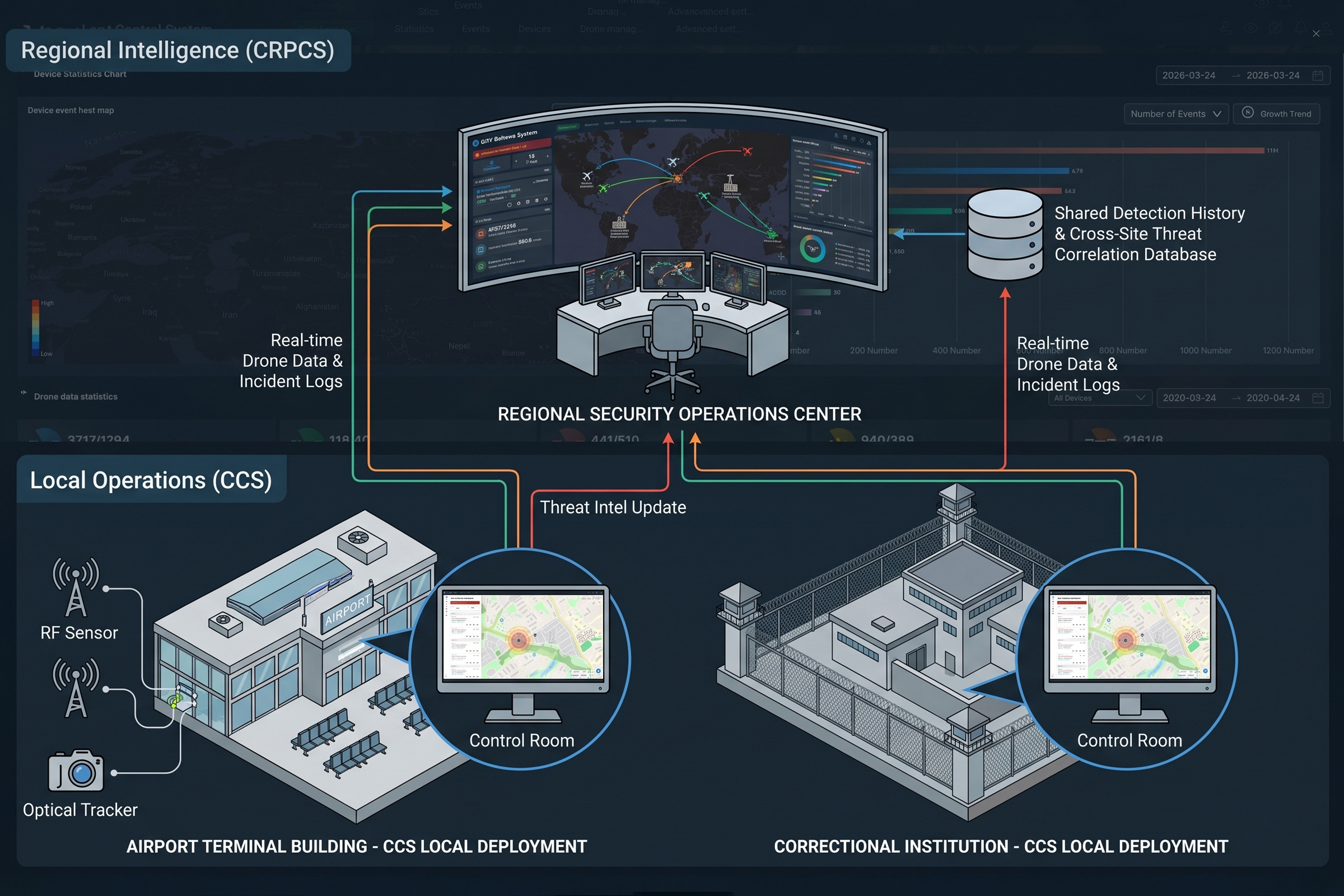
CCS is designed for single-site operation with one control room. CRPCS supports distributed deployments across multiple facilities, with shared threat databases, cross-site alert correlation, and a centralized command view for regional security operations centers.
Operator Workflow
CCS workflow centers on detection, tracking, and optional camera cueing. CRPCS adds the identification layer — drone model, serial number, flight history. And, for authorized users, a protocol-based intervention option that is more surgical than jamming.
Choosing Between CCS and CRPCS: Four Questions That Matter
Rather than a feature checklist, four operational questions tend to point toward one platform.
- How Complex Is Your Sensor Topology?
A site with two DF10 Max RF sensors and one VAR300 optical tracker — all fixed, all in one location. Can operate effectively with CCS. When the site adds mobile HDJ 3.0 patrol units, airborne D5-Air platforms on drones, and remotely distributed sensors across kilometers of perimeter, the fusion engine in CRPCS extracts more value from the expanded sensor network.
- How Important Is Drone Identification to Your Response?
If the operational need is to know simply that a drone is present and track its position, CCS covers that fully. If the team needs to know which drone — including make, model, serial number, and flight history. Only CRPCS delivers that level of identification. The difference becomes operational when determining whether a drone is a commercial off-the-shelf model flown by an amateur or a repeat intruder tracked across multiple nights.
- Are Multiple Sites Being Netted Together?
A single-site installation typically does not need the distributed command architecture that CRPCS supports. When two or more facilities — for example, separate airport terminals or a city-wide deployment across multiple critical infrastructure sites. Need to share real-time threat data; CRPCS provides the backbone.
- What Is the Volume of Incidents?
Sites experiencing occasional drone overflights — fewer than five confirmed incidents per month. Can manage effectively with CCS. Where incident volume climbs into the tens per month, the protocol intelligence layer helps operators prioritize threats and track repeat patterns across shifts without losing situational context.
How the Two Platforms Work Together
CCS and CRPCS are not competing products. They sit on the same platform lineage, and many sites begin with CCS and upgrade to CRPCS as their threat profile and sensor network grow.
A common deployment pattern starts with CCS at a single high-risk facility — an airport terminal, a data center, or a correctional institution. As facility teams document drone incidents and build a case for expanded coverage, they add CRPCS at the network level, with individual sites continuing to operate CCS locally. The result is a layered command architecture: CCS for immediate operational awareness at each site, CRPCS for cross-site threat intelligence and protocol-level identification.
A real example from our team’s deployment experience illustrates the staged approach. A national airport authority began drone detection operations at its busiest hub with CCS, integrating two DF10 Max direction-finding units and one T100 dual-spectrum tracker. Over the first six months, the CCS event log documented 23 confirmed drone incursions — an average of nearly one per week. The data gave the authority the evidence it needed to secure funding for expansion to three additional airports. They upgraded the central command architecture to CRPCS, networked all four sites, and added protocol-level identification. The key point: none of this would have happened without the initial CCS deployment generating the threat data that made the case for expansion. Start small, document everything, scale with evidence — that is the CCS-to-CRPCS path in practice.
This staged approach has a practical advantage: the site builds operational expertise on CCS before adding the protocol intelligence layer. Operators learn to interpret drone tracks, assess threat levels, and coordinate responses. When CRPCS is deployed, the team already understands the sensor environment — the new layer adds identification and networking without requiring a re-learning of the basics.
The data collected by both platforms feeds into the same C-UAS workflow: detect, identify, track, and — where authorized. respond. Which platform matters less than having a platform at all? A site with five sensors and no C2 software is less capable than a site with two sensors running CCS.
The Hardware Matters, But the Software Decides
In the C-UAS market, the visible conversation often revolves around sensor specifications: frequency range, detection distance, and bearing accuracy. Those numbers matter — they define what the system can see. But the operational difference between an effective drone defense and a collection of individual sensors is the software layer that connects them.
CCS delivers unified situational awareness for sites that need to bring multiple sensors onto one screen and reduce the time between detection and decision. CRPCS adds protocol intelligence — the ability to not just see that a drone is there, but to know exactly what it is, whether it has been there before, and, where authorized, to intervene through the drone’s own communication protocol.
The right choice depends on the site, the threat profile, and the growth path the organization expects to follow. What is consistent across both platforms is the principle: the sensor network provides the raw data. The command software turns that data into an operational response. Neither works without the other.
Connect with us
Ready to Secure Your Low-Altitude Airspace?