Directional vs Omnidirectional Drone Jamming: Why Precision Matters
Aug 27 2026
The Hidden Cost of Omnidirectional Jamming
When a drone threatens a protected site, the instinct is to transmit broadly and overpower it. That is what omnidirectional jamming does. It blankets the area with an interfering signal, aiming to disrupt the drone’s control link wherever it happens to be. It is simple, and it works, up to a point. The problem is what it takes down with it.
Omnidirectional interference does not discriminate between a hostile drone and every other radio device in range. At an airport, that means ground communications, navigation aids, and the wireless systems the operation depends on. In a city, it means the networks, sensors, and devices that surround the protected site. A broad jamming response can protect one asset while disrupting the environment it sits in, which is often worse than the drone it was meant to stop.
There is also a practical limit. Omnidirectional energy spreads in all directions, so its strength at any single point is diluted. To reach a drone at a distance, the system has to push more power, which enlarges the collateral footprint further. It is a self-defeating loop: the more it reaches, the more it disrupts.
The Case for Directional Intervention
Directional jamming takes the opposite approach. Instead of broadcasting in every direction, it concentrates the interfering signal into a narrow beam aimed at the drone. The effect is twofold. The beam reaches farther with less total energy because the energy is not wasted on empty space. And the interference stays contained because it only affects the narrow cone where the drone is.
For electromagnetic-sensitive environments, this is the difference that matters. A directional system can intervene against a drone while leaving the surrounding spectrum largely untouched. The ground crews keep their radios. The navigation systems keep working. The neighboring businesses never notice. Precision is not a luxury in these settings. It is the requirement that makes intervention possible at all.
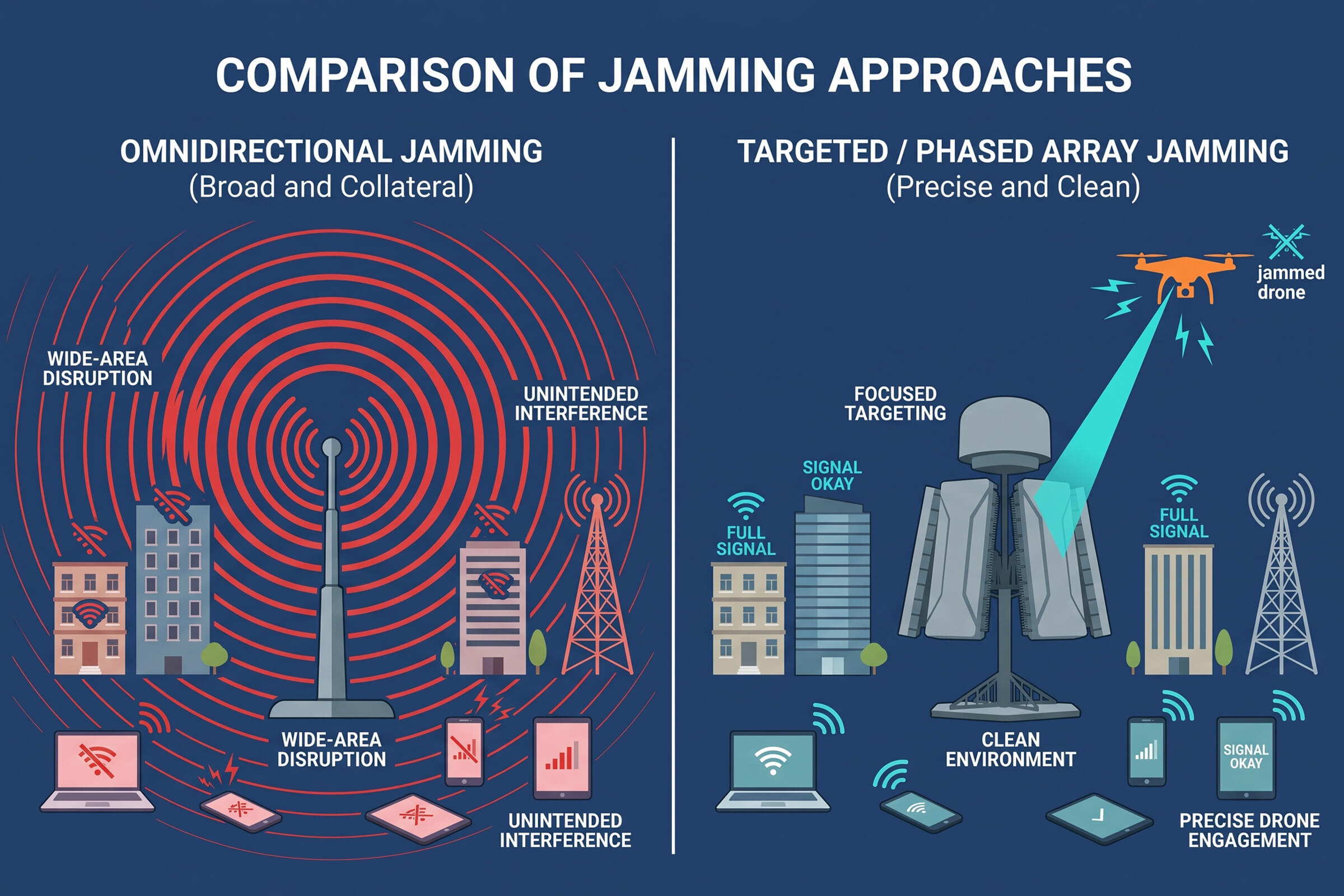
The trade-off has always been coverage. A single directional beam can only point one way, which creates blind spots elsewhere. A drone approaching from behind or from the side is outside the beam and outside the protection. That limitation is what has kept directional systems from replacing omnidirectional ones in fixed-site defense until the array approach arrived.
DFJ53 Max: 360-Degree Coverage Without Blind Spots
The DFJ53 Max resolves the coverage problem with a multi-face high-gain array and adaptive beamforming. Instead of one antenna pointing one way, it uses an arrangement of high-gain faces that together cover the full 360 degrees around the site. Adaptive beamforming steers the interference energy toward the detected drone, no matter from which direction it approaches.
The result is the best of both approaches. The system keeps the precision and containment of directional jamming because the energy is still focused into a beam. But it eliminates the blind spots because that beam can be formed and steered in any direction, continuously, across the full circle. A drone does not find a gap in the coverage. It finds a beam waiting for it from whatever direction it comes.
The DFJ53 Max monitors a broad radio frequency range, spanning from 400 MHz to 6 GHz, which covers the command and video links used by the large majority of commercial drones. Detection extends across a wide area, with the system able to sense a drone at up to 5 kilometers and intervene at closer range with focused, directional energy. The combination of wide-band detection and full-circle directional intervention is what makes it suited to fixed-site protection in sensitive locations.
For the operator, all of this is invisible. The system handles detection, beam steering, and tracking automatically. The operator sees the contact, sees the intervention, and does not need to manually aim anything. That is the practical payoff of the array approach: precision and coverage, without requiring a human to manage either one in real time.
The multi-face design of the DFJ53 Max applies this across the full circle. Where a single face would leave the sides and rear uncovered, the multi-face arrangement ensures that every direction is covered by at least one array face. The system forms and steers the beam continuously, so a drone approaching from any heading meets a focused, directed response rather than an empty gap.
This is a fundamental difference from a mechanically steered antenna. A dish or a horn has to rotate to aim, which takes time and creates gaps during the movement. An array with electronic beamforming changes direction in microseconds, tracking a moving drone as it crosses the sky. There is no rotation lag and no moment when the beam is pointing the wrong way.
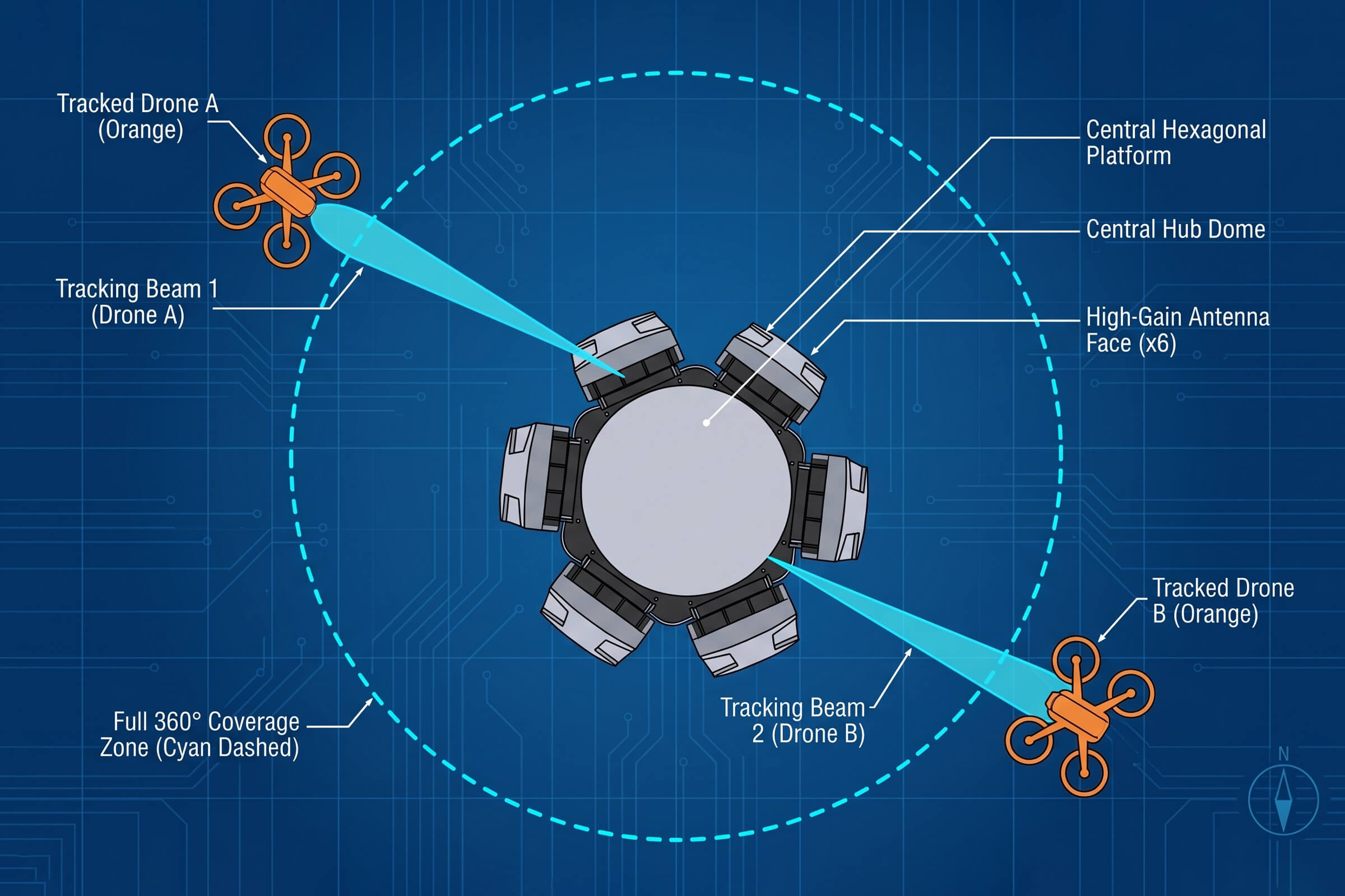
The technology that makes full-circle directional coverage possible is adaptive beamforming. The idea is straightforward, even if the implementation is not. An array of antennas works together as a single, steerable system. By adjusting the timing and phase of the signal at each antenna element, the array can concentrate its output into a narrow beam and point that beam anywhere, instantly, without physically moving anything.
How Adaptive Beamforming Works
Why Cities and Airports Need Precision
The environments where drone defense matters most are also the environments where broad interference is least acceptable. Airports sit inside a dense web of radio systems, from air traffic control to ground operations to passenger networks. A city center is saturated with wireless signals from thousands of devices. In both cases, an omnidirectional response would be disruptive to the very operation it is meant to protect.
A directional array changes the calculus. It lets a security team intervene against a specific drone without taking down the spectrum around it. For an airport, that means the operation can continue while the threat is handled. For a city venue, it means the event goes on, and the surrounding neighborhood is unaffected. Precision intervention is not just a technical preference. It is what makes drone defense deployable in the places that need it most.
This is also a regulatory consideration. In many jurisdictions, the legal space for drone countermeasures is tighter in populated areas, where the risk of collateral interference is treated seriously. A system that demonstrates contained, directional intervention is more likely to be acceptable where a broad, indiscriminate jamming response would not be. Precision is how drone defense earns the right to operate in sensitive places.
The split matters for procurement too. A site that buys only a fixed system leaves its mobile teams uncovered. A team that relies only on handheld units has no persistent watch over the site. The complete answer combines both: fixed arrays for the perimeter, handheld units for the response. Each covers the situations the other cannot reach.
This is why the fixed and mobile layers complement rather than compete. The fixed system, like the DFJ53 Max, holds continuous coverage over a defined site, watching around the clock with full-circle directional precision. The mobile layer, like the HDJ 3.0, gives a responder the ability to detect, localize, and address a drone in the field, wherever the situation happens to be.
A fixed directional array is the right answer for a site that needs persistent protection, but many drone incidents do not happen at a single fixed location. A VIP motorcade moves through a city. A patrol team responds to a report. A temporary event appears and disappears over a weekend. These situations need capability that moves with the team, not capability that is bolted to a mast.
The Fixed and Mobile Split
Handheld Support: HDJ 3.0
Fixed directional arrays are not the only tool in the kit. For mobile teams, patrols, and on-the-move response, the HDJ 3.0 brings detection and intervention into a handheld unit. It detects across the 400 MHz to 6 GHz range and provides direction-finding to localize the drone, with a direction-finding accuracy of about 10 degrees RMS or better.
Built for field use, the HDJ 3.0 runs on dual hot-swappable batteries for extended operation, delivers several hours of runtime, and presents the picture on a compact screen. It is the complement to a fixed system: the fixed array holds continuous, wide-area coverage, while the handheld unit lets a responder move to the contact and address it up close. Together they cover both the persistent and the on-demand sides of drone defense.
The second question is coverage. Directional precision is only worth having if it does not leave holes. A single steerable beam, however precise, is a liability if a drone can simply approach from behind it. The array approach answers that objection by combining the containment of a beam with the completeness of a full circle. That is the specific problem the DFJ53 Max was built to solve, and it is the reason the old trade-off between precision and coverage no longer has to be made.
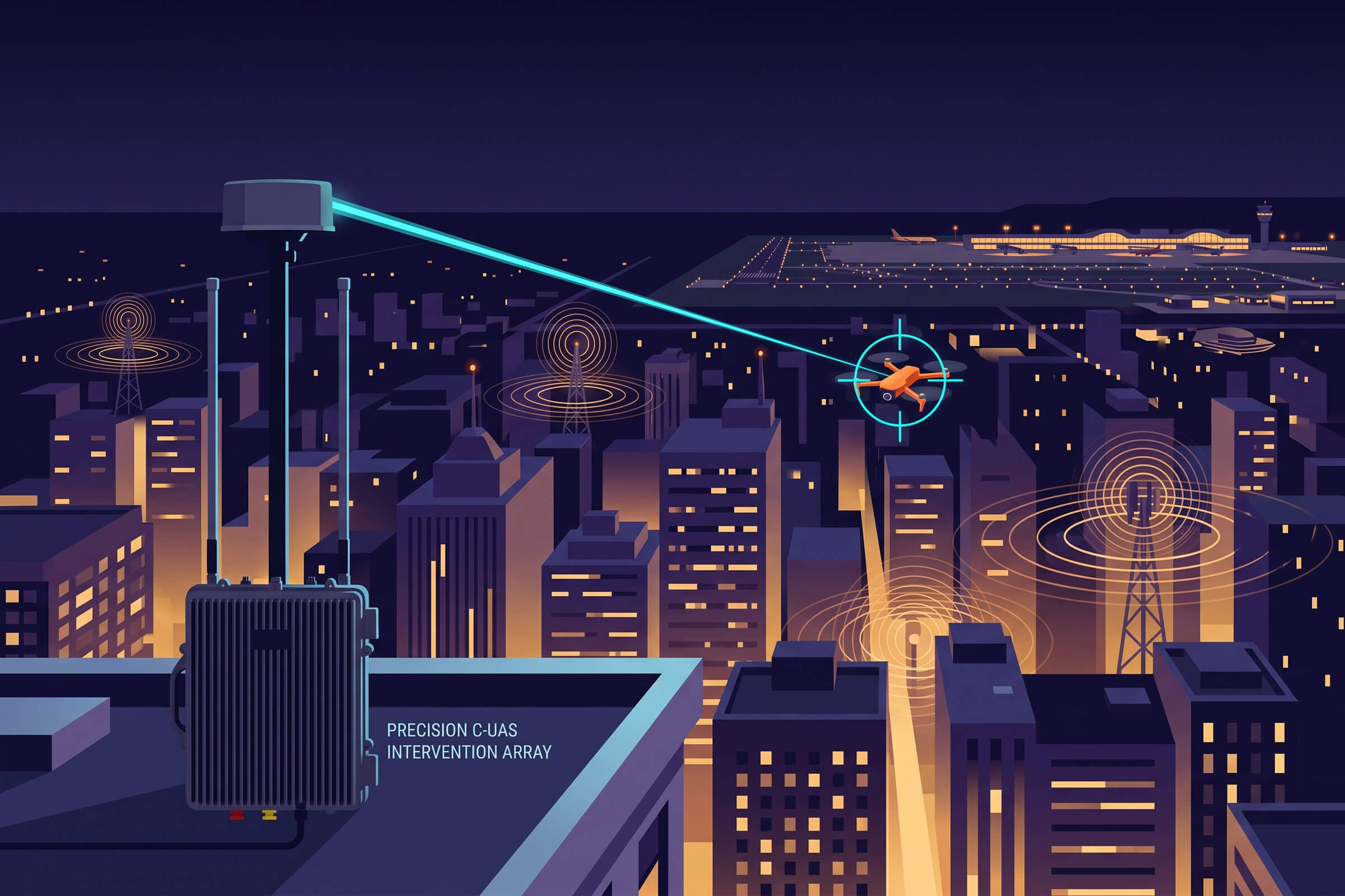
A word on how to think about the choice. The decision between directional and omnidirectional intervention should not be made on power alone. It should be made in the environment. Ask what else shares the spectrum around the protected site. If the answer is nothing, in a remote and isolated location, broad coverage may be acceptable and simple. If the answer is an airport, a city, a power grid, or a communications network, then precision is not optional. It is the only approach that does not trade one problem for another.
The Bottom Line
The choice between omnidirectional and directional jamming is not a choice between strength and weakness. It is a choice between a blunt instrument and a precise one, and the setting decides which is acceptable. In open, isolated terrain, broad coverage has its place. In cities, airports, and other electromagnetic-sensitive environments, precision is the only workable answer.
The DFJ53 Max removes the historical trade-off by pairing the precision of a directional beam with the coverage of a full-circle array. For a fixed site that cannot afford to disrupt its own spectrum while it stops a drone, that combination is the difference between a response that works and a response that works without collateral damage. And that, in the places that matter most, is the whole point.
Connect with us
Ready to Secure Your Low-Altitude Airspace?