Airport Drone Defense: Why the Threat Has Escalated, and What Procurement Should Ask
Sep 03 2026
From Disruption to Explosives
Two events in August 2026 mark a change in how airports should think about drones. In the early hours of August 5, German police found a drone carrying an unidentified explosive device near the southern runway of Leipzig/Halle Airport. They defused it, but not before both runways closed and passenger and cargo flights were diverted. One freighter may have touched an unidentified object and suffered minor damage. On August 19, an unauthorized drone near runway 28 at Sao Paulo Guarulhos International Airport halted takeoffs and landings for about thirty minutes, diverting at least ten flights.
Neither event was a first. Guarulhos has seen repeated drone disruptions throughout the year. Rio de Janeiro has recorded at least seven drone-delivered explosive incidents since March 2026, with police confirming that organized groups are now flying larger agricultural drones carrying heavier payloads. But Leipzig was a step change for the aviation sector specifically. The threat at an airport is no longer just a drone straying into protected airspace and forcing a pause. It is now a drone carrying a payload that could damage an aircraft or a terminal. Procurement logic has to catch up with that shift.
The Airport Threat Spectrum
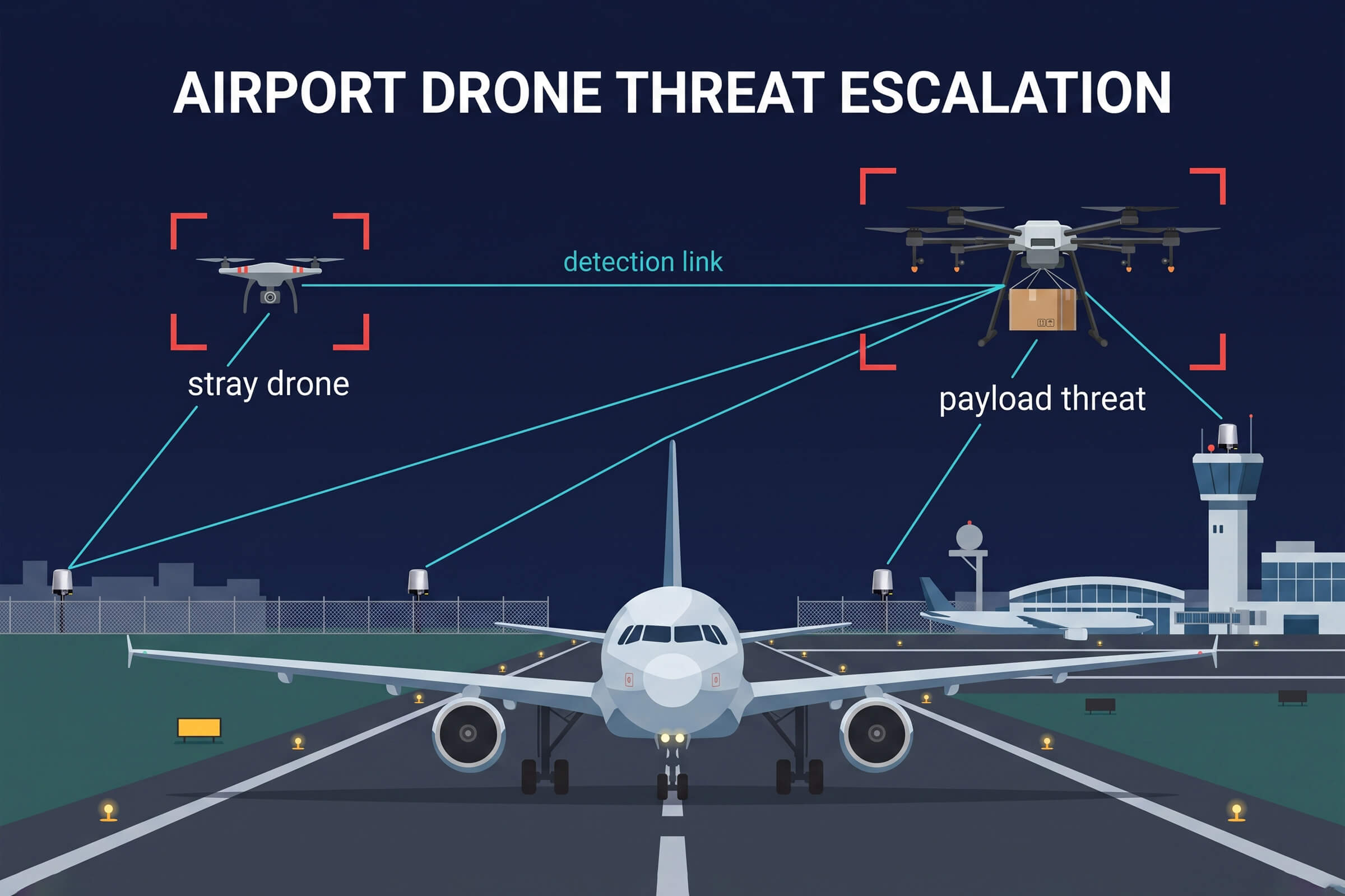
Airports face a range of drone events, and they are not all the same problem. At the low end is the stray drone, an amateur or a careless operator who wanders into protected airspace without intent. It forces a pause but rarely more. In the middle is deliberate disruption, a drone flown into an approach corridor to halt operations, whether as protest, mischief, or coercion. At the high end is the payload-carrying drone, a platform carrying an explosive or another payload intended to damage an aircraft or a building.
The distinction matters because the response is different in each case. A stray drone needs to be found and the operator located. Deliberate disruption needs rapid confirmation so the runway can close and reopen with confidence. A payload-carrying drone needs everything faster and more carefully, because the margin for a wrong call is zero. A system that treats all three the same way will be too slow where it should be quick and too blunt where it should be precise.
Why Airports Cannot React Like Other Sites
Most facilities can respond to a drone by shutting something down. An airport cannot. Every minute of closed runway is a chain of diverted flights, missed connections, and stranded passengers, and the cost compounds fast. The response has to be quick, but it also has to be right. A false alarm that closes a runway is itself an operational event with a price tag.
Airports are also dense electromagnetic environments. Air traffic control, ground operations, navigation aids, and passenger networks all run on radio spectrum that a broad, indiscriminate countermeasure would disturb. Any intervention has to be precise enough to leave the surrounding spectrum intact. That constraint rules out blunt approaches and pushes airports toward detection-first, confirmation-second designs.
Finally, there is the safety floor. Nothing an airport does to address a drone can endanger an aircraft or the people on the ground. That is why the sequence matters as much as the hardware: detect, confirm, then decide, with every step documented. In a setting this regulated, the process is the product.
Three Shifts in What Airports Buy
The August events point to three changes in procurement logic. The first is continuous low-altitude coverage. A single detection point leaves gaps, and a drone only needs one gap. Airports are moving toward a detection layer that watches the full perimeter and the approach corridors all the time, not just when an incident is reported.
The second is graded alerting. An airport is surrounded by birds, weather returns, legitimate radio traffic, and commercial aircraft. A system that treats every contact as a drone will cry wolf until the operators stop listening. The value is in a system that tells the difference between a bird, a plane, and a drone, and raises only the alerts that need a human.
The third is a low-collateral response. The days of answering a drone with a broad shutdown of spectrum, or of treating any drone as a shoot-down decision, are over for civil airports. The requirement is a response that stops the threat without stopping the airport, and a record that stands up afterward.
The Detection Layer: RF Direction Finding
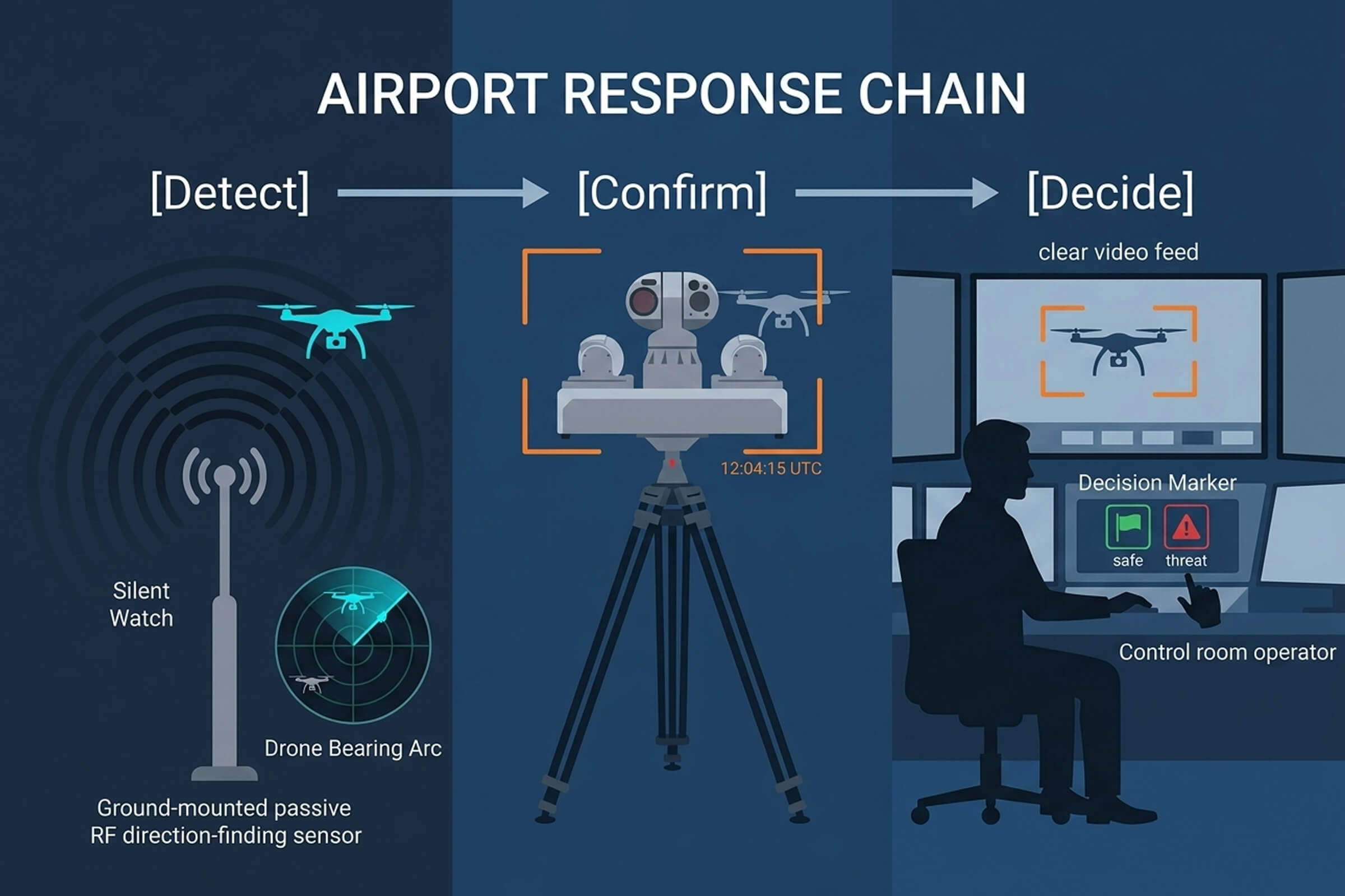
The first layer is radio frequency direction finding. A drone is a flying radio, and its command and video links are visible to a passive sensor whether or not the drone is in line of sight. The DF Series units, such as the DFJ83, measure the angle of arrival of a drone’s signal across a wide band from 30 MHz to 6 GHz, detecting a drone at up to eight kilometers with direction-finding accuracy of three degrees RMS on a hovering target.
Placed around an airport perimeter, two or three direction-finding units draw intersecting bearings that locate the drone. Because the detection is passive, it emits nothing and interferes with nothing, which is the first requirement for an airport. It watches the spectrum continuously and stays silent, so it can run all day without touching the radio environment the airport depends on.
There is a deeper reason the detection layer leads. In a heavily regulated setting, detection and identification are the capabilities an airport can deploy without licensing friction. They raise no interference concerns and no authorization questions. An airport that builds this layer first is operational on day one, while the harder questions around intervention are still being worked out.
Filling the Gaps: Airborne Coverage
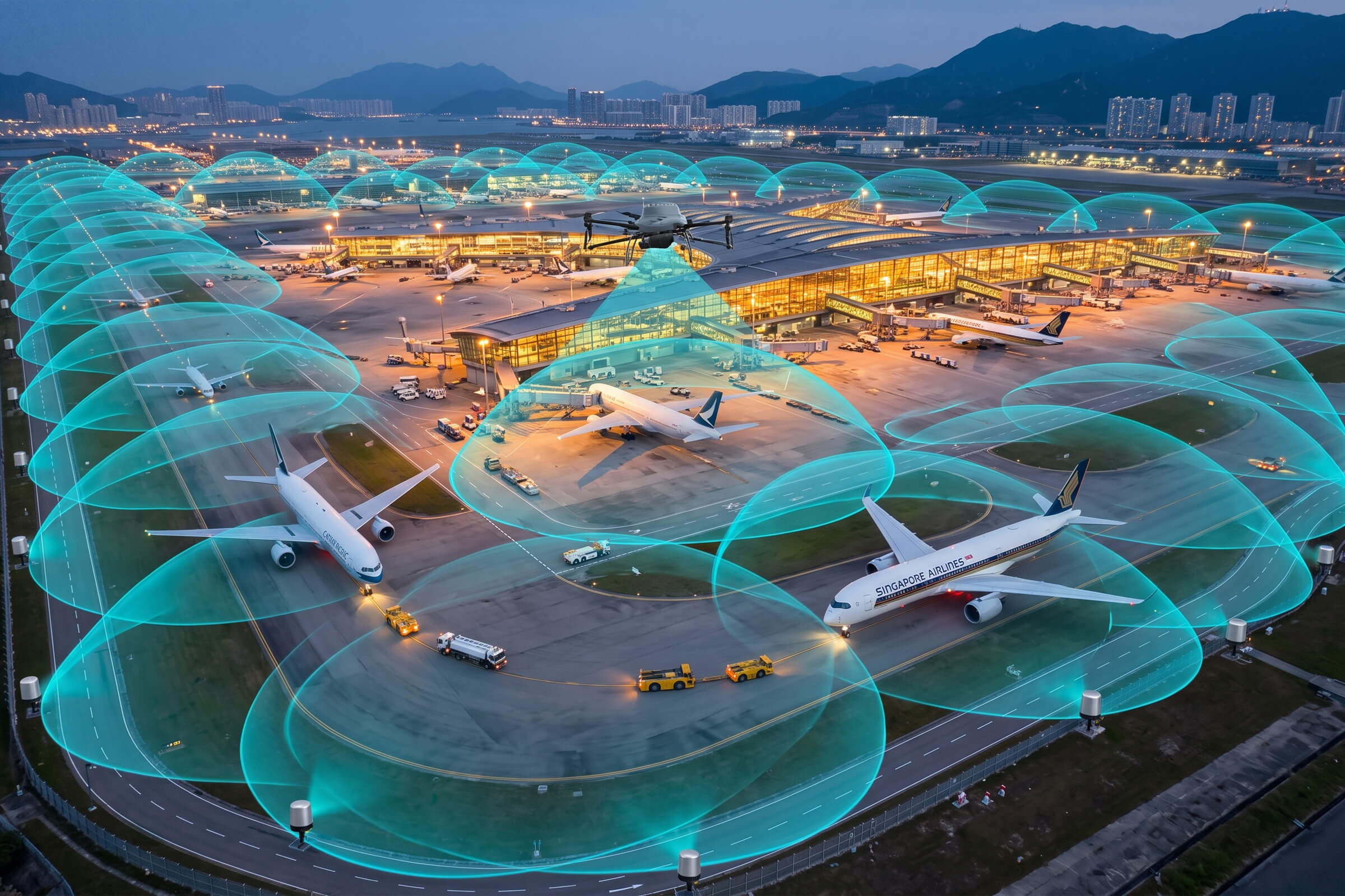
Ground sensors see the world from roughly eye level, and an airport is full of structures that block the view: terminals, hangars, parked aircraft, jet bridges. A drone on the far side of a terminal is invisible to a ground node. That is where an airborne payload helps.
The D5-Air is a drone-mounted detection payload covering the 400 MHz to 6 GHz band with a detection range of up to five kilometers. It watches a full 360 degrees horizontally, which lets a single airborne node cover an area that would take several ground sensors to reach. It is not a replacement for the fixed perimeter layer. It is the tool that fills the shadows, deployed when a specific sector needs a closer look or a gap needs to be closed quickly.
The value of a mobile layer is flexibility. A fixed perimeter cannot be everywhere, and no airport can afford to cover every corner with permanent infrastructure. An airborne node moves to where the gap is, whether that is a temporary construction zone, an event, or a sector the fixed layer cannot see. It turns coverage from something fixed and rigid into something the airport can point to where it is needed.
Visual Confirmation: EO/IR Tracking
Detection tells an operator that something is there. Confirmation tells them what it is, where exactly it is, and what it is doing, and that is what turns an alert into something an airport can act on. The VAR300 is an all-weather electro-optical and infrared tracker built for this. It pairs a 640 by 512 infrared sensor with AI-driven visual tracking, detecting a drone at up to one kilometer in daylight and roughly half a kilometer at night, and holding a track beyond that.
The confirmation layer earns its place in two ways. It filters false alarms, so the runway does not close over a flock of birds. And it produces the evidence. When an incident triggers a report, a review, or a legal process, a time-stamped video of the drone, its path, and its behavior is what holds up. An RF log that says a drone was present is weak by comparison.
Confirmation also connects to the aviation authorities. When an airport reports a drone sighting, the report has weight because it is visual and verifiable. That weight matters because it is what allows a rapid, confident decision to close and reopen a runway, and it is what survives the investigation that follows every incident.
In a city airport, this link to law enforcement is what closes the loop. Detection finds the drone, confirmation records it, and the operator’s location gives the authorities somewhere to go. An airport that only stops the drone is playing defense forever. One that locates the operator starts reducing the number of times it has to play at all.
Direction-finding supports this directly. The same bearings that place the drone point back toward the controller, because the operator’s radio link is part of the same signal exchange the sensor reads. As the drone moves and the operator stays put, the bearings converge on the launch point. That is the lead the police need, and it is generated before the drone even lands.
Stopping the drone is only half the response. The other half is finding the person flying it. A drone that is forced down or turned away leaves an operator who can fly again in minutes, from a different spot, with a different drone. The durable outcome is to locate the operator while the drone is still in the air.
Locating the Operator
The Regulatory Reality
Airport drone defense is not decided by detection range alone. A high-profile airport project in Europe was reworked in 2026 not over a failed test but over how the system was classified, how it was licensed, and who was authorized to operate it. The lesson travels: before a system is bought, the procurement team has to map the legal path. Is it approved for civil use? Who is permitted to operate it? How is the data handled?
That is why graded configuration matters. A well-designed airport deployment can start with passive detection and visual confirmation, which raise no interference concerns, and add a carefully scoped intervention layer only where regulation and licensing allow. The system should be able to operate in detect-and-alert mode today and step up to a fuller response where the legal space exists. Buying for that flexibility is what keeps an airport compliant and effective at the same time.
The Bottom Line
The drone threat at airports has changed, and the procurement playbook has to change with it. Continuous low-altitude coverage, graded alerting, and a low-collateral, well-documented response are now the baseline. Passive RF direction finding finds the drone, airborne coverage closes the gaps, and EO/IR confirmation turns an alert into evidence.
An airport that builds that chain, in that order, gets a system that can stop a drone without stopping the operation. That is the only kind of airport drone defense worth buying.
Connect with us
Ready to Secure Your Low-Altitude Airspace?