The Cost-Exchange Problem: Why Layered, Software-Defined Drone Defense Wins
Sep 03 2026
The Arithmetic That Is Breaking the Defense Budget
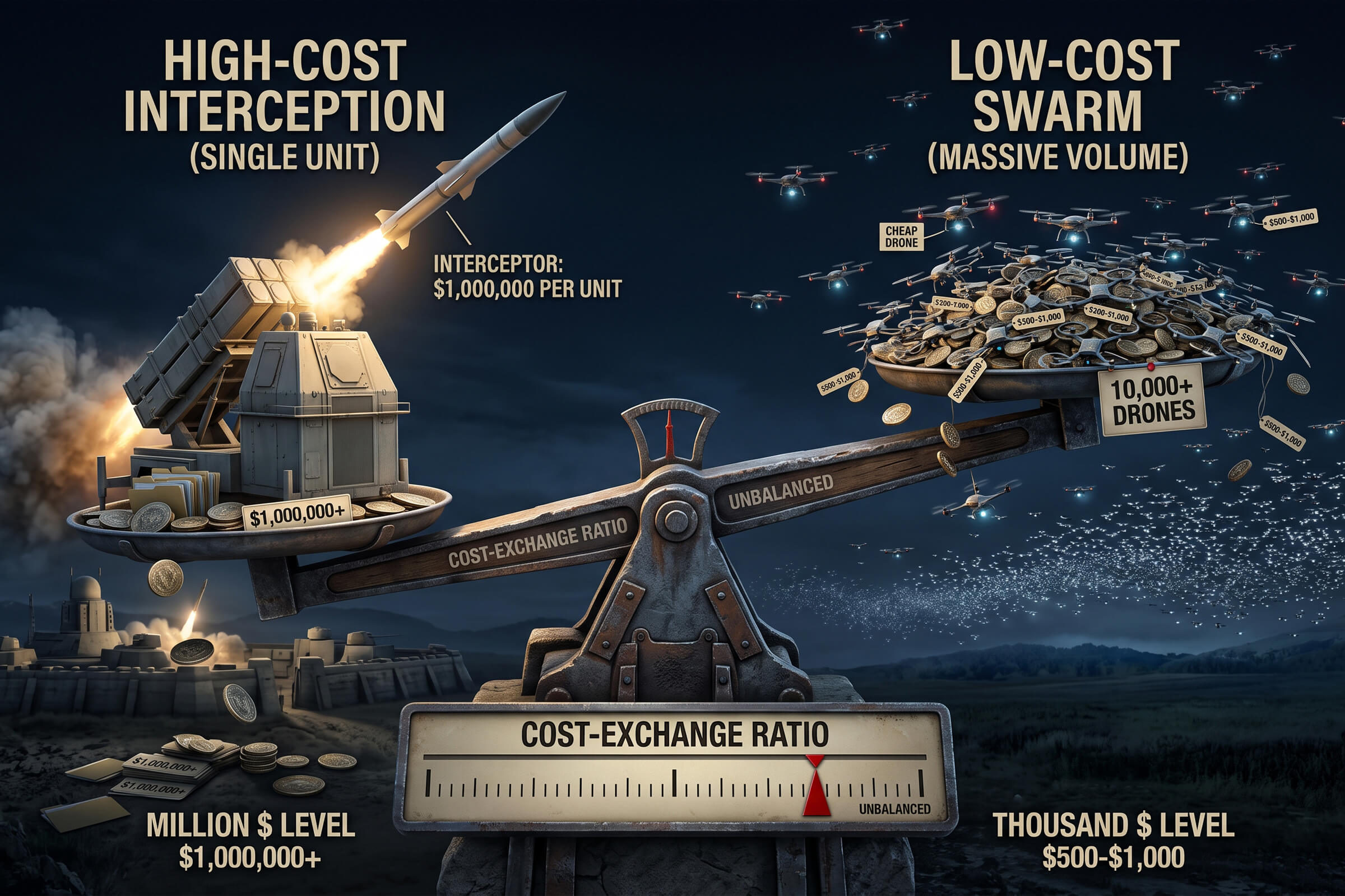
A senior European defense official put it bluntly in late August 2026: using an interceptor that costs millions to stop a drone that costs a few thousand is an arithmetic that cannot hold. It is not a new observation, but it has stopped being a debate and started being a constraint. The drone has become the cheapest way to make the other side spend money, and the counter-drone market is now organized around answering one question: how do you defend against a threat that costs almost nothing without spending a fortune to do it?
The numbers behind the warning are public and consistent. DroneShield reported first-half 2026 revenue up 74 percent year over year, with recurring revenue up 229 percent and now about nine percent of the total. The demand is real, and it is growing. The same half saw a Red Sea port suspend operations after sustained drone pressure, another reminder that the cost of not defending can exceed the cost of defending.
Why the Exchange Ratio Is Getting Worse
The problem is not just that drones are cheap. It is that they are getting cheaper, more capable, and more numerous at the same time. A single drone is a nuisance. A wave of them is a different problem, because every unit in the wave demands a response, and the responses cost money that does not scale down to match.
This is the exchange-ratio trap. If a defender answers every drone with an expensive effect, the attacker wins by simply sending more drones than the defender can afford to stop. The defender’s budget becomes the target. The only way out is to make the response cost less than the threat it neutralizes and to reserve the expensive options for the small number of cases that truly need them.
The trap is not theoretical. The same European official pointed to the mismatch directly: an interceptor priced in the millions against a drone priced in the thousands. The arithmetic only breaks one way, and it is not in the defender’s favor. Any strategy built on outspending the threat is a strategy that loses the moment the threat is massed.
The Layered Answer
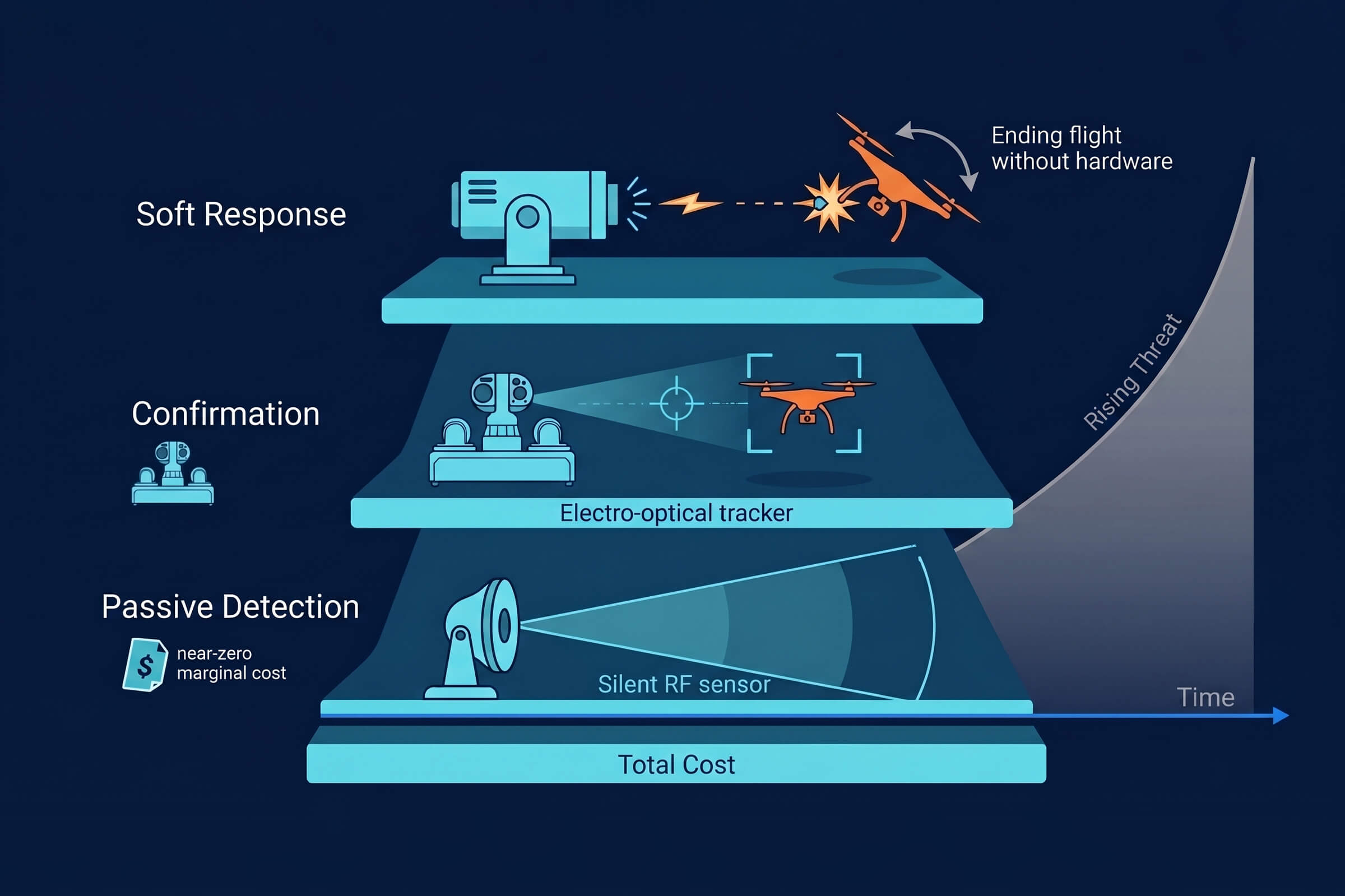
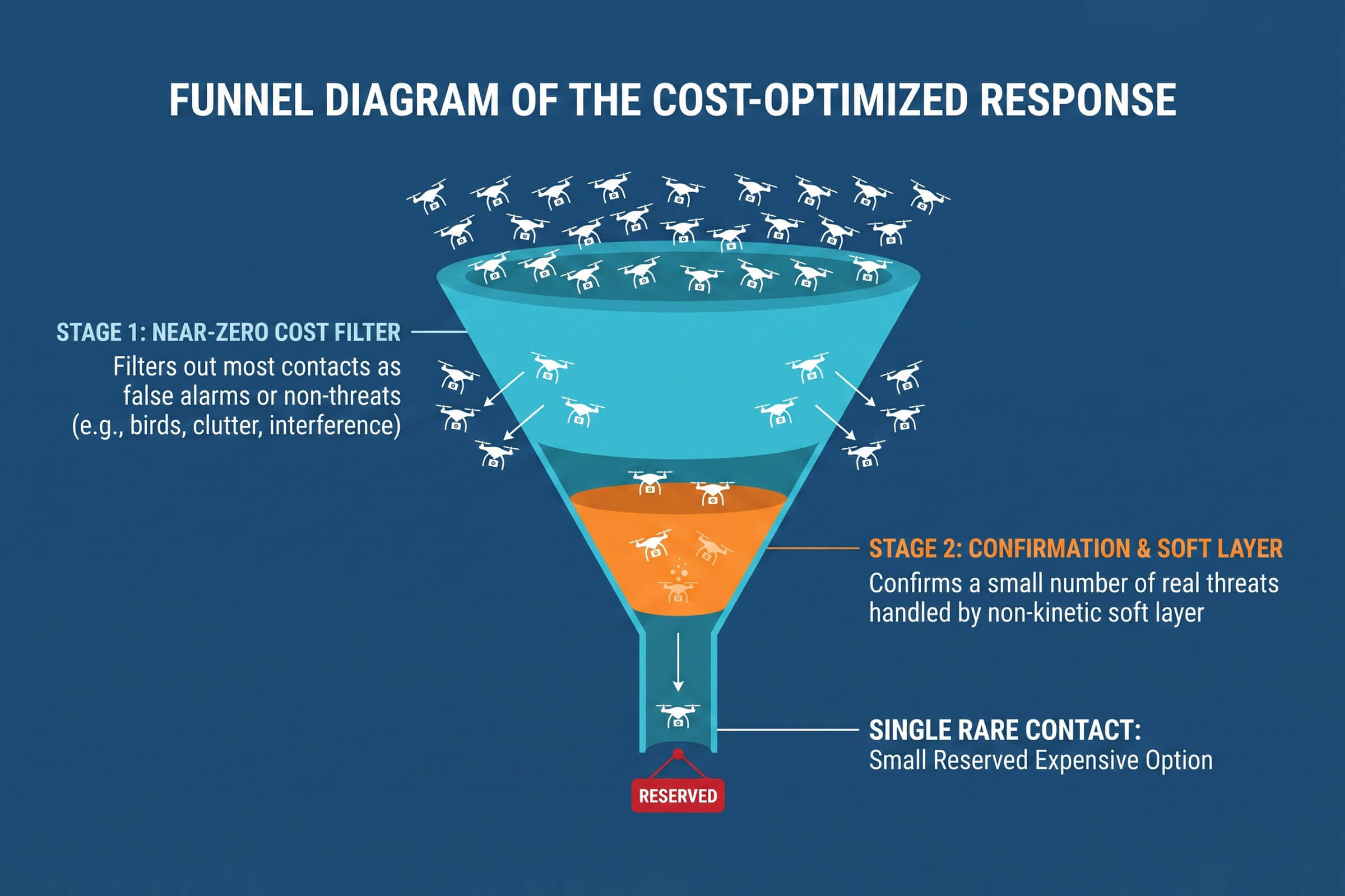
The counter to the exchange-ratio trap is layering, and it follows a simple logic. Detect early with something cheap and always-on. Confirm what you found. Then apply the least expensive effect that solves the problem, saving the costly options for the rare case that justifies them.
Passive radio frequency detection is the foundation because it is cheap to run, emits nothing, and covers a wide area continuously. It does the watching without spending a per-incident cost. Confirmation, whether by electro-optical tracking or by fusing several passive sensors, removes the false alarms that would otherwise waste the response layer. Only then does the question of effect arise, and only for the contacts that are actually threats.
That order of operations is what makes the economics work. Most drone events end at detection and confirmation, at a cost that is effectively fixed rather than per incident. The expensive decisions are reserved for the small fraction of cases that genuinely need them.
The Cost Advantage of the Soft Layer
Within the effect layer, the soft options carry the cost advantage. A radio frequency approach that breaks the link between a drone and its operator, done with a directional beam rather than a broad blast, ends the flight without consuming a physical round. It costs electricity, not hardware, and it can be used again the next minute. That is the property the exchange ratio rewards: a response whose marginal cost is near zero.
This is where a wide-band direction-finding sensor like the DFJ53 Max, with its 360-degree directional array, fits. It finds and localizes the drone first, so the intervention is aimed rather than sprayed. Aimed intervention uses less energy and touches less of the surrounding spectrum, which keeps the response precise and repeatable. Precision is not just a safety property. It is a cost property.
The software layer adds to the same arithmetic. A command-and-control platform that fuses the sensor feeds, correlates tracks, and queues the response removes the human cost that would otherwise sit between detection and action. Fewer operators, faster decisions, fewer wasted responses. Software is how the defense scales without the cost scaling alongside it.
Reserve the Expensive Effect for the Rare Case
None of this means the costly options disappear. There will always be a contact that justifies a hard response, and a layered system should keep that option in reserve. The point of the soft layer is not to replace the hard layer. It is to make sure the hard layer is used rarely enough that the budget survives.
The division is simple in principle. The passive and soft layers handle the routine, the wide, the frequent, at near-zero marginal cost. The expensive effect handles the exceptional, the confirmed, the unavoidable. When the layers are built in that order, the system spends almost nothing most of the time and reserves its budget for the moment it actually needs it. That is what balancing the exchange ratio means in practice.
The practical rule for a buyer follows. Start from the constraint: what can you legally and safely use at your site? In most civilian settings, that constraint leaves you with detection, confirmation, and a precise soft response. Build that well, and you have answered the threat at the lowest cost the constraint allows. The exchange ratio stops being a vulnerability and becomes a design requirement you have already met.
This is why the market is drifting toward it. The same half-year that showed strong revenue growth also showed the recurring, software-driven part of the business growing far faster than the hardware. Buyers are paying for outcomes, for updates, for a system that stays current without being replaced. That is the soft, layered model in its commercial form, and it is where the exchange ratio and the market’s direction point in the same direction.
The soft layer is built for exactly those constraints. A directional radio frequency response ends the flight without a falling object, without a debris field, and without the collateral damage a hard effect carries. It is the option that can actually be used where the demand is, which is what makes it the economic answer and not just a technical one. In civilian airspace, the soft layer is not the cheap alternative. It is often the only alternative.
The exchange ratio is sharpest in the places where counter-drone demand is growing fastest: airports, energy sites, stadiums, correctional facilities. These are civilian settings, and the constraints they impose push hard toward the soft layer. A hard kinetic response in the middle of a city is rarely an option at all. The question is not whether a missile can stop a drone. It is whether any hard effect can be used there without creating a worse problem.
Why Soft-Kill Fits Civilian Sites
What the DroneShield Numbers Actually Say
Read closely, the DroneShield report is less about one company and more about where the market is going. The 74 percent revenue growth says the demand is real and broad. The 229 percent growth in recurring revenue, still only nine percent of the total, says the industry is starting to sell outcomes and updates rather than just boxes, and there is room to grow. The losses posted despite the growth say that scaling a hardware business is expensive, which is itself a signal about what buyers should value.
For a buyer, the takeaway is to pay attention to the total cost of a defense, not the sticker price of a sensor. A system that costs little per incident and gets cheaper as it runs is the one that survives a long engagement. A system that wins every single drone with an expensive effect is a system the budget will eventually refuse to fund. The exchange ratio decides which kind you have bought.
When the full picture is counted, the layered, software-defined stack wins on cost for the same reason it wins on effect. It spends almost nothing on the routine, keeps the expensive options in reserve, and removes the human and hardware waste that inflates the true cost of a defense. That is what balancing the exchange ratio actually looks like on a balance sheet.
There is also the hidden cost of false alarms. Every false positive that reaches an operator consumes attention, and attention is the scarcest resource in any security operation. A system that filters its own false alarms, that confirms before it alerts, is cheaper to run even before the effect layer is considered. Cost is not just what you pay. It is what you spend in people, in fatigue, and in the decisions that follow a bad alert.
A system with a low sticker price and a high per-incident cost is a system that gets expensive the moment it is actually used. A system that consumes a physical round with every engagement is a system whose budget scales with the number of drones the attacker sends, which is exactly the trap the exchange ratio sets. The cheaper system over time is the one whose marginal cost per incident is near zero, because that is the only cost curve that stays flat while the threat grows.
Most procurement asks the wrong question first. The sticker price of a sensor tells you almost nothing about what the system will cost to own and to use over five years. The questions that matter are the ones that follow. What does it cost per incident, not per unit? Does the response consume hardware, or does it run on electricity? How many operators does it take to run a shift, and how much does the software cost to keep current?
How to Read the Cost of a System
Building for the Long Run
The sustainable counter-drone system is the one built around a cheap, passive detection layer, a confirmation layer that protects the operators from false alarms, and a soft effect layer that ends flights without spending hardware. On top of that sits software that ties it together and takes the labor out of the loop. That stack answers a wave of drones at a cost that stays flat, while reserving the costly options for the rare case.
The arithmetic that is breaking defense budgets is not going to reverse. Drones will keep getting cheaper and more numerous. The organizations that stay ahead of it will be the ones that stop trying to outspend the threat and start trying to out-design it. The exchange ratio is the new unit of account, and the soft, layered, software-defined stack is the only answer that balances it.
Connect with us
Ready to Secure Your Low-Altitude Airspace?