Why Passive Detection Is Becoming the Center of Counter-Drone Systems
Sep 23 2026
In mid-September 2026, two product announcements landed a few days apart and said the same thing from different angles. Patria signed a deal to deliver its MUSCL passive radar system to a European customer, a sensor that detects aircraft using radio signals already in the environment rather than emitting its own. And Arbe Robotics launched a compact 4D imaging radar aimed at FPV and fiber-optic drones, the aircraft that are hardest for radio-frequency detection to catch. The common thread is a quiet but decisive shift in how counter-drone systems are being built.
For years, the default answer to drone detection was radio-frequency sensing: listen for the drone’s control and video links. That answer is now under pressure from two directions, and the response is pushing the whole field toward passive detection and multi-sensor fusion.
The Two Things Breaking Pure RF
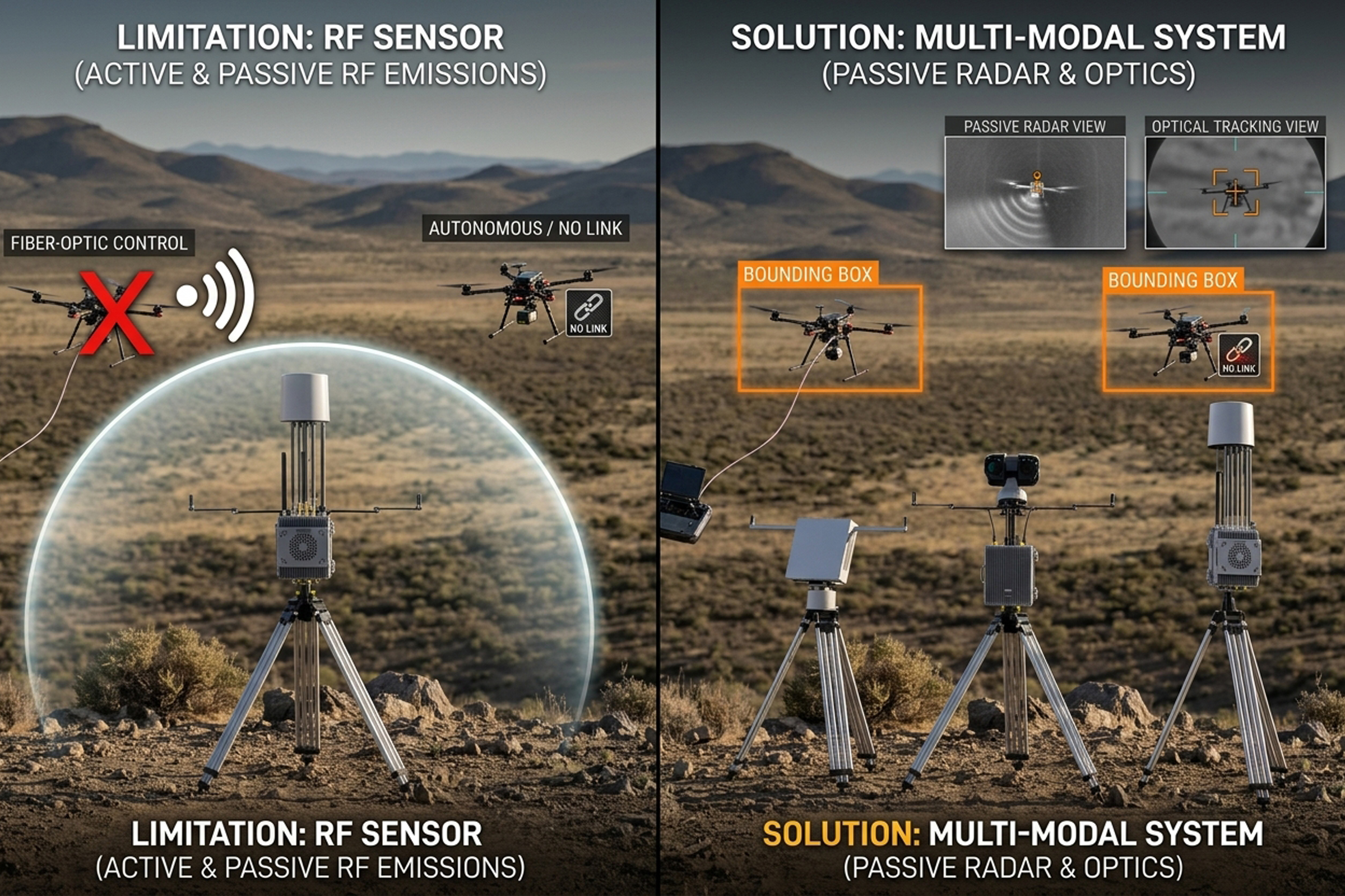
Radio-frequency detection has a structural weakness: it only sees drones that are actively transmitting. Two categories of aircraft exploit that weakness, and both are spreading fast. The first is the autonomous drone, which flies a pre-programmed route and does not need a live control link at all. There is nothing to listen for. The second is the fiber-optic drone, which uses a spooled cable to carry its control and video signals instead of a radio link. Again, there is no radio emission to detect.
This is why the industry’s interest has swung toward sensors that do not depend on the drone’s own transmissions. A radar sees the aircraft itself, its physical body, regardless of whether it is talking. An electro-optical sensor sees it visually. These are the sensors that close the gap pure RF leaves open, and they are the reason passive radar and 4D imaging radar are now headline products.
Passive Radar and the Value of Emitting Nothing
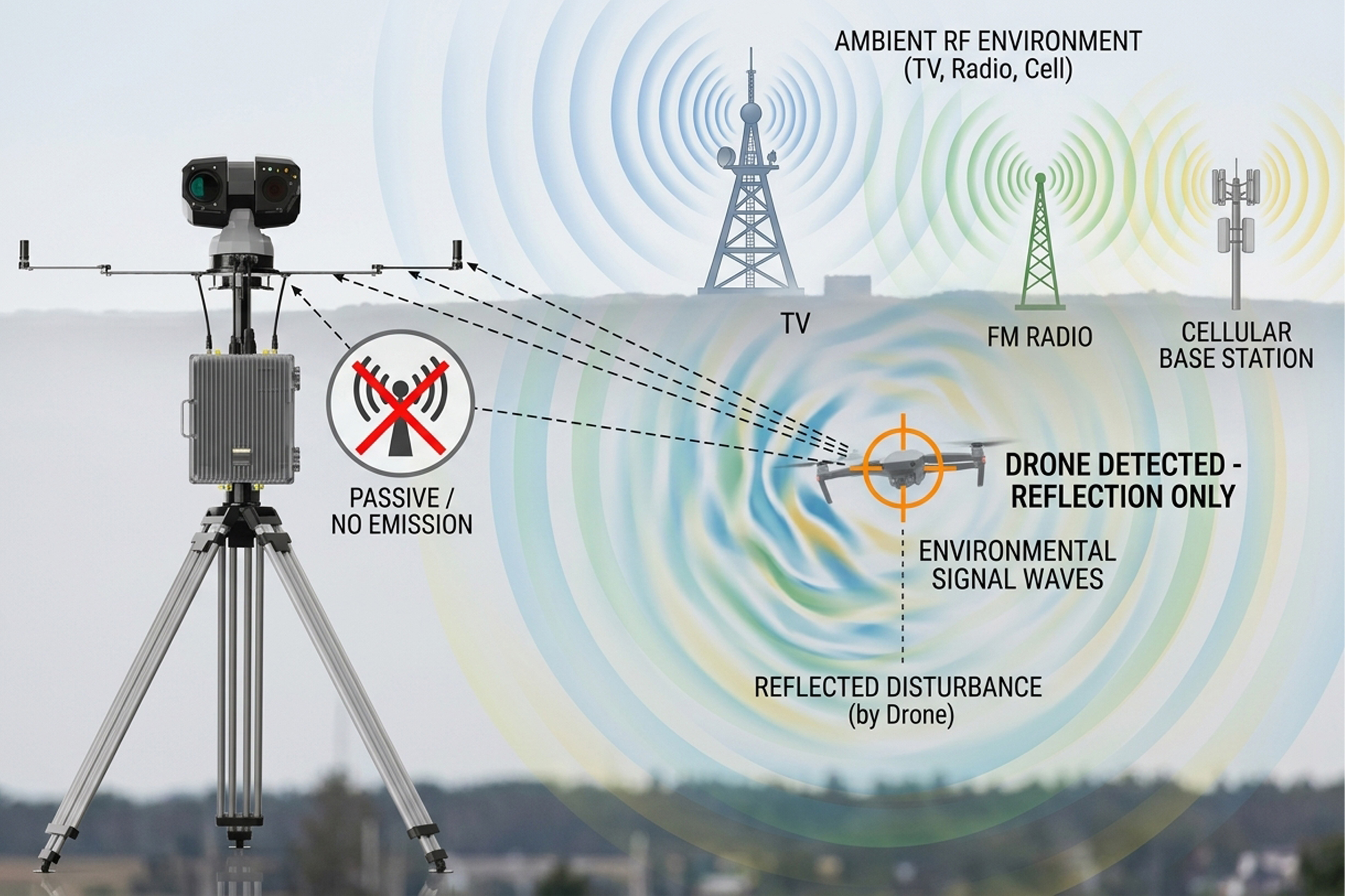
Passive radar works on an old idea with a new application. Instead of sending out its own pulse, it uses signals that are already there: broadcast television, FM radio, mobile base stations, the ambient radio energy that blankets any populated or defended area. When a drone moves through that energy field, it disturbs the reflections, and the passive radar reads the disturbance to find the aircraft. It emits nothing, which means it cannot be found and cannot interfere with the environment it watches.
That last property is why passive radar fits where active radar does not. In a sensitive electromagnetic environment, an active radar is another transmitter to license and coordinate. A passive radar is invisible. It adds nothing to the spectrum and reveals nothing about itself. The same logic runs through LZ TECH’s passive line: the DF Series direction-finding sensors and the D5-B time-difference-of-arrival node both work by receiving, never transmitting. They are part of the same broader movement toward detection that leaves no trace.
TDOA and the Move to Positioning
Passive detection changes the question from what the signal is to where the target is. Radio-frequency sensing can identify a drone and give a rough bearing. Time-difference-of-arrival goes further: when the same signal reaches several synchronized passive nodes at slightly different times, those timing differences turn directly into a position. The D5-B is built for this, covering 30 MHz to 6 GHz, detecting a drone out to three kilometers, and placing it to better than ten meters, all without emitting.
Positioning is the property that makes a passive network actionable. A bearing tells an operator which way to look. A coordinate tells them where the target actually is, which is what a response needs. As the threat shifts toward aircraft that cannot be seen by their radio signal, the ability to place a contact precisely, from passive timing alone, becomes the backbone of the detection layer.
Fusion Is the Real Product
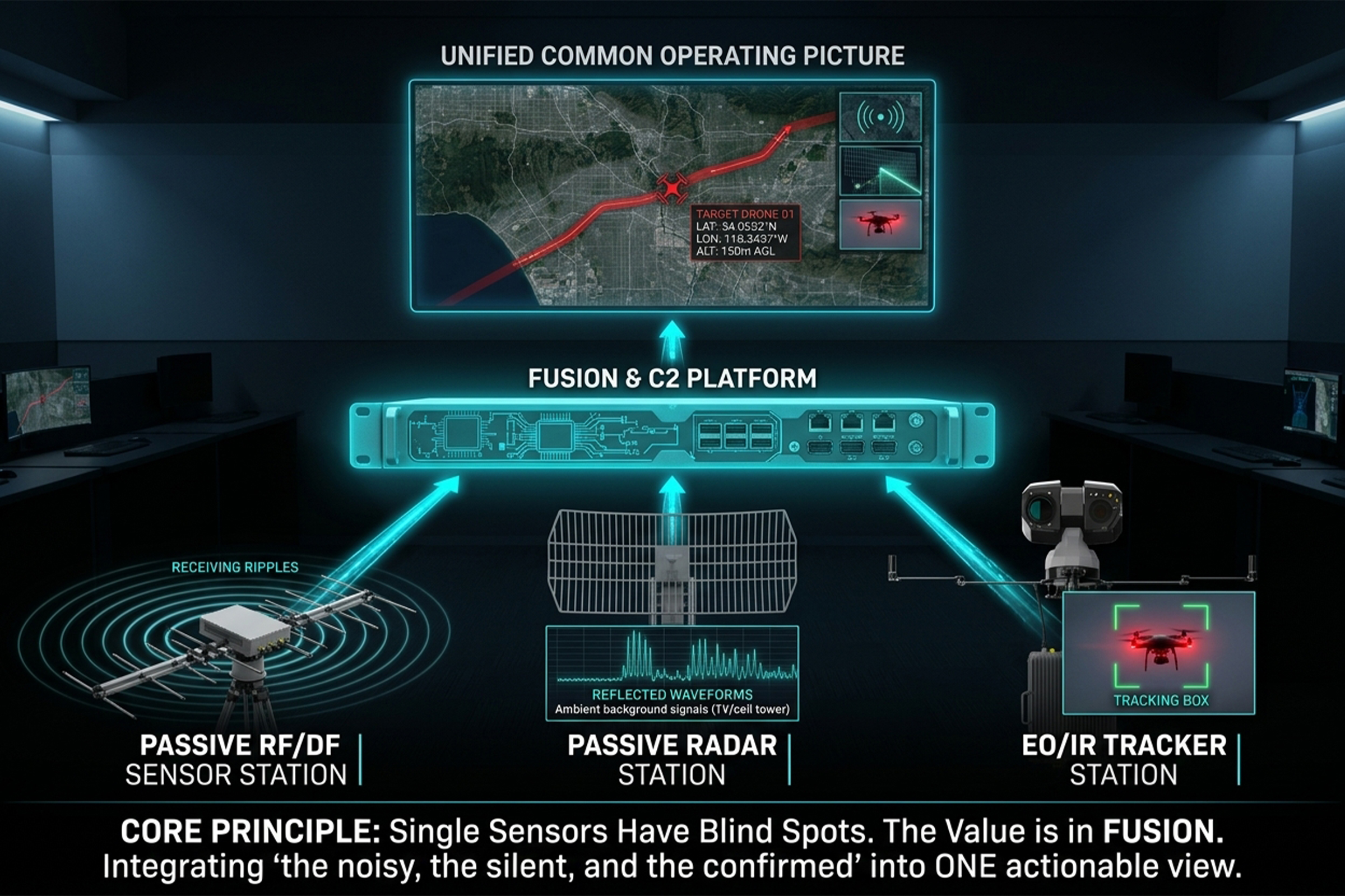
No single sensor solves the new threat. Radio-frequency detection catches the transmitting majority. Radar catches the silent and the fiber-optic. Electro-optical confirmation sees what the other two find and builds the record. Each is incomplete alone. The system emerges only when they are fused, and that is where the September announcements converge with a deeper trend.
The value is not in any one sensor. It is in the layer that turns several partial answers into one coherent picture. The VAR300 electro-optical tracker takes a position from RF or TDOA and locks on visually. The DF Series gives the first, wide, passive alert. The D5-B places the contact precisely. Wired together, and fused through a command platform such as CCS, they cover the aircraft that transmits, the aircraft that does not, and the aircraft that must be seen to be believed. Fusion is the thing the customer is actually buying, because fusion is what makes a defense out of a set of sensors.
A stack that can answer all three is ready for the threat as it is now. A stack that answers only the first is ready for the threat as it was a few years ago. The difference is not a minor upgrade. It is the difference between a system that catches most drones and a system that catches the drones deliberately built to avoid it. The September announcements, from passive radar to 4D imaging, are all efforts to close that second gap.
If the threat is diversifying, the sensible response is to check the detection stack against the ways a drone can now avoid it. Three questions cover most of the ground. Does the stack see the drone that transmits? That is the radio-frequency and TDOA layer, and it covers the majority. Does it see the drone that does not transmit, the autonomous and fiber-optic aircraft? That is the radar and optical layer. And does it confirm the contact before any action is taken? That is the visual confirmation that closes the loop.
A Checklist for a Changing Threat
What This Means for Buyers
The practical takeaway is simple and worth stating. Do not build a counter-drone system around a single detection method, because the threat is actively evolving away from any single method. Build around a passive core, radio-frequency and TDOA for the transmitting majority, and pair it with radar and optical for the silent and the fiber-optic minority. Then connect it all through a command layer that fuses the feeds.
The September announcements, passive radar on one side and 4D imaging radar on the other, are both bets on this architecture. They are responses to a threat that has learned to go silent. The buyers and integrators who read the signal will build the same way: a passive, fused, multi-sensor stack that does not depend on the drone playing by the old rules.
LZ TECH’s line is designed around exactly that. The DF Series and D5-B are passive sensors that feed a shared picture. The CCS platform fuses them with third-party radar and optical feeds. The result is not a walled garden but a set of building blocks that an integrator can place inside a larger, multi-sensor stack. In a market that is rewarding fusion over single-vendor lock-in, that openness is the point.
For a system integrator, the September announcements carry a concrete signal. The counter-drone stack is being judged less on any single sensor and more on how well the sensors hand off to each other and to the command layer. A vendor whose sensors only speak to their own software is building for a market that is leaving that model behind. A vendor whose passive sensors feed standard interfaces, and whose command platform accepts other vendors’ sensors, is building for the market that is emerging.
The point of fusion is that each sensor’s limits are covered by another sensor’s strength. Radio-frequency and TDOA cover the transmitting majority. Radar covers the silent and fiber-optic minority. Optical confirmation covers the moment of decision. A system built around one method inherits that method’s blind spot. A system built around fusion inherits no single blind spot, because the layers are chosen to cover each other’s edges. That is the real reason the field is converging on the fused, passive stack, and it is the reason the September product announcements look the way they do.
It is worth being precise about what passive detection does not do, because the honest answer shapes the architecture. Passive detection is quiet and hard to find, but it depends on there being some energy to read. A passive radar needs the ambient broadcast signals to be present. A TDOA network needs the drone to emit something, or a transmitter somewhere to bounce off it. None of these are weaknesses when the stack is built right; they are the reason the stack has to be a stack and not a single sensor.
The Limits That Define the New Stack
The Integrator’s Choice
The result is a detection layer that is quieter, harder to find, and more complete. It is quieter because it adds nothing to the spectrum. It is harder to find because there is nothing to detect about it. And it is more complete because it combines the radio-frequency view of the transmitting drone, the radar view of the silent drone, and the optical view of the drone that must be confirmed. That completeness is what the new threat demands, and it is why passive detection has moved to the center of the architecture.
The turn toward passive detection is not a fashion. It is a response to two hard facts. The first is the spreading use of fiber-optic and autonomous drones, which strip radio-frequency detection of its primary target. The second is the regulatory and environmental pressure against emitting anything you do not have to, especially in populated or sensitive airspace. Passive sensors answer both: they do not depend on the drone transmitting, and they do not transmit themselves.
Why the Shift Is Happening Now
The Bottom Line
Pure radio-frequency detection is not dying, but it is no longer enough. Autonomous and fiber-optic drones have cut away the assumption it was built on, and the industry is answering with passive radar, passive positioning, and multi-sensor fusion. The center of gravity is shifting from listening for a signal to watching the airspace itself, passively and from many angles at once.
For an operator, the choice is not between passive and active, or between radio and radar. It is whether to build a system that can see the drone that transmits, the drone that stays silent, and the drone that must be confirmed visually, all in one picture. The threat has already diversified. The defense has to diversify with it.
Connect with us
Ready to Secure Your Low-Altitude Airspace?