Defending Crowded Skies: The Fallout Problem in Urban Drone Defense
Sep 28 2026
On September 18, 2026, a drone was intercepted as it approached a restricted area near Mecca, and the falling debris from that interception landed in a populated area. Public reporting confirmed that the debris caused civilian harm: one resident was killed, and two others were injured. The drone was stopped. The protection worked, in the narrow sense. But the outcome was not a clean success, and that is the lesson the event carries for anyone defending a crowded place.
In an open field or over a remote site, stopping a drone is the end of the problem. Over a city, a stadium, a religious gathering, or a major event, stopping the drone is only the beginning of the question. Where does it come down? What does it carry? Who is underneath? The defense of crowded skies is measured not by whether the drone is stopped, but by whether it is stopped in a way that does not turn one danger into another.
The Problem Is Not Detection. It Is Consequence.
Most discussion of counter-drone systems focuses on whether they can find and stop a drone. That framing is adequate when the airspace above is empty. It breaks down the moment there are people underneath, because every response carries a second-order cost. A drone that is disabled in the air does not vanish. It falls, and what falls with it — its frame, its payload, its battery — comes down somewhere.
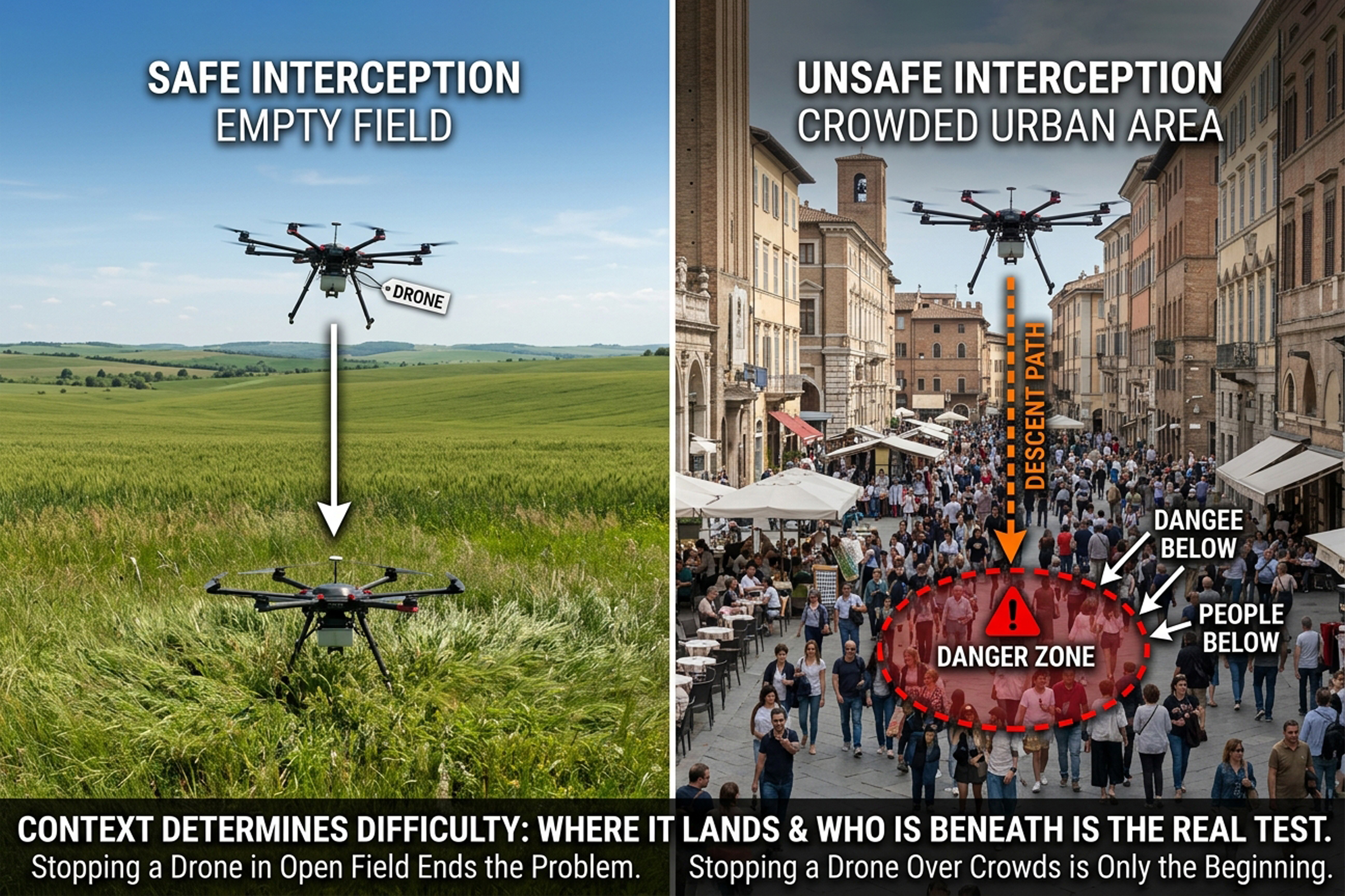
That somewhere is the whole problem. In a crowded environment, the difference between a successful defense and a costly one is whether the operators knew where the drone would come down, and whether they had the time to act on that knowledge. The Mecca event is the clearest recent example: the drone was stopped, but the debris found people. The goal of a well-designed urban system is to make sure that question — where will it come down — is answered before the response is triggered, not discovered after.
Early, Precise Detection Buys the Time to Choose
Every good outcome in a crowded environment starts the same way: with enough warning to make a choice instead of a reaction. If the operators know a drone is coming while it is still far out, they can decide where to act, whether to clear a zone, and how to sequence the response. If they discover the drone only when it is already overhead, their choices are gone, and the outcome is whatever the moment allows.
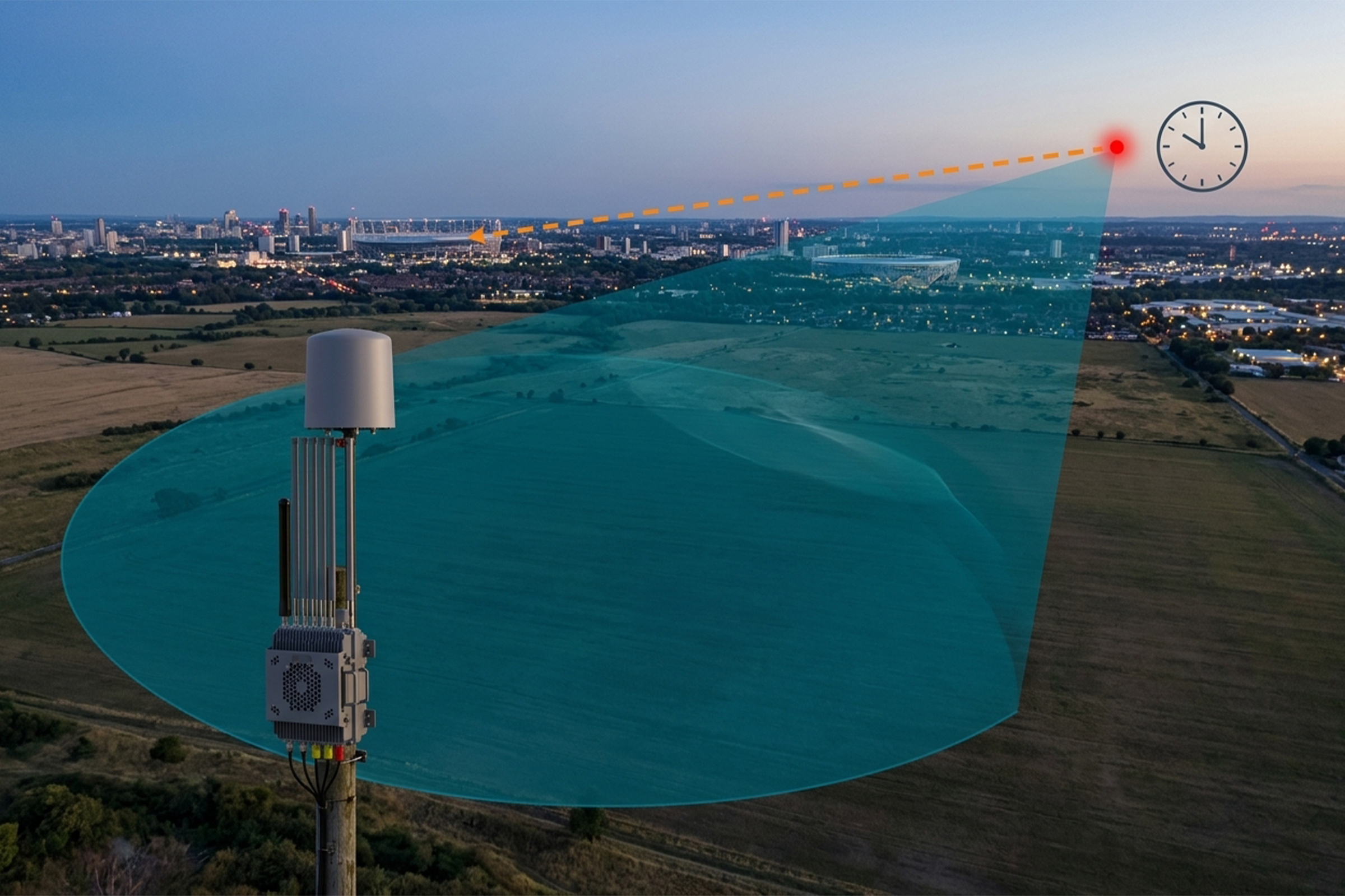
This is where the detection layer earns its keep. The DF Series of direction-finding sensors reads a drone’s radio signals passively across 30 MHz to 6 GHz, detecting a drone at up to eight kilometers with direction-finding accuracy of three degrees RMS. Eight kilometers is time. At that distance, even a fast drone is minutes away, and minutes are what let the operator move from reacting to deciding. Passive sensing also matters here because it adds no emissions of its own to an environment that may already be dense with radio traffic from a crowd.
Knowing Where It Will Come Down
Detection that only gives a bearing is not enough over a crowd. The operator needs a position, a track, and a sense of where the aircraft is heading, because the whole point is to understand the consequences before they happen. A continuous track, updated as the drone moves, tells the operator not just where the drone is, but where it will be, and that is the information a fallout decision is built on.
Layered with the DF Series, a passive time-difference-of-arrival node such as the D5-B turns the bearing into a coordinate, placing the contact precisely across the detection volume. Together they give the operator the two things a crowded environment demands: the early warning to choose, and the precise track to choose correctly. The response then becomes a considered action with a known location, rather than a guess made under pressure.
Seeing Before Acting
The last thing an operator should do over a crowd is act on a radio contact alone. A radio track near a stadium could be a delivery drone, a media aircraft, an authorized survey flight, or a genuine threat, and the cost of confusing them, over a crowd, is severe. The VAR300 electro-optical and infrared tracker takes the position from the detection layer and locks onto the aircraft visually, confirming what it actually is before any response is considered.
Confirmation protects the crowd in two directions. It prevents acting on a false alarm, which in a crowded place can be as dangerous as not acting at all. And it ensures that when a response is taken, the operator has a clear picture of the aircraft and its position, which is exactly what a safe, controlled outcome requires. The visual layer is what turns an uncertain contact into a decision the operator can stand behind.
The Mecca event is a sobering reminder that the two are not the same. A drone was stopped, and yet people were harmed, because the response was not controlled at the point where control mattered most: the decision about where the aircraft would come down. The systems that avoid that outcome are the ones that build control into every layer, from the first passive detection to the final shared decision. That is the standard crowded skies demand, and it is the standard the field is now being asked to meet.
For an operator defending a city, a stadium, or a gathering, the choice of system is really a choice about control. A system that only detects leaves the response to improvisation. A system that detects, places, confirms, and shares gives the operator control over the sequence of the response, and therefore over its consequences. In a crowded place, that control is the difference between a defense that protects people and one that merely stops drones.
Choosing a Defense That Controls the Outcome
None of these layers alone is sufficient, and the failure mode of a dense environment is not that one layer fails but that they are not connected. A sensor that sees a drone but cannot place it, a position that cannot be confirmed, a confirmation that cannot be shared, each is a broken link in a chain that has to hold together under pressure. The layered answer works because each layer hands off cleanly to the next, and the whole becomes more than the sum of its parts.
A crowded environment cannot be defended with a single sensor or a single response, because no single tool answers the whole question. The detection layer has to reach far enough out to buy time, which is what a wide-area passive sensor provides. The positioning layer has to be precise enough to place the contact, which is what a TDOA node provides. The confirmation layer has to see the aircraft, which is what an optical tracker provides. And the coordination layer has to tie it all together, which is what a command platform provides.
The Layered Answer for Dense Airspace
Managing the Response, Not Just the Threat
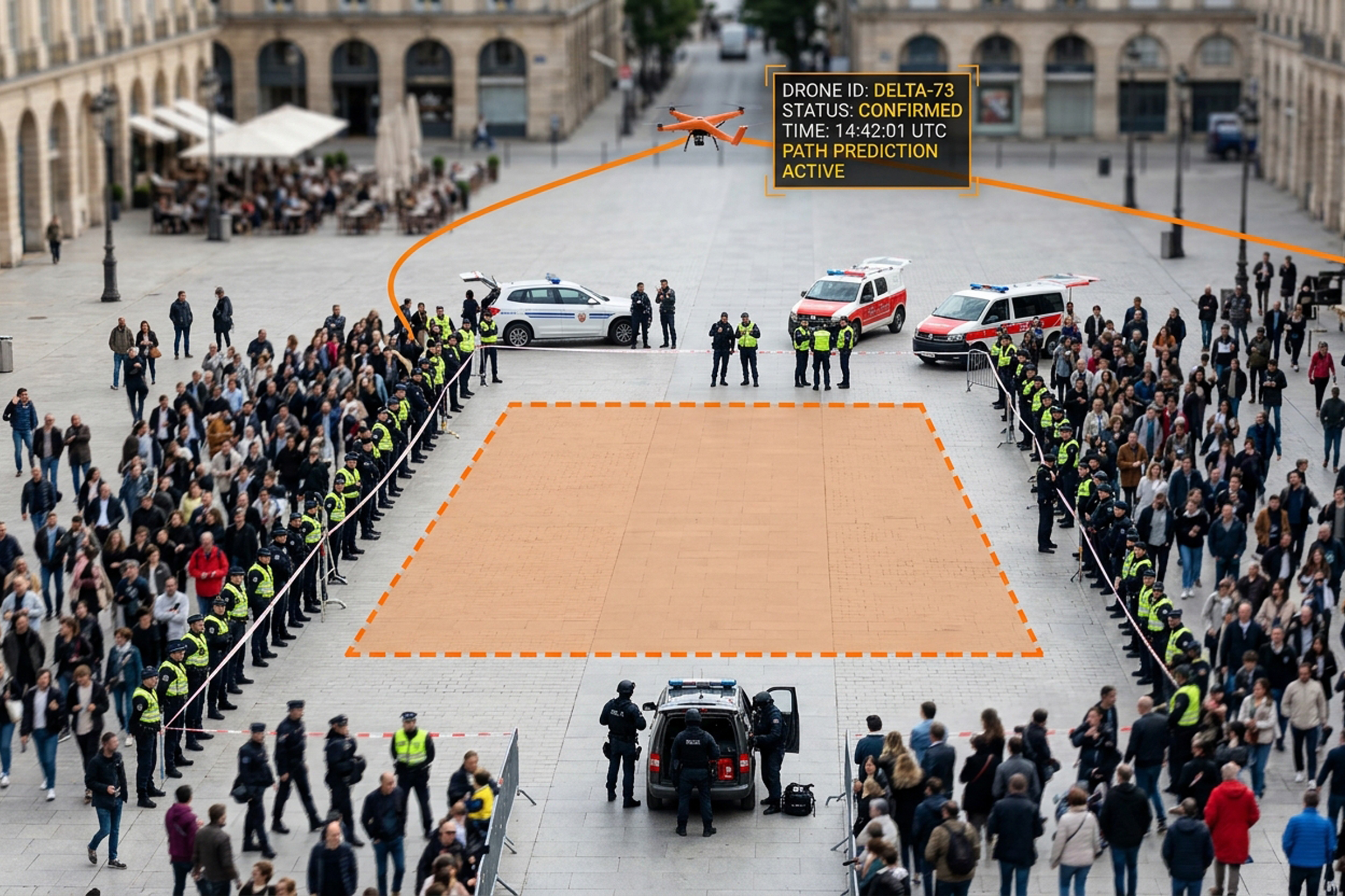
Once the drone is confirmed and tracked, the goal of the response changes. It is no longer simply to stop the aircraft. It is to stop it in a way that manages where it comes down. That means choosing the moment and the location, coordinating with ground teams to clear or cordon the area, and sequencing the response so that the aircraft is brought down over the least harmful spot available.
This is a coordination problem more than a hardware problem. The CCS command platform fuses the detection and confirmation feeds and shares them across everyone involved — the operator, the on-site security team, the civil authorities — so that the decision to act and the decision about where and when are made together. In a crowded environment, that shared picture is what separates a response that is controlled from one that is merely effective.
The DF Series and D5-B provide the early track and the precise position. The VAR300 provides the visual confirmation. The CCS platform provides the shared picture that lets the on-site team and the civil authorities clear the right zone at the right moment. When those pieces are connected, the response becomes a rehearsed sequence instead of a scramble. In a crowded place, that sequence — early detection, precise track, visual confirmation, shared decision, cleared zone — is the entire difference between protecting people and merely stopping a drone.
The difference between a controlled outcome and a bad one often comes down to a few minutes of coordination. Once the drone is tracked and confirmed, the operator’s job shifts to the ground: clearing or cordoning the area where the aircraft is most likely to come down, and sequencing the response so the aircraft is brought down over the least harmful spot available. This is not a sensor problem. It is a coordination problem, and it only works when the picture is shared in real time.
Clearing the Zone and Sequencing the Response
The Bottom Line
The Mecca event in September 2026 made a point that crowded-environment defenders have understood for years but rarely state plainly: stopping the drone is not the same as protecting the people. The two are related, but they are not the same, and the gap between them is where the real work of urban drone defense happens.
The system that protects a crowd is the one that sees the drone early, tracks it precisely, confirms it visually, and manages the response so that the question of where it comes down is answered before it is too late. That is a higher bar than simply finding and stopping an aircraft. But in a crowded sky, it is the only bar that matters.
Connect with us
Ready to Secure Your Low-Altitude Airspace?