From Contract to Capability in 80 Days: The Rise of Mobile Counter-Drone Deployment
Sep 29 2026
In mid-September 2026, DroneShield announced it had taken a counter-drone system from contract award to vehicle-mounted delivery, live-fire acceptance testing, operator training, and initial operational capability in about 80 days. A few days earlier, Leonardo and Marshall showed a containerized Falcon Shield that packs a full counter-drone stack into a standard ISO container and can be shipped by road, rail, or air. Taken together, the two announcements mark a shift that has been building for a while: counter-drone capability is becoming mobile, and mobile means fast.
The fixed site, the permanent mast, the poured foundation, all still have their place. But the threat moves, and the operators who defend against it increasingly need to move too. The question the September announcements answer is not whether mobile counter-drone works. It is how fast a customer can get from a decision to a working capability, and the answer is getting much shorter.
Why Mobility Won
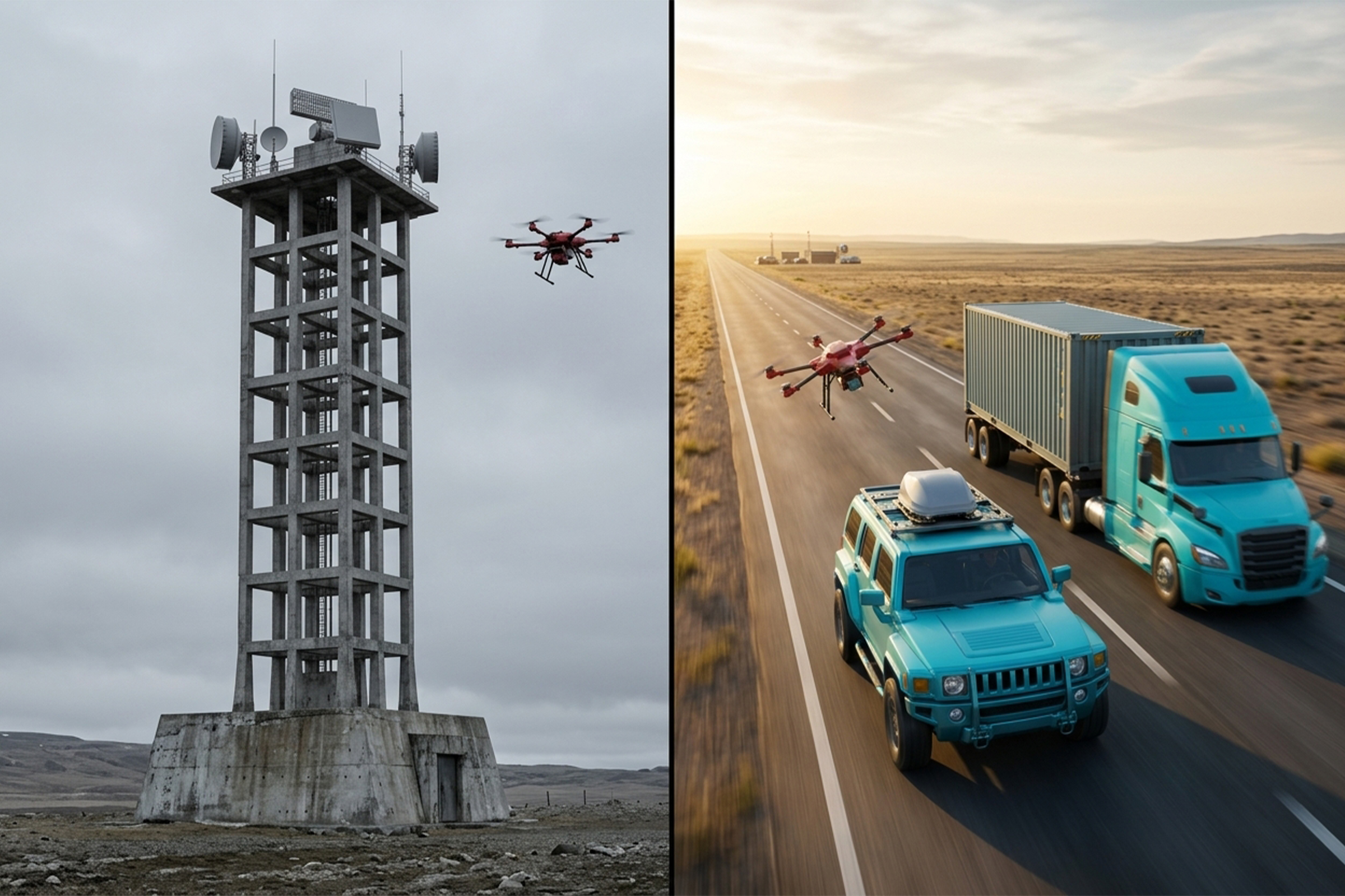
A fixed counter-drone site is a commitment to a specific place, and the drone threat has shown it will go where the defense is not. An event appears in a new city. A facility is threatened and needs coverage tomorrow, not next quarter. A border sector flares up and then goes quiet. In every case, the customer needs a capability that can be present quickly and moved when the situation changes.
Mobility answers that need directly. A vehicle-mounted system can drive to the location, set up in a fraction of the time a fixed site requires, and relocate when the threat does. A containerized system goes further: it can be flown, trucked, or shipped to a distant site and stood up in hours, bringing a complete detection and response stack in a single load. For the growing share of customers whose threat is temporary or shifting, the fixed site is no longer the default. It is one option among several.
The Vehicle-Mounted Platform
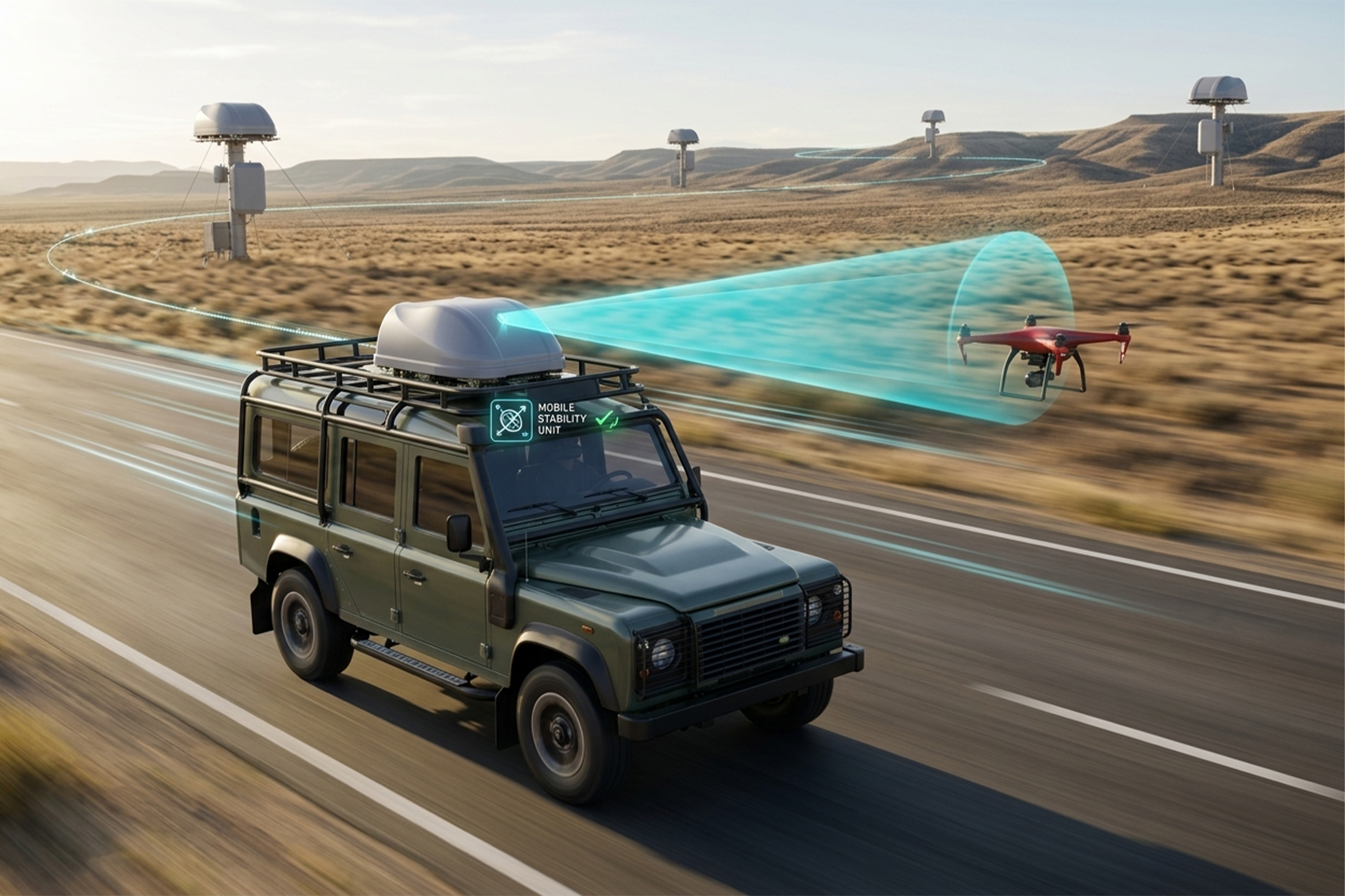
LZ TECH’s vehicle-mounted counter-drone platform, the VM, is built for exactly this use. It covers 30 MHz to 6 GHz for detection, with a detection range out to about three kilometers, and it is designed to operate on the move at speeds up to 80 kilometers per hour. The enclosure is IP66-rated, and the system is specified to operate from minus 40 to plus 60 degrees Celsius, which means it is not a fair-weather capability. It is meant to work while the vehicle moves, in the conditions the vehicle itself is expected to survive.
The point of a vehicle-mounted system is not that it does more than a fixed site. It is that it does the same job while moving, and it does it without the site. That changes where and when the defense can be present. A convoy, a visiting delegation, a temporary perimeter, a rapid deployment to a new location: all of these are cases where a fixed system cannot be there in time, and a vehicle-mounted system can be there already.
Detection on the Move
Detecting a drone from a moving vehicle is a harder problem than detecting it from a fixed mast, and it is worth being clear about why. A fixed sensor has a stable reference. A moving sensor has to separate the drone’s signal from its own motion, its own platform noise, and a changing electromagnetic environment as it travels. The fact that the VM is specified to operate at speed means the detection chain is built to hold its accuracy while the platform is in motion.
That capability pairs naturally with the DF Series of fixed and portable direction-finding sensors, which cover the same 30 MHz to 6 GHz band and detect a drone at up to eight kilometers with three degrees RMS accuracy. A mobile unit does not have to work alone. It can operate as the moving node in a wider network, handing off to fixed sensors when it arrives and extending their coverage when it moves. The architecture that emerges is neither fixed nor mobile. It is both, coordinated through a common command layer.
The Shared Picture That Moves With You
A mobile unit has a particular need that a fixed site does not. It is always somewhere new, often without the fixed infrastructure of a permanent facility. It has to be able to bring its picture with it and plug into the wider operation wherever it parks. The CCS command platform is the layer that makes this work, fusing the mobile unit’s feeds with fixed sensors and presenting a shared picture to the operators who need it.
This is where mobile capability becomes more than a single vehicle. A vehicle-mounted system connected to a shared platform is a moving node in a network. When it drives into an area with existing sensors, it joins them. When it drives somewhere uncovered, it extends coverage. The command layer is what turns a truck with a sensor into a deployable piece of a larger defense, and it is the difference between a mobile unit and a mobile system.
The LZ TECH VM is built to these demands. Its IP66 enclosure keeps out dust and water. Its operating range of minus 40 to plus 60 degrees Celsius means it does not stop being useful in extreme heat or cold. And its defined detection band and command interface mean it plugs into a wider network without a custom integration project. These are the specifications that decide whether a mobile system actually works in the field, and they are the ones a buyer should check first.
Mobility is not free. It places demands on the hardware that a fixed site can ignore, and the September announcements show what those demands are. The system has to survive movement, which means a sealed enclosure against dust and water and a tolerance for vibration. It has to work across a range of conditions, because a vehicle or a container ends up in places a fixed site never would. And it has to integrate fast, because the whole point of mobility is speed.
What Mobility Demands of the Hardware
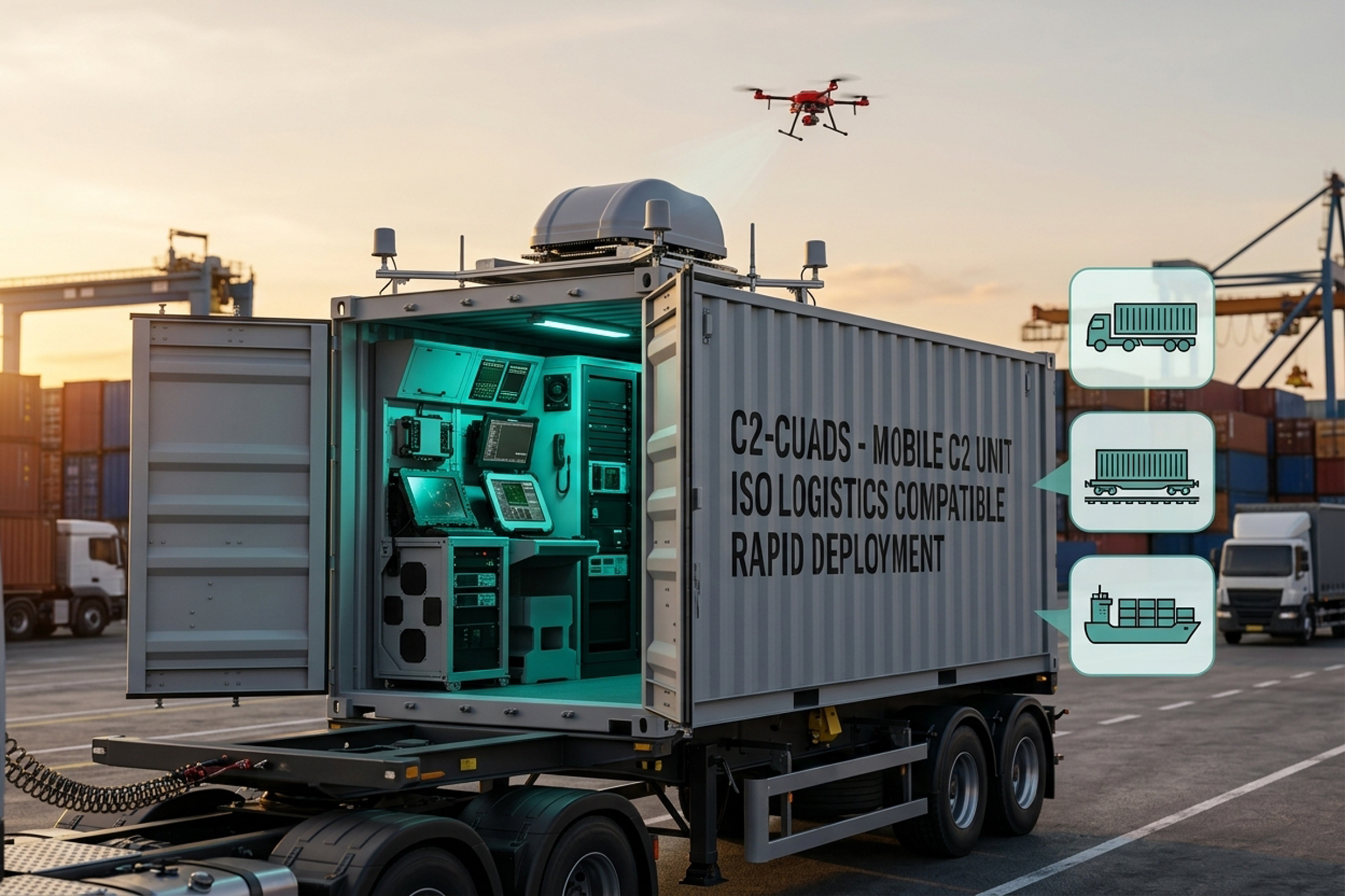
The advantage is not subtle. A container is already a solved problem in transport. It fits a truck bed, a rail car, and a ship’s hold without special handling. Packing a counter-drone stack into that form factor means the capability can be stood up anywhere the container can be delivered, without pouring a foundation or building a mast. For a base, a forward site, or a temporary event, that is the difference between a capability that arrives in days and one that arrives in months.
The containerized approach deserves its own mention, because it is a different answer to the same mobility problem. A vehicle-mounted system moves with a unit or a convoy. A containerized system moves the entire fixed site. The Leonardo Falcon Shield shown in September packs a command system and a surveillance and targeting capability into a standard ISO container, the kind that already moves through the global logistics system by truck, rail, and ship.
Containerized: Capability in a Standard Box
The 80-Day Standard
The DroneShield announcement is significant less for the system than for the timeline. About 80 days from contract to initial capability is a statement about what customers now expect. The days of a counter-drone project measured in years of integration are not over everywhere, but a clear alternative has emerged: a platform that can be mounted, accepted, trained on, and stood up in a single quarter.
That timeline favors vendors whose systems are productized rather than custom-built for each site. A vehicle platform with a defined detection band, a defined accuracy, a sealed enclosure, and a command interface can be delivered fast because the hard integration work has already been done. The VM, the DF Series, and the CCS platform are built this way, as products that fit together rather than as a custom integration that has to be invented for each customer. In a market that now measures delivery in weeks, that is the capability that wins.
What matters is that the pieces can share a picture. A fixed sensor, a vehicle-mounted unit, and a containerized stack should all be able to feed the same command platform, so that coverage is continuous whether the defense is standing still or moving. That interoperability is the thread that ties the mobile trend together, and it is the reason the command layer, not any single platform, is the part of the system that will matter most in the year ahead.
The rise of mobile deployment does not retire the fixed site. It gives the buyer a third option, and the sensible choice is usually a mix. A permanent facility with a known, persistent threat still warrants a fixed installation. A convoy, a delegation, or a shifting perimeter warrants a vehicle-mounted system that moves with the unit. A base, a forward site, or a temporary event that needs a complete stack in a short window warrants a containerized system. Most real deployments use more than one.
Choosing Between Fixed, Vehicle, and Container
The Bottom Line
The September announcements — a vehicle-mounted system delivered in 80 days and a containerized system shown in a standard box — are two faces of the same change. Counter-drone capability is no longer something you build into a place. It is something you bring to a place, fast, and move when the threat moves.
For a buyer, the implication is practical. When you evaluate a counter-drone system, ask not only what it detects and how accurately, but how long it takes to get it working where you need it, and whether it can move when you do. The fixed site will always have its role. But the systems that can show up in a quarter, on a vehicle or in a container, are the ones that match the way the threat actually behaves.
Connect with us
Ready to Secure Your Low-Altitude Airspace?