Counter-Drone Response Is Getting Narrower, and Compliance Is Why | LZ TECH
Nov 06 2026
On 29 October 2026, the United States Federal Communications Commission proposed opening the 24.45 to 24.65 gigahertz band to ground-based radar for finding and tracking unauthorised drones around airports, borders, prisons, stadiums and critical infrastructure. Read the proposal for what it signals, not just what it allows.
The regulator is making room for detection while keeping response under tight control. Detection is being given a lane. Response is not. That asymmetry is the most important fact in counter-drone procurement this year, and it is quietly rewriting the specification for the response half of the system.
Why Broad Response Is Losing the Argument
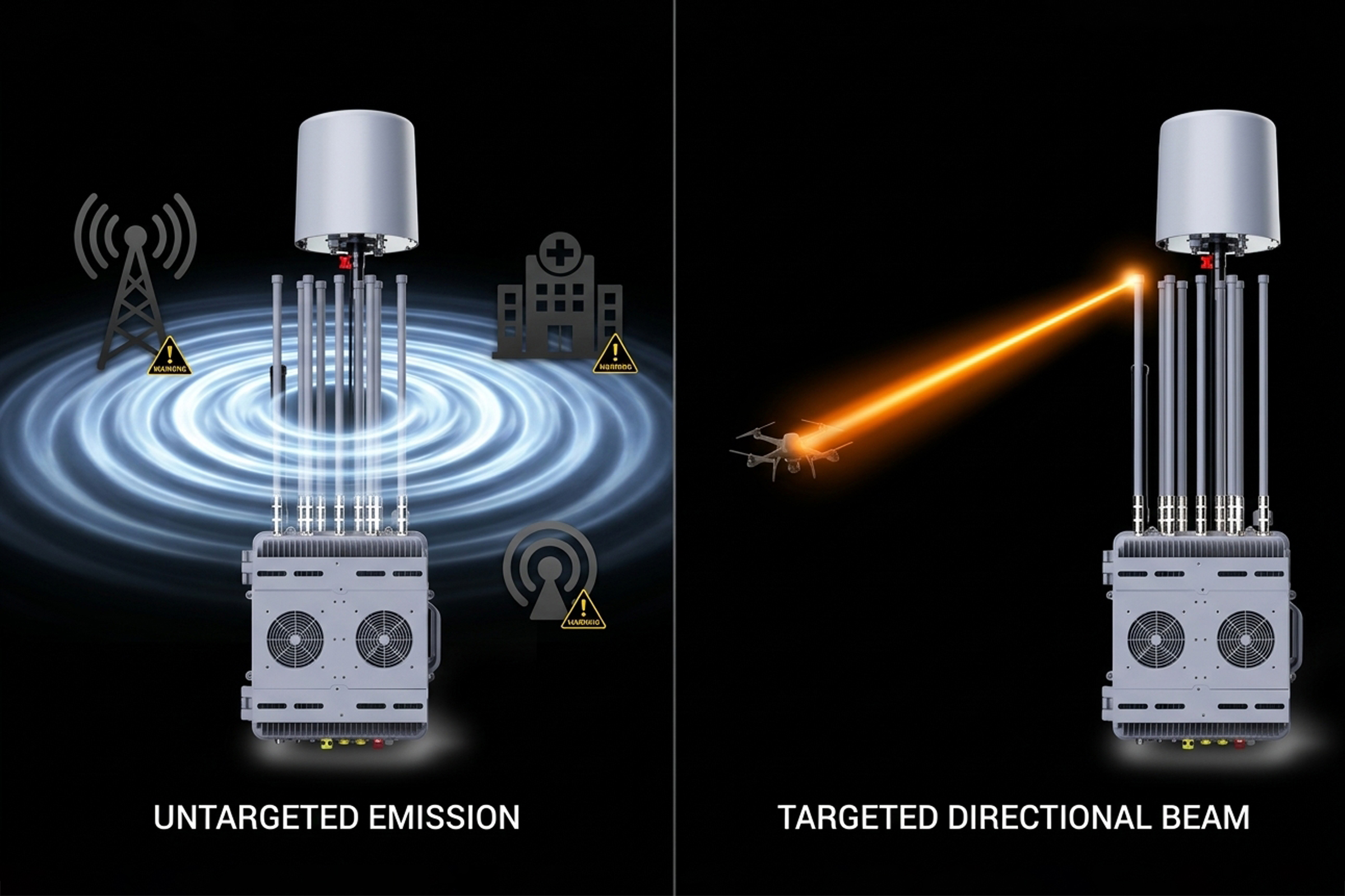
A counter-drone response that broadcasts in every direction at once was once the default, because it was simple. Aim nothing, fire everything, and let the target walk into the energy. It still works, and it still has a place where nothing else is available.
But a broad response has a bill attached, and the bill is getting harder to ignore. Energy that is not aimed at the aircraft is aimed at something else: a neighbouring cell tower, a hospital link, a navigation receiver, an air traffic channel. The wider the beam, the wider the collateral, and the wider the collateral, the harder the approval.
Regulators are not against response. They are against response that cannot say where its energy went. A system that can point its output and report what it did is a system that can be licensed. A system that fills a whole sector and records nothing is a system that will spend its life in a legal review.
The collateral is not abstract. A port sits next to a shipping channel whose radios run around the clock. A stadium sits under an approach path. A refinery shares a fence line with a hospital whose helicopter pad depends on a clean navigation signal. A broad response does not know about any of them, and that is the problem. It treats the whole sky as the target, when the site only has authority over a small patch of it.
The Three Steps from Broad to Precise
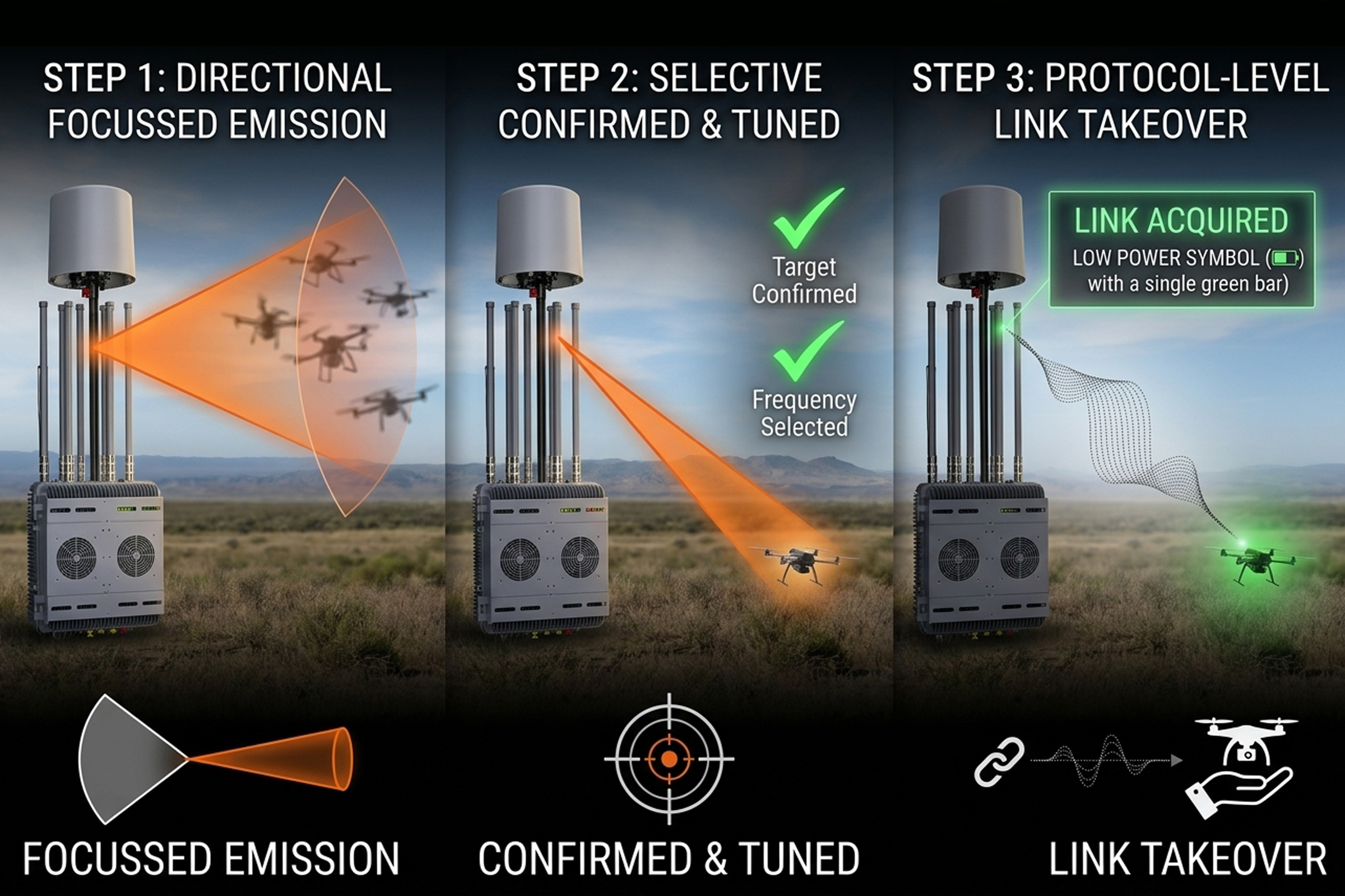
The response market is moving along three steps, and most sites sit on one of them already.
The first step is directional response. Instead of covering everything, the output is concentrated into a narrow beam and pointed only at the sector where a confirmed track sits. The energy that used to wash over the whole site now lands on a small patch of sky, and everything else stays quiet.
The second step is selective response. The response fires only when detection confirms a target, and only at the frequencies that target actually uses. A drone on a consumer link and a drone on a homemade link do not need the same answer, and a selective system does not give them one.
The third step is protocol-level response. For a defined set of supported links, the system does not overpower the aircraft at all. It works with the control channel itself, at low output, to interrupt or redirect a specific machine. This is the quietest form of response there is, and for an authorised deployment it is the one that raises the fewest questions.
What We Build for That Direction
The JV Series sits on the third step, built for non-standard links rather than the mainstream consumer protocols. It works against the TBS and ELRS links, and analogue FPV channels that a homemade machine tends to use, and it can place a warning directly into the video feed the operator is watching, which turns the response into a notice rather than an interruption. It works with detection, so it acts only after something has been confirmed, and it fits both a fixed mount and a vehicle.
Placing a warning into the feed deserves a moment, because it changes the nature of the event. An interruption is a confrontation the operator may not understand. A message that appears in their own goggles, in their own language, tells them they have been seen and that the site is watching. It de-escalates before anything physical has happened, and it leaves a record that a notice was given. For an authorised deployment, that is often the entire response the site needs.
The wider J family fills out the earlier steps. Directional units concentrate output into a narrow beam for portable and fixed use, and a selective fixed unit combines narrowband precision with broader coverage under a single control, choosing its response after the detection layer has named the target. None of this is specified by raw power. It is specified by where the energy goes, when it fires, and what it leaves untouched.
For every one of these, the operating rule is the same: authorised deployments, in line with local law, with a record of what happened. A response that cannot say what it did is a liability, not a capability.
The Graded Response That Compliance Expects
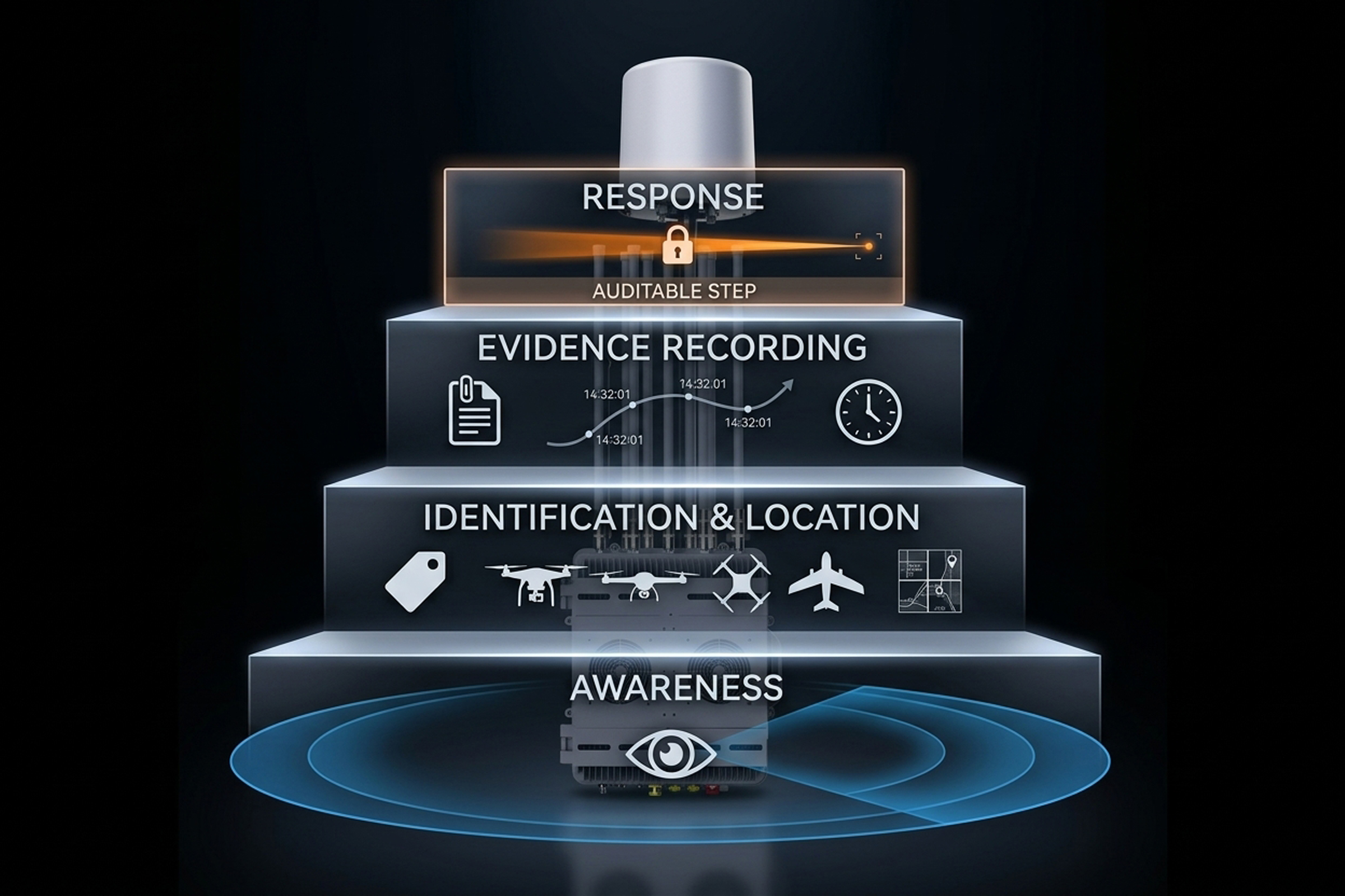
The spectrum regulator is only one of the authorities a site answers to. The others, aviation, privacy, local policing — all expect the same shape, and it is a ladder, not a switch.
The first rung is awareness: the system sees an aircraft and tells someone. The second is identification: it names the model and the position. The third is evidence: it records the track, the timing, and the classification so the event can be reconstructed later. The fourth is response, and it sits last on purpose. A site that cannot do the first three convincingly has no business pulling the fourth lever, because the fourth is the only rung that can be audited against a licence.
The order matters because the first three rungs answer a question before anyone asks it. An incident review does not ask whether the site could have responded. It asks whether the site knew, whether it could say what it saw, and whether it has a record of the moment. A site that has the first three can explain itself afterwards. A site that jumped straight to response has to explain why it acted on a track it cannot now reconstruct.
Most of the value a counter-drone system delivers lives on the first three rungs. The response exists to close the loop when nothing else will, and the more precise it is, the less the site has to justify it.
What a Tender Should Ask
A buyer who wants a defensible response layer should ask four questions and ignore every number that does not answer them.
Where does the energy go? When does the system fire, and what confirmation is required first? What does it leave untouched: the adjacent bands, the neighbours, the navigation receivers. And what record does it keep of its own actions, in a format a regulator can read?
The last one is the one suppliers dodge, because it is not a performance figure and it cannot be put on a slide. A proper record is not a log line saying the system acted. It is a timestamped account of the track, the confirmation, the frequency, the direction, the duration, and the result, exportable to a machine that is not the vendor’s. A supplier who can answer those four is a supplier whose response will survive a review. A supplier who can only quote reach and power is selling a problem dressed as a spec sheet.
Where LZ TECH Fits
We build the response layer on the narrow side of the market, on purpose. The JV Series and the wider J family are selective and directional rather than broad, because that is the direction the regulators are pointing and the direction the sites are asking for.
We also build the detection layer that sits in front of them, because a precise response is only as good as the confirmation that triggers it. A narrow beam with a wrong target is worse than a broad beam with no target at all.
The Bottom Line
The counter-drone response of the future is not louder. It is narrower, more selective, and better documented, because that is the only kind a site can get approved and defend afterwards.
The spectrum proposal is the tell. Detection is being given room to grow, and response is being asked to show its work. Build for the second of those, and the first takes care of itself.
Connect with us
Ready to Secure Your Low-Altitude Airspace?