Airport Drone Disruption: Why Fast Recovery Is the Real Metric
Sep 24 2026
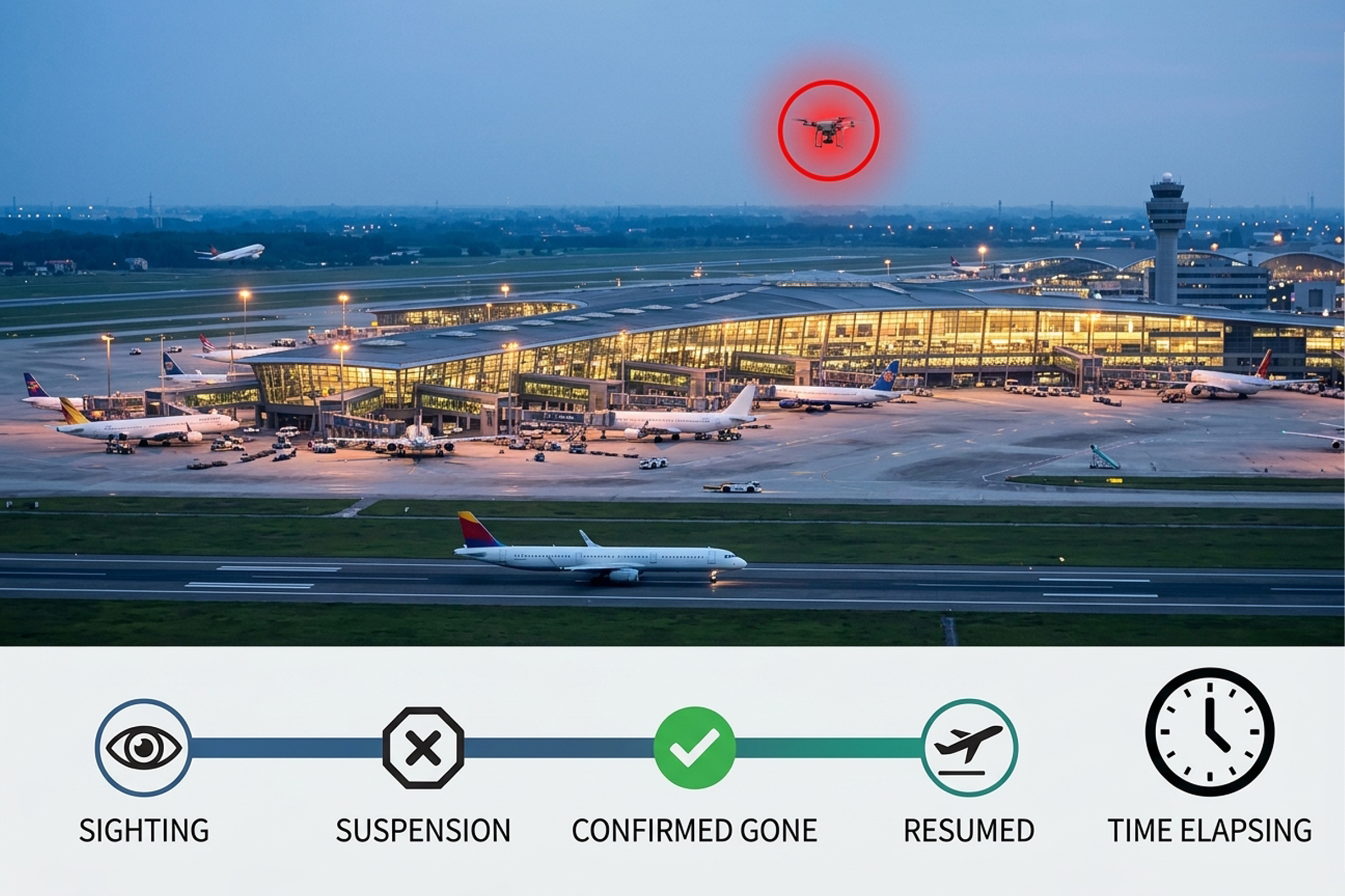
On the evening of September 11, 2026, Brussels Airport received a drone sighting report and paused runway traffic. It reopened roughly thirty minutes after the last sighting. The next evening, a sighting in the same area disrupted air traffic again. Public information confirmed no aircraft model, no operator, and no statement on whether any countermeasure was taken. What it confirmed, clearly, was the sequence: detect, pause, wait, reopen.
That sequence is the reality of airport drone defense, and it points to a metric that rarely appears on a datasheet. The question an airport actually lives with is not how far a sensor can see. It is how fast the operation can return to normal after a drone is spotted, without closing more than it must, and without letting a genuine threat through.
Why Airports Cannot Afford a Long Pause
Every minute a runway is closed is a chain of diverted flights, missed connections, and stranded passengers, and the cost compounds fast. An airport does not have the luxury of shutting down and waiting out a drone the way a less time-sensitive site might. It has to reopen the moment it is safe to do so, and it has to be able to justify that decision.
That puts a particular weight on the detection layer. The operator needs to know, quickly and reliably, whether the drone is still there, where it went, and whether it is gone for good. A system that can answer those questions in seconds lets the airport resume operations with confidence. A system that leaves the question open forces the airport to keep the runway closed, at a cost that grows every minute.
The Detection Layer: Seeing the Drone and Its Operator
The first requirement is to see the drone while it is still in the air, and to keep seeing it until the situation is resolved. The DF Series of direction-finding sensors reads a drone’s radio signals passively across 30 MHz to 6 GHz, detecting a drone at up to eight kilometers with direction-finding accuracy of three degrees RMS. It works whether the drone is in line of sight or hidden behind terminal structures, because it is reading the signal, not the aircraft.
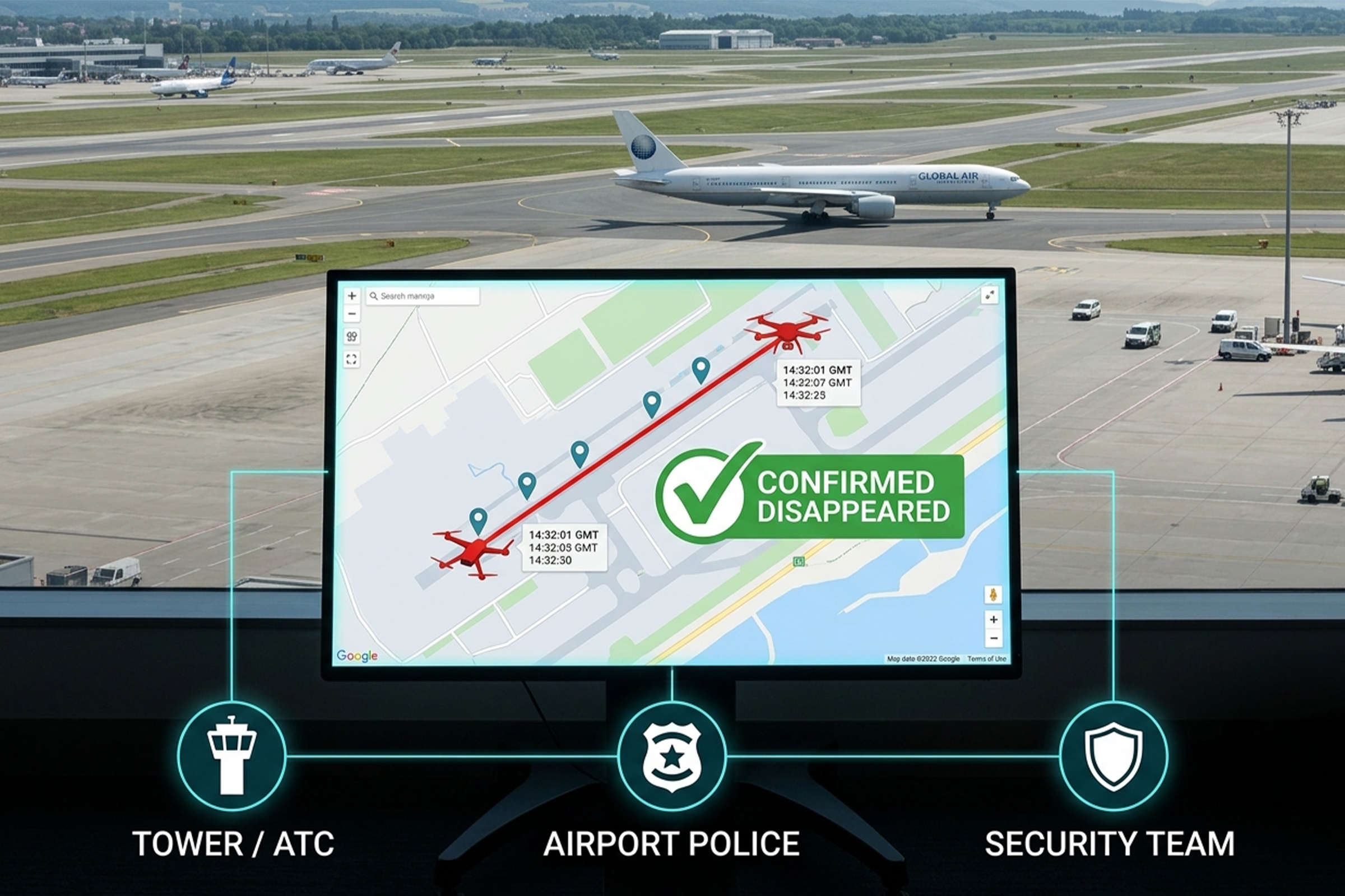
Equally important is the operator. A drone that is turned away leaves an operator who can fly again in minutes. The same bearings that place the drone point back toward the controller, because the operator’s radio link is part of the same signal exchange. As the drone moves and the operator stays put, the bearings converge on the launch point. That is the lead the airport hands to the police, and it is what turns a thirty-minute disruption into an investigation that can prevent the next one.
Confirmation That Closes the Loop
An airport cannot close a runway on a radio contact alone, and it cannot reopen it on a guess. Somewhere in between, it needs visual confirmation. The VAR300 electro-optical and infrared tracker takes the bearing from the RF layer and locks onto the aircraft visually, giving the operator a picture of what they are actually dealing with, in daylight and at night.
Confirmation serves both halves of the decision. When the drone appears, the visual confirms it is real, so the pause is justified. When the drone departs, the visual confirms it is gone, so the runway can reopen. Without that second confirmation, the airport is left reopening on a judgment call, which is how a thirty-minute pause becomes a much longer one. The optical layer is what lets the airport close fast and reopen faster.
The Shared Picture That Speeds the Whole Sequence
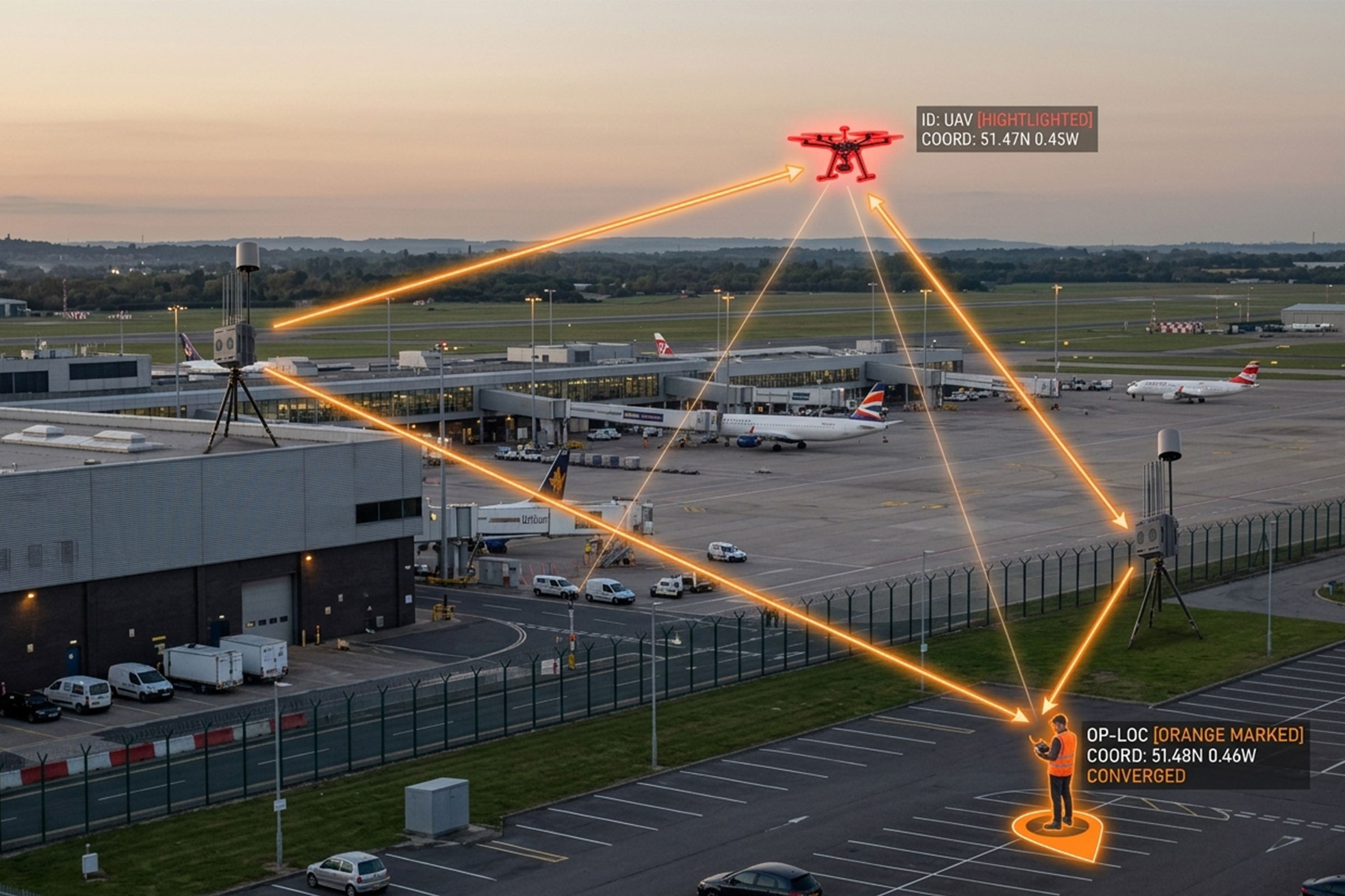
An airport drone event involves more than the control tower. Airport police, the operator’s security team, and sometimes the national aviation authority all need to know the same thing at the same time. The CCS command platform fuses the detection and confirmation feeds into one picture and shares it across the people who need it, so the decision to pause and the decision to reopen are made on the same information by everyone involved.
That shared picture is what turns a scattered response into a fast one. When the tower, the police, and the security team all see the same track, the same position, and the same confirmation, the coordination happens in seconds instead of phone calls. For an airport, where the whole point is to keep the closure as short as possible, that coordination is the difference between a thirty-minute disruption and a much longer one.
Building for Fast Recovery
The metric that matters, fast recovery, is not bought with a single sensor. It is the product of a sequence. Detection sees the drone and its operator while the drone is still out. Confirmation verifies it is real, then verifies it is gone. The shared picture keeps every decision-maker aligned. Each layer shortens a different part of the pause, and together they shrink it to the minimum the situation allows.
The Brussels events are the template, not the anomaly. A drone sighting, a pause, a reopening, all in under an hour. The airports that do this well are not the ones with the most powerful countermeasures. They are the ones with the fastest, clearest detection and confirmation, because that is what decides whether a drone costs them thirty minutes or an afternoon.
The Brussels events, with their unreported model and operator, are a reminder of how thin the public record can be. The airports that invest in a detection stack that logs everything are the ones that can answer the question afterward, to the regulator, to the airline, and to themselves. Fast recovery and a complete record are the same capability, seen from two sides.
A drone disruption does not end when the runway reopens. There is a report to file, an investigation to run, and often a regulatory follow-up. The airport has to be able to show what happened, and that means the detection stack has to produce a record, not just an alert. A passive RF track with timestamps and bearings, a visual confirmation with a time code, and the operator location derived from the same signal: together they are the evidence that turns an operational pause into an answered question.
The same passive bearings that place the drone point back toward the controller, because the operator’s radio link is part of the signal exchange the sensor reads. As the drone moves and the operator stays put, the bearings converge on the launch point. That convergence is the lead the airport hands to the police, and it is what changes the situation from a recurring disruption to an investigation with an endpoint. An airport that only stops the drone is playing defense forever. One that locates the operator starts reducing the number of times it has to play.
There is a part of the airport response that gets less attention than the drone itself, and it is often the part that matters most. Stopping a drone ends the flight. Finding the operator ends the problem. A drone that is turned away leaves a person who can fly again in minutes, from a new spot, with a new aircraft. The durable outcome is to reach the operator while the drone is still in the air.
This reframing changes what airports buy. A longer detection range is valuable, but only if it buys earlier warning that leads to a faster, safer decision. A more powerful countermeasure is valuable, but only if it is part of a sequence that ends with the runway open again. The September events at Brussels, with their thirty-minute pause and their unanswered questions about model and operator, are a case study in why the metric is recovery time and not raw capability.
The airport’s counter-drone investment is ultimately a bet on minimizing the pause, and that bet should shape every design choice. A detection layer that takes minutes to confirm a contact is a layer that adds minutes to the pause. A shared picture that requires a phone call between agencies is a picture that adds phone calls to the pause. The whole stack, from the wide passive watch to the final confirmation, should be judged by one question: does it make the pause shorter?
Designing the Response Around the Pause
The Operator, Not Just the Drone
Evidence for the Investigation That Follows
A system that is slow to confirm either direction is a system that turns a thirty-minute disruption into an afternoon. The airport is not choosing between seeing the drone and not seeing it. It is choosing how long the sky stays a question mark, and every layer of the detection stack, the wide passive watch, the operator location, the visual confirmation, the shared picture, exists to shrink that window.
The reason fast recovery is the metric is that the cost of the open question is enormous. While a drone sighting is unresolved, the airport is paying for every minute in diverted flights and stranded passengers, and it is paying in a currency that does not come back. The goal of the detection and confirmation stack is to close that question as fast as possible, in both directions: confirm the threat is real, so the pause is justified, and confirm it is gone, so the pause can end.
The Cost of the Open Question
The Bottom Line
Airport drone defense is usually discussed in terms of detection range and countermeasure power. The September events at Brussels suggest a different emphasis. The airport’s real problem is not finding the most decisive way to stop a drone. It is finding the fastest way to prove, to everyone who needs to know, that the sky is clear again.
Detection that sees the drone and its operator, confirmation that closes the loop in both directions, and a shared picture that keeps the whole team aligned. That is what turns a drone sighting from a crisis into a measured, brief pause. For an airport, that is the whole game.
Connect with us
Ready to Secure Your Low-Altitude Airspace?