C-UAS Integration: How to Build a Multi-Sensor Drone Defense System
Jul 02 2026
Introduction
If you have spent any time evaluating counter-drone systems, you have noticed something: every vendor has a product that does part of the job well. One vendor sells radar. Another sells RF detection. A third has the best cameras. A fourth built the jamming hardware. Nobody seems to have built the whole thing.
That is not a coincidence. Counter-drone defense is genuinely multi-technology by nature. No single sensor type covers all the threat scenarios you are likely to face. The integration problem is not a vendor failing. It is the fundamental challenge of the space.
This article is about solving that integration problem. Not by buying everything from one vendor, though that is one option. By understanding what integration actually means, what the architecture components are, and how to make the pieces work together in a way that gives you a functioning system instead of a collection of expensive components.
The limits of single-sensor counter-drone
Before we talk about integration, it is worth being clear about why you need it. Each counter-drone technology has documented blind spots.
RF detection misses autonomous drones that do not transmit, modified drones running on frequencies outside your monitoring bands, and DIY builds using custom protocols. If your detection layer is RF-only and someone flies a pre-programmed autonomous UAV over your site, you see nothing.
Radar sees moving objects but struggles to classify them. Is it a bird, a plastic bag, or a drone? Without a second sensor, you are guessing. In high-clutter environments, the track density can overwhelm operators.
EO/IR cameras need to know where to look. Point a camera at empty sky and you have a very expensive security camera. Cameras are powerful confirmation tools, but as primary detection they require either very high coverage density or external cueing from radar or RF.
No single technology gives you detection, classification, tracking, identification, and response confirmation. That is why multi-sensor architectures exist.
Multi-sensor fusion architecture
The detection-to-response chain
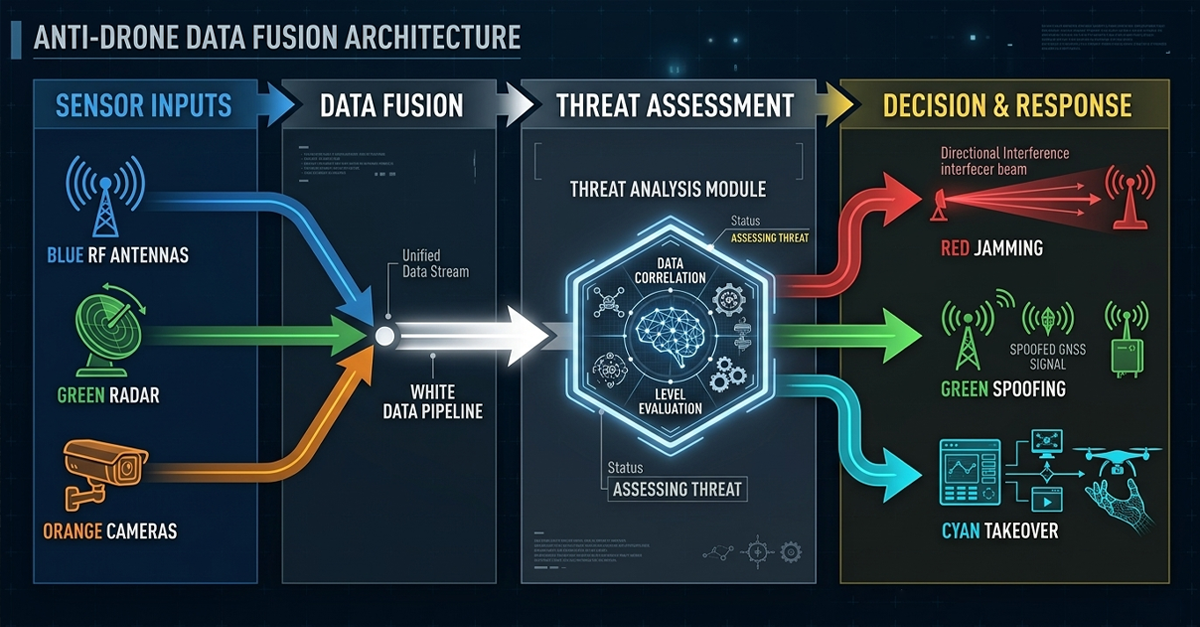
Every multi-sensor counter-drone system follows the same functional chain: sensor input, data fusion, threat assessment, decision, and response. The sensors see different things. The fusion layer combines what they see. The threat assessment layer decides what it means. The decision layer determines the response. The response layer executes.
The critical word is fusion. Raw data from multiple sensors is not integration. Integration means the system combines sensor data to produce a single coherent picture of the airspace. That picture should show the same object detected by multiple sensors as one track, not as three separate tracks that an operator has to correlate manually.
Data fusion is what separates a real multi-sensor system from a collection of sensors feeding separate displays. The former scales to handling multiple simultaneous incursions. The latter does not.
LZ TECH Multi-tech Fusion Detection Solution
LZ TECH’s Multi-tech Fusion Detection Solution combines radar, EO/IR, and RF in a single detection system. The stated RF detection range is up to 10 kilometers. The system handles active EO/IR searching and tracking alongside radar detection, with all sensor data processed through a unified C2 layer.
The API interface is worth noting for organizations with existing security infrastructure. An open API means the LZ TECH fusion system can feed data into a broader security operations center rather than operating as a standalone system. Whether that matters depends on how your security operations are structured.
The deployment model is flexible. LZ TECH offers both fully integrated configurations where everything comes from one vendor, and modular configurations where their detection system integrates with existing sensors or response hardware from other vendors.
Multi-tech Fusion Interception Defense System
The Interception Defense System adds the response layer to the detection architecture. Radar, EO/IR, and C2 feed into an FPV interceptor capability. The idea: when a drone is detected and classified, the system can deploy an interceptor drone to physically intercept the threat rather than relying solely on electronic countermeasures.
The multi-platform deployment options cover fixed, portable, and vehicle-mounted configurations. The environmental adaptability specifications are relevant for sites in extreme climates. We have seen systems specified for controlled indoor conditions fail in field environments within months. Temperature range and ingress protection ratings should match your actual deployment conditions, not ideal laboratory conditions.
Command and control: the brain of C-UAS
What C2 software actually does
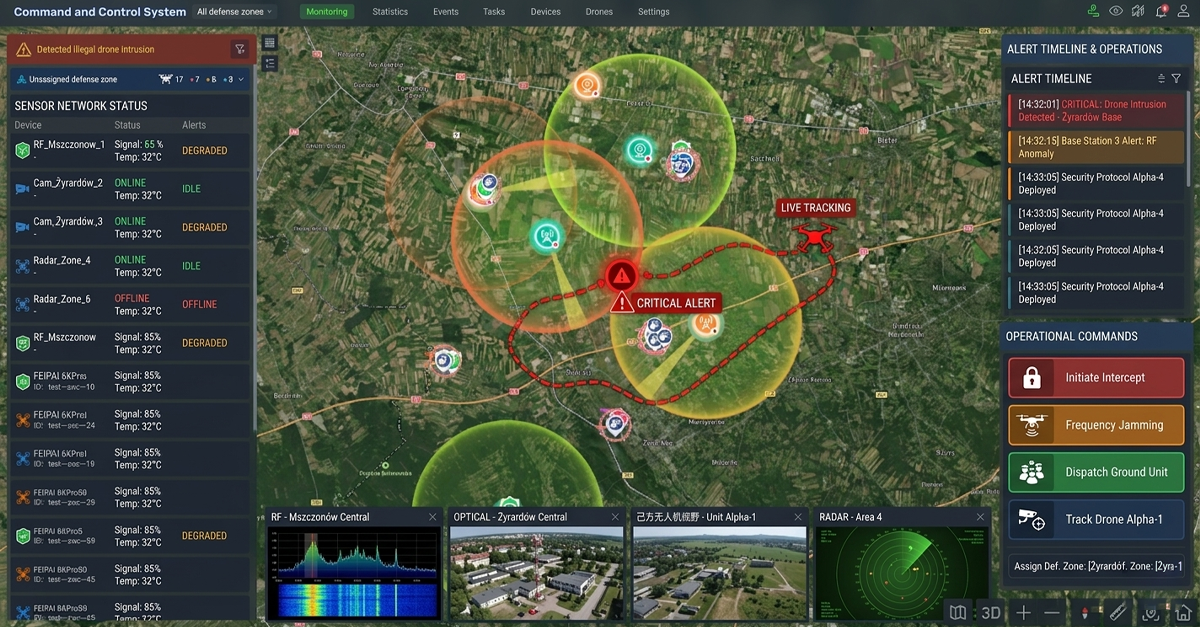
C2 software is the layer that nobody talks about enough until it fails. It collects data from all sensors, processes and displays that data in a way that operators can use, manages alarm workflows, supports decision-making, and coordinates response devices.
In a single-sensor system, C2 is relatively simple. One sensor, one display, one response option. In a multi-sensor system with multiple response modalities, C2 becomes the critical enabling technology. If the C2 cannot handle the data volume and present it coherently, the sensor investment is largely wasted.
The specific C2 capabilities that matter in practice: real-time alarm management, data fusion across multiple sensor types, historical playback for incident review, and flexible workflow configuration for different threat scenarios.
LZ TECH CCS platform
The CCS platform is LZ TECH’s C2 offering. The core interface provides a unified command view across all connected sensors. The GIS panoramic display overlays real-time drone trajectory data on a geographic map, which is more useful than a two-dimensional radar-style display for operators who need to understand spatial relationships at a site.
Cross-region monitoring capability supports multi-site operations where a central security team oversees several locations. Smart alarm workflows let operators configure automated responses for different threat levels, which matters when multiple incursions happen simultaneously.
Cloud and local deployment options cover the range from organizations that want minimal on-premise infrastructure to those with data residency requirements or air-gapped networks. Mission replay and data logging support post-incident analysis and regulatory reporting.
Permission configuration is relevant for larger organizations where different operator roles need different access levels. A guard on patrol does not need the same system access as a site security director.
Data interoperability and open standards
One of the persistent problems in counter-drone defense is vendor lock-in. Buy a sensor system from one vendor and you often cannot easily integrate response hardware from another. The C2 software may only talk to sensors from the same vendor. Over time, you end up with a system architecture determined by what one vendor happened to sell you.
The SAPIENT standard, developed in the UK for autonomous sensor integration, is one attempt to address this. Open API interfaces like the one LZ TECH builds into CCS are another. Sensor-agnostic C2 design means you can swap individual sensors without replacing the entire system.
If you are evaluating counter-drone vendors, ask specifically about API support and sensor interoperability. The answer tells you a lot about whether the vendor is building a platform or just selling products.
Deployment models by site type
Fixed-site deployment is the most common configuration. Airports, prisons, power plants, government facilities, stadiums. These sites have defined perimeters, relatively stable threat profiles, and usually a security operations center with operators on shift. A typical configuration: RF detection at the perimeter, radar for wide-area coverage, EO/IR for confirmation, and jamming or interception for response. C2 in the operations center.
Vehicle-mounted deployment serves mobile protection scenarios. Convoy protection, VIP transport routes, border patrol, temporary event security. The vehicle-mounted system trades raw detection range for mobility. The vehicle becomes the moving protection bubble.
Portable and handheld deployment is the tactical end of the spectrum. Single officers, rapid response teams, event security patrols. A handheld jammer and detector combination is lightweight enough to carry but limited in range and duration compared to vehicle-mounted or fixed configurations.
Air-ground coordination represents the more sophisticated end of deployment models. Airborne detection assets feed data to ground-based C2, extending coverage beyond what ground sensors can achieve. LZ TECH’s D5-Air is positioned for this role.
What real deployments look like
Airport perimeter: DF Series direction finding at the fence line, D5-B TDOA positioning for precise location, VAR300 for active EO/IR scanning, VM vehicle-mounted system for patrol coverage, and H3 Pro handheld units for rapid response officers. The C2 layer coordinates all of it and feeds the airport security operations center.
Critical infrastructure: DFJ stationary jammer at the perimeter, DF direction finding for incoming threat bearing, and TR100 for integrated radar and EO/IR coverage of the inner zone. This is a layered defense model within a single site.
Large event security: portable HD5 system for rapid deployment, H3 Pro for patrol teams, HDJ 3.0 handheld jammer as the response tool. This configuration can be set up and torn down quickly, which matters for events that last days rather than years.
Border security: DF Series TDOA networking extends coverage across a linear border area, with VM vehicle-mounted units providing mobile response capability along the route.
What integration actually costs
Here is the part vendors do not put in their brochures. Integration costs money and time. Buying a fully integrated system from one vendor is the expensive option upfront but the cheaper option over three to five years when you count the engineering hours saved.
Buying best-of-breed components and integrating them yourself is cheaper at purchase but demands engineering resources you may not have. We have seen organizations buy what looked like excellent components and spend a year trying to make them work together.
The middle path is modular systems from a vendor that builds for interoperability. You buy the sensor fusion layer and response hardware from one source but retain the ability to swap individual sensors.
For most organizations evaluating counter-drone defense, the recommendation is the same: start with the threat model, work backward to the sensor requirements, and then evaluate whether the integration overhead of your chosen configuration is realistic for your organization. A simpler system that works is better than a sophisticated system that never gets fully integrated.
Connect with us
Ready to Secure Your Low-Altitude Airspace?