Counter-Drone Architecture: One Box or Two? | LZ TECH
Nov 05 2026
On 29 October 2026, Sentrycs put a single fixed price on a portable counter-drone package that discovers, tracks, identifies, and responds from one unit, offered to state and local enforcement agencies with three years of maintenance included. The announcement matters less for the number than for the shape. Detection and response in one enclosure is now a product category a buyer can tick on a form, and the buyer now has to decide whether that shape fits the site.
The question is not which vendor builds a better box. It is whether one box or two matches the physical nature of the response you are authorised to use, and the geometry of the place you have to protect. Get that right, and the specification almost writes itself.
The question has become urgent because the procurement itself has changed shape. A buyer who once bought a single detector to cover a single fence now buys a system that has to detect across a whole estate, respond in a few places, and report into a command picture that another department runs. The architecture is the first decision that locks in or rules out every decision after it. Choose wrong, and the buyer is not buying a worse product; they are buying a rework, and rework on a mast is the most expensive kind there is.
Why Combined Systems Sell
The combined unit wins on three counts, and all three are real.
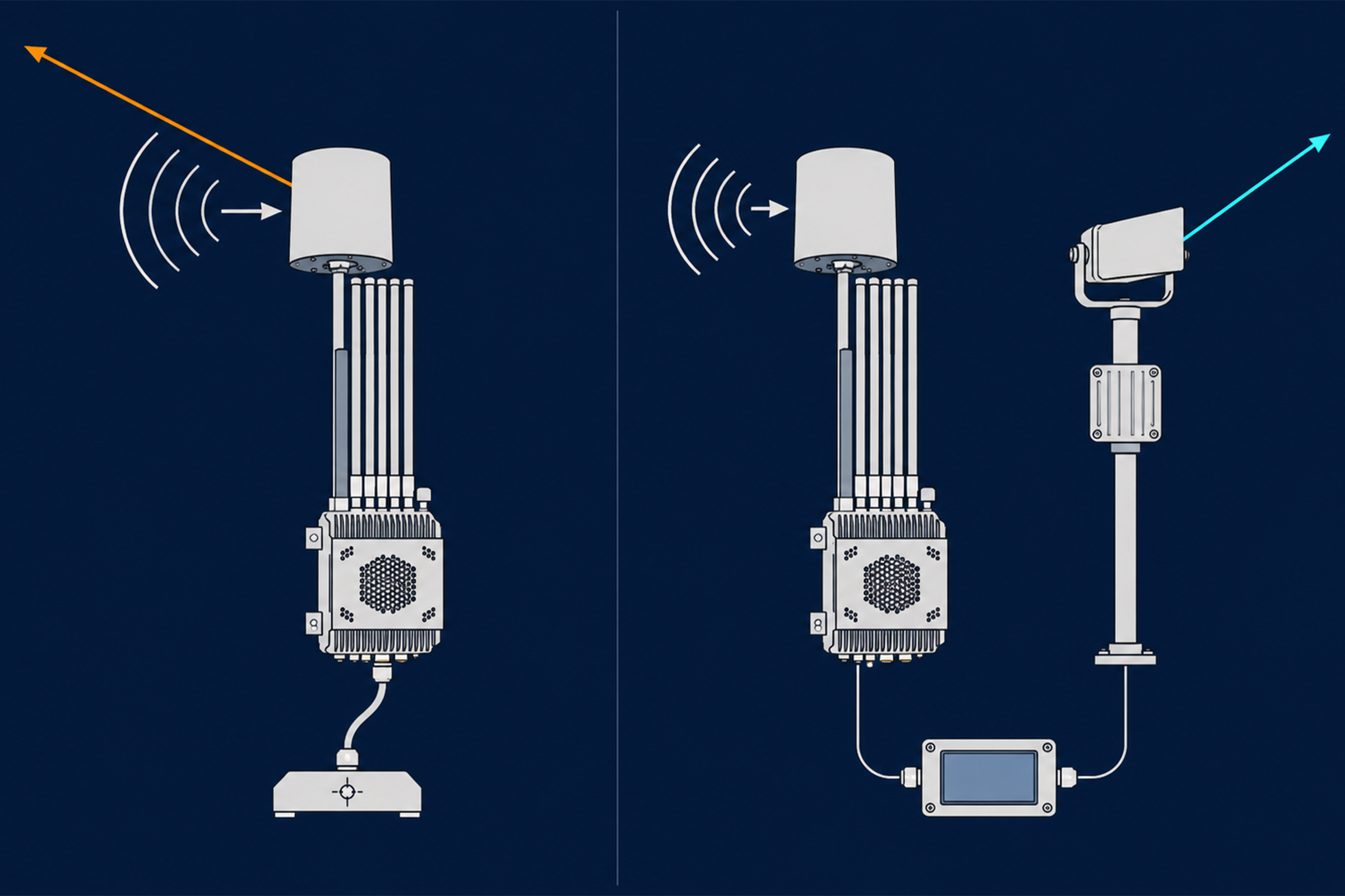
Deployment is the first. One mast, one power feed, one commissioning visit, one set of drawings. A site with a single risk point and a fixed perimeter wants exactly that. There is less to mount, less to align, less to maintain, and less to explain to the finance office.
Latency is the second. When detection and response share a chassis and a controller, the handoff from confirmed track to countermeasure does not cross a network or a third-party integration. It happens inside one box, in a time an operator never has to think about.
Inventory is the third. One spare part line, one training module, one firmware stream. For a buyer who will run the system with a small team, that is a genuine saving in operating cost, not just capital cost.
What the Response Is Made Of
The architecture question turns on something quieter: what kind of response are you actually using.
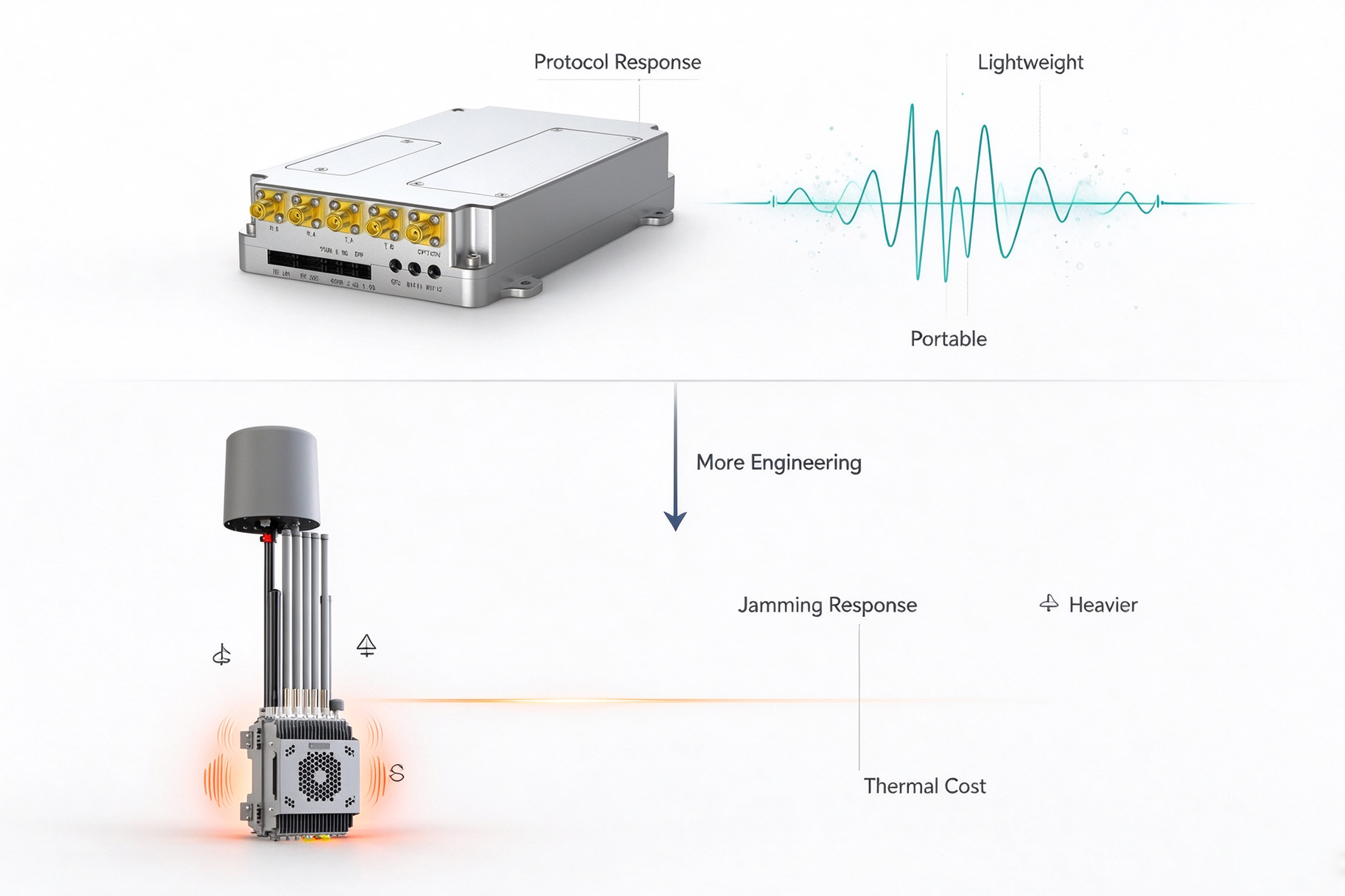
A response that works through the radio link itself, by understanding the protocol an aircraft uses rather than overpowering it, is light. It needs little transmit capability, no large amplifier, no heavy thermal design. That is why a protocol-based response can travel in a portable package the size of a small case, and why a vendor can sell it at a fixed price with the detection built in.
A response that works by overpowering the control or navigation link is different. It needs transmit capability, cooling, and shielding, and those add weight, volume, and heat to whatever enclosure they share with the detection electronics. That is the trade a combined system makes. The detection half is a sensitive receiver that wants a quiet, stable environment. The response half is a transmitter that wants the opposite. Putting them in one box is an engineering decision, not a marketing one, and it has to be paid for somewhere.
Where a Combined System Earns Its Keep
A fixed site with a defined perimeter and a standing requirement is where the combined form makes the most sense, and it is the form we build the DFJ Series for.
DFJ53 is a fixed unit that detects, finds direction, locates, and responds from one enclosure. Its detection half covers 30 MHz to 6 GHz, holds more than 35 aircraft at once, and finds direction to roughly 3 degrees against a hovering target. DFJ83 extends the same idea for a wider perimeter, with detection across 30 MHz to 6 GHz out to a reference eight kilometres and the same direction-finding grade. In both, the response half is built for selectivity rather than raw output, concentrated into a narrow beam and triggered only after a track is confirmed, for authorised deployments in line with local law.
Both are sealed enclosures built for outdoor life, with a footprint measured in tens of centimetres and a weight a two-person team can handle on a mast. They are fixed assets, which is the point. A combined unit earns its place where the requirement is permanent, because the trade it makes, receiver and transmitter in one chassis, is worth paying only when the box stays put for years.
Notice what is written and what is not. The detection numbers are published. The response numbers are not, because a jamming figure quoted without the target, the link, the environment and the legal context describes a configuration the buyer does not have.
Why Split It
The split form, detection on one set of hardware and response on another, is not an inferior version of the combined form. It is the right answer for a different set of sites, and it has three advantages.
Independent upgrade is the first. Detection improves every year, as protocol libraries grow and classification gets better. Response improves on a different clock, driven by spectrum rules and authorisation. When they share a box, you upgrade neither cleanly. When they are separate, you can replace the detection every two years and leave the response untouched, or the reverse.
Selective response is the second. A separate response layer can be added only where the site needs it, pointed only at the sector that matters, and left dark everywhere else. That matters for a site that sits next to an airport, a hospital or a broadcast tower, where a broad response is a problem rather than a solution.
Cleaner authorisation is the third. A passive detection layer can be deployed today, while the legal review of a response capability is still open. Split architecture lets the site buy the seeing now and add the responding after the paperwork, instead of delaying both until the last approval arrives.
Choosing by Site, Not by Sheet
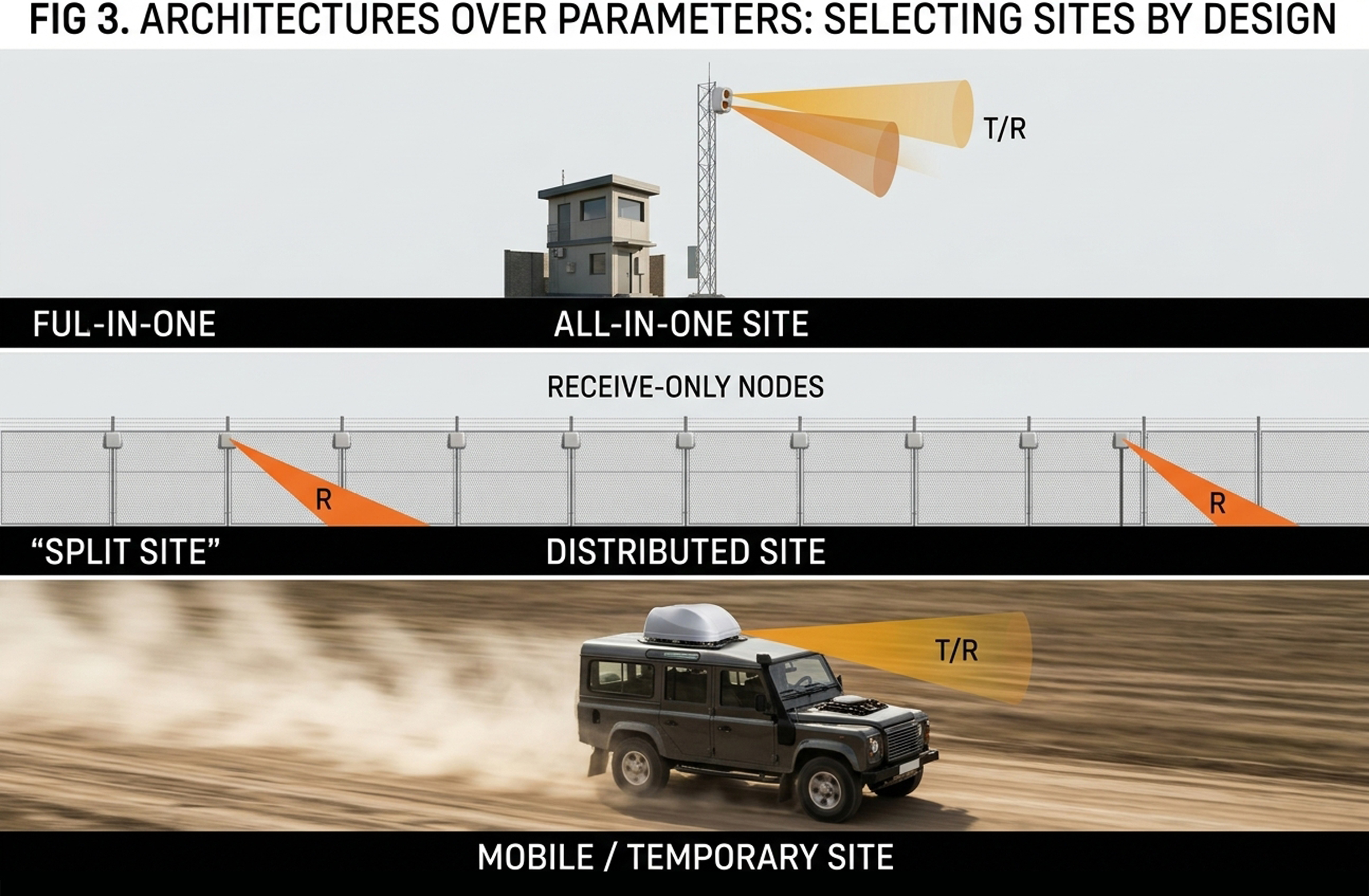
The decision is not a hierarchy of capability. It is a division of labour between three site shapes.
A fixed installation around a single asset is a combined site. A substation behind a fence, a reservoir, a single terminal building, all want one mast and one box, because there is nothing to distribute and nothing to move.
A wide estate with several sectors and a shared command picture is a split site, because the detection must be everywhere and the response only in some places. A port with three berths, a refinery with a tank farm and a pipeline route, a correctional estate with several blocks, all need the seeing spread thin and the responding concentrated where the risk actually is.
A mobile or temporary requirement, a convoy, a summit, a one week event, is a third shape that needs its own form factor and its own wiring. It cannot wait for a mast and it will not be there next month, so it buys portability and speed over integration.
Most organisations end up with more than one shape over time, which is why the real question is not combined or split but whether the pieces share a command platform. Detection and response, combined or not, have to report into one picture and one record, or the architecture is an argument waiting to happen.
Where LZ TECH Fits
We build both forms, and we keep them on the same platform. The DFJ Series answers the fixed combined requirement. Our separate detection line and our separate response line answer the split requirement. CCS sits above both, so a site that starts combined and later adds a sector of split coverage does not end up running two systems, it extends one.
We would rather a buyer choose the architecture that fits the site than the one that fits our catalogue, because a system chosen for the wrong shape gets blamed for the geometry, and that blame lands on the whole category.
The Bottom Line
The combined unit is not better than the split unit, and the split unit is not more advanced than the combined. They are answers to different physical problems: what the response is made of, where the site is, and whether the seeing and the responding move on the same clock.
Choose the shape before the spec sheet. The spec sheet will then agree with the site, and the site will still be working in year three.
Connect with us
Ready to Secure Your Low-Altitude Airspace?