Defending the Nodes Nobody Watches: Drone Threats to Remote Infrastructure
Sep 22 2026
Two September 2026 events, on opposite sides of the world, point to the same shift. Along Saudi Arabia’s east-west crude pipeline, satellite imagery and industry sources indicated that drone strikes had hit three pump stations, pausing a line that normally carries four to five million barrels a day and takes weeks to repair. And in Colombia, a drone struck a civil aviation 3D radar site, a facility placed in a rural area precisely because it needed a clear, unobstructed signal. Neither target was a headquarters. Neither was a fenced compound with a guard at the gate. Both were nodes.
That is the point the events make. Critical infrastructure is not one big building you protect. It is a network of nodes, many of them remote, spread across terrain that is expensive and difficult to watch. The drone threat has learned this, and the defense has to follow.
The Geography of Critical Infrastructure
Most critical systems are shaped like a web, not a fortress. A pipeline is a line with pump stations every few dozen kilometers. An air-traffic network is a set of radar sites placed on hilltops and open plains for line of sight. A power grid is a chain of substations strung between generation and load. The system works because the nodes are connected, but each node sits alone on the ground.
That scattered geometry is what makes infrastructure hard to defend. You cannot put a perimeter fence around a pump station in the desert the way you can around a data center. You cannot staff a guard at every radar hill. The nodes that matter most, the ones whose loss stops the whole line or blinds the whole network, are often the ones farthest from any permanent presence.
The September events exploited exactly this. A pipeline is only as strong as its weakest pump station, and an airspace is only as visible as its most remote radar. Hit the node, and you have hit the network.
What a Remote Node Needs
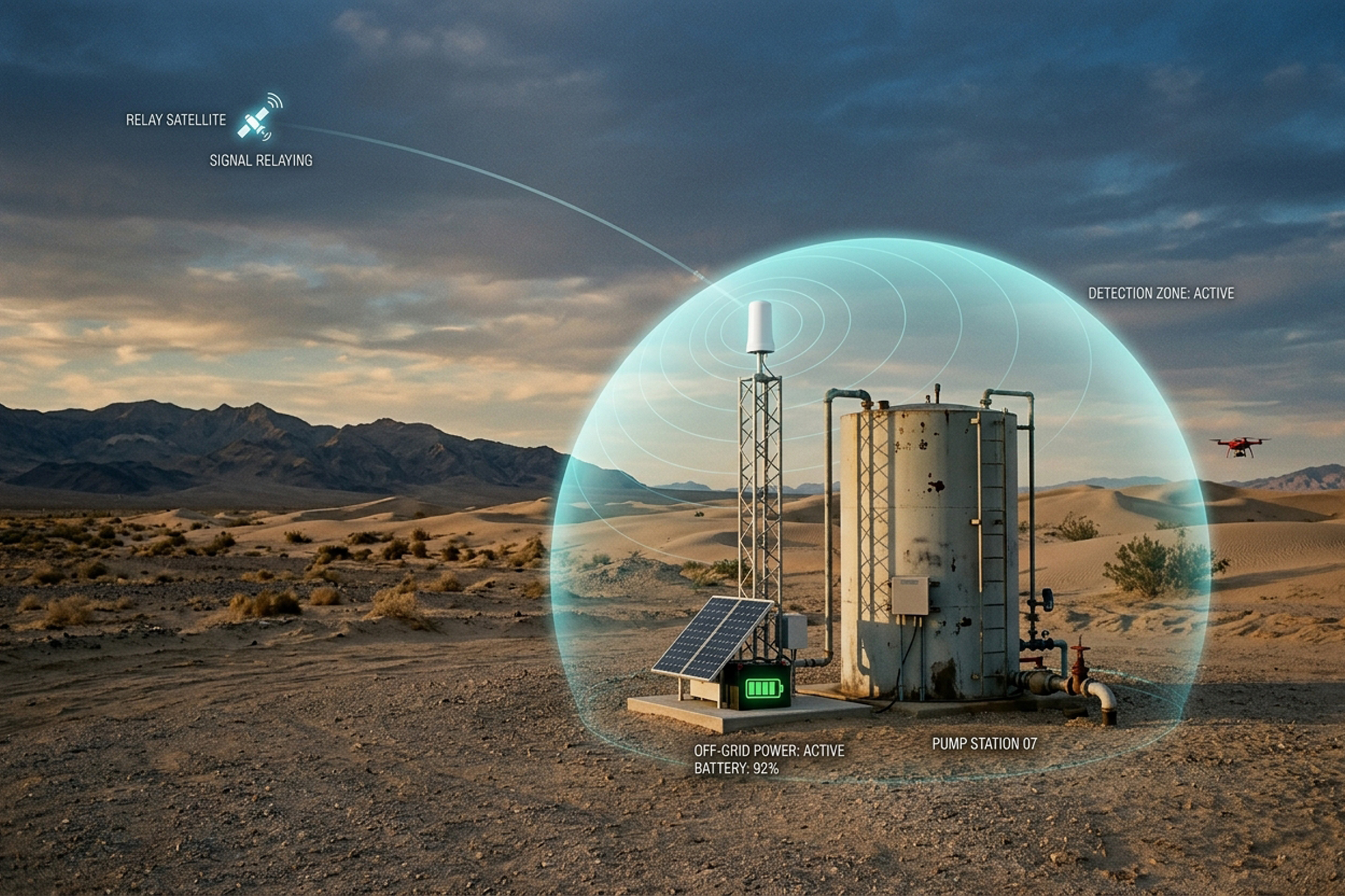
Defending a remote node is a different problem from defending a compound. The requirements follow from the location. The node is far from the grid, so the detection layer has to run on very little power, ideally from solar and battery. It is far from the operators, so the system has to report back over a link that may be thin or intermittent. And it is far from any maintenance team, so the hardware has to be something that can sit in the weather for months without attention.
These are not optional features. They are the minimum condition for a remote node to be watched at all. A sensor that needs mains power is a sensor that goes dark the moment the node it protects loses power. A sensor that needs a technician on site is a sensor that spends most of its life unwatched. The defense of a remote node starts with hardware that can survive being left alone.
Passive, Low-Power Detection as the Foundation
The first layer for a remote node is passive radio frequency detection. A drone flying toward a pump station or a radar hill cannot avoid emitting: its control link, its telemetry, and its video feed are all radio energy. A passive sensor reads that energy without transmitting anything itself, which is exactly what a remote, power-constrained site needs.
The DF Series of direction-finding sensors fits this role. It listens across 30 MHz to 6 GHz, detecting a drone at up to eight kilometers with a direction-finding accuracy of three degrees RMS. Because it is passive and low-power, it can be placed at a node, paired with solar and battery, and left to watch without adding to the site’s own radio environment or its power draw. That is the difference between a node that can be monitored and one that is simply assumed to be safe.
Placing the Contact at a Spread-Out Site
A bearing alone is not enough when the node sits in open terrain and a drone can approach from any direction. The operator needs a position, not just a direction, and the position has to be precise enough to act on. The D5-B is a passive time-difference-of-arrival node that turns timing differences across a small network into a coordinate. A single D5-B covers 30 MHz to 6 GHz out to about three kilometers, at altitudes up to one kilometer, tracking more than thirty aircraft with positioning accuracy better than ten meters.
For a remote site, that precision matters more than it does at a facility. At a compound, a rough bearing still tells you which gate to watch. At a pump station in open desert, a rough bearing tells you almost nothing, because there is no gate and no wall to narrow the question. The coordinate is what lets a thin response team drive to the right place instead of searching the horizon. Passive positioning turns a vague warning into a known contact, which is what a small, dispersed defense actually needs.
Seeing the Contact Before Acting
The last step is confirmation. A radio contact near a remote node could be a delivery drone, a survey aircraft, a passing hobby flight, or a genuine threat. The operator cannot act on the difference without seeing it. The VAR300 electro-optical and infrared tracker takes the position from the RF and TDOA layers and locks onto the aircraft visually, in daylight and at night, building the record that any serious response requires.
Confirmation also protects the operator from its own worst case: responding to a false alarm and exhausting a scarce response. Remote nodes are defended by small teams who cannot be everywhere. Every contact they act on has to be real, and the only way to be sure is to see it. The optical layer turns a radio contact into a picture, and the picture into a decision the team can defend afterward.
Building a Network of Watched Nodes
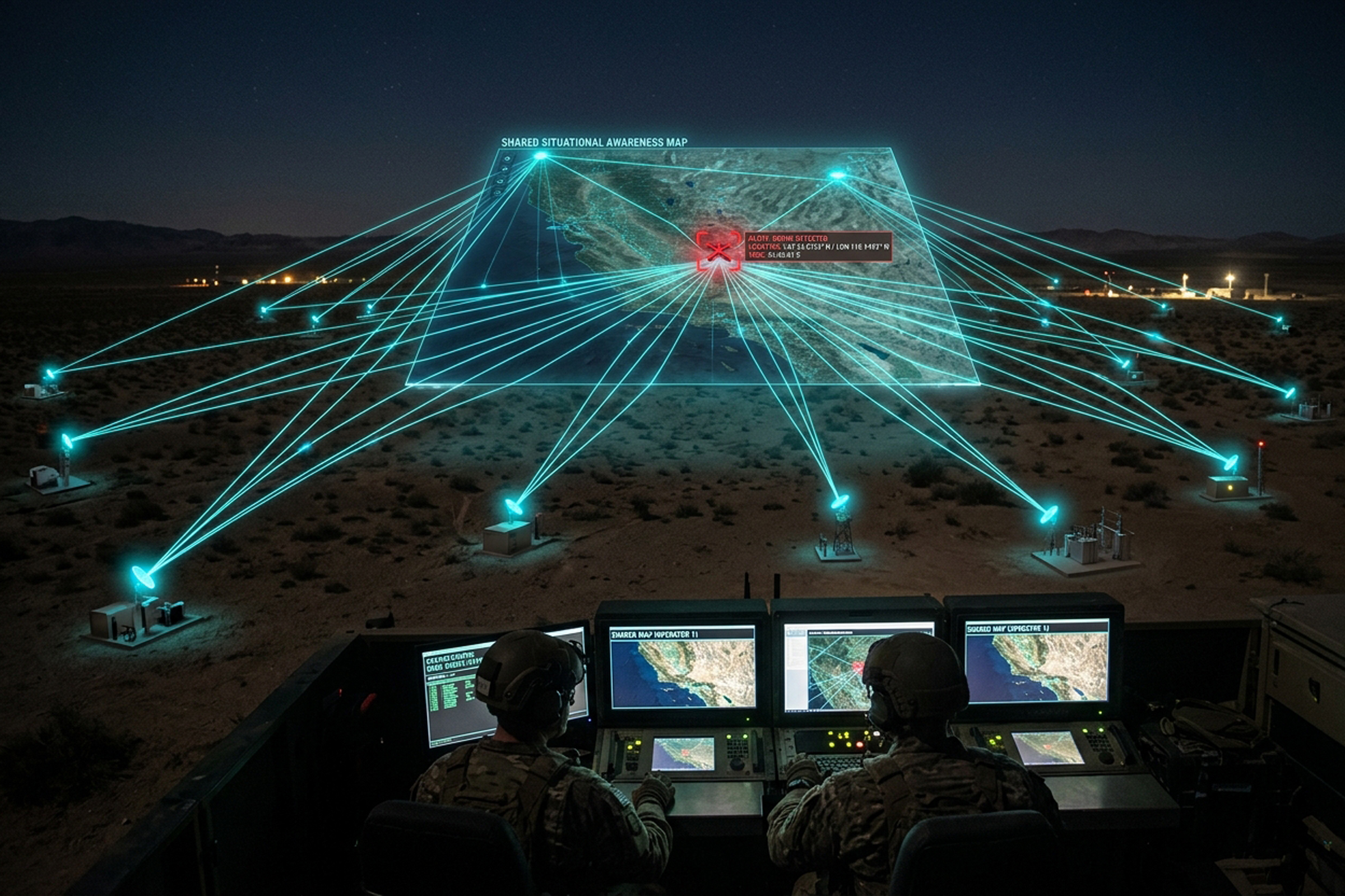
The shift the September events demand is not from one sensor to a bigger one. It is from protecting a compound to watching a network. Each node gets a passive, low-power detection layer. The nodes report back over whatever link they have. A shared command picture, such as the CCS platform, fuses the feeds so that a contact near any node is visible to the operators responsible for it, even when those operators sit far away.
This is how dispersed infrastructure gets defended in practice: not by hardening every node into a fortress, which is impossible, but by giving every node a tripwire. The tripwire is passive, so it does not disturb the node it protects. It is low-power, so it survives the outages that define remote sites. And it feeds a shared picture, so a thin team can watch many nodes from one place. That is the difference between a network that is protected and one that is simply hoping nothing happens.
The shared command picture is what makes this possible. When every node’s tripwire feeds one platform, one operator can watch many nodes at once, and the system itself does the continuous watching. The operator is freed from staring at each remote screen and instead responds to the contacts that matter. For infrastructure operators who are already thin, that is not an optimization. It is the only model that works.
The defining constraint of dispersed infrastructure is that you cannot put a person at every node. The defense has to work with a thin team covering many sites, which means the system has to be autonomous where it can be and reported where it must be. A contact near a pump station should surface, with a position, to an operator who may be hundreds of kilometers away, without requiring anyone to have been watching that node at the moment.
The passive, low-power nature of the DF Series and D5-B makes this coverage decision easier than it would otherwise be. When a sensor is cheap to power and cheap to deploy, the threshold for covering a node drops, and the network can afford to watch more of its critical points. The question of where the detection sits becomes a question of which nodes to prioritize, not which nodes the budget can stretch to. That is a meaningfully better question to be answering.
A practical question follows from the geography: where do you put the sensors. The answer is not everywhere, because budget does not allow it, and not only at the biggest nodes, because the September events were aimed at the smaller ones. The right approach is to treat the network as a whole and cover the nodes whose loss costs the most, whether they are large or not. A pump station that can stop four million barrels a day matters far more than its physical size suggests.
Choosing Where the Detection Sits
Scaling Without Staff
The second is power. A remote node is often exactly the kind of place where the grid is unreliable or absent, and the detection layer cannot assume mains power. Passive, low-power sensing is the answer. A node drawing tens of watts can run on solar and a battery, surviving the outages that would kill a heavier system. This is not a nice-to-have. It is what decides whether the node is actually watched, or only watched in theory until the first power cut.
A remote node has two constraints that a compound never faces, and both shape the system. The first is reporting. The detection layer has to get its findings back to the people who can act, and the link is often thin. A pump station in open desert may have nothing but a narrow satellite or radio backhaul, which means the system cannot stream raw video or heavy telemetry. It has to be built to send the compact, essential signal: a contact, a bearing, a position, a timestamp. The DF Series and D5-B fit this because their output is small and structured, which travels over links that would choke on a video feed.
The Reporting and Power Problem
The Bottom Line
The September strikes on a pipeline and an air-traffic radar made a point that infrastructure operators are still absorbing: the drone threat does not go where the guards are. It goes where the guards are not, to the pump stations, the radar hills, and the substations that keep the system alive. The defense has to follow it there.
The sites that respond will not try to fence the desert or staff the hills. They will give every node the same cheap, passive, low-power tripwire, and connect those tripwires into one picture. A watched node is not invulnerable, but it stops being a surprise. And for infrastructure, where the cost of a surprise is a paused pipeline or a blind sky, that is the difference that matters.
Connect with us
Ready to Secure Your Low-Altitude Airspace?