Drone Defense for Flammable Sites: Stopping Drones Without a Spark
Sep 09 2026
In August 2026, drones struck the Zawiya oil complex in Libya on successive days. One struck a storage tank holding roughly 4.5 million liters of gasoline, which caught fire and collapsed. A nearby power facility was hit by two more, one of them striking the fire-suppression system itself. Days later, a group claimed drone attacks on a refinery at Jazan in Saudi Arabia. None of this was a first. It was the continuation of a pattern energy operators have watched for years, and it frames a problem that is harder than most counter-drone work.
The Stakes at a Flammable Site
An energy facility changes the rules of a drone incident. Over a warehouse or a parking lot, an unauthorized drone is a nuisance. Over a tank farm, a gas processing unit, or a compressor station, the same drone is a potential ignition source. The site is full of materials that burn and full of equipment whose failure carries consequences far beyond the fence line.
That single fact reshapes the whole response. The threat is not only what the drone might carry, but what the site itself will do if something goes wrong. A falling object, a spark, a short circuit, or even a badly chosen countermeasure can all trigger the event the operator is trying to prevent. In a hazard zone, the defense has to be right the first time, because the margin for a wrong call is measured in ignition risk rather than inconvenience.
What the August Attacks Showed
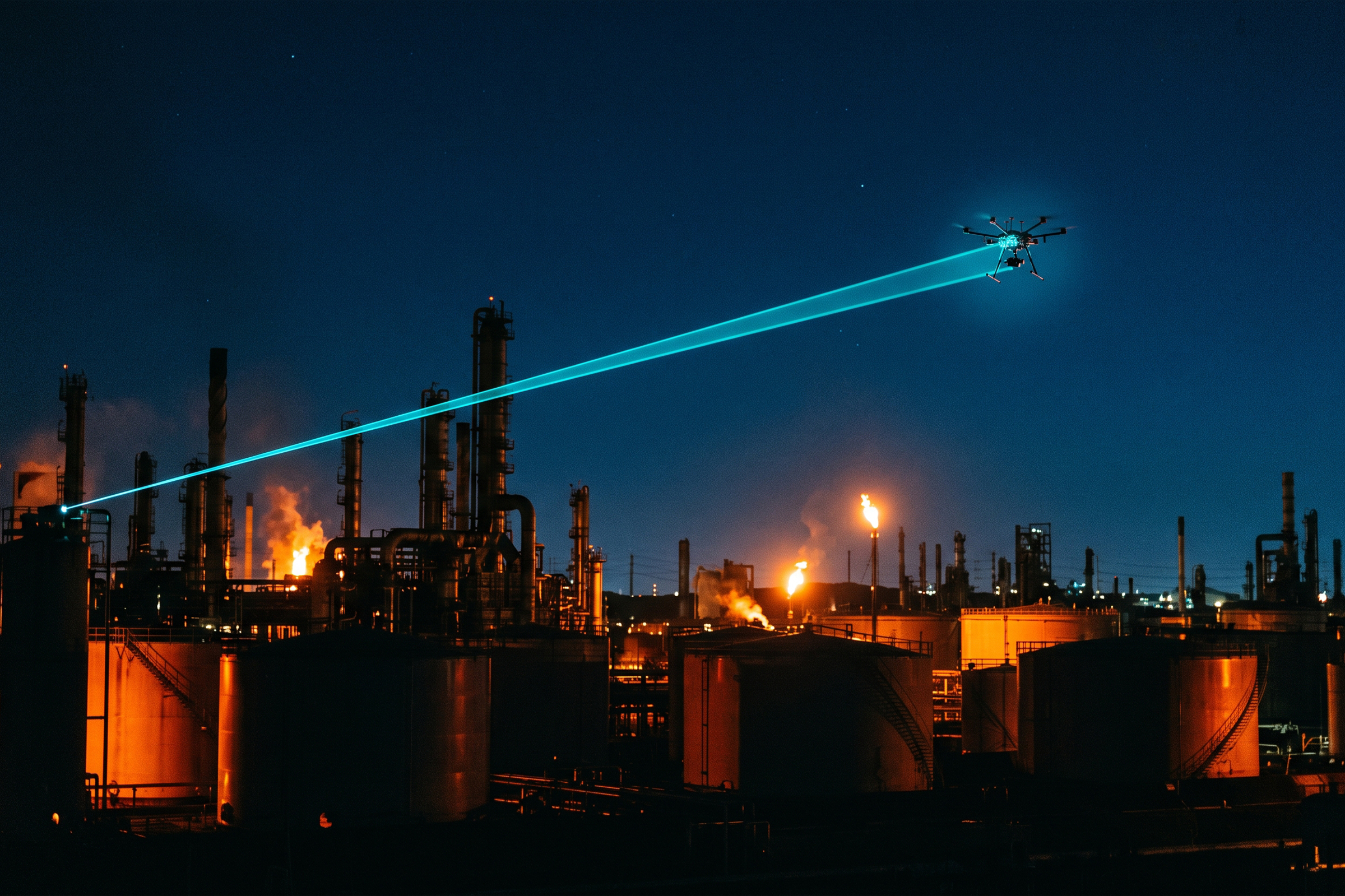
The Zawiya and Jazan incidents carried the same lesson from opposite sides of the energy map. The attackers did not need to breach a perimeter or defeat a defense in depth. They flew a cheap aircraft over the site, released or aimed a small payload, and left the resulting fire to do the damage. The fire-suppression system was itself a target at Zawiya, which tells you the attackers understood the site well enough to aim at the things that would make the damage worse.
The other lesson is about how these events reach the public. Libya’s state oil company warned that continued attacks could force it to declare force majeure, a legal term that stops contractual deliveries and ripples through the market. A drone did not just start a fire. It threatened a production status, a set of contracts, and a country’s export revenue. Energy infrastructure is not simply another customer for drone defense. It is the sector where a single flight can move from a security incident to a market event in hours.
Why Detection Must Come First
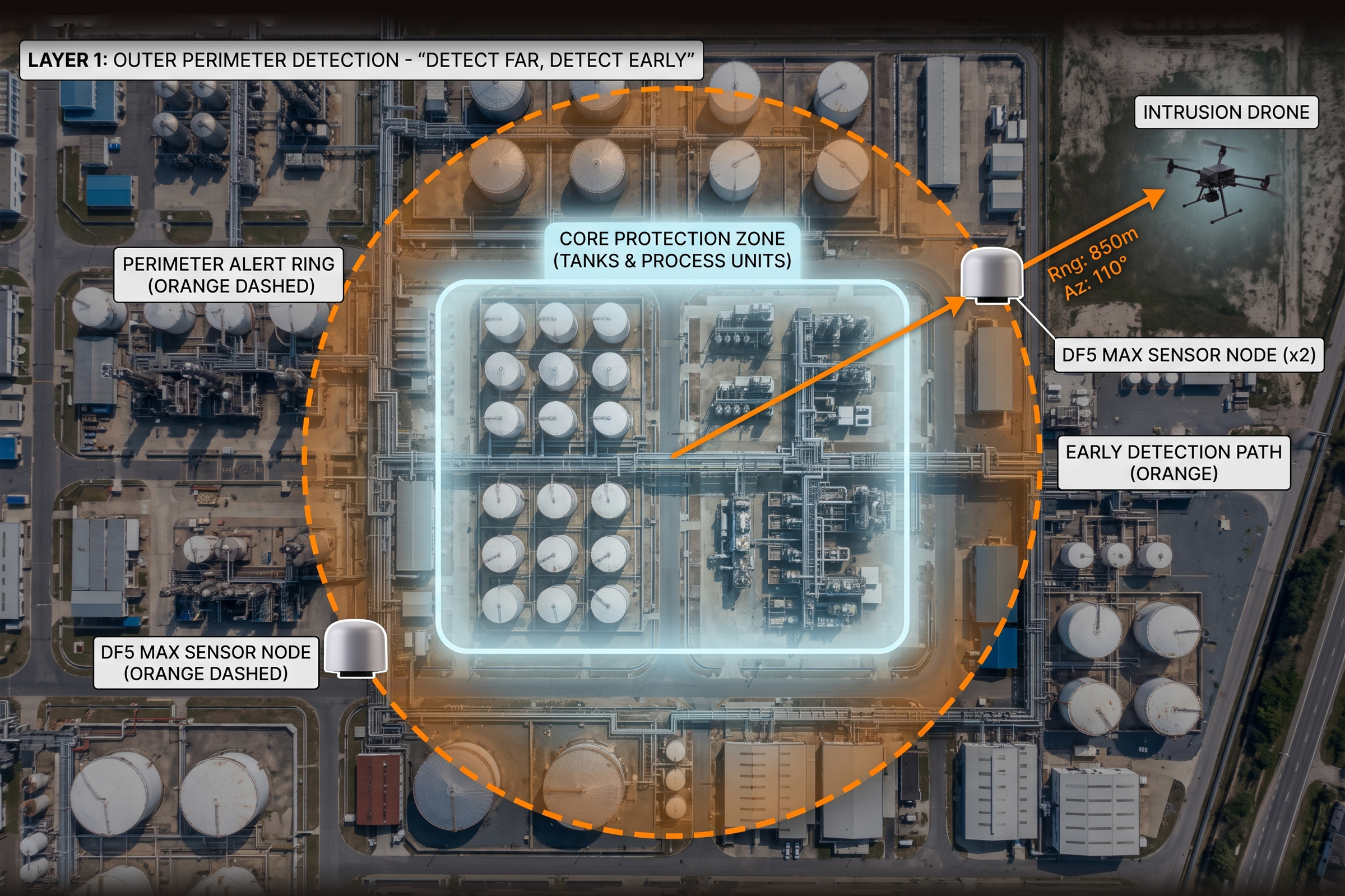
In a hazard zone, the most important capability is knowing early that something is approaching. The further out an operator can see, the more time there is to assess, decide, and act before the drone is over something that burns. Detection is also the layer with the fewest constraints. Passive radio frequency sensing does not transmit, does not interfere, and does not introduce any risk of its own, which is exactly what a flammable site needs.
The DF5 Max fits this first layer. It watches the 400 MHz to 6 GHz band, the range where most commercial drones and their control links operate, with a detection distance of up to 5 kilometers and direction-finding out to about 3 kilometers at a ten-degree RMS accuracy. It can track more than thirty aircraft at once, which matters when the threat is not a single drone but a coordinated pattern. Placed around the boundary of a site, these units build a warning ring that buys the response team its most valuable asset: time.
The Hard Part: Response in a Hazard Zone
Detection is the easy half. The hard part is what to do once a drone is confirmed over a site full of flammable material. This is where most generic counter-drone advice fails, because the standard options were not designed for a place where a falling object or an uncontrolled impact can start a fire.
A kinetic response, any effect that physically brings the drone down, is a poor fit. In a hazard zone, you do not want to create a projectile over your own tanks. Even a successful hit leaves debris, and debris falling into the wrong place is the exact outcome the operator is trying to avoid. The same logic rules out any broad-spectrum signal jamming that spills into the site’s own communications, control systems, or safety equipment. In an energy facility, the spectrum is already carrying the signals that keep the plant running.
A Response That Stays Contained
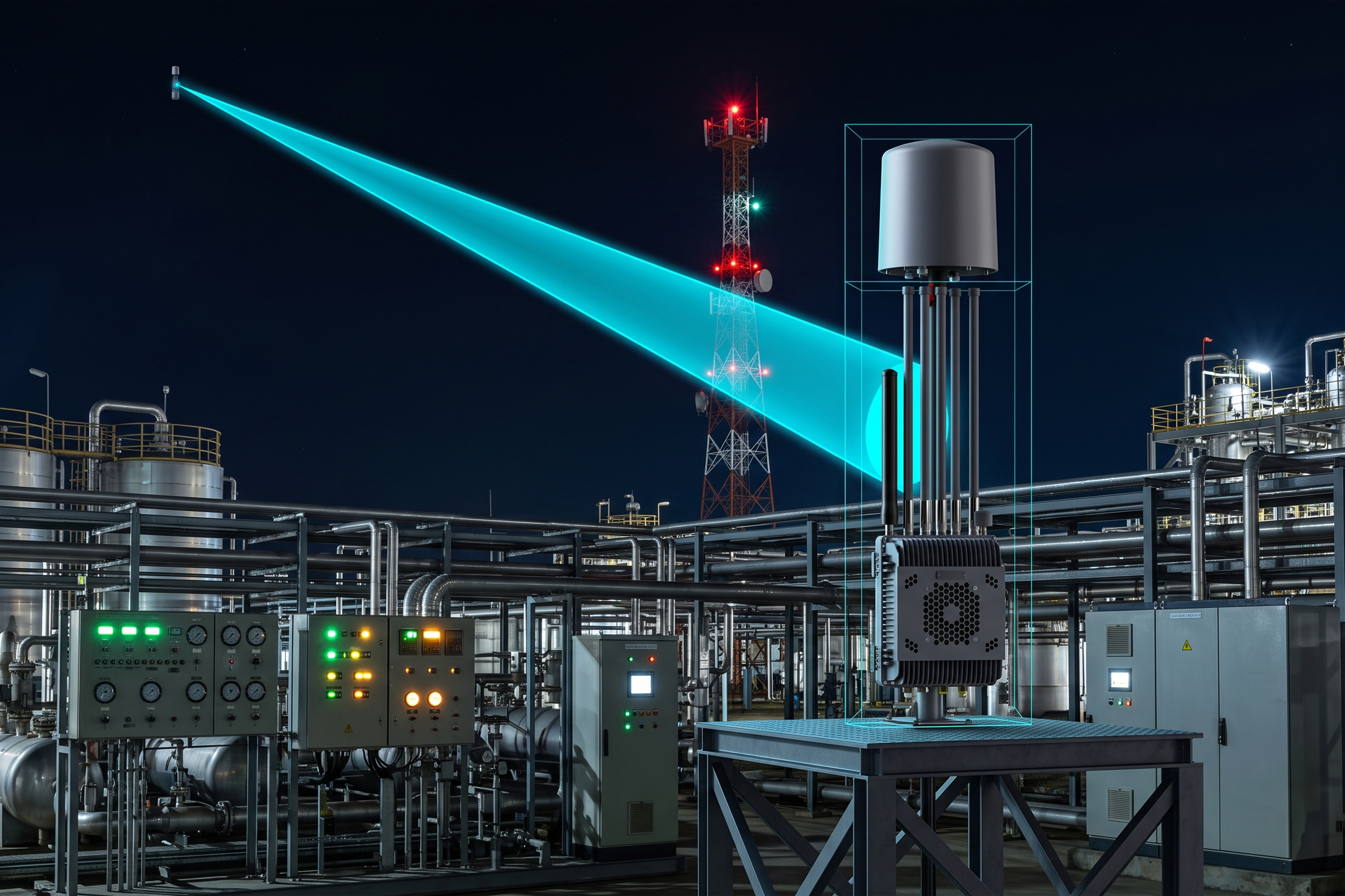
The answer for a hazard zone is a response that is directional and contained. Instead of blanketing the airspace, the intervention aims a narrow, focused beam at the single aircraft and leaves the surrounding spectrum untouched. That precision is what makes the difference between stopping a drone and disrupting the plant you are trying to protect.
The DFJ53 Max is built around this idea. Its multi-face array of high-gain antennas shapes the energy into a focused beam rather than an omnidirectional wash, with full 360-degree coverage so there is no blind angle. The aim is not raw power. It is placement: enough energy aimed precisely at one aircraft to end its flight or force it away, while everything around it, the plant’s radios, its sensors, its safety systems, keeps working.
This is the low-collateral principle in practice. The effect is confined to the threat, which is the only acceptable outcome in a place where collateral means something that catches fire.
Visual Confirmation Before Any Action
Before any response is taken, an operator in a hazard zone needs to see what they are dealing with. A radio contact could be a delivery drone passing overhead, a survey aircraft, or an actual threat. Acting on the wrong one wastes a response and, in the worst case, creates the incident. Visual confirmation is what separates a measured decision from a guess.
The VAR300 provides that confirmation. It combines electro-optical and infrared imaging to track a detected contact, giving the operator a clear picture of the aircraft in daylight and at night. With daytime detection beyond one kilometer and tracking beyond one and a half kilometers, and infrared coverage that keeps working after dark, it closes the loop between the RF warning and the response decision. In a flammable site, that loop is not a luxury. It is the difference between responding to a drone and responding to a rumor.
The Sequence That Keeps a Site Safe
A flammable site cannot treat detection, confirmation, and response as three separate purchases that happen to share a fence. They are one sequence, and the sequence only works when each step is timed to the last. The warning ring sees the drone while it is still minutes out. The confirmation layer turns the warning into a picture the moment it matters. The contained response is ready but unused until the operator is certain. That timing is the entire discipline of hazard-zone defense.
The alternative, jumping to a response the moment a contact appears, is how a hazard zone gets itself into trouble. A response fired at an unidentified contact over a tank farm is a roll of the dice with the site’s own materials as the stakes. The sequence exists to remove the dice. By the time anything is done, the operator knows what the drone is, where it is, and that acting is safer than waiting. Nothing is aimed at until it is known, and nothing is known until it is seen.
The Cost of Getting It Wrong
It is worth stating the downside plainly, because it is the reason energy operators cannot treat this as a generic security purchase. A mishandled drone incident at an energy site does not end with a report. It ends with a fire, a production stoppage, or an insurance event, and each of those has a price that dwarfs the cost of the defense.
The point of the Zawiya incident is not where to assign blame. A drone reached a storage tank, and the fire did what fires do in a place full of fuel. The operator’s real loss was not the drone that caused it. It was the tank, the product, the production status, and the force majeure risk that followed. Defense spending at a flammable site is not a line item. It is priced against the cost of a single tank going up, and on that comparison, the layered approach is not an extravagance. It is the cheapest option available.
Insurance, Regulation, and the Reason to Start Now
Two forces beyond the immediate threat are quietly pushing energy operators toward drone defense. The first is insurance. Underwriters pricing a refinery or a tank farm increasingly ask what the site does about drone risk, and a site that can show continuous monitoring and a logged detection history negotiates from a stronger position than one that cannot. The second is regulation, as airspace authorities extend drone-safety rules around critical infrastructure and operators face pressure to demonstrate that they monitor low-altitude airspace.
Both forces reward the operator who starts with detection. A warning ring of DF5 Max units, VAR300 confirmation on the critical assets, and a contained DFJ53 Max response are not only the right sequence for safety. It is the sequence that produces the logs, the coverage, and the demonstrated diligence that insurance and regulators want to see. The operator who builds it now is ahead of the requirements that will eventually catch up with everyone in the sector.
A Layered Path for Energy Operators
For an energy operator, the practical sequence runs from the outside in. First, a warning ring of DF5 Max units at the boundary, watching the full band and logging every contact. Second, VAR300 confirmation on the highest-value assets, so that detection is always followed by a clear picture. Third, a contained, directional response capability, the DFJ53 Max, is held in reserve for the confirmed threat that will not turn away.
Each layer is passive or contained by design, and each is usable at a flammable site without introducing a new risk. The operator starts by seeing, then by confirming, and only then by acting, and the action is aimed rather than sprayed. That is the sequence the Zawiya and Jazan incidents argue for: not more force, but the right force, placed precisely, in a place where precision is the only kind that is safe.
Energy infrastructure was one of the first sectors to learn that a cheap drone can reach a multi-billion-dollar asset. The August attacks are a reminder that the lesson is still being written. The operators who answer it will not be the ones with the biggest jammers. They will be the ones who can see early, confirm clearly, and respond without lighting their own fuse.
Connect with us
Ready to Secure Your Low-Altitude Airspace?