Echodyne’s 30,000-Unit Radar Factory Signals Mass Demand for Counter-Drone Radar – Where TR100 Fits
Jul 24 2026
In mid-2026, radar manufacturer Echodyne opened a new production facility with an annual capacity exceeding 30,000 MESA radar units. It is a significant signal for anyone watching the counter-drone industry: the demand for small-target detection radar is no longer experimental or niche. It is moving into volume manufacturing.
A factory producing 30,000 radar units per year represents a structural shift in how the market thinks about drone detection sensors. For context, a typical defense radar program might order a few hundred units over its lifetime. A few thousand units over several years is considered a large program. Thirty thousand units per year is a completely different category. It means the manufacturer expects demand from multiple procurement programs running simultaneously, across different customer types and geographic regions.
This article examines what the Echodyne factory expansion tells us about the state of counter-drone radar demand, explains the radar fundamentals that matter for drone detection, and describes where the LZ TECH TR100 integrated radar and electro-optical platform fits into a market that is clearly scaling up.
What the Echodyne Factory Expansion Actually Means
Echodyne’s MESA (Metamaterial Electronically Scanned Array) radar is one of the best-known compact phased-array radars on the market. The company has supplied systems to the U.S. Department of Defense, Homeland Security, and allied governments for perimeter security, drone detection, and border surveillance.
The MESA platform is notable for using metamaterials to achieve electronic beam steering in a flat-panel form factor, without the mechanical complexity of a rotating antenna. This makes it suitable for fixed-site installations where reliability and low maintenance are priorities. The technology has been battle-tested in operational environments and has built a strong reputation among defense users.
The jump to 30,000-unit annual capacity signals that Echodyne sees market demand expanding well beyond its current customer base. A factory of this scale is not built on speculation alone. It is typically backed by either confirmed multi-year procurement contracts or a well-founded forecast of demand growth across multiple customer segments. Either way, it represents a vote of confidence in the counter-drone radar market that is hard to ignore.
This aligns with what we are seeing across the counter-UAS sector. Governments are no longer running pilot programs that test a few sensors at a single site. They are writing procurement budgets for nationwide deployment programs. The drone threat has moved from conceptual to operational, and the demand for detection sensors is scaling accordingly.
Three Demand Signals Embedded in One Factory
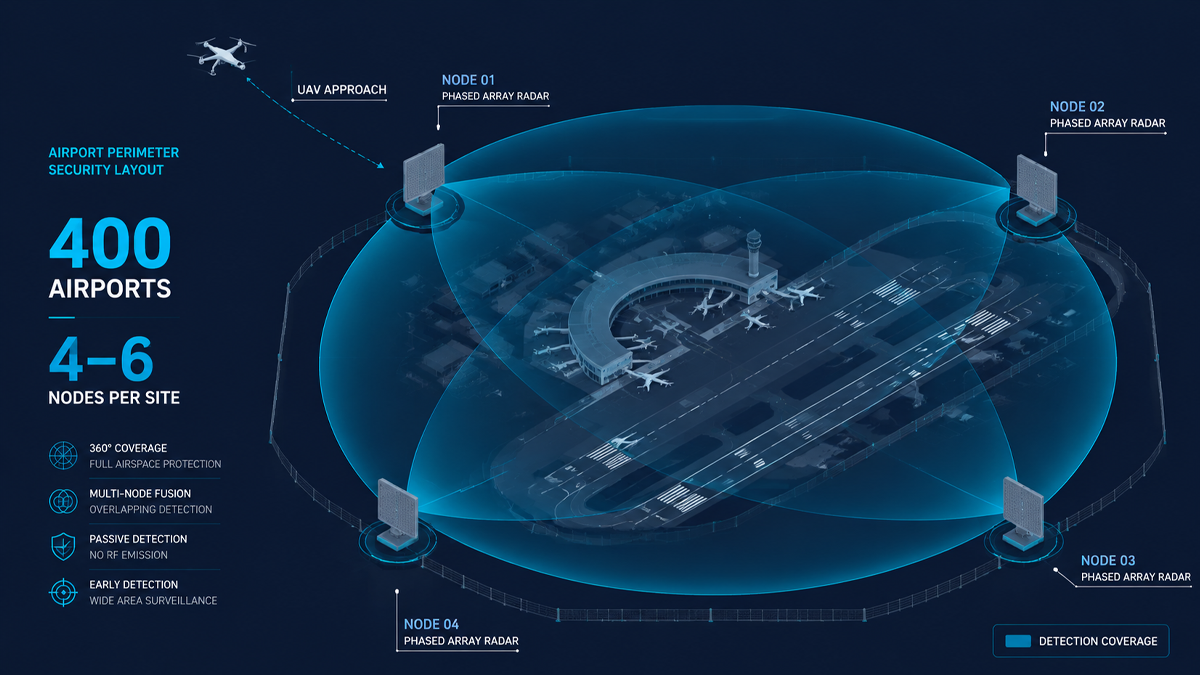
The 30,000-unit capacity is not just one number. It reflects at least three distinct demand forces that are converging in the counter-drone market.
1. Airspace Awareness Mandates Are Becoming Law
Several countries now require critical infrastructure operators to maintain drone detection capability. Airports, power plants, prisons, and sports venues are being told they must know what is flying within their airspace. Radar is the foundation sensor for this requirement because it provides all-weather, day-and-night detection that optical sensors alone cannot match.
The regulatory trend is only accelerating. In Europe, the European Union Aviation Safety Agency has been developing standards for counter-drone operations at airports. In North America, the FAA has extended its authority over drone operations and is working with security agencies on detection requirements. In Asia and the Middle East, several governments have mandated counter-drone systems at critical national infrastructure sites.
For each site that falls under a mandate, the minimum requirement is typically a radar for primary detection, backed by some form of secondary confirmation sensor such as an electro-optical camera. This creates a direct, regulation-driven demand for radar units that did not exist five years ago.
2. Drone Proliferation Is Outpacing Detection Coverage
Commercial drone sales continue to grow globally. DJI alone ships millions of units annually across consumer, enterprise, and agricultural product lines. New manufacturers in China, the United States, and Europe are entering the market with platforms that range from sub-250-gram consumer drones to heavy-lift industrial aircraft.
The ratio of drones in the sky to installed detection sensors is heavily skewed toward the drones. Most critical infrastructure sites, large public events, and urban areas have zero dedicated drone detection capability. Closing that gap means installing radar at a scale that did not previously exist outside military air defense networks.
This is not a temporary imbalance. Drone production is growing faster than the rate at which detection systems are being deployed. The gap is widening, not narrowing, and that creates sustained demand for detection hardware over the medium to long term.
3. Integration Is the Bottleneck, Not Sensor Availability
A radar alone does not solve the counter-drone problem. The hardest part is fusing radar data with electro-optical and infrared sensors, RF detection systems, and a command-and-control platform that turns raw tracks into actionable alerts. End users do not want a radar. They want a system that identifies, tracks, and classifies threats with minimal operator workload.
Integration is where the real engineering work happens. A radar produces hundreds of track points per minute. An RF detection system produces signal intercepts. An EO/IR camera produces video. Fusing these data streams into a single coherent picture, with automated classification and alert prioritization, is a software and systems-engineering challenge that many organizations underestimate.
The manufacturers that succeed in this market will be those that solve the integration problem, not those that build the best individual sensor. This is the design philosophy behind the TR100: an integrated unit that combines radar, visible-light, infrared thermal, and wide-angle cameras in a single platform with a shared coordinate frame.
Understanding Radar Cross Section for Drone Detection
Any discussion of counter-drone radar eventually comes back to RCS, or Radar Cross Section. RCS is a measure of how detectable an object is by radar, expressed in square meters. It varies dramatically by the target’s size, shape, material composition, and orientation relative to the radar beam.
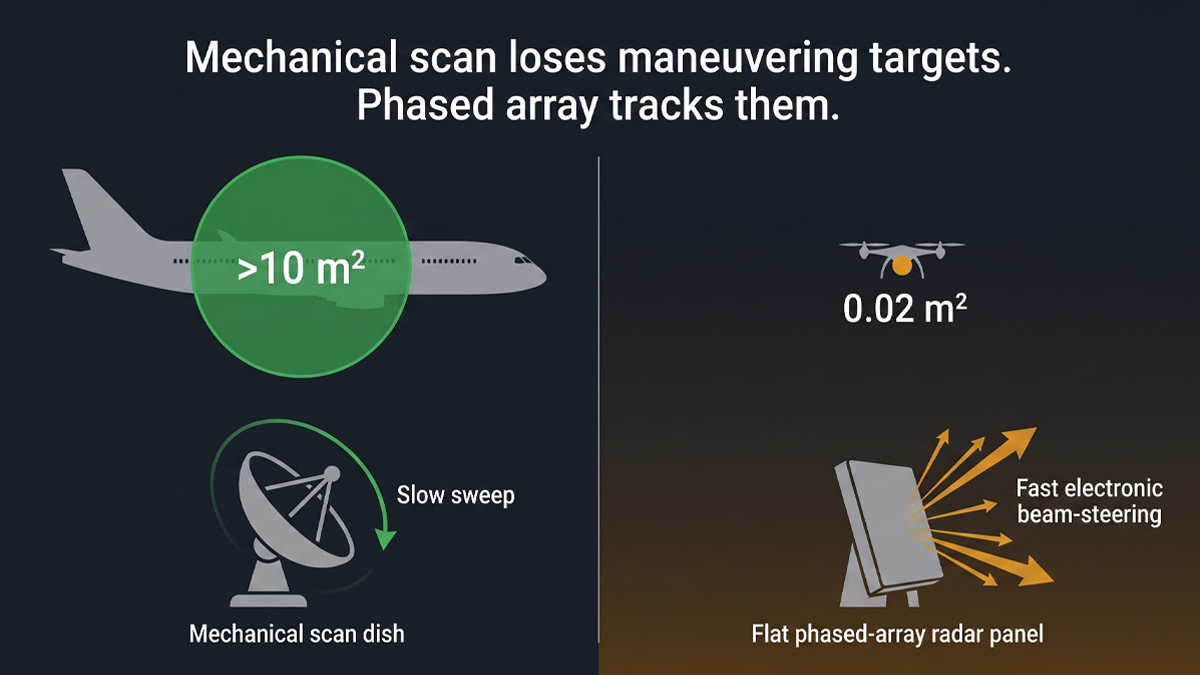
A commercial airliner has an RCS in the range of tens to hundreds of square meters. A fighter aircraft might be in the single-digit range if designed with some radar signature reduction. A small consumer drone like the DJI Mavic series has an RCS around 0.02 square meters. That is roughly the radar return of a small bird.
This is why drone detection radar is a specialized engineering problem. The radar must have enough sensitivity to pick up a tiny, slow-moving object while rejecting clutter from birds, ground vehicles, weather phenomena, and other environmental noise. The signal-to-noise ratio for a 0.02 square meter target at 2 kilometers is extremely challenging.
RCS also varies with the radar frequency and the aspect angle of the target. A drone viewed from the front presents a different RCS than the same drone viewed from the side or from below. The plastic body of most consumer drones is relatively transparent to radar, but the metallic components such as motors, battery, and electronic boards produce returns. The rotating propeller blades create a characteristic micro-Doppler signature that can help distinguish drones from birds.
The TR100 from LZ TECH specifies detection at an RCS of 0.02 square meters for a DJI Mavic 4-class target. This is a realistic and meaningful threshold. It covers the most common commercial drone platforms that security operators encounter in the field. It does not over-promise by claiming detection at 0.001 square meters, which would require military-grade radar at a very different cost point.
The TR100: Integrated Radar and EO/IR in a Single Platform
The LZ TECH TR100 is designed for the integration challenge described above. It combines a phased-array radar with a multi-spectral optical payload in a single unit, reducing the number of separate hardware boxes that an integrator or end user must manage.
The radar subsystem provides azimuth coverage of at least 90 degrees and elevation coverage of at least 90 degrees. Detection range is at least 2 kilometers against a DJI Mavic 4 class target at 0.02 square meters RCS. Position accuracy is 2 meters or better.
The optical subsystem carries a 6.1 millimeter to 561 millimeter continuous optical zoom lens that covers everything from wide-angle situational awareness to long-range identification. Three camera types operate simultaneously: a visible-light camera, an infrared thermal camera, and a wide-angle camera.
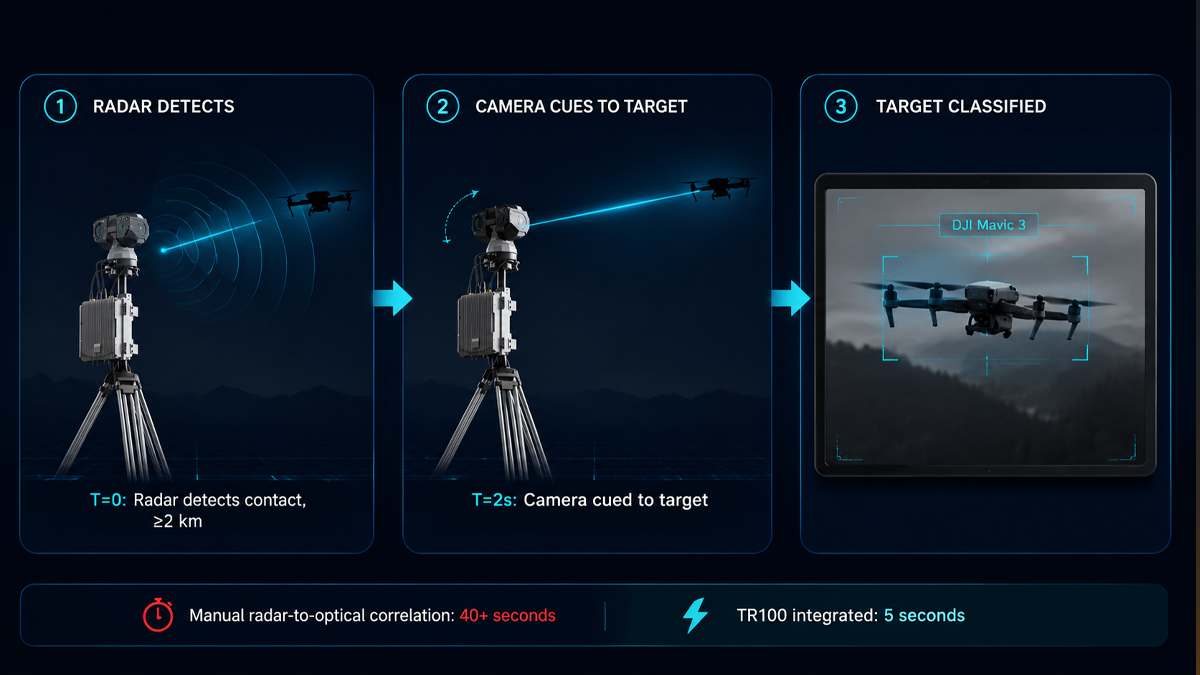
For identification, the TR100 can visually confirm a DJI Mavic 3-class target at 2 kilometers or more during daytime and at 1 kilometer or more at night. For tracking, it maintains a visual lock at 3 kilometers or more during daytime and 2 kilometers or more at night.
The integrated design provides a practical advantage that separate sensors cannot match: the radar and cameras share a common coordinate frame. When the radar detects a target, the cameras slew automatically to the correct bearing without any manual alignment or calibration step. The operator sees a visual confirmation immediately. This tight coupling between detection and identification is what makes a system usable by a security team under operational pressure.
Why Phased-Array Radar Matters for Counter-UAS
Phased-array radar differs from traditional mechanically scanned radar in one critical way: it has no moving parts. The beam is steered electronically by controlling the phase of the signal across an array of antenna elements. This provides several advantages for drone detection that are worth understanding.
First, update rate. A phased-array radar can redirect its beam to any point in its field of view in milliseconds. A mechanical radar must physically rotate its antenna, giving it a refresh cycle measured in seconds. For a fast-moving drone that can change direction instantly, a high update rate is essential for maintaining a stable track. If the radar only looks at the target once every few seconds, the track can break or jump between updates.
Second, reliability. No motor, no gears, no bearings to wear out. For permanently installed systems that must operate 24 hours a day, 365 days a year, in outdoor conditions, this reduces maintenance burden significantly. A mechanical radar deployed at a remote site requires periodic servicing. A solid-state phased-array radar can, in principle, operate for years without physical maintenance.
Third, multi-target handling. A phased-array radar can interleave tracking and search functions, simultaneously following multiple targets while continuing to scan for new ones. This is the operational mode in which Echodyne’s MESA radar and the TR100’s radar both operate. It is particularly important for counter-drone missions where multiple drones may be approaching from different directions simultaneously.
Fourth, resistance to jamming. Phased-array radars can adapt their beam pattern electronically to suppress interference from specific directions. This provides a degree of electronic protection that mechanical radars cannot easily replicate.
 a
a
Where TR100 Fits in the Growing Radar Market
The counter-drone radar market is segmenting into roughly three tiers. At the high end are military-grade 3D radars with ranges exceeding 10 kilometers, full hemispherical coverage, and price tags in the hundreds of thousands to millions of dollars. These systems are designed for integrated air defense networks and are typically too expensive for civilian infrastructure applications.
At the low end are simplified Doppler sensors that can detect movement but cannot track, classify, or provide precise coordinates. These are useful for triggering alerts but provide limited situational awareness on their own.
The TR100 occupies the middle tier: a professional-grade phased-array radar with integrated EO/IR, designed for the 2-kilometer detection class that covers most real-world operational scenarios at airports, borders, critical infrastructure sites, and event venues. It provides the core capabilities that security teams need, without the cost and complexity of a military air defense radar.
This middle tier is where the volume demand is materializing. Most sites do not need to detect drones at 10 kilometers. They need reliable detection within a 2-kilometer perimeter, with automated visual confirmation and tracking. As factories like Echodyne’s scale up to 30,000 units per year, they are betting that this middle tier will generate procurement volumes that were previously reserved for consumer electronics, not defense sensors.
The TR100 is designed to operate as a standalone detection and identification unit, or to integrate with broader RF detection and jamming systems through LZ TECH’s CCS command-and-control platform. The platform handles sensor fusion, alert prioritization, and automated response workflows so that a security operator can manage multiple sensors without being overwhelmed by raw data streams. Multiple TR100 units can be networked to extend coverage across a site, sharing tracks and maintaining consistent target identification across sensor boundaries.
Conclusion
Echodyne’s factory expansion is one data point among many, but it is a telling one. When a radar manufacturer commits to 30,000-unit annual capacity, they are betting that the counter-drone market is entering a procurement phase, not a trial phase. The TR100 addresses the same market demand from the system-integration side: providing a radar-plus-optics unit that is ready to deploy, not just a sensor that needs a separate integration project.
The next several years will determine which architectures become standard for counter-drone detection. The trend is clear: integrated, phased-array, and designed for volume deployment at civilian and paramilitary price points. The TR100 is built for that market reality.
For security planners evaluating counter-drone radar options, the key question is no longer whether radar is needed. That question has been answered by the market signals described in this article. The question is which architecture to adopt. An integrated approach that combines radar, optical sensors, and software into a single deployable unit reduces integration time, operator training burden, and lifecycle maintenance cost. These factors matter as much as raw detection range when a system must operate 24 hours a day, 365 days a year, at sites that may not have dedicated technical staff on hand.
Connect with us
Ready to Secure Your Low-Altitude Airspace?