Motorola Acquires D-Fend for $1.5 Billion: What Platform Giants Entering Counter-Drone Means for System Integrators
Jul 31 2026
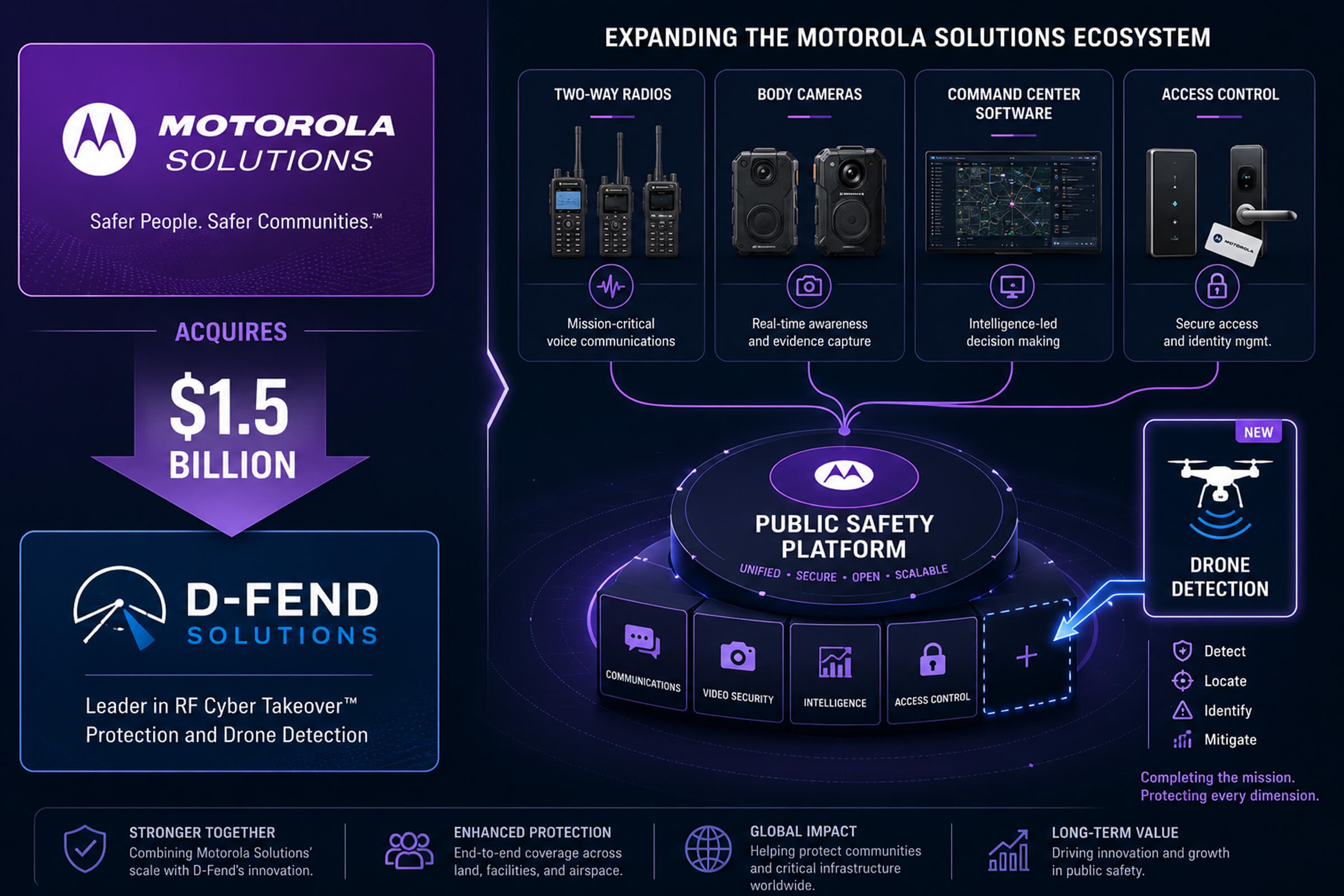
In June 2026, Motorola Solutions announced the acquisition of D-Fend Solutions, an Israeli counter-drone technology company, for approximately 1.5 billion dollars. The deal closed within weeks, and by July, Motorola had already begun integrating D-Fend’s EnforceAir radio-frequency takeover technology into its broader public safety and security portfolio.
This acquisition matters for reasons that go beyond the dollar amount, which is large. It matters because of who the buyer is. Motorola Solutions is not a defense contractor. It is a communications and public safety technology company. Its core customers are police departments, emergency services, airports, stadiums, and municipal governments. The same organizations that are increasingly being asked to respond to drone incidents. Motorola’s entry into counter-drone is a signal that the market has shifted from a niche security concern to a mainstream public safety requirement.
The platform effect: what happens when a communications giant enters C-UAS
Motorola’s existing customer relationships span tens of thousands of public safety agencies worldwide. Its product ecosystem includes two-way radios, body-worn cameras, video management systems, command center software, and access control. Adding drone detection and mitigation to that portfolio is not a diversification play. It is an adjacency play. The same police department that buys Motorola radios for its patrol officers is the department that gets called when a drone drops contraband into a prison yard or flies over a stadium during a game. Motorola can now sell that department a counter-drone solution through the same procurement channel and the same sales team that already serves the account.
For D-Fend, the acquisition solves a distribution problem. D-Fend’s technology, particularly its RF-based cyber takeover approach that avoids jamming and instead seizes control of the drone’s communication link, is technically differentiated. But D-Fend was a mid-sized company selling to government security agencies one deal at a time. Motorola turns that sales motion into a portfolio sale. The counter-drone capability becomes a checkbox on a broader public safety proposal rather than a standalone procurement that requires a separate vendor evaluation.
For the counter-drone industry as a whole, the Motorola-D-Fend deal is one of several signals suggesting that large platform companies see C-UAS as a growth adjacency. When a company with Motorola’s market access and installed base enters a category, it changes the competitive dynamics. Smaller pure-play C-UAS companies face a new kind of competitor: one that can bundle drone detection with radios, cameras, and command center software in a single contract, and that already has the customer relationship before the counter-drone conversation even starts.
The integrator’s dilemma: buy a complete system or build with modules
For system integrators and security technology providers that are not Motorola, the acquisition raises a strategic question. If platform companies are entering the counter-drone market with complete, vertically integrated solutions, what is the path for an integrator that wants to add drone detection to its own product lineup without becoming a reseller for a competitor?
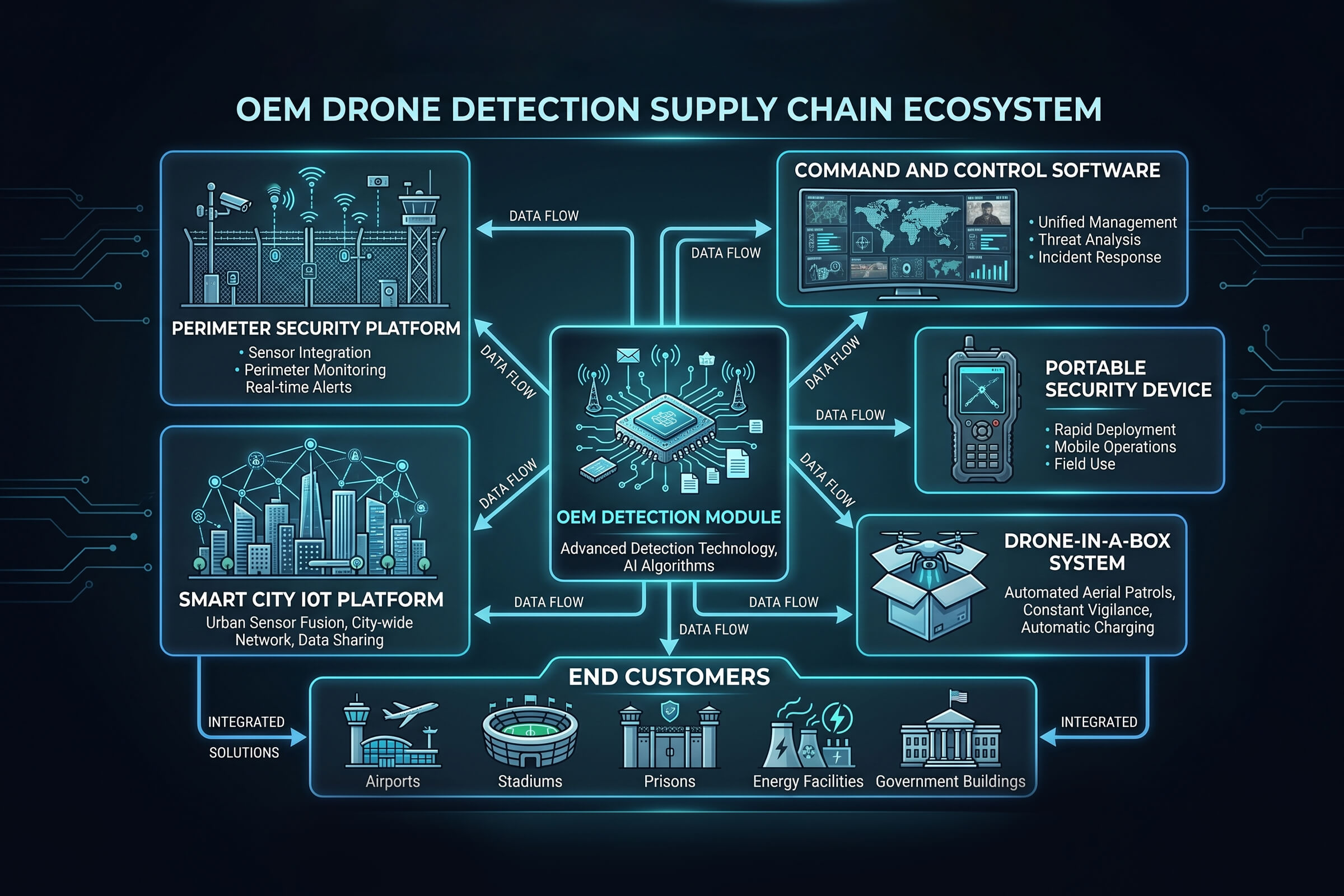
The answer, for a growing number of integrators, is OEM detection modules. Rather than buying a complete counter-drone system with its own command interface, user management, and reporting tools, an integrator purchases a detection engine as an embeddable component. The integrator integrates that component into its own platform, behind its own user interface, under its own brand. The end customer sees a unified security system, not a separate counter-drone add-on with a different login and a different support contract.
LZ TECH’s OEM detection module family is designed for exactly this use case. The modules are compact hardware units that combine an RF front end covering 70 MHz to 6 GHz with an onboard computing unit running LZ TECH’s protocol analysis software. They include a full API interface for integration into third-party command and control platforms. They detect and identify drone models from DJI, Autel, and other major manufacturers, as well as DIY and FPV drones that use non-standard protocols.
The OEM module family currently includes the D-MB Mini, the DF Pro-MB, and the D Pro-MA, covering different size, power, and performance requirements. All three share the same CRPC-based detection engine. The differences are in form factor, antenna configuration, and deployment profile. The D-MB Mini is designed for embedded integration in space-constrained platforms such as portable security devices and compact sensor nodes. The DF Pro-MB adds direction-finding capability for applications that need bearing information in addition to detection and identification. The D Pro-MA offers the highest sensitivity for long-range detection in fixed-site deployments.
The integrator provides the enclosure, the mounting, the power supply, the networking, the user interface, and the response workflow. LZ TECH provides the detection intelligence. This division of labor lets the integrator build counter-drone capability into its existing product line without developing RF expertise from scratch, while maintaining full control over the customer relationship and the user experience.
What the Motorola deal signals for the module market
When a platform company acquires a counter-drone vendor, it creates two effects for the module market. First, it validates the technology category. A 1.5 billion dollar acquisition price says that counter-drone RF technology has substantial enterprise value and a credible growth trajectory. That attracts investment and customer attention to the broader category, including module-based approaches.
Second, it creates a competitive gap that modules fill. Motorola’s integrated solution will appeal to organizations that already use Motorola products and want a single-vendor stack. But it will not appeal to integrators who compete with Motorola in adjacent categories, or to organizations that have standardized on a different security platform and do not want to introduce a second vendor’s command interface. For those buyers, an OEM module that integrates into their existing platform is the natural choice. The Motorola acquisition does not shrink the module market. It expands it, by making counter-drone capability a must-have rather than a nice-to-have for any security platform that serves critical infrastructure or public safety customers.
LZ TECH’s position in this market is built on two advantages. The first is protocol coverage. The CRPC engine, now in its third generation, decodes drone communication protocols at the application layer and, in its most advanced form, the control layer. This produces the drone model, serial number, GPS coordinates, altitude, speed, and remote controller position — not merely a detection alert. For an integrator embedding a detection module, the richness of the data feed determines how much value the integrator can build on top of it. A module that only says ‘drone detected at 2.4 GHz’ gives the integrator very little to work with. A module that says ‘DJI Mavic 3, serial number X, at coordinates Y, altitude Z meters, flying toward bearing W, pilot at coordinates P’ gives the integrator everything they need to build a complete situational awareness display and response workflow.
The second advantage is scale. LZ TECH has shipped to customers in more than 60 countries and maintains a 10,000-square-meter manufacturing and service center in Luoyang, China, with approximately 500 employees, roughly 40 percent of whom are in research and development. For an integrator selecting an OEM module partner, the question is not only whether the module works today. It is whether the supplier will be updating the drone protocol database, adding support for new models, and shipping product five years from now. Scale and R&D depth matter for that answer.
A market that is just getting started
The Motorola-D-Fend deal is unlikely to be the last acquisition of its kind. As counter-drone technology moves from specialized military procurement to mainstream public safety and critical infrastructure spending, more platform companies will look for entry points. Some will acquire. Some will partner. Some will build in-house. For system integrators that want to offer counter-drone capability without waiting for the next acquisition cycle or building RF expertise from the ground up, OEM detection modules provide a path that is available today, not in the next funding round.
The counter-drone market is accelerating. Platform companies entering the space is both a symptom of that acceleration and a cause of further acceleration. The integrators that move now, while the supply chain of embeddable detection modules is mature and the competitive field is still taking shape, will be the ones whose platforms are ready when the request for proposal arrives with a counter-drone requirement on page three.
Connect with us
Ready to Secure Your Low-Altitude Airspace?