Portable Drone Detection’s Next Step: From Fixed Protocol Libraries to Edge AI
Oct 16 2026
On October 6, 2026, MyDefence announced the Wingman Edge, a wearable drone detector that weighs under one kilogram and is 17 percent lighter than the generation it replaces. Two details in the announcement matter more than the weight. The first is that the device runs signature library matching and an on-device AI spectrum analysis at the same time. The second is that it shares what it detects, and what it sees in the spectrum, with other operators, vehicles, and command systems. Together, those two details describe where portable drone detection is heading.
For years, the portable detector has been understood as an alarm. You carry it, it buzzes, you look up. That model still has value, but it is no longer the interesting part of the product. The interesting part is what the device contributes to everyone else. A portable detector that only alerts its own holder is one data point. A set of them feeding one shared picture is a sensing network, and a network is worth more than the sum of its alarms.
Two Philosophies of Portable Detection
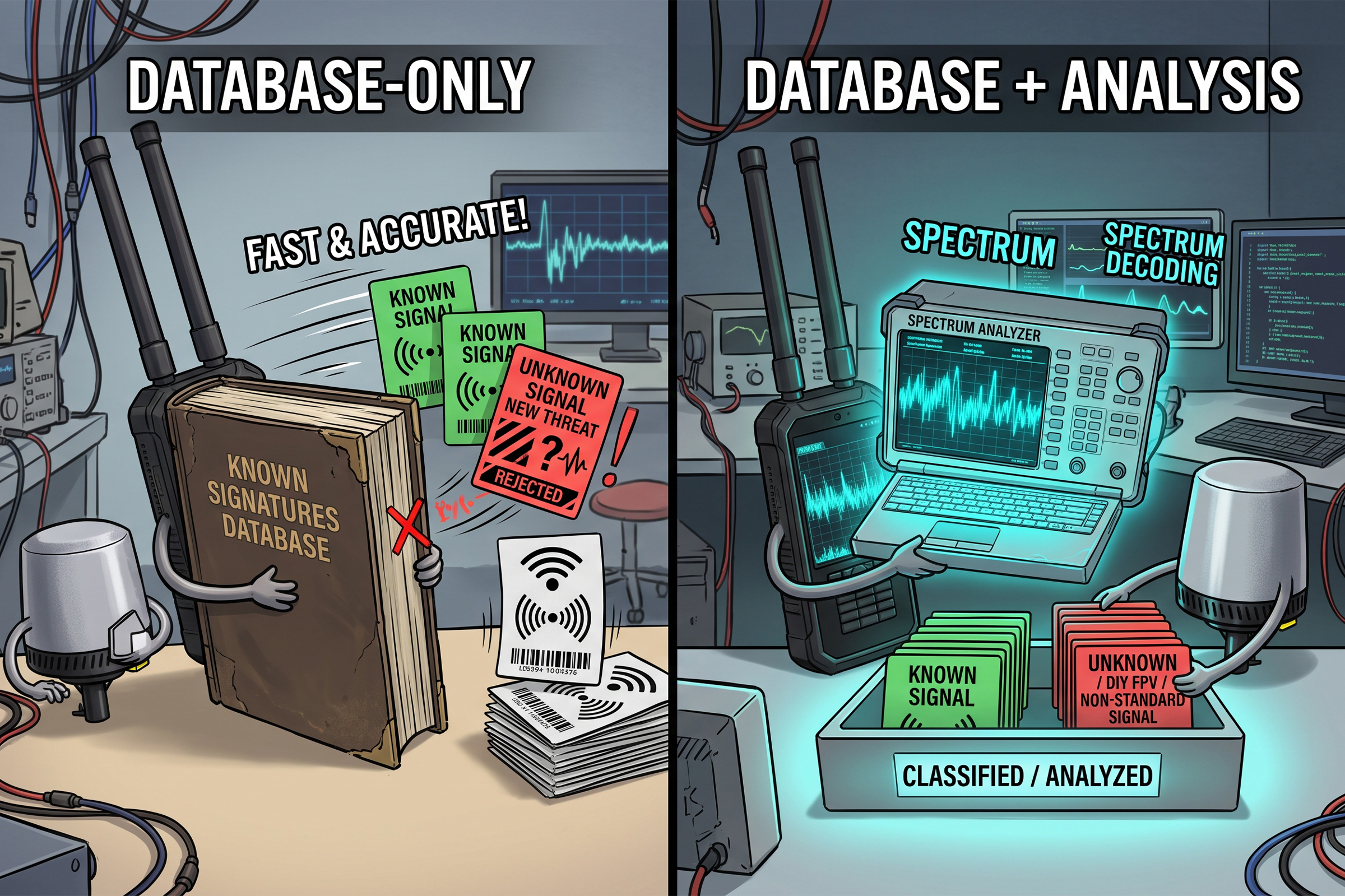
Portable detection has always come in two philosophical flavors, and the difference between them decides what the device can find. One approach matches what it receives against a library of known signals. If a drone’s control link matches an entry, the device names it. This is fast, inexpensive, and very accurate for the models in the library. It is also blind to anything the library has never seen.
The other approach analyzes the spectrum itself and asks not whether a signal matches a known entry, but whether it behaves like a drone link at all. This is harder; it needs more processing power, and it produces a classification rather than a name. Its advantage is that it can flag an aircraft no library contains, which is exactly the category that has grown fastest: small FPV builds, custom airframes, and low-cost machines assembled from parts that were never registered anywhere.
The two approaches are not rivals so much as different shifts on the same watch. A library answers quickly and precisely when it has seen the signal before. Spectrum analysis answers more slowly but keeps working when the signal is new. A device that does both covers the common case at speed and the unusual case with judgment, which is the combination that a field operator actually needs.
What Edge AI Actually Adds
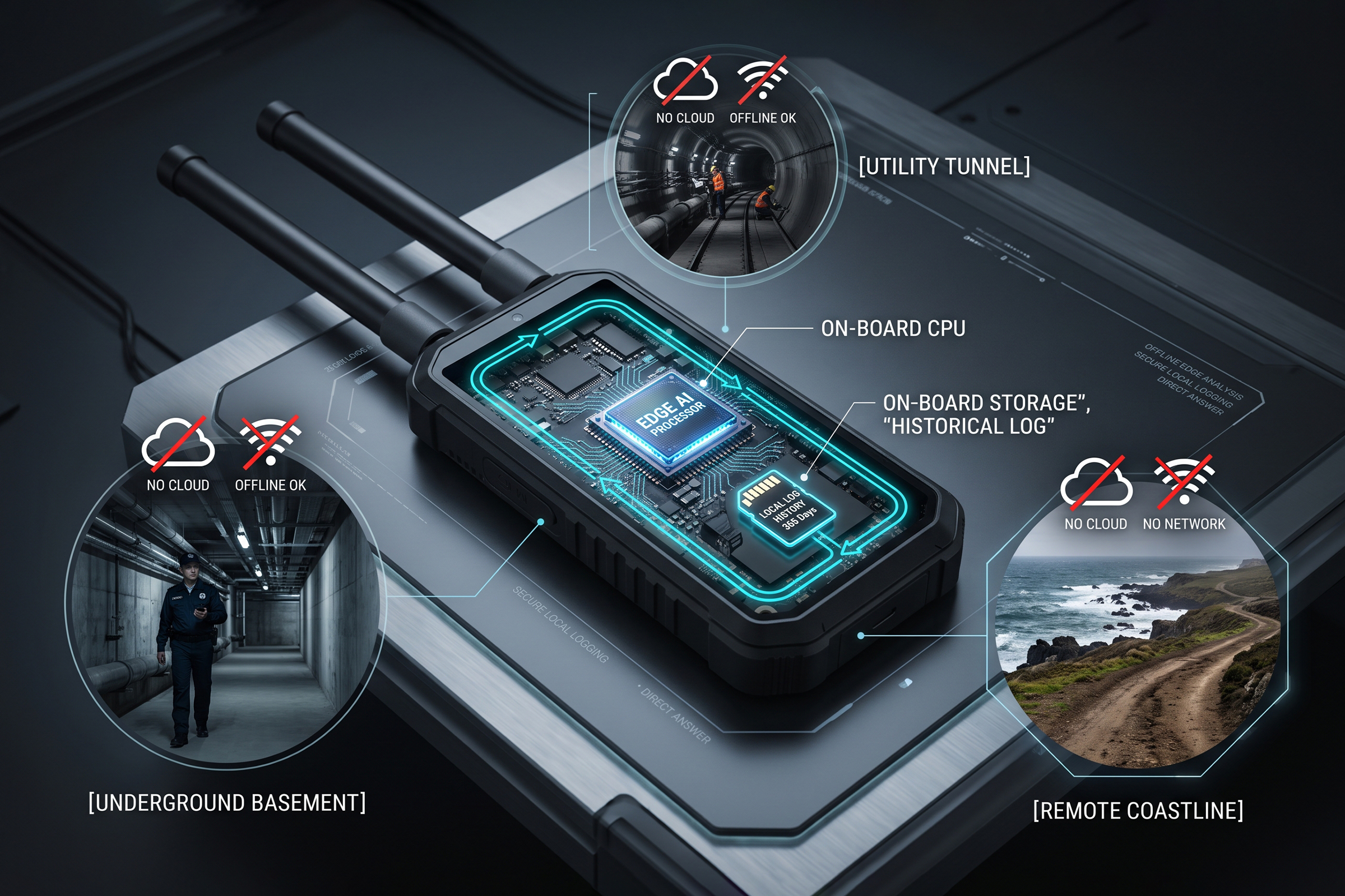
Running the analysis on the device rather than on a server is what turns that second approach into something a person can carry. A detector that ships its spectrum to a remote processor needs a network, waits for a reply, and stops working when the connection does. A detector that classifies locally keeps working in a basement, in a tunnel, on a shoreline with no coverage, and inside a building where the local network has been switched off for security reasons.
Local classification also changes what the device can be trusted with. When the analysis happens on board, the answer arrives in the time it takes the operator to look up, and it does not depend on a link that may be congested precisely when the airspace is busiest. For a portable tool, the latency of the answer is part of the answer, and the edge approach puts the latency where it belongs.
There is a third effect that gets less attention. On-device analysis produces a local record. Every reading is captured on the device whether or not a network is present, which means the operator can reconstruct what happened after the fact, and the organization can build its own picture of what normally flies over a given location. Over a year, that local history is more useful than any single alert, because it establishes the baseline against which an anomaly becomes visible.
The Case for Staying Passive
Both of these developments sit on top of an older design choice that has become more valuable, not less: the portable detector listens and does not speak. A passive device adds nothing to the radio environment it is monitoring, which keeps it usable in dense urban settings, near airports, and inside buildings where an active emitter would raise questions nobody has time to answer.
Passive operation is also the property that makes a network of portable detectors practical. Ten receivers can be deployed in a crowded area without any of them competing with the traffic they are trying to read, and without any of them needing a transmission license to be there. That is not a minor convenience. Most of the sites that need portable coverage, from a temporary event to a moving convoy, are exactly the places where the administrative path is shortest, and the tolerance for signal interference is lowest.
The practical consequence is that passive portable detection can go where an active system would need a permission that no one can obtain in time. A detector that can be switched on at a festival, a construction site, or a port without a regulatory process is a detector that actually gets used, and a capability that is not deployed protects nothing.
From an Alert to a Contribution
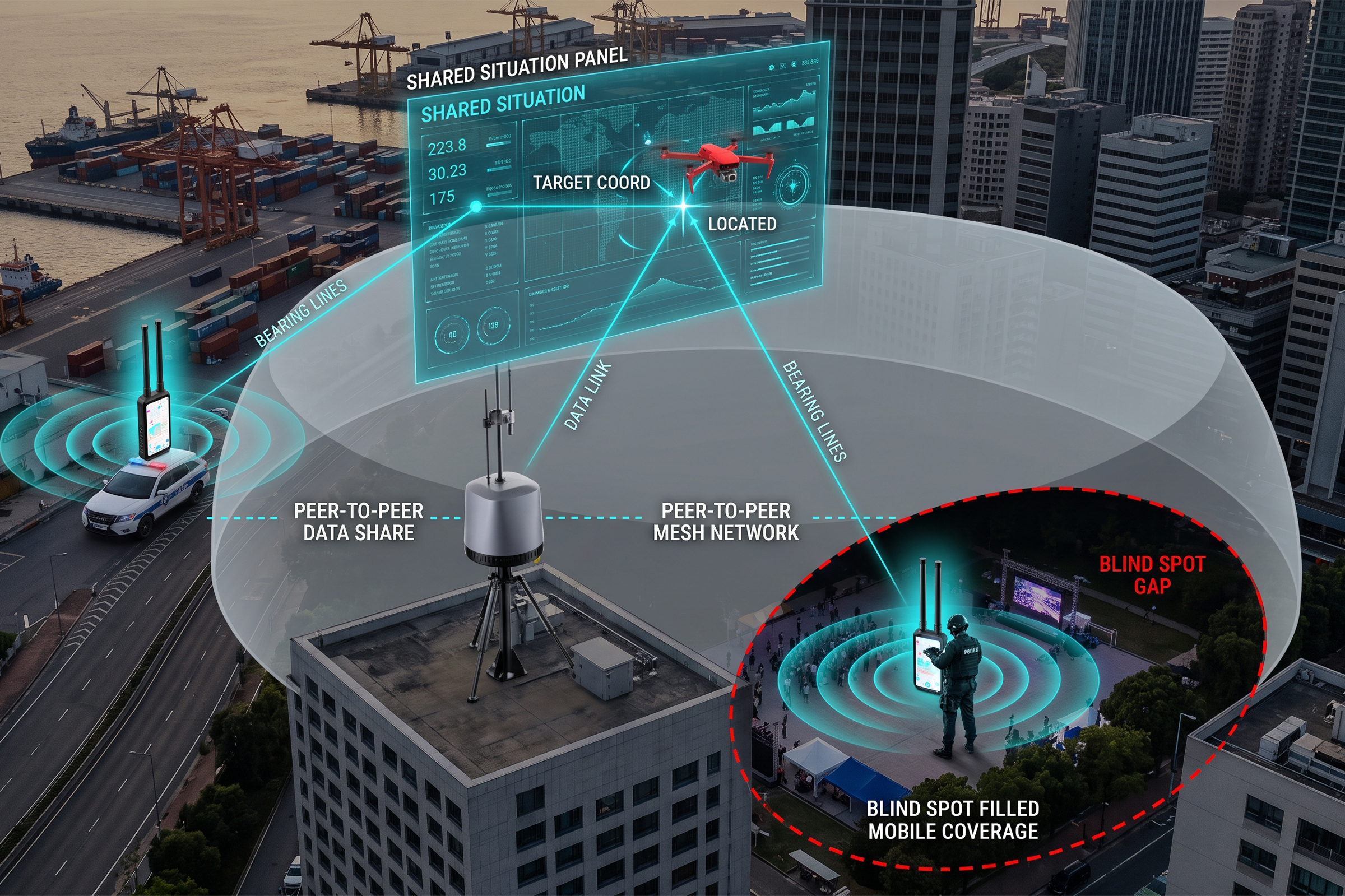
The change the October announcement makes visible is the move from an alert to a contribution. A standalone detector tells one person that something is overhead. A cooperative one tells the network where the signal is, what it looks like, and which other devices can see it, which is what allows a shared picture to exist without a fixed installation. Several portable sensors in different hands, reporting into one layer, cover ground that no single fixed site could cover.
That is also how a portable device earns a place inside an estate that already has fixed sensors. A fixed installation knows its own coverage well and its gaps equally well. A set of portable detectors carried by the people who move through those gaps turns the gaps into covered ground, and it does so without a construction project, a planning application or a mast. The contribution is not a better alarm. It is additional coverage that the network did not have before.
The value of that contribution rises with the number of devices. Two detectors in the same area already give a rough sense of direction, because each reports a different bearing to the same signal. A handful of them, reporting time-stamped readings into one layer, produce something closer to a position. The network effect here is not a marketing phrase. It is the arithmetic of how many bearings it takes to resolve a location.
Where Handheld and Portable Fit
Two form factors answer two different jobs. The handheld detector is built for the person who has to decide now. It is light enough to carry all day, it identifies a drone at the protocol level rather than only sensing energy, and it produces a position accurate to a few meters. The H3 Pro detects at up to three kilometers, follows more than eleven aircraft at once, and responds in under five seconds. It weighs under 600 grams without the antenna and runs for more than four hours on its built-in battery, across a temperature range of -25 to 65 degrees Celsius. It also works from a moving vehicle at speeds up to 80 kilometers per hour, which is what makes it useful for patrol and convoy duty rather than only for a static post.
The portable case answers a different question: what to bring when there is no infrastructure at all. The HD5 covers a continuous 100 MHz to 6 GHz span, runs for six to seven hours on a replaceable battery, presents its picture on a 13.3-inch screen, and travels as a single closed case under 14 kilograms. It is the unit that gets switched on at a site with no power, no mast, and no control room, which is the normal condition for a temporary event or an emergency deployment. Its range depends on the protocol it is reading and on how clean the local spectrum is, so the honest figure is a conditional one rather than a single headline number.
Offline Operation Is Not Optional
The edge approach also settles an argument that has run through portable detection for years. A device that depends on a cloud service is a device that fails on the day the service is unavailable, and the day a drone appears over a site is not the day to discover that the local link is down. Offline classification is not a feature to be traded against accuracy. It is the condition that makes the device usable in the places it was bought for.
The same logic applies to the network. A cooperative layer that assumes permanent connectivity will not survive contact with a remote site, a moving patrol or a building with its own security policy. A network of portable detectors should degrade into a set of working detectors when the link is lost, and recover into a network when the link returns. Anything else is a design that performs in the demonstration and not in the field.
Backward compatibility belongs in the same conversation. An organization that already runs fixed sensors and a command layer does not want a portable device that speaks only to itself. It wants one that reports into the picture it already has, so that the new coverage arrives as an addition rather than as a second system to manage. Interoperability is what decides whether portable detection extends an estate or fragments it. For LZ TECH, our portable detectors report into the same layer as our fixed sensors, so additional coverage arrives as an extension of the estate rather than as a second system to run.
Portable drone detection is changing faster than its form factor suggests. The device still looks like a box that a person carries, but the work it does has moved. A fixed library of known protocols is no longer enough on its own, because the fastest-growing share of the threat is the part no library has seen. Classification has to happen on the device, in the moment, without a network. And the result has to be shared, because a portable detector feeding a networked picture is worth far more than one that only makes a noise.
The direction the October announcement points at is therefore not about weight. It is about where the intelligence sits, whether the device can work alone, and whether it makes the whole network smarter. A portable detector that answers yes to those three questions is a sensing node. One that answers no is an alarm, and the market has started to price the difference.
Connect with us
Ready to Secure Your Low-Altitude Airspace?