Prison Drone Detection: Verified, Not Assumed | LZ TECH
Oct 28 2026
A drone that delivers contraband to a prison does not cross the wall at eye level. It comes over at eighty or a hundred metres, hovers for a few seconds above a roof or an exercise yard, releases a package of a few hundred grams and leaves. The fence, the patrol route and the camera on the gate were all built for a threat that arrives on the ground, which is why prison drone detection has less in common with perimeter security than most sales literature suggests.
On 21 October 2026, Reuters reported that France’s August legislation allows approved critical infrastructure operators and their contractors to detect, interfere with or bring down drones near designated facilities, with a plan to extend coverage to more sites by 2027. A pilot programme has already recorded three systems integrators and seventeen counter-drone solutions. Germany is examining a legal route for operator involvement, Austria has proposed a similar direction, and Poland authorises designated security staff to act in some restricted energy zones.
The regulation has moved from whether a site is allowed to look to who is allowed to act. For a prison the harder question sits between those two: what can the site prove. A detection that cannot be turned into a statement of fact, with a time, a position and an object class, changes nothing about the morning shift.
Why a Prison Is a Cylinder, Not a Fence
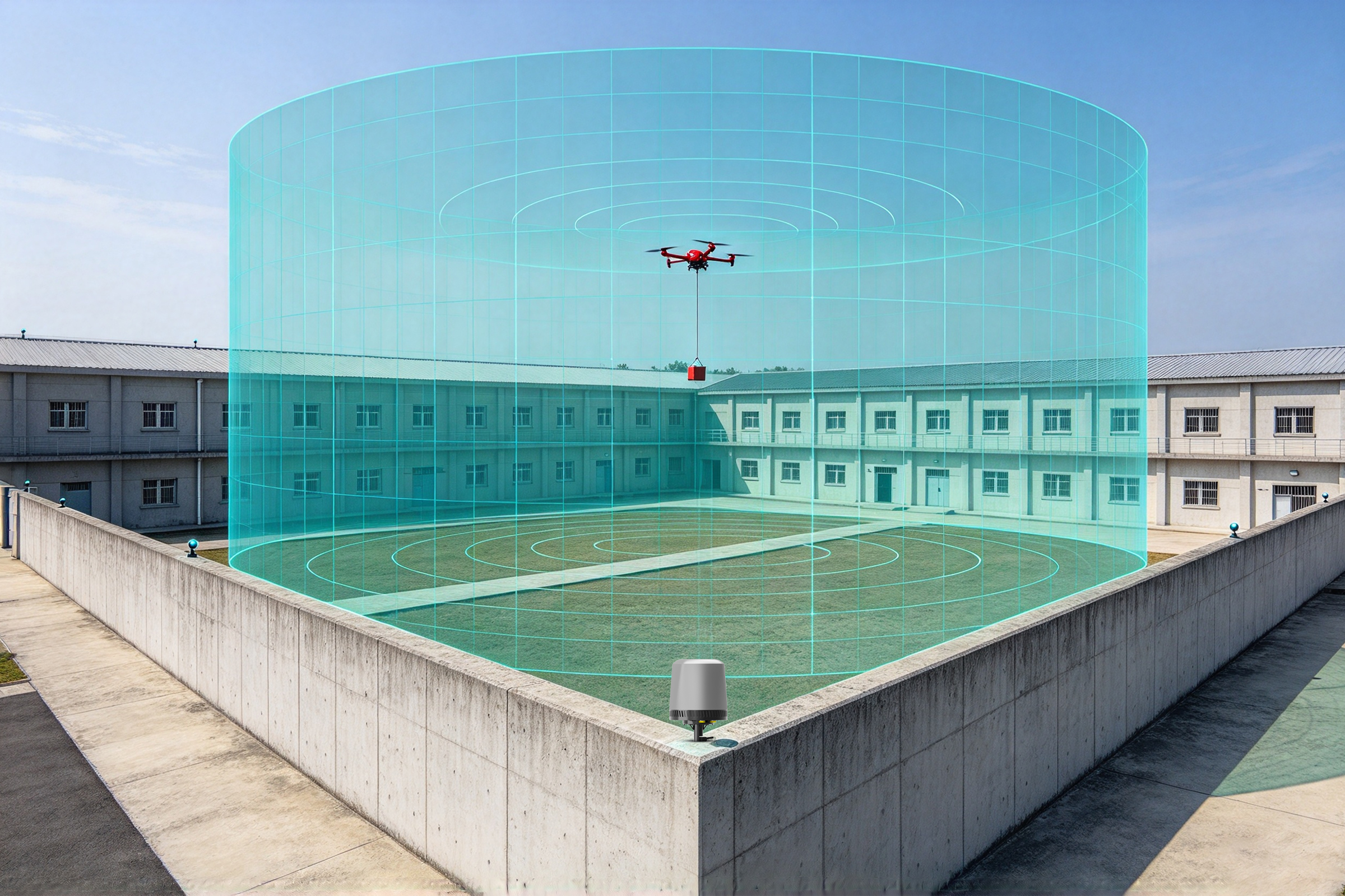
Perimeter security is one dimensional. A fence is a line, a patrol is a route, and a gate camera has a field of view that points outward along the ground. The aerial threat to a prison occupies a volume: roughly the footprint of the residential wings and the yards, extruded upward for a few hundred metres. The job is to know what enters that volume, from any direction, including straight down.
That geometry reverses the usual sensor layout. A mast on the wall aimed at the horizon covers the approach but leaves a cone of blindness directly above the site, and the drop point is inside the wire rather than outside it. Two consequences follow. The sensor that matters most is often the one looking at interior airspace. And the performance figure that matters is not maximum range but the shortest range at which a reliable track can be produced close in, where the aircraft is slow, low and close to structure that scatters radio energy in every direction.
A short detection at the drop point is worth more than a long detection at the boundary, because it is the one that names a wing.
What Actually Comes Over the Wall
Contraband that arrives by air is light. Phones, SIM cards, tobacco, prescription drugs, small tools. The payload is usually under a kilogram, well inside the capacity of a consumer quadcopter bought in a shop. The aircraft is not fast, does not fly high and does not need to be sophisticated. It needs thirty seconds of undisturbed hover above a roof.
So the specification should be built around small, slow, low targets at short to medium range, in an environment full of other radio traffic, at night, and it should be built around reliability rather than reach. A site that buys several kilometres of detection has bought warning time it can use. A site that buys the same distance and no way to fix a position has bought a siren.
Range does have one real contribution, and it is time. Three kilometres of warning gives a control room a minute or two to look, to call a patrol and to start a recording. Two hundred metres of warning gives the person at the screen nothing to do but watch.
Three Ways a Corrections Deployment Fails
The first failure is false alarms in a dense radio environment. A prison estate is a city block of radios: staff handsets, body-worn cameras, Wi-Fi across several bands, vehicle tracking, door systems, and a mobile network outside the wall. A passive detector that reports energy rather than identifying a protocol will find something to report every hour. The fix is protocol-level identification, so that a reading either carries a model, a serial number, and a control link, or it does not get escalated.
The second is night. Most deliveries happen after dark, and the optical confirmation chain changes character after sunset. Our VAR300 covers day and night with a 640 by 512 thermal core and detects a Mavic 3 class aircraft at one kilometre in daylight, tracking it at 1.5 kilometres; the same figures become 500 metres and 800 metres at night. Those are honest numbers for a small thermal aperture, and they mean the camera has to be placed where the geometry works rather than on the furthest corner of the estate.
The third is staffing. A prison at two in the morning has one officer on a console and a roster that does not flex. A system that needs a dedicated operator will be switched off within a month, quietly, and nobody will record that in the project review. Unattended operation with a reviewable record is not a convenience for this customer. It is the difference between a system that is used and a system that is installed.
A Gap That Passive Detection Cannot Close
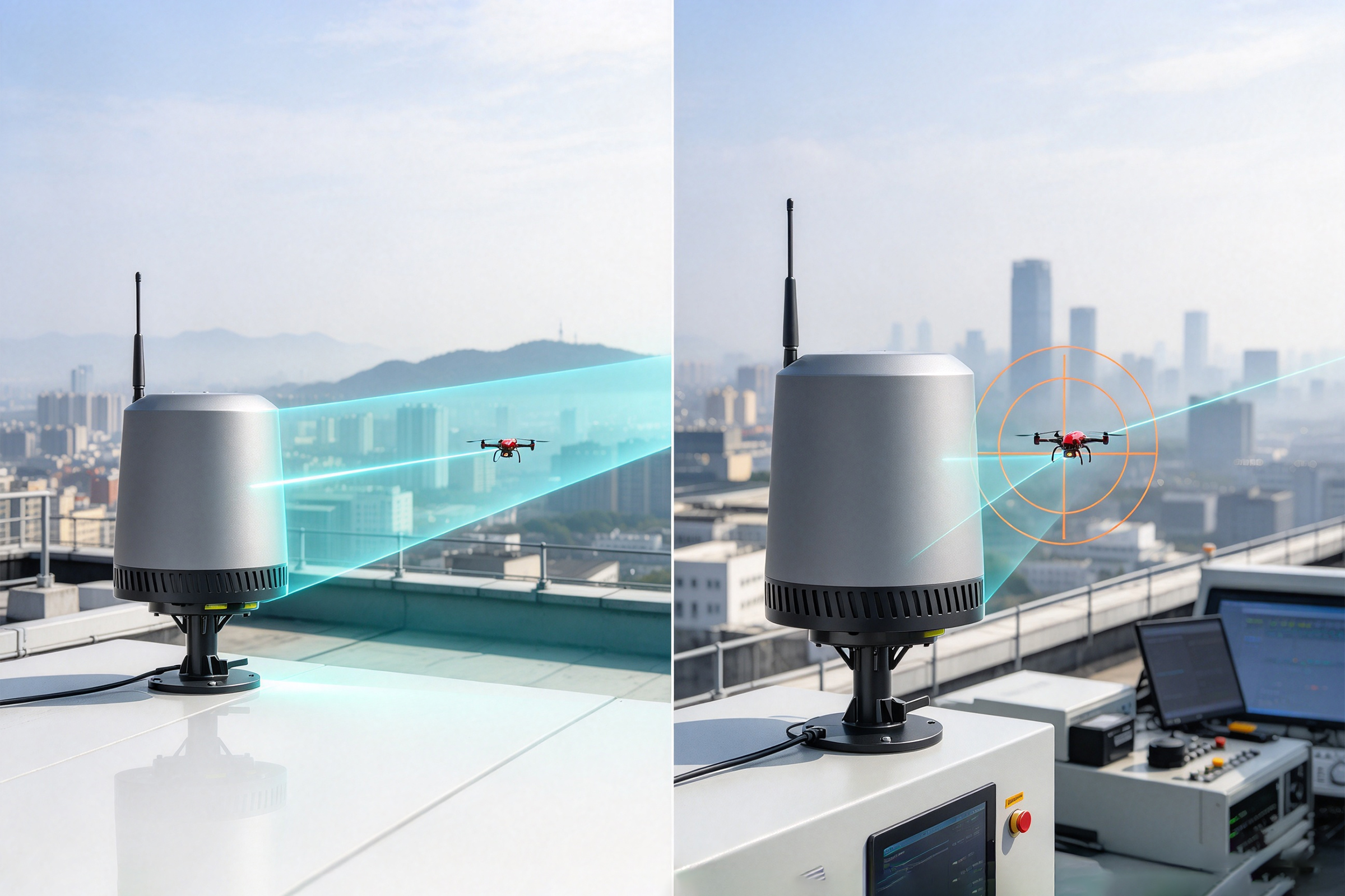
Radio frequency detection has one structural gap. An aircraft flying a pre-programmed route with no live control link emits very little to receive at the moment of the drop. That is the case no passive sensor handles, and it is exactly the case where a payload arrives without any operator nearby.
The answer is a second sensing mode alongside the radio layer, and the choice of that mode depends on the site’s geometry and clutter rather than on a catalogue. On a prison, the useful question is not which technology is better. It is which combination produces a position inside the protected volume, at night, in a site surrounded by metal and masonry.
What Verified Means in Practice
A bearing is a line, not a point. One direction-finding sensor says the aircraft is somewhere along a ray, and a control room cannot dispatch anyone to a ray. Two or more sensors reporting to one platform produce a fix, and the fix is what turns an alert into an instruction: east wing roof, north yard, exercise cage three.
D5-B is built for that step. It is a compact multi-node time difference of arrival locator covering 30 MHz to 6 GHz, with stated accuracy better than 10 metres root mean square, a response inside two seconds, more than 30 aircraft handled at once, a reference distance of three kilometres and coverage of 360 degrees horizontally and from 90 degrees below to 90 degrees above. It weighs three kilograms and draws about 60 watts, which is why an estate can mount nodes on existing structures instead of building masts.
The sequence that works on a corrections site has four steps. Passive radio frequency detection, which transmits nothing and therefore raises no licensing question, establishes that something is present and which protocol it speaks. Multiple nodes produce a position. An optical unit, cued by that position, confirms the object, separates a quadcopter from a bird and records it. The platform keeps the sequence as one event rather than three unrelated alarms.
T100 belongs at the fourth step rather than the first. It is a pointing tracker, not a search sensor: it accepts a track from a radio or radar source and turns it into a confirmed identification, with a long focal length daylight channel, a thermal channel and a wide-angle channel on one gimbal, and enough onboard compute to classify without streaming video to a server. For a site that already has detection, that is the cheapest way to add confirmation. For a site starting from nothing, the order runs the other way.
The Record Is the Deliverable
Corrections is an evidence environment. An incident may end up in a police investigation, a disciplinary hearing, a parole decision, an internal inquiry or an inquest, and every one of those audiences asks the same question in a different accent: how do you know?
That question is answered by a file, not by a feature list. The file needs a timestamp synchronised across sensors, a position with a stated accuracy, an object classification, a track history, and the image captured at the moment of confirmation. Our V4.0 software release tightened time synchronisation across a site to under one second, which matters because a track a minute out of step with a camera cannot place an aircraft over a specific roof.
The file also needs a retention rule. A camera aimed at the sky above a prison also sees the housing estate next door, and privacy law in most of Europe sets limits on how long that footage may be kept and who may look at it. A supplier who arrives with a retention policy and an access model is easier to approve than one who arrives with a hard drive.
The Authority Question, Handled Once
The French statute is the clearest statement so far that a civilian operator can hold a lawful route to action, and it is written with conditions: approved operators and contractors, designated facilities, a supervisory structure. Most other jurisdictions have not gone that far, and a prison service in those places can buy detection this year and cannot buy action.
This is why the platform matters more than the product list. An installation that begins as detection only, and can later accept an authorised response module without replacing the sensors or the software, survives a change in the law. An installation that ties detection to a single sealed unit does not. Where a response capability is fitted, it is enabled for authorised operators, under a written procedure and in accordance with applicable local law.
What a Corrections Tender Should Specify
Seven items decide whether the project works, and none of them is a headline range figure.
First, draw the protected volume in three dimensions, including roofs, yards and the airspace directly above them, and ask for coverage of that volume rather than a radius from a wall.
Second, ask for detection performance against a small quadcopter carrying a payload, at a stated height, in the site’s own radio environment.
Third, ask for a false alarm budget per 24 hours at a comparable site, in writing.
Fourth, ask for fix accuracy in metres, because a position names a wing and a bearing names nothing.
Fifth, ask for night confirmation range with the camera that will actually be installed.
Sixth, ask what an officer sees at three in the morning, and what the system does when nobody answers it.
Seventh, ask what the second prison inherits. A template is a platform decision made at the first site. Another project is a cost paid twice.

Where LZ TECH Fits
Our fixed detection line starts with DF10 in its current V2.0 configuration: 70 MHz to 8 GHz, a reference detection distance of up to eight kilometres, direction finding accuracy of about 3 degrees against a hovering target and about 10 degrees against a moving one, 100 watts or less, 13 kilograms without the antenna, rated from minus 25 to 60 degrees Celsius and sealed to IP66. On a prison it is the sensor that establishes presence at the boundary and hands a bearing inward.
D5-B supplies the position. VAR300 and T100 supply the confirmation, day and night. CCS is the layer that makes an estate out of them: device access and health, one map, alarms, allow and deny lists, warning and response zones, event records, statistics and an unattended mode, with CRPCS adding browser and mobile access plus workflow for sites that need to run a procedure rather than watch a screen.
We have supplied sensors and platforms to customers in more than 60 countries, and the pattern repeats in every corrections project. The site buys the picture first, because the picture is what a governor can defend.
The Bottom Line
A prison cannot close its airspace. It can name what crossed it, at what time, at what height and above which roof, and it can put that in a file that survives being questioned.
That is a narrower ambition than the industry usually advertises, and it is the one that matches the job. A wall was the right answer to a threat that walked through a gate. The next phase is not a taller wall. It is a verified air picture over a small volume of sky, held by a platform that a night shift can actually operate.
Connect with us
Ready to Secure Your Low-Altitude Airspace?