Procurement Moves Downstream: Why Civil Agencies Buy Detection Before Response
Oct 23 2026
On October 13, 2026, the government of New South Wales opened a procurement for drone detection across its prisons, after two suspected contraband deliveries in a fortnight and three arrests. Radio frequency detection and radar were named as the priority technologies. Three days later, Thailand’s civil aviation authority suspended general drone permits over a restricted zone in Bangkok to support the police counter-drone centre during the International Monetary Fund and World Bank meetings, with any flight connected to the event required to apply in advance, obtain special authorisation and coordinate with that centre.
Two procurements, two continents, and neither of them is a national security programme. One is a corrections service trying to stop contraband arriving over a wall. The other is a civil aviation regulator protecting an airspace for a week.
This is the part of the market that has moved fastest in the last two years, and it has moved in a direction the industry did not plan for. The customer is no longer a specialist who understands radar cross sections. It is a facilities manager, a prison governor, a police inspector or an airport operations officer. They read the same tender documents we do, and they bring a different set of questions.
Why Civil Agencies Became the Fastest Growing Buyers
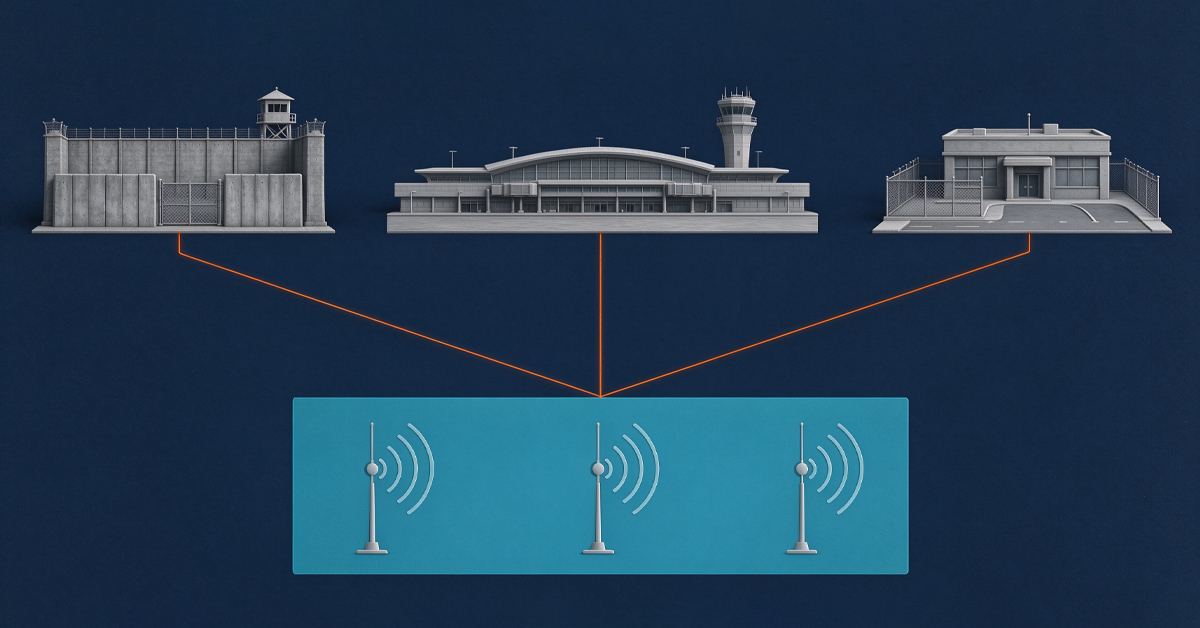
Four places in ordinary civil life have turned into drone problems in a short space of time, and each of them carries a legal duty that has nothing to do with national policy.
The first is the correctional estate. A prison is a walled perimeter with a known population and a contraband economy that has discovered a delivery route above the wall. The prison estate in the United Kingdom reported 1,497 drone incidents in a single year. A service that counts incidents at that volume is not asking whether drones are a problem. It is asking what to buy first.
The second is civil aviation. An airport does not close because of a policy preference. It closes because the tower cannot assure separation while an unidentified object is inside the approach path. The cost is measured in diverted arrivals and missed connections, and the person who has to explain it is an operations director.
The third is the public event. A summit, a finance meeting, a stadium fixture or a national celebration produces a temporary restricted zone with its own rules, its own permit process and a fixed date. There is no time to build anything permanent, and no tolerance for a system that needs three months of site work.
The fourth is the city itself. A police force that receives reports of drones over a hospital, a substation or a crowd has to respond with the staff it already employs, on the shift roster it already runs.
None of these buyers is looking for a national capability. They want an operational answer to a nuisance, a safety risk or a crime, and they want it inside an existing legal framework and an existing budget line.
The Three Costs a Civil Buyer Actually Counts
Civil agencies evaluate a counter-drone system differently from a specialist buyer, because three costs dominate their calculation and range is not one of them.
The first is acquisition, and it is the least interesting. Every supplier can quote a price for a box, and the boxes are more similar than the brochures suggest.
The second is regulatory friction. A device that transmits needs a licence, a licence needs a process, and the process needs a decision maker who may not exist for this category of equipment in that jurisdiction. A device that only receives needs none of that. For an agency that has a date on the calendar, the difference between a four-week deployment and an eighteen-month approval is the entire project.
The third is operating labour. Every additional screen, every additional login and every additional report is a person-hour taken from a roster that is already full. A system that needs a dedicated operator is a system that a prison cannot staff at night and an airport cannot staff at peak. A system that runs unattended and leaves a record someone can review in the morning fits the staffing these organisations actually have.
There is a fourth cost that appears later and surprises buyers: the cost of a false alarm. A civil site with a genuine operational job has no spare people to investigate three tracks an hour, and an operator who is asked to investigate noise stops investigating. Sensitivity without a workable false alarm rate is not a feature. It is a staffing problem disguised as a specification.
Why Passive Comes First
Passive detection means receiving only. The sensor reads the radio link between an aircraft and its controller, and it transmits nothing of its own.
That one property produces three advantages that civil buyers value above range.
It removes the licensing question. A receiver that emits nothing does not require a frequency authorisation in most jurisdictions, which means it can be installed and used while a legal review of other options is still underway.
It removes the interference question. A prison inside a residential area, a hospital campus, a port and an airport all share a low tolerance for radio emissions of unknown effect. A passive sensor adds nothing to the local spectrum, so it can run beside aviation radio, public safety radio and building systems without a coordination study.
It produces evidence as a by-product. A passive sensor that logs what it hears builds a record of the radio environment over time, which is the raw material for both operational decisions and legal proceedings. For an organisation that may have to justify an action in front of a regulator, a court or a public inquiry, that record is not a bonus feature. It is what makes the purchase defensible.

The Authority Gap Is Normal, Not a Failure
The New South Wales case is worth reading closely, because it describes a problem that has nothing to do with technology.
The procurement is for detection. The prison officers’ union simultaneously asked for a change in the law so that officers could use portable electronic equipment to force a drone to land. The service can buy the ability to see an aircraft approaching with a payload. Under current law it cannot act on what it sees.
This gap is not unusual and it is not evidence of a bad purchase. It is the normal sequence in civil procurement. Detection is legally simple, technically mature and easy to justify to a finance committee. Response is legally complex. It needs an authorised operator, a defined procedure, a record of the decision and an accountable chain that survives review. Most agencies reach detection first because that is the part they can approve, and they add response when the legal framework catches up.
Suppliers who treat that sequence as an obstacle tend to lose the deal. Suppliers who design for it, so that a detection-only installation can later accept an authorised response module without being replaced, tend to keep the customer for a decade.
A Response Ladder Where Only the Last Step Is Conditional
The response question is where the language in this industry gets sloppy, and where the compliance boundary matters most.
A useful frame has four levels. The first is awareness: the site knows something is present. The second is characterisation: the site knows what it is, where it came from and where it is going, which is what passive radio frequency detection with direction finding provides. The third is documentation: the event is recorded with time, position, track and classification, in a form that survives review. The fourth is action, and action is where authorisation, local law and operator qualification decide what is available at that site on that day.
The first three levels are unrestricted in most jurisdictions and they carry most of the value, because a documented detection is enough to trigger an existing procedure. That procedure might be a patrol dispatch, an airspace notification, a search of a compound or a prosecution. All of them work without any device that affects the aircraft.
The fourth level is conditional. Any capability that affects an aircraft in flight must be deployed under authorisation and in accordance with applicable local law, with a named operator, a defined procedure and a record of the decision. That is not a disclaimer bolted onto a product page. It is the design constraint that determines what a supplier should offer an organisation whose legal position is not yet settled.
Matching the Form Factor to the Site
Three shapes cover most of what a civil agency needs, and the choice is decided by the site rather than the specification sheet.
The handheld detector answers the officer or the duty manager who has to check something now. The H3 Pro detects at up to three kilometres, follows more than eleven aircraft at once and responds in under five seconds. It weighs under 600 grams without the antenna, runs more than four hours on its internal battery, works from minus 25 to 65 degrees Celsius and operates from a moving vehicle at up to 80 kilometres per hour. That last figure is what makes it a patrol tool rather than a fixed post.
The portable case answers the site with no infrastructure and no data to build any. The HD5 covers a continuous 100 MHz to 6 GHz span, runs six to seven hours on a replaceable battery, presents on a 13.3-inch screen, and travels as one closed case under 14 kilograms. It is what gets switched on at a summit venue, a construction compound or an emergency cordon where there is no power, no mast and no control room. Its range depends on the protocol being read and on how clean the local spectrum is, so the honest figure is conditional rather than a single headline.
The vehicle answers the moving perimeter. VM covers 30 MHz to 6 GHz for detection at up to three kilometres, holds about 3 degrees of direction-finding accuracy against a hovering target and about 10 degrees while moving, and operates at vehicle speeds up to 80 kilometres per hour. The unit weighs about 60 kilograms in an IP66 housing rated from minus 40 to 60 degrees Celsius. Where a response option is fitted, it is enabled only for authorised operators under the procedures described above.
For a permanent site, the DF Series passive direction finding sensors read the control link without transmitting. DF10 in its current V2.0 configuration covers 70 MHz to 8 GHz across minus 25 to 60 degrees Celsius. One unit gives a bearing; several units reporting to one platform give a position, which is why the fixed part of a civil deployment is usually specified in numbers rather than in range.
What a Civil Tender Should Ask For
Because these buyers are new to the category, the questions they write into a tender matter more than the answers they receive.
Ask for a false alarm rate measured over a stated period at a comparable site, not a detection probability. Ask what the system does when the network is unavailable, because a prison wing and a temporary venue both lose connectivity. Ask who owns the recordings, and whether they can be exported in a format a lawyer can read. Ask what happens at the end of the support period, and whether the installation still detects. Ask how a second site would be added, because the second site always comes.
None of those questions favours one supplier. All of them make the tender harder to answer with a brochure, which is the point.

The Bottom Line
The civil market arrived without a strategy document, because it was created by individuals solving local problems: a governor with contraband over the wall, an operations director with a diverted arrival, a commander with a summit in three weeks.
They buy detection first because detection is what they can approve, deploy and defend, and because a documented track is enough to trigger the procedures they already run. Response comes later, when the law catches up and the budget allows it.
For LZ TECH, that is the sequence our passive product line is built around, with the command layer ready to accept an authorised response module when the customer’s authority to use one exists. An agency that starts with detection has not bought an incomplete system. It has bought the part of the problem that can be solved this year.
Connect with us
Ready to Secure Your Low-Altitude Airspace?