Stadium Drone Security: Detection, Identification, and Mitigation for Major Sporting Events
Aug 07 2026
Every summer, the global sporting calendar puts tens of thousands of people in outdoor stadiums. The Olympic Games, the Premier League, the MLB season, the UEFA European tournaments. For security directors at these venues, the checklist is long. Crowd management, access control, perimeter monitoring. One item that used to be near the bottom has been moving up the list fast: drone incursions.
The numbers tell the story. Between 2019 and the end of 2025, the UK AirproX Board recorded over 600 drone-related incidents across the country, many involving large public gatherings. France’s civil aviation authority reported at least 60 confirmed drone sightings over prohibited French airspace during the 2024 Olympic Games period alone. These are not hypothetical scenarios. They are data points from events that already happened.
A drone over a stadium creates three problems at once. First, there is the physical safety risk. An out-of-control drone falling into a crowd is a kinetic event. Second, there is the operational disruption. A confirmed drone sighting during a match forces organizers to decide within seconds whether to pause the event, evacuate sections, or continue and hope. Third, there is the reputational damage. Video of a drone hovering over a packed stadium goes viral before security has even identified the operator. A stadium that cannot secure its airspace is a stadium that loses public trust.
This article walks through a layered approach to stadium drone security: passive detection to find the drone, electro-optical verification to confirm the threat, and directional jamming to neutralize it. The goal is protection without disruption. A full stadium should not have to be empty because one person flew a drone too close.
The stadium detection challenge
Stadiums are among the hardest environments for drone detection. The same characteristics that make a stadium a good venue make it a difficult RF environment. Metal roof structures reflect signals. Tens of thousands of mobile phones create background noise across multiple frequency bands. Broadcast equipment, Wi-Fi networks for press and operations, and public safety radio systems crowd the spectrum. A detection system that works in an open field may struggle in a stadium with a full crowd on game day.
Passive RF detection is the first layer because it addresses the core challenge without adding to it. The DFJ Series is an all-in-one detection and jamming system designed for fixed-site deployment. For stadium use, the DFJ83 model begins with detection across 30 MHz to 6 GHz, covering the frequency bands used by almost all commercial and consumer drones. It identifies the drone model, serial number, GPS coordinates of both the drone and its remote controller, altitude, speed, and heading. All of this happens without the sensor emitting a signal. The drone and its operator have no way of knowing they have been detected.
The DFJ83 achieves direction-finding accuracy of 3 degrees for a hovering drone and 10 degrees for a moving target. In a stadium setting, where seconds matter, that bearing tells the security team roughly where in the sky to look and roughly where the operator is standing. The detection range extends to 8 kilometers. In practice, this means a drone approaching a stadium can be picked up while it is still kilometers away, giving the team several minutes of decision time before it enters the exclusion zone.
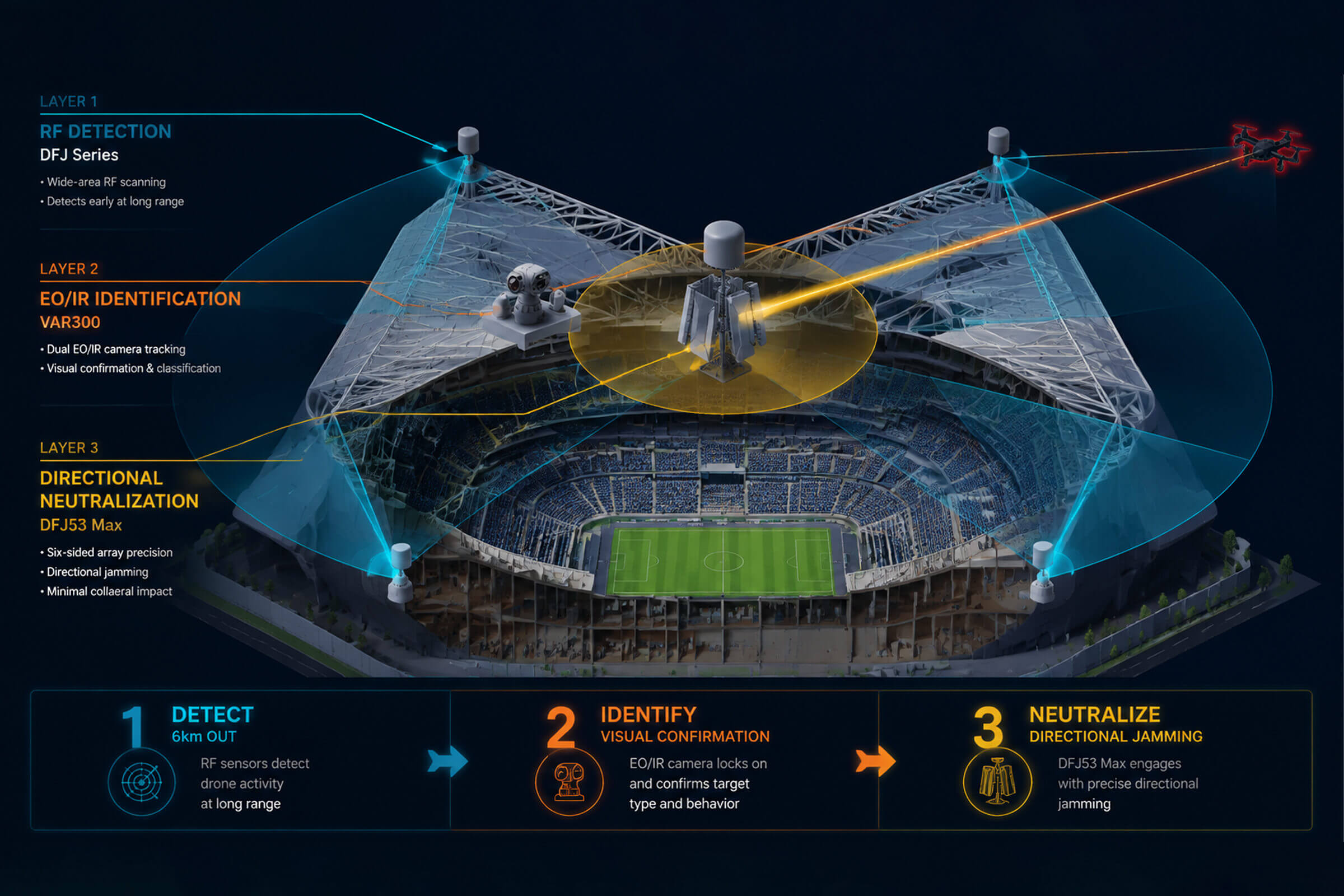
For stadium deployments that require 360-degree coverage with zero gaps, the DFJ53 Max is the higher-specification option. Its six-sided high-gain shield array uses adaptive beamforming to create a full-circle defensive perimeter. Detection spans 400 MHz to 6 GHz with a range of up to 5 kilometers. The system detects mainstream UAVs, FPV racing drones, and custom DIY builds. It operates autonomously 24 hours a day, 7 days a week, and integrates its detection and mitigation functions into a single closed loop: identify, track, neutralize. The zero-blind-spot design matters at a stadium where a drone could approach from any direction, and a gap in coverage means a gap in security.
Seeing what RF detects: the VAR300 verification layer
RF detection tells the security team that a drone is out there and gives a bearing and approximate position. For a stadium where the response protocol requires escalation before any disruption to the event, that approximate fix is not enough. The team needs visual confirmation before they act. They need to know the drone is real, what it looks like, and whether it is moving toward the venue or just passing nearby.
The VAR300 is a fixed electro-optical and infrared surveillance system that provides that confirmation. Once an RF sensor hands off a target bearing, the VAR300 slews its dual thermal and visible-light cameras toward the bearing and begins autonomous tracking. In daylight, it detects a DJI Mavic 3 at 1 kilometer or more and maintains tracking beyond 1.5 kilometers. At night, its VOx uncooled infrared detector with 640 by 512 resolution detects the same target at 500 meters and tracks it at 800 meters. The built-in AI recognition engine classifies objects and suppresses false alarms from birds, aircraft, and other moving objects in the sky.
For a stadium security director, the VAR300 solves a specific problem. The clock starts ticking the moment an RF detection alert appears. Without visual confirmation, the only safe option is to treat every alert as a real threat. That leads to unnecessary event pauses and crowd disruption. With visual confirmation from the VAR300, the team can distinguish a real drone incursion from a false alarm in seconds rather than minutes. The camera’s screen shows the captured image, the target similarity score from the AI classifier, and the real-time bearing. The decision to escalate becomes an informed one rather than a reflexive one.
Airborne coverage for stadium blind spots
A stadium’s physical structure creates detection blind spots that ground-based sensors alone cannot resolve. The underside of a roof overhang. The approach corridor is blocked by a neighboring high-rise. The sector is masked by the stadium’s own lighting towers. A drone that comes in low along one of these shadow zones can pass under the beam of every fixed ground sensor on the property.
The D5-Air is an airborne RF detection payload that mounts on a standard commercial UAV platform such as the DJI M400 or M350. From its airborne position, it scans 400 MHz to 6 GHz and achieves a detection range of up to 5 kilometers. It feeds received signal data in real time back to the ground station, where it integrates with the DFJ Series and VAR300 data streams through the CCS command platform. The D5-Air spends its flight time above the stadium periphery, looking down into the zones that ground sensors overlook. When the event ends, it lands. During the event, it fills the gap.
From detection to response: the jamming decision
Not every drone detection requires a jamming response. Some drones are simply passing overhead at altitude with no relation to the event. Some are operated by the media with accreditation. But when a drone is identified as a genuine threat, the response needs to be fast, precise, and contained. A stadium packed with 60,000 people cannot tolerate broadband interference that disrupts mobile phone service, broadcast equipment, or emergency communications.
Directional jamming is the solution to that constraint. The DFJ83 jams drones across bands at 900 MHz, 1.5 GHz, 2.4 GHz, 5.2 GHz, and 5.8 GHz, with each band configurable independently. Its effective jamming range extends to 3 kilometers. The jamming is directional rather than omnidirectional. It targets the specific bearing where the drone and its operator are located. The rest of the stadium, including mobile networks, Wi-Fi, and broadcast frequencies, remains unaffected.
The DFJ53 Max takes directional precision further. Its six-sided high-gain shield array with adaptive beamforming produces 360-degree high-power directional jamming that focuses energy on the threat axis. The beamforming technology steers the jamming signal electronically rather than mechanically, so there are no moving parts to maintain and no lag time while an antenna rotates. The system suppresses the drone’s image transmission, data link, and navigation link simultaneously. The affected area is a narrow cone centered on the drone, not a wide circle around the stadium.
An integrated workflow: from seconds to resolution
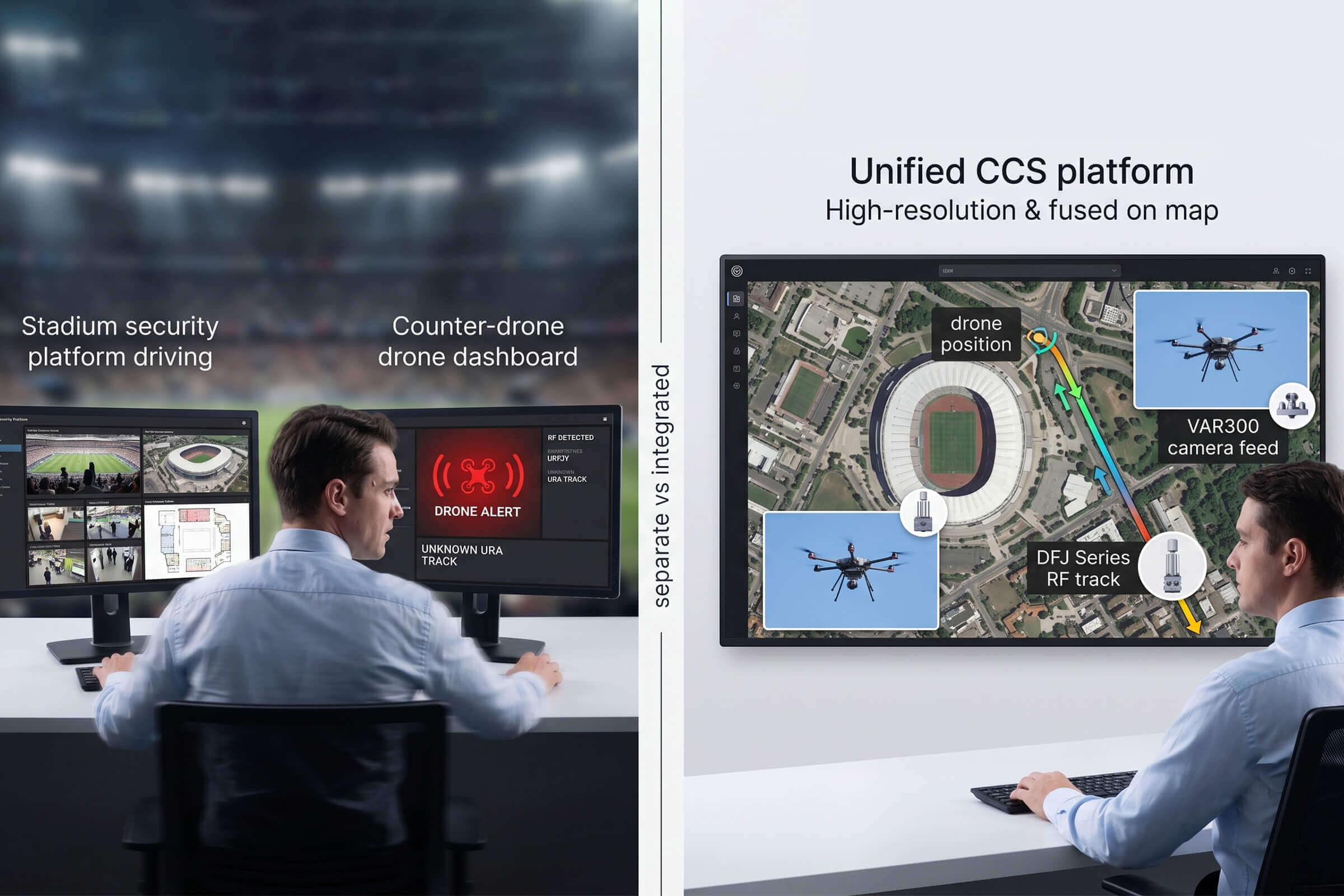
The pieces fit together in a sequence that, when rehearsed, takes the security team from detection to resolution with clarity at each step. A drone enters the detection perimeter at 6 kilometers, picked up by a DFJ83 or DFJ53 Max node positioned on the stadium roof. The CCS platform receives the alert and presents the drone’s model, position, altitude, speed, and operator location on a single map. The VAR300 camera slews to the assigned bearing and begins visual tracking. The security director confirms the threat visually on the VAR300 feed. If the drone continues toward the exclusion zone, the jamming system is activated on the specific bearing. The drone loses its control and video link and either returns to its home point or descends immediately. The event continues uninterrupted.

This workflow does not depend on any single product working perfectly. The RF detection system provides range and identification. The electro-optical system provides visual confirmation and AI classification. The airborne sensor covers the blind spots. The directional jamming system provides precision neutralization that respects the electromagnetic environment of a packed stadium. Each layer handles what it handles best. The platform ties them together.
For stadium operators planning their airspace security for the 2026-2027 season, the technology exists. The implementation is a matter of site survey, sensor placement, and integration testing. The season calendar does not wait.
Connect with us
Ready to Secure Your Low-Altitude Airspace?