The Counter-Drone Procurement Shift: From Single Devices to National C2
Oct 14 2026
For most of the past decade, counter-drone procurement worked like a hardware purchase. A site found a gap in its coverage, bought a detector to fill it, added a countermeasure where the rules allowed one, and considered the perimeter handled. That model still exists at the low end of the market. At the top of the market, it is being retired, and the first nine days of October 2026 made the retirement visible in public documents.
Three announcements landed inside a single week. EOS, the Australian systems house, signed a contract worth about 370 million pounds with an undisclosed Gulf Cooperation Council government to build a nationwide counter-drone system, with MARSS NiDAR as the AI command layer and EOS acting as prime contractor and integrator. NATO DIANA used its Rapid Adoption Service for the first time, awarding capability development contracts to seven companies from six nations, with validation planned at a live trial event in the Czech Republic. And Intelic, a Dutch company, won a 30 million euro award from the Netherlands for an airspace security upgrade built on its Nexus software, which sits above radars, sensors and cameras from several different vendors.
Read separately, these are three unrelated news items about three different customers. Read together, they describe one change. None of the three purchases is mainly a device. Each one buys a layer that sits above the devices, a command and control function that turns many inputs into one operational picture. And each one assumes that the picture will keep being supported for years after the hardware is delivered. That is a different kind of purchase, and it changes what a supplier has to be good at.
Three Deals, One Direction
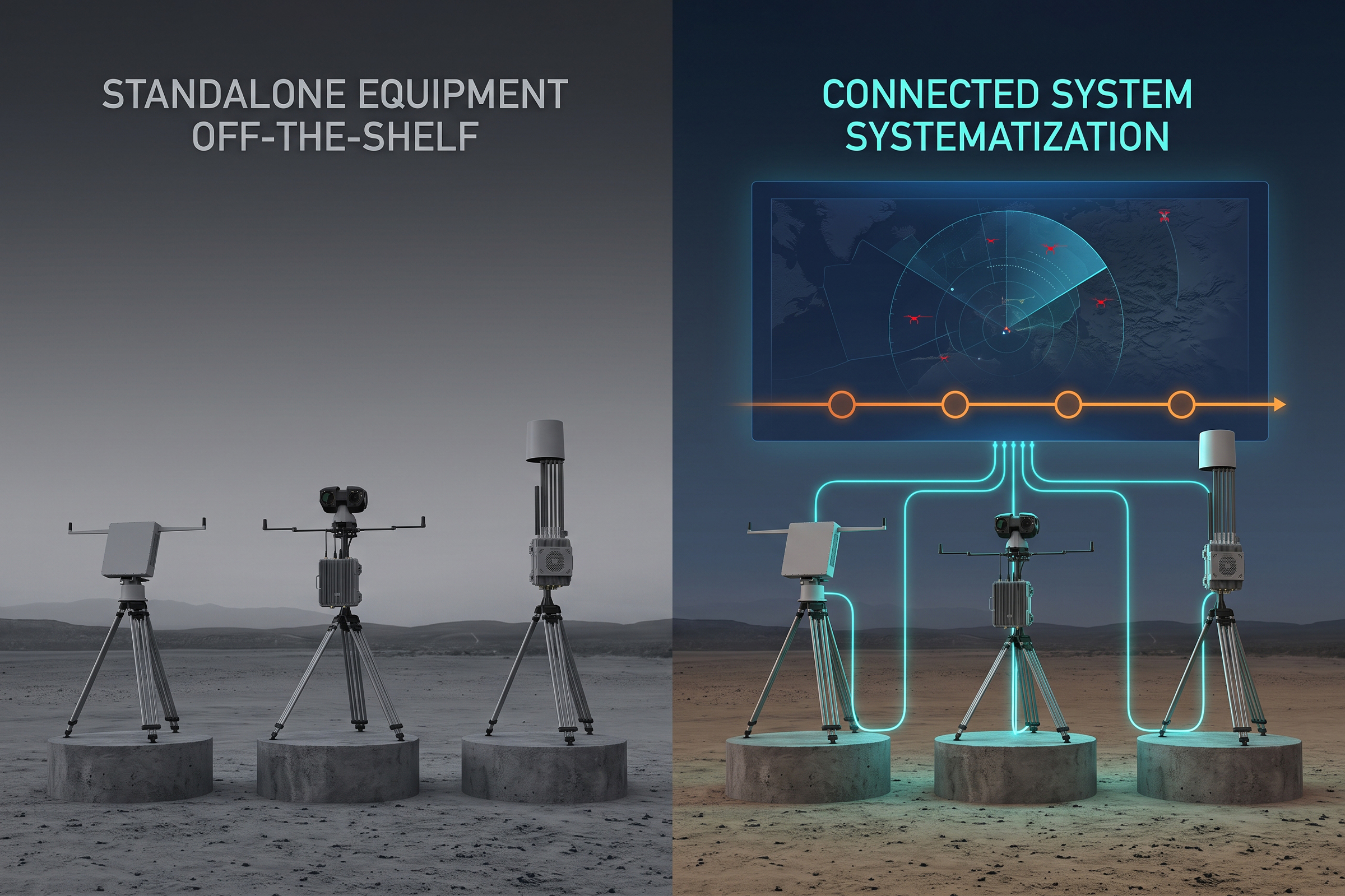
The three programs differ in almost every respect except their shape. One is national and dispersed, designed to cover a whole country rather than a short list of fixed sites. One is a fast evaluation route, in which short contracts and field trials replace a multi-year specification cycle. One is an airspace security upgrade that deliberately does not replace the sensors the customer already owns. Different geographies, different budgets, different procurement cultures, and the same underlying question: how do you connect a mixed set of sensors, from more than one vendor, into something a single operator can act on?
That question is the reason the three deals exist. A country that has already bought radar from one supplier, cameras from a second, and radio frequency detection from a third does not need a fourth sensor. It needs something that makes the first three work as one. The award structures in all three cases point at the layer above the hardware, because that is the layer that decides whether a mixed estate behaves like a system or like a shelf of unrelated products.
The budget context makes the direction harder to dismiss as a coincidence. NATO has stated that member nations plan to spend more than 40 billion dollars on counter-UAS capability over the next five years. Money at that scale does not get spent on individual detectors site by site. It gets spent on structures that can be procured once and extended repeatedly, which is precisely what a national command layer is.
The Buyer Is Buying a System, Not a Sensor
When the object of the purchase is the integration layer, the comparison at bid stage changes. A buyer is no longer asking which sensor sees furthest. The buyer is asking which supplier can absorb hardware it did not manufacture, carry it into one picture, and keep that picture accurate as the estate grows. A specialist with one excellent sensor can lose to a generalist with an adequate sensor and a strong interface, because the interface is now the part the customer cannot build alone.
This is also why the integration layer has to be read as two separate jobs. One job is aggregation: taking feeds from many device families, normalizing them, and presenting a single view. The other job is interpretation: working out what a given contact actually is. A platform that aggregates without interpreting floods the operator with undifferentiated tracks. A platform that interprets without aggregating gives a good answer about one sensor and nothing about the rest of the estate.
The seam between vendors is where most real programs fail. Two sensors that each perform well in isolation can behave badly together if their clocks are not aligned, if their coordinate frames are not reconciled, or if their alert logic is not harmonized. That seam is invisible on a datasheet and obvious in operation, and it is the reason buyers now weight integration experience above raw specifications. The supplier who has already solved the seam problem is worth more than the supplier who has the best single number.
Why Long-Term Service Moved Into the Contract
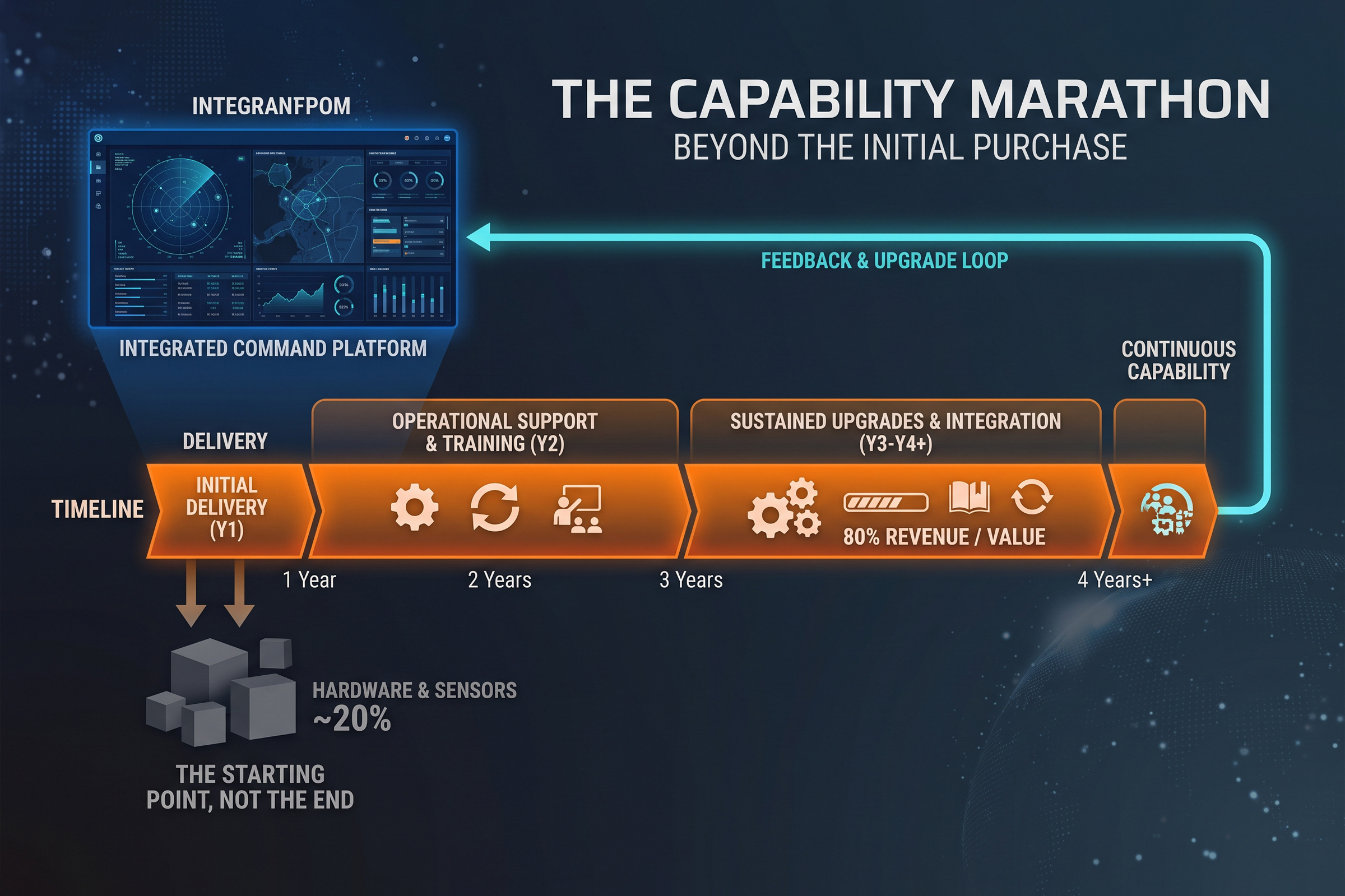
The financial structure of the EOS award is the clearest evidence of how the market has changed. Roughly 80 percent of the revenue is expected to be recognized 12 to 24 months after the contract becomes unconditional, and around 20 percent is tied to four years of support services. A fifth of the contract is a commitment to keep the system working, not to build it. Buyers are now writing sustainment into the original award instead of treating it as a later problem.
That has consequences on both sides of the table. For the buyer, it converts a capital purchase into a capability that has to be maintained, trained on, and updated as the threat changes. For the supplier, it moves the revenue from a single delivery event to a multi-year obligation, and it makes the quality of local support a bid criterion rather than a courtesy. A supplier who cannot staff a support function in the customer’s region is now exposed before the award, not after it.
The same logic runs through the arrangement at EOS in the other direction. A contract that is conditional on bank guarantees, advance payments and export licenses is a contract in which the commercial and regulatory work is as heavy as the engineering work. Winning the technical evaluation is a milestone, not the finish. Programs at this scale are won by suppliers who treat licensing, financing and support as part of the product.
Where Open C2 Decides the Bid
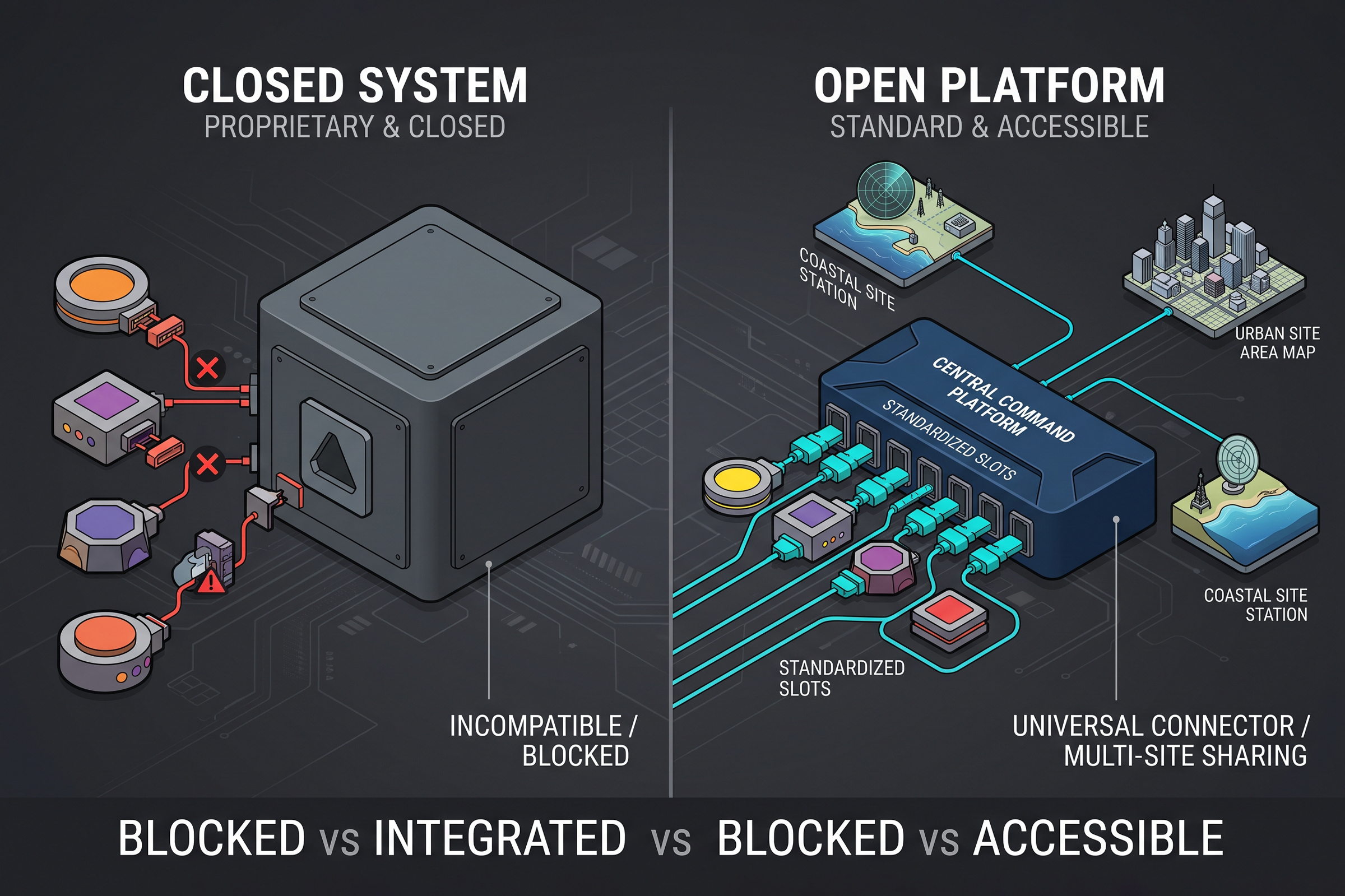
If the purchase is a layer above the sensors, then the openness of that layer decides who is allowed to compete. The Intelic approach is the clearest illustration: the Nexus software does not ask the customer to replace existing radars and cameras; it connects them, and the value it claims lies in shortening the path from detection to a decision. A closed platform can also do this, but only for its own hardware, which is a shrinking share of most national estates.
This is the design logic behind our CCS command platform and the CRPCS protocol layer. CCS is built to accept feeds from many device families and present one operational picture across sites and regions, so a customer can add or replace hardware without rebuilding the command layer. CRPCS sits closer to the signal itself and reads the drone’s own control and telemetry link, which allows the same platform that aggregates sensors to also classify what is flying, including machines that are not announcing an identity at all.
The two functions answer two different questions on the same screen. Aggregation answers where the contact is and which sensor saw it. Protocol-level reading answers what it is and how it is being flown. A program that buys only the first gets a map. A program that buys both gets a classification layer, and the classification layer is what lets an operator decide rather than merely react.
Evidence Is Becoming Part of the Product
The NATO DIANA structure points at the second half of the same shift. Instead of a long specification followed by a large order, the program runs short contracts, then live trials, then a documented result, and only then national procurement decisions. The trial is not a formality at the end of the process. The trial is the process. What gets purchased afterwards is the evidence as much as the hardware.
For a supplier, this raises the bar in a specific way. It is no longer enough to publish a detection range in a brochure. The claim has to be reproducible, in a named environment, against a named target, with the conditions written down. A vendor whose numbers only hold in a clean setting will be found out during the trial, and the trial result follows that company into every subsequent bid it enters.
The shift also rewards a particular kind of documentation. A trial that produces a raw log is worth less than a trial that produces a log an evaluator can read: what was detected, at what distance, in what conditions, from which sensor, at what time. Evidence in that form is reusable across programs, which is why suppliers who invest early in recording and reporting end up with an advantage that compounds. It is also the same evidence that a support contract needs in order to improve the system after delivery.
What This Means for Buyers and Builders
For a buyer, the practical checklist has changed shape. Start with the interface, because a command layer that cannot absorb third-party sensors will lock the estate into one supplier for a decade. Insist on a protocol-level identification capability alongside aggregation, because a map that cannot say what is flying is not a decision tool. And write sustainment into the award, because the system that is hardest to support is the one that quietly stops being updated.
For a builder, the lesson is about where to invest. A sensor that is excellent in isolation but invisible to a command layer is a component, and components are compared on price. A sensor that arrives with a documented interface, reproducible test data, and a support plan is a system element, and system elements are compared on the strength of the whole. The October awards went to suppliers who understood that the customer was buying the whole.
Counter-drone procurement at the top of the market has stopped being a device purchase. The EOS award, the NATO DIANA route and the Intelic contract all buy a layer above the sensors; they all assume a mixed estate assembled from several vendors, and they all stretch into years of support. That combination changes what a serious supplier has to offer: not the longest range on a datasheet, but an open command layer, protocol-level identification, evidence that survives a trial, and a support organization that outlasts the delivery. For LZ TECH, the three October awards describe the market our line was built for: an open command layer, protocol-level identification, and hardware that behaves as a system element rather than a standalone box.
None of this is a surprise to anyone who has followed public purchasing over the past two years. October simply made it explicit in three separate contracts at once. Buyers who act on it will build estates that can absorb new sensors as the threat changes. Builders who act on it will stop selling devices into a market that has already moved on.
Connect with us
Ready to Secure Your Low-Altitude Airspace?