When Drones Reach the City: Protecting Civilian Infrastructure at Ground Level
Sep 17 2026
A United Nations fact-finding mission reported in early September 2026 that drone attacks in one conflict accounted for more than a thousand deaths in the first five months of the year. The mission’s language was careful, as such reports must be, but its list of targets was not: hospitals, schools, markets, camps for the displaced, and the electricity, fuel, and water systems that keep a city alive. The finding is a specific conflict’s record. The pattern is a general warning, and it travels far beyond any one country’s borders.
What the report describes is a shift in where the drone threat lands. It is no longer only a matter of front lines and defended positions, if it ever was. It is a matter of the places civilians live, and the systems they depend on, and those places were never designed to be defended.
The Threat Has Moved Downstream
Civilian infrastructure has a particular vulnerability, and it is not that it is valuable. It is that it is everywhere, and it cannot be hardened the way a single high-value site can. A power station, a water plant, a hospital, a market: each is a node in a network that a city needs constantly, and none of them can be sealed off without breaking the very service it is meant to provide.
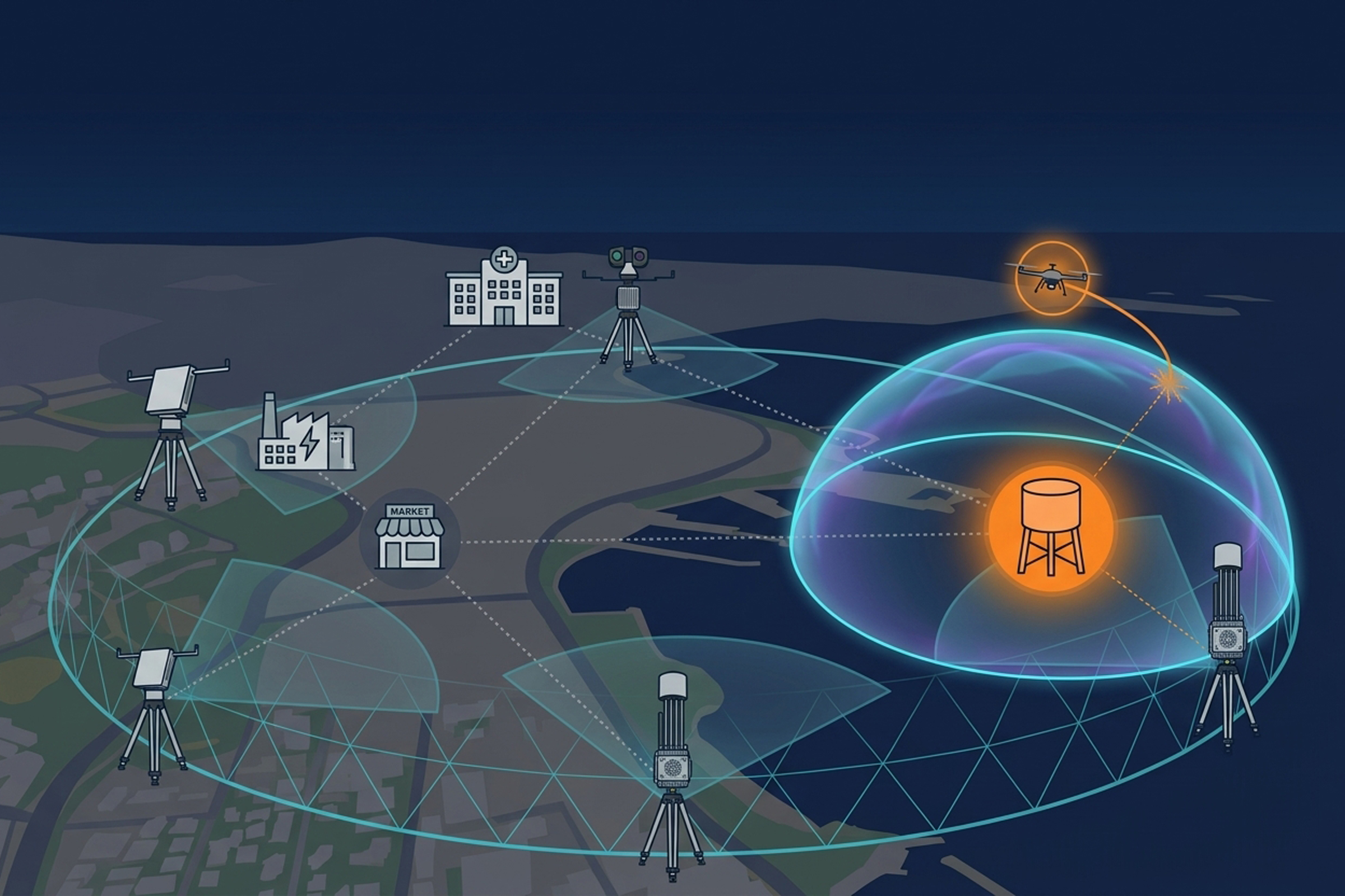
The geography makes it worse. Critical infrastructure is often placed where the land is cheap, and the neighbors are few: the edge of town, the outskirts, the route along a fuel line or a water course. Those are exactly the places that are hardest to watch, because they are far from the grid, far from the cameras, and far from the people who would notice something wrong. A drone does not have to penetrate a defended perimeter. It has to find an unguarded node, and civilian infrastructure is full of them.
The Off-Grid Problem Comes First
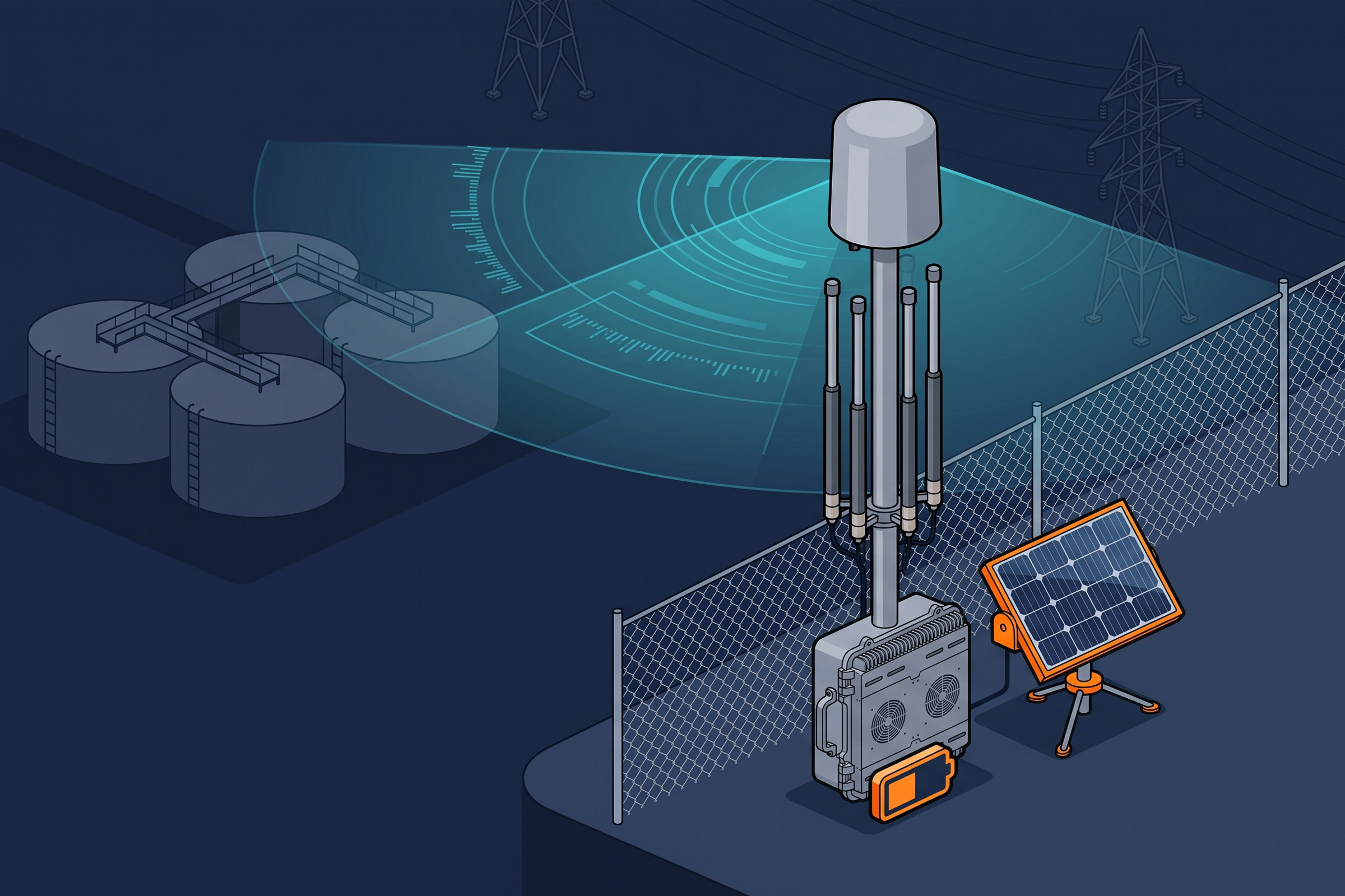
Any plan to protect this kind of infrastructure starts with a basic constraint: the sites that need protection most are often the ones with the least reliable power. A sensor that depends on mains electricity is a sensor that goes dark the moment the grid it is protecting goes down, which is precisely the moment it is needed. The first requirement for infrastructure protection is therefore not sensitivity. It is that the detection layer keeps running when everything around it has stopped.
This is why low-power, passive sensing matters at the ground level. A passive node that draws tens of watts can run on solar and battery, surviving the outages and the fuel shortages that define the environments where this threat is worst. The DF Series of direction-finding sensors is built for this: passive, low-power, and able to be placed at a remote node and left to watch without a permanent installation crew or a generator on site.
Detection Without Adding Risk
There is a second constraint that civilian sites impose, and it is the opposite of what a hard-target site might choose. At a power plant or a fuel storage facility, the last thing an operator wants is a detection layer that transmits aggressively. Fuel and electricity sites are sensitive environments. A system that radiates can interfere with the equipment it is protecting, and it draws attention to itself in exactly the way a defensive layer should not.
Passive direction-finding sidesteps the problem. It emits nothing, so it cannot interfere with the site’s own systems and cannot be found by the operator it is trying to detect. It listens for the radio signals a drone cannot avoid emitting: its control link, its telemetry, its video feed. The DF Series reads that energy across 30 MHz to 6 GHz and returns a bearing, turning an invisible approach into a known contact without adding a single signal of its own to the site.
Placing the Contact, Then Seeing It
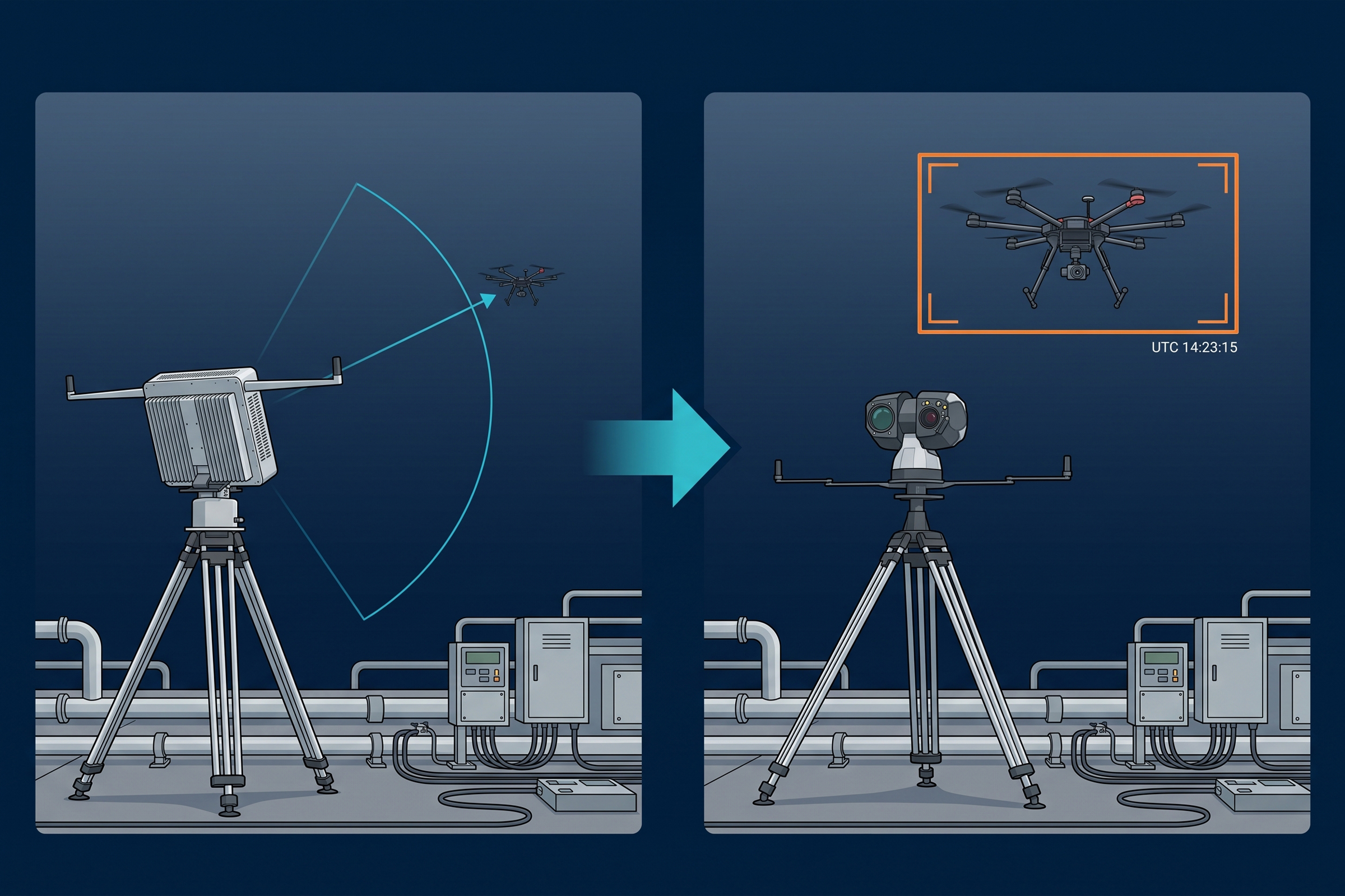
A bearing alone is not enough at a spread-out site. The operator needs to know where the contact is, not just which way to look, and then needs to see it with enough clarity to decide. The DFJ53 Max adds directional precision to the detection layer, covering 400 MHz to 6 GHz and resolving the contact’s direction tightly enough to cue the next step. The VAR300 electro-optical and infrared tracker then takes that position and locks onto the aircraft visually.
The sequence matters. The RF layer works through darkness, weather, and distance, which is what makes it the right first line at a site that cannot count on a clear day. The optical layer then confirms what the RF layer found, turning a radio contact into a picture the operator can act on and record. For a hospital or a water plant, that confirmation is what separates a defensible response from a guess, and it is what builds the record that follows any serious event.
Layering for a Site That Cannot Afford to Miss
A civilian site faces a different arithmetic than a hardened one. It cannot treat every contact as a threat, because the noise level is high: delivery drones, hobby flights, survey aircraft, and the ordinary traffic of a working city. But it also cannot afford to miss the one contact that matters, because the cost of a hit is measured in lives and in the failure of essential services.
The answer is layering, and it is the same logic that works at an airport or a border, scaled down. The detection layer watches continuously and passively, catching anything that emits. The positioning layer turns contacts into coordinates. The confirmation layer sees the target and builds the record. Each layer is passive, so the site can run all of them without regulatory or safety complications. The result is not a fortress. It is a tripwire stretched around a node that was previously unwatched, and that tripwire is what turns a surprise into a decision.
The Bottom Line
The UN report is a single conflict’s accounting, but the pattern it records is the important thing. The drone threat has moved into the places civilians live and the systems they depend on, and those places were never built to be defended. The sites that respond will not do it with harder perimeters or bigger sensors. They will do it with a detection layer that is passive, low-power, and off-grid, that places a contact precisely, and that confirms it with a picture.
For a power station, a water plant, or a hospital, that is the difference between being an unguarded node in a network and being a node that sees what is coming. The threat is not going to spare the places that are hardest to defend. The only real answer is to make them less hard to watch.
Connect with us
Ready to Secure Your Low-Altitude Airspace?