NATO’s $40 Billion C-UAS Pledge: What It Means for Counter-Drone Procurement
Jul 10 2026
At the Ankara Summit, 32 NATO allies agreed to spend more than $40 billion on counter-drone capabilities over five years. Here is how the C-UAS Marketplace changes procurement, which technologies will get certified, and what the spending wave means for the industry.
Introduction
On July 7, 2026, NATO leaders wrapped up the Ankara Summit with a figure that reset the counter-drone industry’s sense of scale. Thirty-two member nations committed more than $40 billion to C-UAS capabilities through 2031. They also announced a C-UAS Marketplace, a certification-led procurement framework that lets any member buy from any certified vendor without running their own tender process. And they set a target to train five times more drone operators by the end of 2027.
This is not a report. It is a funded mandate with a procurement vehicle attached. Stack it on top of the World Cup $250 million C-UAS deployment in the US, and 2026 is the year counter-drone graduated from a niche military program to a structured, certifiable, multi-billion-dollar procurement category.
Here is what the NATO announcements mean on the ground. Who benefits first. What technologies are best positioned for certification. And what procurement teams should be thinking about right now.
The numbers: $40 billion over five years
The $40 billion figure covers the full capability chain: detection, tracking, identification, neutralization, command and control, and operator training. It is not a single NATO budget line. Each member nation funds its own procurement against agreed capability targets. But the C-UAS Marketplace changes how that money actually flows.
Before the Marketplace, if Lithuania wanted a counter-drone system, it wrote its own RFP, ran its own evaluation, conducted its own trials, negotiated its own contract. A vendor that qualified in Estonia had to go through the same gauntlet again in Portugal. The Marketplace flattens that. A system that passes NATO C-UAS certification becomes available to all 32 members through a shared procurement mechanism. One certification. Thirty-two markets. That is the structural shift behind the spending number.
Other items from the Ankara communique:
- NSPA signed several hundred million euros in surveillance drone contracts.
- Belgium and the Netherlands signed an MOU for joint air defense system procurement. That is two midsize NATO members pooling demand to get better terms from suppliers.
- Five times more trained drone operators by end of 2027. Hardware without operators is a very expensive paperweight, and NATO knows it.
- A dedicated C-UAS working group under the Defence Investment Pledge will standardize threat assessment and certification criteria across all 32 nations.
The C-UAS Marketplace: certification becomes a license to sell
The Marketplace is the structural piece that matters most. NATO already runs similar frameworks for ammunition and communications equipment. Applying that model to counter-drone means the alliance has decided C-UAS is a standardized domain, not a collection of one-off experiments. That changes what vendors build and how buyers buy.
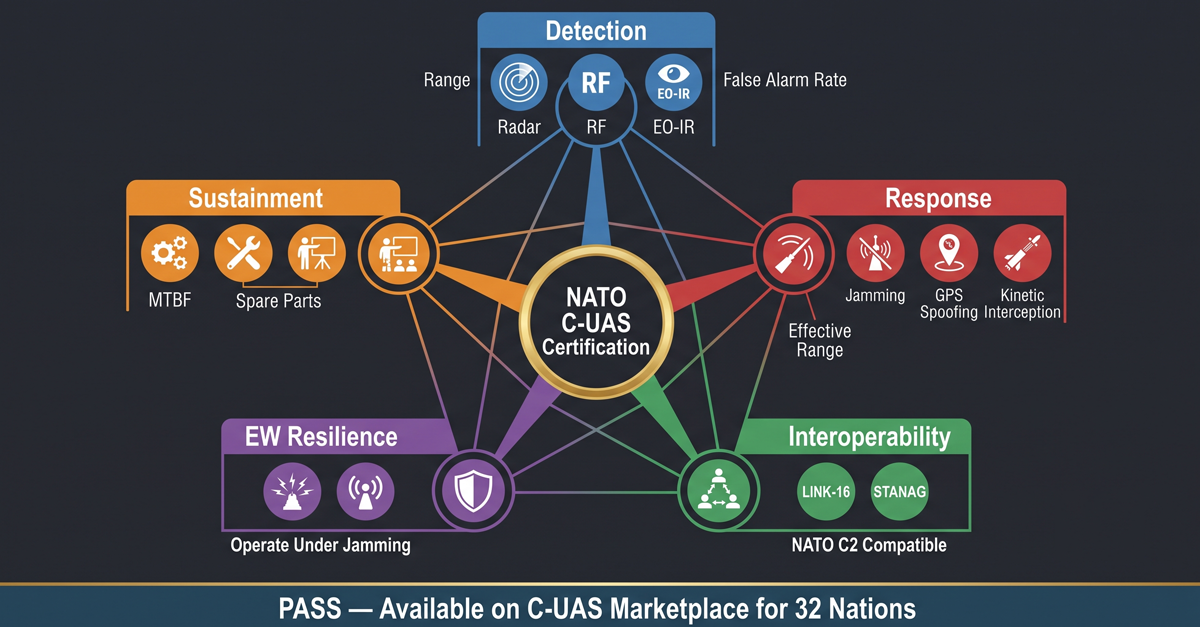
Here is what certification will likely evaluate:
- Detection range and false alarm rate against NATO-specified drone types. Not just DJI consumer models. The test set will include military fixed-wing UAS, loitering munitions, and multi-drone swarm scenarios.
- Response effectiveness: for jammers, effective range and frequency coverage. For spoofing, GNSS constellation support and spoof accuracy. For kinetic intercept, hit probability and safe standoff distance.
- Interoperability: the system feeds data into NATO-standard C2 platforms using LINK-16, STANAG 4586, or equivalent. A closed proprietary dashboard is dead on arrival.
- Electronic warfare resilience: certified systems operate when the other side jams back. Self-protection and graceful degradation under EW attack are baseline, not optional.
- Deployment and sustainment: mean time between failures, field repair procedures, spare parts availability across member nations with different logistics chains.
For a C-UAS vendor, NATO certification is not a marketing badge. It is a procurement key. Without it, you sell to individual nations, one RFP at a time, each with its own qualification cycle. With it, any NATO member can place an order through the Marketplace without repeating the evaluation. That turns a fixed certification cost into a 32-nation addressable market.
Who benefits first from NATO C-UAS certification
European C-UAS companies are the most immediate winners. They are physically inside NATO member states. They have existing relationships with national procurement offices. Their installed base makes field validation faster because the testing authority can visit an active deployment rather than arranging a bespoke trial from scratch.
DroneShield supplies RF detection and handheld jammers with military deployments across several NATO countries. Dedrone runs RF and radar detection at airports and government sites throughout Europe. Sentrycs does protocol-based identification and takeover, with prison and infrastructure deployments that give it operational data no lab test can replicate. Robin Radar makes bird and drone radar for European military airfields. MBDA and Thales bring missile-based kinetic C-UAS from the air defense side, systems that already conform to NATO munitions standards.
The wildcard is non-European vendors whose technology fills gaps that the European incumbents do not address well. Protocol-level detection. OEM components that drop into existing radar stacks. Modular form factors built for third-party integration. Those are three entry vectors where NATO certification creates a path that did not exist before the Marketplace existed.
What the NATO checklist is missing: identity
The certification criteria as currently described cover range, frequency, EW hardening, and C2 interoperability. All of those are necessary. None of them answer the question that drives every engagement decision: who is flying the drone?
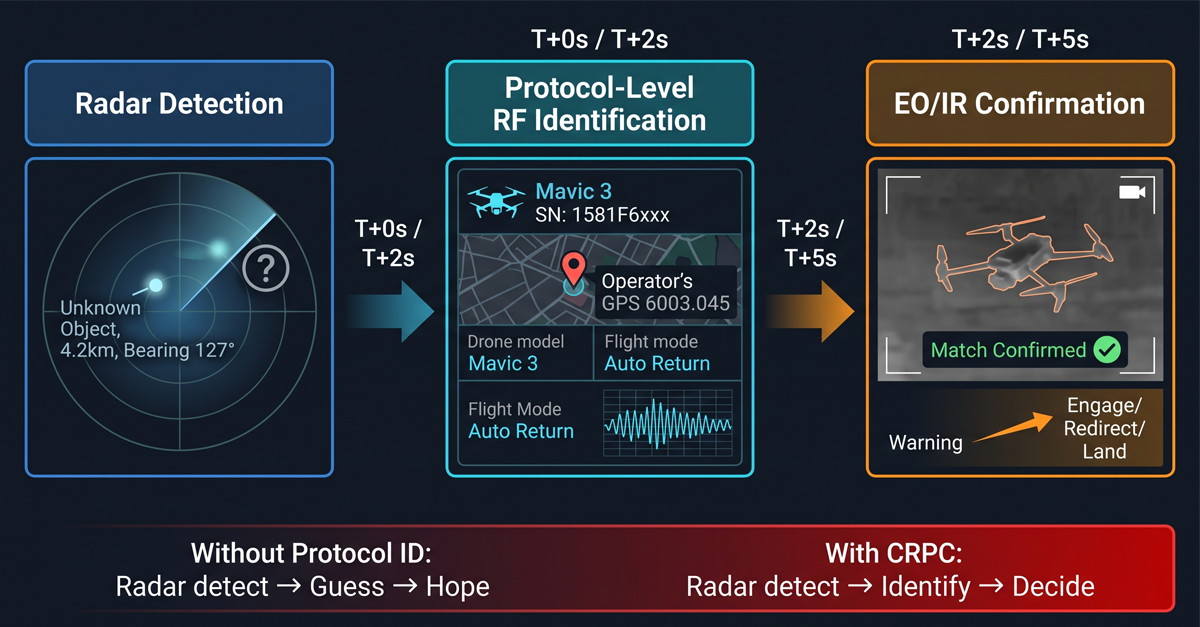
A radar tells you there is an object at 4.2 kilometers, bearing 127 degrees. It cannot tell you whether it is a DJI Mavic flown by a local hobbyist or a fixed-wing military drone executing a pre-programmed recon route. An RF jammer can break the control link. It cannot tell you the operator’s location or the drone’s serial number. Identity is what separates a diplomatic incident from a justified engagement. Shoot down a tourist’s drone over a NATO base, you have a press problem and a foreign ministry phone call. Let a military drone finish its recon pass, you have an intelligence failure. The operator needs to know which one it is before pulling the trigger.
Protocol-level detection addresses this gap directly. Our team at LZ TECH built Cognitive Radio Protocol Cracking to pull the drone’s electronic identity out of its communication signal. The CRPC engine decodes the bitstream between the drone and its controller. Known model in the fingerprint database? You get the serial number, the home point GPS, and the current flight mode, all without emitting a single watt. Unknown model? The system logs the signal pattern for forensic analysis and blacklisting.
For a NATO operator, that changes the escalation timeline. Radar picks up the target at maximum range. Protocol-level RF identifies it while it is still inbound. By the time EO/IR gets a visual lock, the operator already knows the drone type and whether this is threat or nuisance. Under the C-UAS Marketplace framework, identification capability needs to be a certification criterion, not an afterthought added in version two.
Modular C-UAS: built for NATO procurement logic
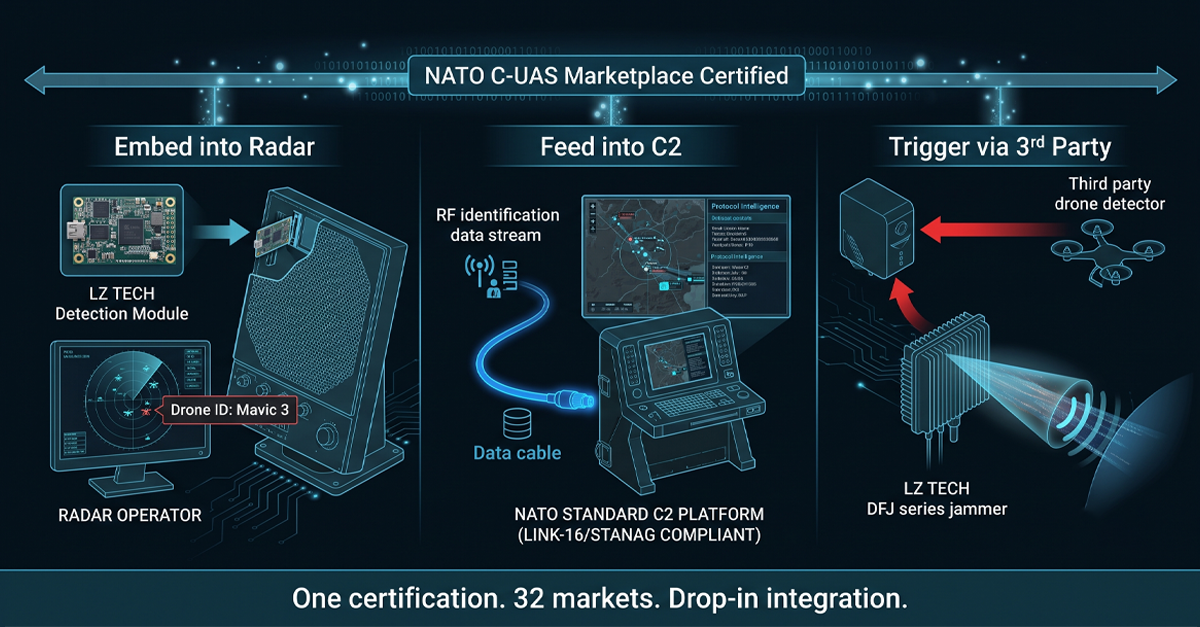
NATO certification favors modularity. A system that only works as a standalone stack forces each new member nation to rip out whatever they already have and start over. A system designed to plug into existing infrastructure, third-party radar, someone else’s C2, a different vendor’s cameras, gets deployed faster and clears procurement review faster.
Our Detection and Defense System is built on that logic. Passive RF detection plus protocol analysis, no emissions, no spectrum interference. The detection module takes a feed from an existing radar. The RF identification data feeds into a NATO-standard C2 platform. The DFJ series jammer accepts triggers from a third-party detection system. Each component earns its place in an existing stack instead of demanding a clean slate.
For vendors who already sell sensors into NATO, the protocol analysis engine works as an OEM component. Drop it into a radar vendor’s C-UAS platform to add identity intelligence to existing track data. The radar company keeps the customer relationship. The protocol engine provides a capability layer they would otherwise spend years building. That kind of modular integration is how you get through NATO certification faster, because you are solving a specific gap rather than duplicating something already deployed at 32 different scales across 32 different budgets.
The CRPCS software platform unifies the feeds into a single operator interface. The CCS command platform handles multi-site monitoring with GIS overlay and role-based access that maps onto NATO command hierarchies. The architecture is designed for interoperability, not lock-in. That is the difference between a system NATO procurement officers can evaluate once and a system they have to renegotiate for every new deployment site.
Five times the operators: the bottleneck NATO is naming out loud
The fivefold operator training target matters as much as the $40 billion. Every C-UAS deployment hits the same wall eventually: you can buy all the hardware you want, but if there are not enough trained people to interpret the data, the system underperforms. NATO putting operator headcount into the same communique as the dollar figure means they have seen this play out in Ukraine, in the Middle East, at every exercise.
The training gap changes what kind of C-UAS system gets purchased. A system that needs a full-time operator staring at a screen for every sensor feed does not scale to 32 nations running multiple sites each. A system that automates classification, suppresses false alarms at the sensor level, and only escalates to the operator when the AI is uncertain, scales. That is the architecture shift the operator target forces.
Autonomous detection and tracking, like the VAR300, handles routine airspace monitoring without an operator babysitting the screen. Protocol-level identification automates the model and serial number lookup that currently requires a human analyst. Automated alarm routing through the CCS platform sends only actionable alerts to the operators who need them, at the security level they are cleared for. That is the human factors piece of the NATO certification picture that procurement teams should be considering alongside the range and frequency specs.
The bottom line
NATO put $40 billion and a procurement mechanism behind counter-drone technology. That reshapes the entire industry. Certification replaces individual RFPs as the filter. Interoperability replaces proprietary stacks as the baseline expectation. And the fivefold operator target confirms that even the best hardware gets bottlenecked by the number of people qualified to run it.
For C-UAS vendors, the window is the next 18 months. Get into the certification pipeline while the criteria are still being defined. For NATO procurement teams, the task is defining those criteria to cover the full kill chain without leaving gaps that the threat has already evolved past.
Detection at range is table stakes now. Identification under pressure is what separates systems. At $40 billion, spending that budget on radar and jamming alone, without knowing who is at the other end of the control link, is leaving the most expensive question in counter-drone unanswered.
Connect with us
Ready to Secure Your Low-Altitude Airspace?