Counter-Drone Regulation Is Catching Up: H2 2026 Trends and What They Mean
Aug 14 2026
The Regulatory Tide Is Coming In — Faster Than Expected
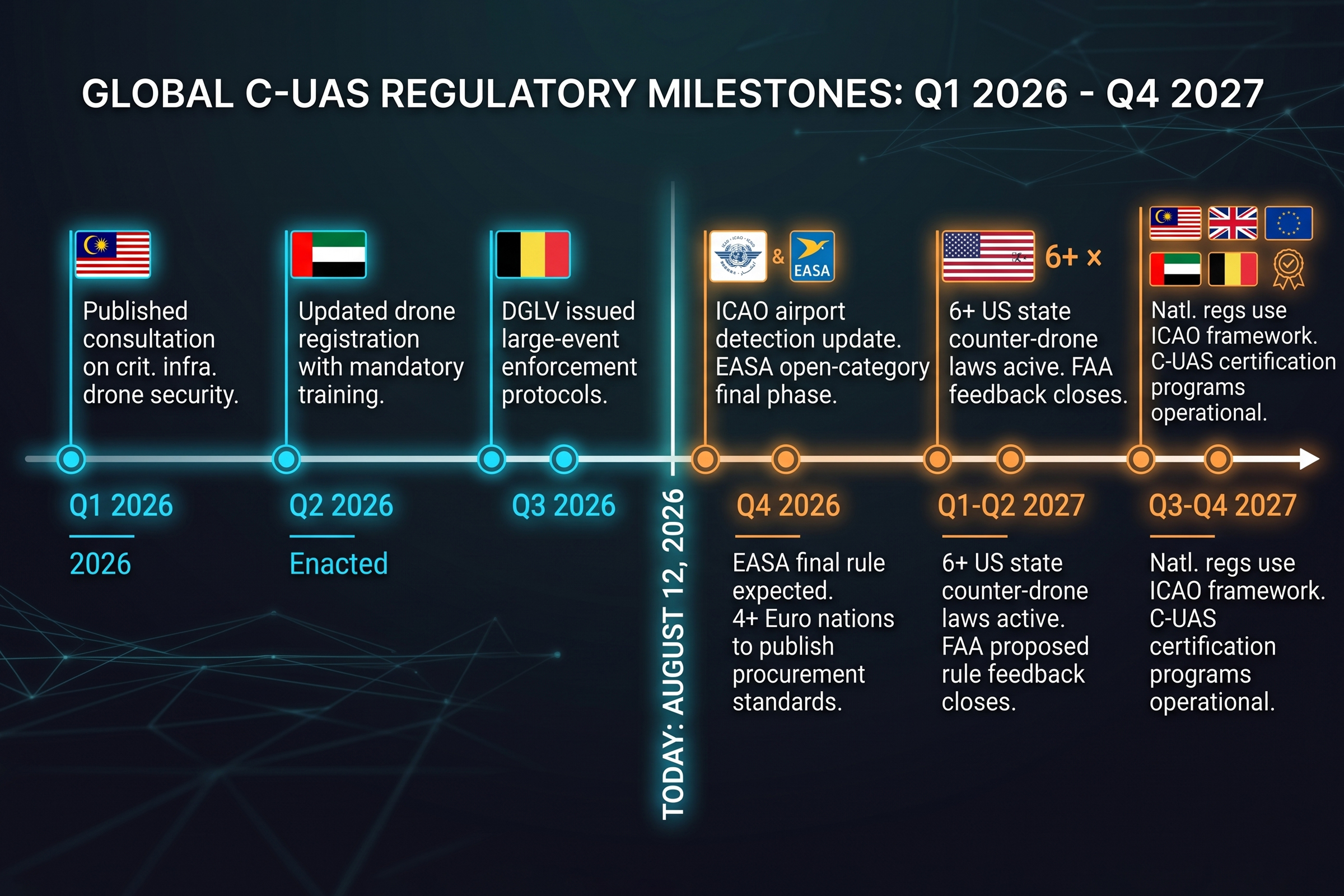
In July 2026 alone, three separate developments shifted the global C-UAS regulatory conversation. Belgium’s civil aviation authority imposed new enforcement protocols for drone violations near large public events. The International Civil Aviation Organization (ICAO) released updated airspace risk management guidance that explicitly addresses unauthorized drone operations near airports. And the European Union Aviation Safety Agency (EASA) continued its review of open-category drone regulations, with industry observers expecting tighter operational limits before the end of the year.
Each development, taken alone, is incremental. Together, they point to a regulatory pattern that corrections facilities, airport operators, and critical infrastructure managers can no longer afford to treat as future-looking: the gap between what drones can do and what regulation allows is still wide, and it is closing from the enforcement side rather than the legislation side. That distinction matters for procurement planning.
Belgium: One Summer of Incidents Writes Policy Faster Than Parliament
During the first half of 2026, Belgium’s Directorate General of Civil Aviation (DGLV) recorded a sharp increase in drone violations at large public events — music festivals drawing tens of thousands of attendees, outdoor sporting venues, and cultural gatherings in urban centers. The incidents followed a recognizable pattern: small commercial drones flying over crowded areas without the required flight authorization. Some carried cameras. Others were operated recklessly, with no apparent malicious intent beyond disregard for airspace rules.
The numbers that prompted the enforcement shift were hard to ignore. The DGLV documented 41 unauthorized drone flights over public events in the first five months of 2026 — more than the total for all of 2025. Several of the incidents involved drones hovering over audience areas at music festivals with attendance in the tens of thousands, where a loss of control or a deliberate act could have caused mass injury. No serious harm occurred, but the risk profile had shifted from theoretical to demonstrable. The enforcement protocols that followed were a direct response to that data — not a political decision, but an operational one forced by incident volume.
In response, the DGLV issued updated enforcement protocols that gave local authorities expanded authority to deploy counter-drone measures at events above a certain attendance threshold. The protocols did not introduce new legislation. Parliamentary processes take time, and Belgium’s legislative calendar was already full. Instead, the authority clarified existing law — arguing that the existing powers to protect public safety at mass gatherings already enabled drone detection and, where necessary, countermeasures. The update simply removed procedural ambiguity that had slowed enforcement.
The Belgian case matters because it illustrates how enforcement catches up to technology incrementally. Not through sweeping legislation, but through practical administrative clarifications that lower the barrier to action. For security teams managing stadiums, arenas, and festival grounds, this is the kind of regulatory shift that changes what is operationally possible on any given weekend.
ICAO: When a Guideline Becomes the Baseline
ICAO’s mid-2026 update to its airspace risk management framework addressed a topic that previous editions had only referenced in passing: the presence of unauthorized drones in controlled airspace around airports and other aviation-sensitive locations.
The updated guidance recommended that member states require drone detection capabilities as part of the security baseline for airports above a certain traffic threshold. It did not mandate specific technologies — ICAO guidance rarely does. But the framing shifted from the previous edition’s permissive “consider establishing” to an expectation-level “should establish” drone detection as part of an airport’s operational risk management.
For the C-UAS industry, ICAO guidance functions as a policy anchor. When national regulatory agencies draft their own binding regulations, they reference ICAO frameworks as the international standard. A recommendation at the ICAO level typically becomes a requirement at the member-state level within two to four years. Airport operators who begin deploying drone detection systems now — before the mandate — are building operational capability on their own timeline rather than scrambling to meet a regulatory deadline.
EASA and the Open Category: Where Consumer Drones Meet the Next Generation of Rules
EASA’s open-category regulation — the rule set that covers most consumer drones under 25 kilograms — has been under formal review since late 2025. The industry consensus is that the final update, expected before the end of 2026, will include three changes that matter for security operations: tighter geofencing requirements, mandatory remote identification for a wider class of consumer aircraft, and stricter operator registration rules.
The open-category review matters for the security industry because it determines what information is available to a drone detection system. Remote identification — the drone equivalent of a digital license plate — broadcasts the aircraft’s position, altitude, speed, and operator registration number. If EASA mandates remote ID for a larger class of consumer drones, RF-based detection systems can integrate that data directly, improving identification accuracy and reducing false positives.
The counterpoint is that mandatory remote ID does not solve the detection problem for high-threat scenarios. Deliberately non-compliant operators — the kind targeting prisons with contraband deliveries or flying over critical infrastructure — can disable or spoof remote ID broadcasts. Signature-based RF detection that identifies the radio protocol itself, not just the broadcast ID, remains the more reliable and harder-to-defeat layer for security facilities facing genuine threats rather than casual airspace violations.
The practical path forward for most security teams is to ensure their drone detection systems work with both remote ID broadcasts and protocol-level RF identification — covering both the compliant and non-compliant sides of the threat spectrum.
Beyond Europe: Other Jurisdictions Moving in Parallel
The regulatory momentum is not confined to Europe. In Southeast Asia, several national aviation authorities have begun drafting drone detection requirements for critical infrastructure sites, with Malaysia’s civil aviation body publishing a consultation paper in early 2026 on security protocols for drone operations near government buildings and energy facilities. In the Middle East, the UAE updated its drone registration and flight authorization system in June 2026, adding mandatory operator training requirements for any drone above 250 grams.
The United States has moved more slowly at the federal level, with the FAA’s drone security rulemaking still in the proposed rule stage as of mid-2026. However, individual states have been more active — at least six states have passed legislation authorizing law enforcement to deploy counter-drone measures in specific circumstances, primarily around correctional facilities and major event security. The patchwork approach at the state level is expected to push federal agencies toward a more unified framework by 2027.
The state-level activity is worth tracking in detail because it creates regulatory precedent that federal agencies can reference. California’s drone security bill, passed in early 2026, authorizes county sheriffs to deploy RF detection systems at correctional facilities and requires quarterly incident reporting to the state legislature. Texas followed with a broader authorization covering critical infrastructure — power plants, water treatment facilities, and oil refineries — and added a provision for law enforcement training on drone detection equipment. Florida, Georgia, Ohio, and Arizona have similar bills at various stages. The pattern is consistent: states are not waiting for the FAA. They are building operational C-UAS frameworks within their existing public safety authority, and the experience those states accumulate will inform the federal rulemaking process when it arrives.
What These Trends Mean for Procurement in Late 2026
There is also a market signal embedded in these regulatory developments that procurement teams should not overlook. When a regulator recommends that airports “should establish” drone detection as a security baseline — as ICAO did in mid-2026 — it creates a compliance-driven demand curve that is separate from the threat-driven demand curve. Threat-driven demand is reactive: a facility buys detection after an incident. Compliance-driven demand is structural: facilities buy detection because their operating license or liability insurance requires it. The second kind of demand is larger, more predictable, and more durable. It is the kind of demand that will define the C-UAS market over the next three to five years, and the deployments that are operational when the compliance mandates arrive will have locked in their position before the procurement wave begins.
Three practical takeaways for security teams evaluating C-UAS decisions in the second half of the year.
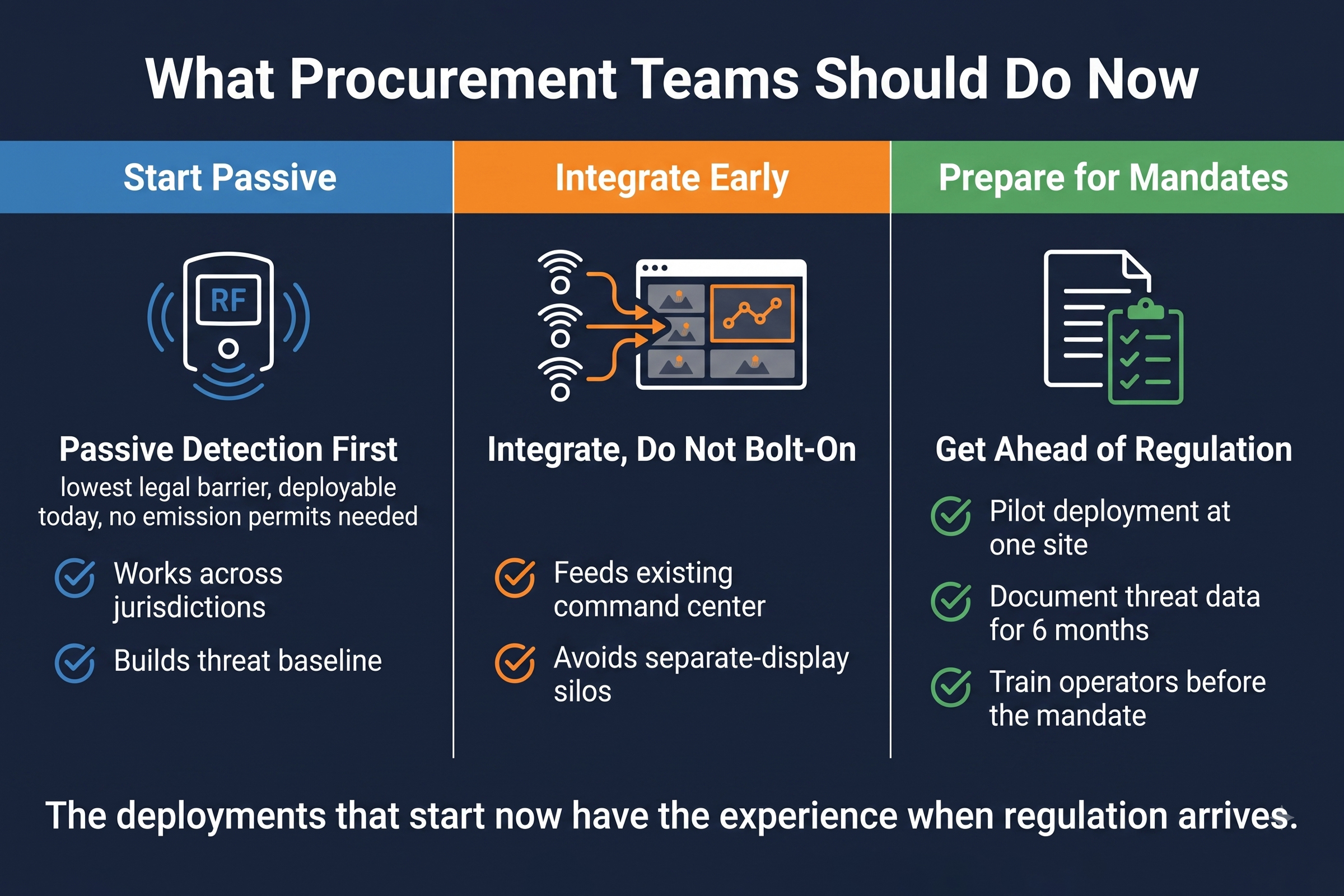
First, passive RF detection is the safest regulatory starting point. Across all three major regulatory developments — Belgium enforcement protocols, ICAO airspace guidance, EASA open-category review — the common thread is that detection and monitoring occupy the first rung on the regulatory ladder. Active countermeasures may be authorized later, but passive detection faces fewer legal barriers today, in more jurisdictions, for a wider range of facility types.
Second, the regulatory environment increasingly favors integrated systems over standalone point solutions. ICAO guidance asks airports to establish drone detection as part of operational risk management, not as a bolt-on gadget. That means a system that feeds into the existing security command center — CCS, CRPCS, or an equivalent platform — rather than one that operates in isolation with a separate display and its own operator.
Third, the pace of regulatory change is accelerating, not slowing. Security teams that begin drone detection deployments now — even at a pilot scale at a single facility — will have operational experience and a documented threat baseline when regulations catch up. Teams that wait for the final rule to be published will discover that procurement timelines, installation cycles, and operator training do not compress simply because the regulation has arrived.
H2 2026: The Calendar Filling Up
The second half of 2026 brings a schedule of industry events that will further shape the regulatory conversation and provide concrete signals for procurement planning.
September hosts the Global Drone Security Summit in Amsterdam, where ICAO and EASA representatives are expected to present detailed enforcement frameworks and answer questions from the industry on implementation timelines. October brings the ICAO Assembly — a once-every-three-years meeting where member states collectively set the agenda for global civil aviation regulation. The Assembly’s outcomes on drone security topics will influence national regulatory calendars for the following three to five years.
Meanwhile, the rollout of national C-UAS certification programs continues at the operational level. At least four European countries are expected to publish updated drone detection procurement standards before year-end. These are the documents that will specify what a compliant drone detection system looks like — frequency ranges, response times, integration requirements — and they will shape the next generation of procurement specifications across the continent.
For the entire C-UAS industry, this is not a waiting game. It is a preparation window. The regulation is being drafted in meeting rooms right now. The deployments that begin now will have the experience, the training, and the documented threat data to operate confidently under any framework that emerges. The deployments that wait will start from zero inside a regulatory window they did not help shape.
Connect with us
Ready to Secure Your Low-Altitude Airspace?