Protocol-Level Drone Defense: Why CRPC Technology Is the Future of C-UAS
Jun 29 2026
Introduction
Most counter-drone systems work at the frequency level. They detect a signal, identify which drone it matches, and then respond. That works well when the drone is a commercial product running unmodified firmware on a known protocol. It fails when it is not.
The gap is real and growing. Modified drones, DIY builds, autonomous UAVs that do not transmit at all, frequency-hopping systems that change bands mid-flight. Library-matching RF detection handles the first category. It does not handle the rest.
Protocol-level defense is the technical response to that gap. Instead of matching signals against a known library, you reconstruct the protocol itself, layer by layer, and work with it directly. This article explains what that means, how LZ TECH’s CRPC technology approaches it, and why it matters for counter-drone defense.
Why frequency-based systems hit a wall
Traditional counter-drone systems operate at the physical and data-link layers. They receive radio signals on known drone bands, compare those signals against a library of known signatures, and classify the drone. That classification drives the rest of the system: identification, tracking, and response decisions.
This approach has a built-in limitation. The library only contains what someone has catalogued. When DJI pushes a firmware update that changes the protocol, the library needs an update too. When an operator modifies a drone to use a non-standard frequency or a custom telemetry format, the library has no entry for it. When a DIY builder assembles a UAV from components and writes custom firmware, the system has nothing to match.
The detection industry calls these unknown drones. In practice, unknown drones are the fastest-growing threat category in many operational environments. They are also the category that frequency-based systems handle worst.
Jamming is the fallback for unknown drones. If you cannot identify it, you cannot selectively target it. You jam everything on the relevant frequency bands and hope the drone goes down somewhere acceptable. That is a blunt instrument. It does not distinguish between a threat drone and a nearby legitimate aircraft using the same bands.
What CRPC actually is
Three evolution stages
LZ TECH’s CRPC (Cognitive Radio Protocol Cracking) has gone through three versions, each adding a deeper layer of protocol analysis.
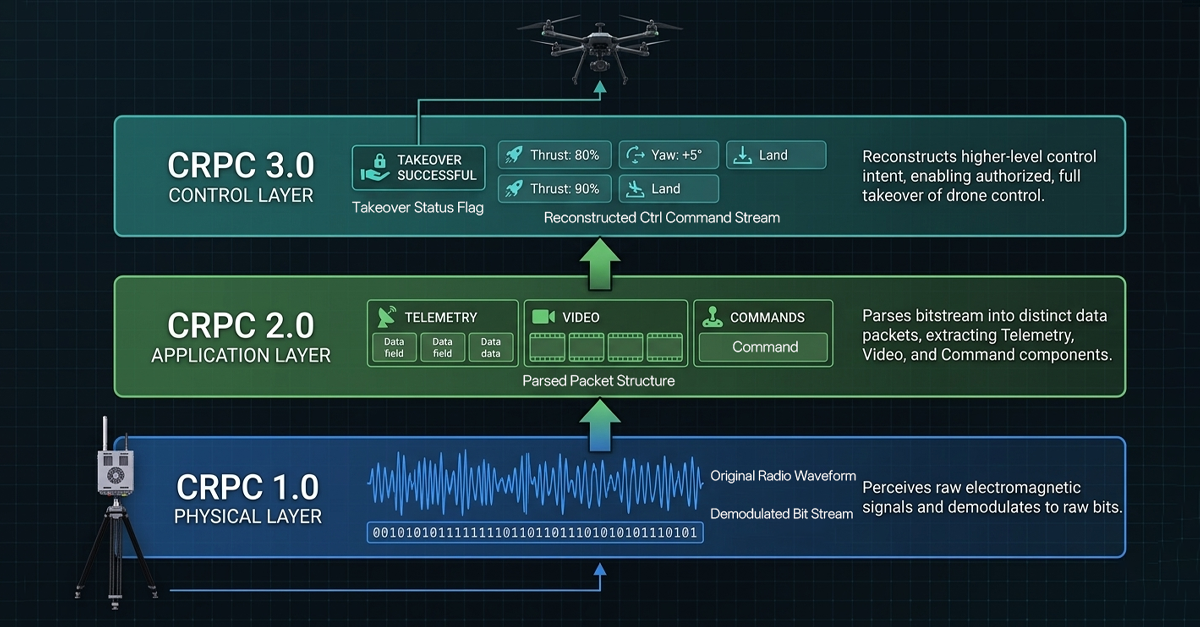
CRPC 1.0 works at the physical layer. It demodulates and decodes the raw radio signal from the drone. That gives you the bitstream. The bitstream is useful but not actionable on its own. It tells you something is transmitting but not what it is saying.
CRPC 2.0 adds application-layer analysis. It parses the decoded bitstream into recognizable data structures: telemetry, video, command packets. The system can identify the drone model and extract flight parameters. This is where most library-matching RF systems operate. They stop at identification.
CRPC 3.0 goes further. It analyzes and reconstructs the control-layer commands. That means the system can understand and, in principle, generate valid command packets for the drone. At that point, identification becomes takeover.
Why protocol cracking is rare
Not many companies can do this. The reason is the skill set it requires. Protocol cracking sits at the intersection of wireless communications, cybersecurity, and embedded systems reverse engineering. You need people who understand radio signal processing at the physical layer, network protocol design at the application layer, and how drone firmware implements control loops at the execution layer.
LZ TECH reports that more than 40% of its workforce is in research and development, with postdoctoral-level capability in wireless communications and signal processing. That is a significant R&D investment for a company in the counter-drone space. It is also the kind of investment you only make if protocol-level analysis is central to your product strategy.
AI-RPC: self-improving detection
How AI enhances signal recognition
LZ TECH’s AI-RPC system uses deep learning models trained on drone signal data. The models serve two functions: signal classification and signal fingerprinting.
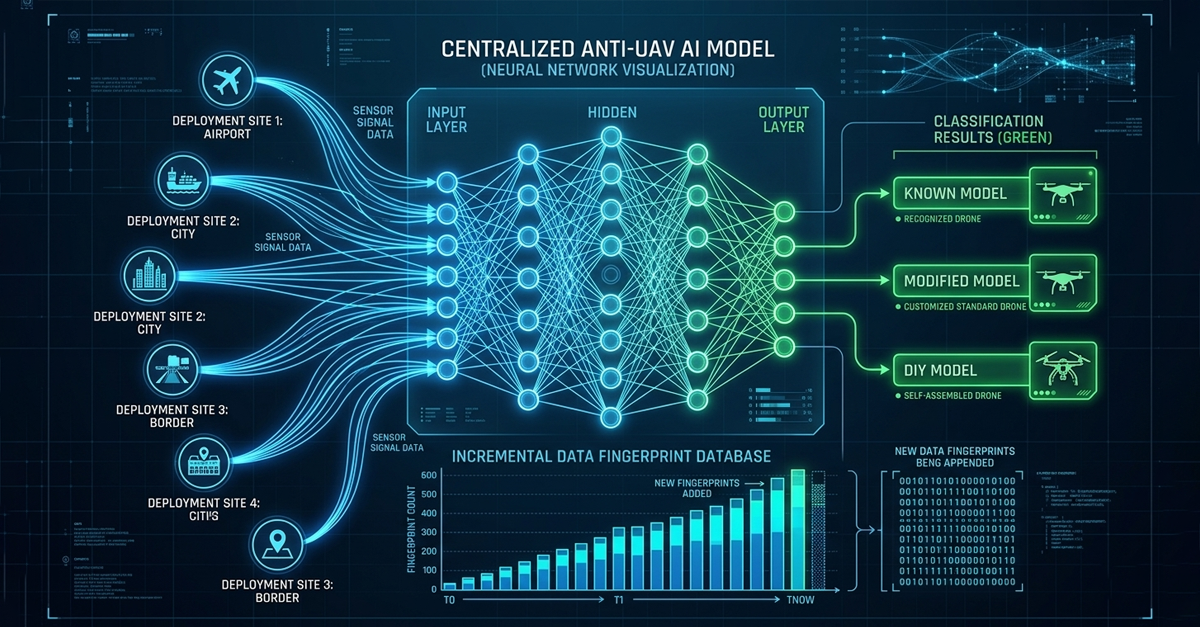
Signal classification sorts unknown signals into categories based on their characteristics. A signal that does not match any known drone library entry still has measurable properties: bandwidth, modulation scheme, packet structure, timing patterns. The AI model can classify these properties and make a reasonable guess about what kind of device generated the signal.
Signal fingerprinting creates a unique signature for each detected device. If the same drone flies over your site repeatedly, the system recognizes it across visits, even if the operator changes the frequency or modifies some protocol parameters. That is harder than library matching and more useful for long-term surveillance of repeated threats.
Growing fingerprint database
Each new signal the system encounters adds to the global fingerprint database. That is the self-improving part. More deployments see more drones, and more drones expand the library. The system does not need vendor updates to learn about new drone types. It learns from exposure.
The practical question: how long does it take for a new deployment to become useful in an environment where it has not previously seen the local drone population? The answer depends on drone traffic density. A site near a city with lots of drone activity will populate the fingerprint database faster than a remote installation with fewer incursions.
ChannelScanner integration
ChannelScanner is LZ TECH’s signal capture tool. It provides instant signal acquisition and processing, feeding data into the CRPC and AI-RPC pipeline. The workflow: scan the spectrum, capture relevant signals, process through the AI models, classify and fingerprint, and feed the results into the C2 system.
The value of a dedicated capture tool is speed. Automated scanning across wide frequency bands generates a lot of data. ChannelScanner filters and prioritizes the signals worth analyzing, reducing the processing load on the classification models.
From detection to takeover: the Ruyi system
The Ruyi system is where CRPC 3.0 becomes operationally meaningful. If the system can reconstruct the drone’s control-layer commands, it can in principle generate its own valid commands. The operator interface exposes this as a one-click takeover capability.
When takeover succeeds, the original operator loses control of the drone. The Ruyi operator sees the drone’s real-time status: position, altitude, speed, battery, flight mode. The operator can then command the drone to land, divert to a controlled area, hover, or descend to a recovery point.
The non-destructive nature is the core differentiator. Jamming destroys the link and lets the drone’s fail-safe decide what happens next. Takeover gives the defender control over what happens next. That matters when the drone is carrying a payload you want to intercept, when the drone is over an area where an uncontrolled descent is dangerous, or when you need to identify the operator by recovering the drone intact.
OEM modules: CRPC in a compact form factor
Not every organization needs a full LZ TECH system. Some need the CRPC capability inside someone else’s hardware. LZ TECH addresses this with a module family: J3, HJ1, and JV-1.
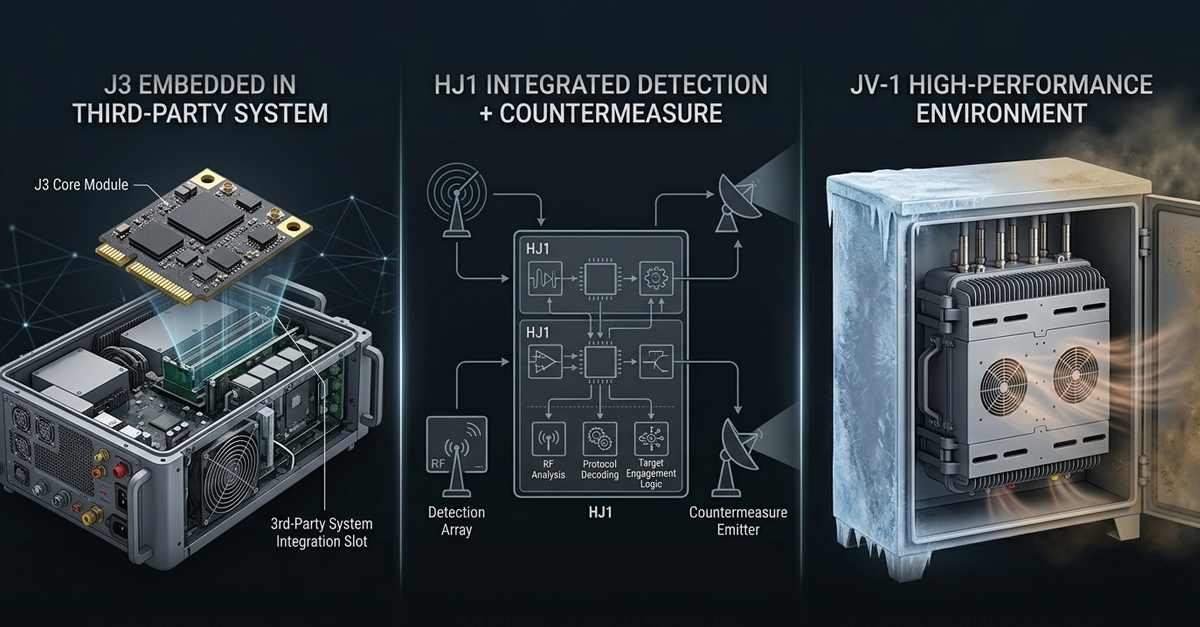
The J3 is the miniaturized module. Small enough to embed in third-party counter-drone systems, portable detection units, or custom security hardware. It carries the core CRPC and AI-RPC processing in a compact form factor.
The HJ1 is the multi-function integration module. It combines detection and mitigation capability in one unit, designed for systems that need both sensing and response in a single integrated component.
The JV-1 is the high-performance module for demanding environments. It handles wider frequency bands and higher signal throughput, suitable for systems that need to process multiple simultaneous drone signals.
All three modules ship with RF accessories for direct integration. The target market is OEMs and system integrators who want CRPC capability without building their own protocol analysis stack from scratch.
How CRPC compares to the field
Most counter-drone vendors operate at the frequency level. They detect signals, match them against libraries, and respond with jamming or spoofing. That is the majority of the market.
A smaller group of vendors can do RF fingerprinting beyond simple library matching. They extract more signal characteristics and can sometimes identify modified drones that pure library matching misses. This is a step up but still operates at the physical and data-link layers.
Protocol-level cracking is the smallest category. Very few vendors can reconstruct control-layer commands and execute takeover. The technical barriers are high, the required expertise is specialized, and the market demand is concentrated among government and military buyers who have the most sophisticated threat profiles.
From what we have seen in the market, LZ TECH positions itself in this third category. The combination of CRPC protocol cracking, AI-RPC self-learning detection, and a full product line from handheld units to integrated fusion systems is not a common combination.
What this means for buyers
Protocol-level intelligence is the most advanced detection and response capability available in commercial counter-drone systems. If your threat model includes modified drones, DIY UAVs, or autonomous platforms that do not rely on standard protocols, frequency-based detection alone will not give you the coverage you need.
CRPC combined with AI-RPC provides detection capability across known commercial drones, modified commercial platforms, and DIY builds. The Ruyi system extends that capability from detection to controlled takeover. OEM modules make the technology available to integrators building custom systems.
The tradeoff is capability depth. Protocol-level systems are more complex than frequency-based jammers. They require trained operators. They are more expensive. Whether that investment is justified depends entirely on what you are defending against and the consequences of a detection failure at your site.
Connect with us
Ready to Secure Your Low-Altitude Airspace?