After the JetBlue Drone Strike: Inside the World Cup’s $250M C-UAS Deployment
Jul 10 2026
The 2026 FIFA World Cup is the largest civilian counter-drone deployment ever attempted. Here is what the tech stack looks like, who is building it, and what airports and stadiums should learn from it.
Introduction
On the morning of June 29, 2026, a JetBlue Airbus A321 was on final approach into JFK. At roughly 3,000 feet, something hit the aircraft. The crew reported a drone strike. The plane landed without incident. Inspection found no airframe damage. If confirmed, it would be the first documented collision between a commercial airliner and a drone in US airspace.
The same day, a helicopter pilot near JFK nearly collided with a large remote-controlled aircraft. Three days earlier, a United 737 with 111 passengers reported a drone at close range on final approach to Newark. Since the World Cup started, the FBI and FAA have confiscated over 500 drones from restricted airspace across 11 US host cities.
This is not random. Big events pull in crowds, cameras, and attention. They also pull in drones. Fans filming from above. Content creators chasing viral footage. People who do not bother checking NOTAMs. The World Cup has turned into the most ambitious civilian counter-drone operation ever run. We are watching a live experiment in what happens when a country treats stadium airspace like the security problem it actually is. The lessons are already piling up for airports, infrastructure operators, and any venue planning security for 2027 and beyond.
A drone strike that almost happened
The JetBlue incident is not the first close call, and it will not be the last. The FAA logs more than 100 drone sighting reports per month at US airports. Most of them are not strikes. A pilot sees something at 1,500 feet. The tower logs it. Nothing else happens. But the gap between seeing a drone and hitting one is not as wide as it used to be.
What changed in June 2026 is density. Eleven US cities are hosting matches. Each venue pulls in tens of thousands of people per match day. Some of those people are flying drones. A few have commercial permits and know the rules. Most are hobbyists who either missed the memo about temporary flight restrictions or decided it did not apply to them. The FBI confiscated 500 drones in a matter of weeks. That tells you how big the gap is between what the rules say and what actually happens in the air.
Commercial aviation has been lucky so far. A drone going into a turbofan engine at 3,000 feet is nothing like a bird strike. Bird turns to pulp. Lithium battery burns. Engine certification tests do not cover burning batteries. The industry has known about this risk for years. What the World Cup deployment proves is that someone finally put real money behind doing something about it.
The World Cup security stack: what $900 million buys
The 2026 World Cup covers three countries, 16 cities, 48 teams, and 104 matches. The US Department of Homeland Security classified it as a National Special Security Event, the same designation used for presidential inaugurations and the Super Bowl. That label unlocks federal money and multi-agency authority that no private venue operator could piece together on their own.
The money:
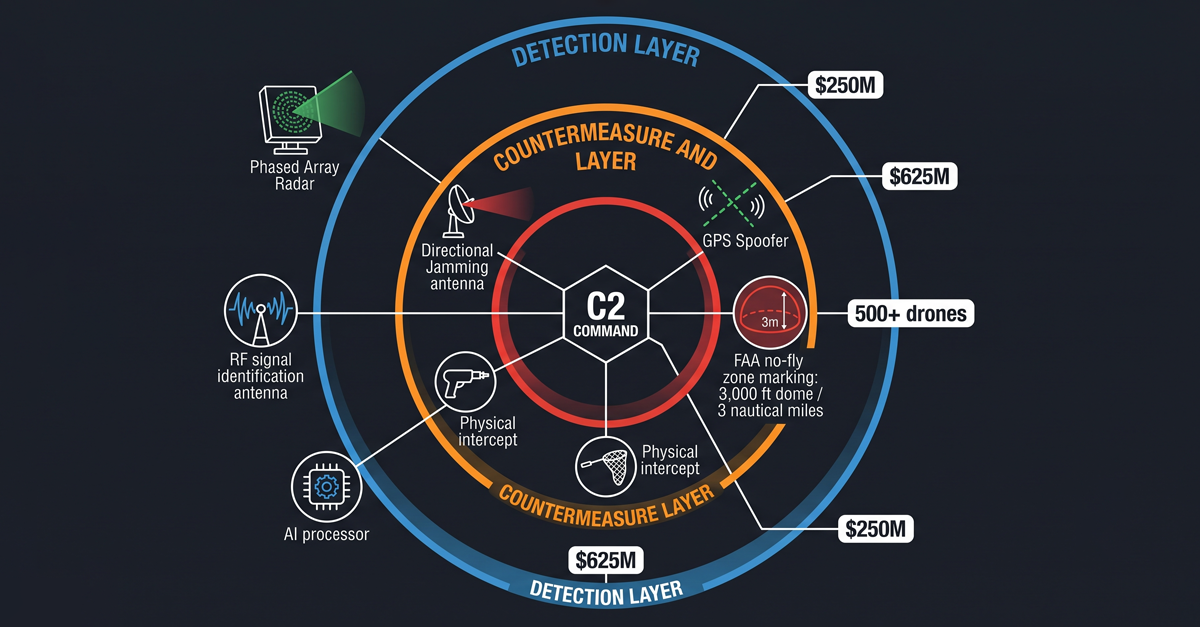
- $625 million from FEMA through the FIFA World Cup Grant Program for general security across 11 US host cities.
- Another $250 million just for counter-UAS hardware and deployment. That is a dedicated line item, not a sub-account of the general security budget.
- Motorola Solutions is the prime integrator. SkySafe is the C-UAS technology partner running the drone-specific hardware and software.
- The command structure ties together FBI, FAA, local police, and emergency management into a shared airspace picture.
Add it up and you are approaching $900 million. $250 million for counter-drone alone is more than most countries budget for their entire annual military C-UAS program. This is not a pilot. It is a full deployment running under the brightest spotlight available.
The tech splits into three layers. Each addresses a different link in the kill chain.
Detection
Surveillance radar plus RF signal identification plus AI alerting. Radar finds the object. RF tells you if it is a drone, and what kind. The AI cross-checks both feeds to keep the false alarm rate down. Without that handshake, a radar track is just a dot on a screen. With it, you know whether that dot is a DJI Mini 4 or a confused gull.
The detection challenge changes with the venue. A stadium in downtown Los Angeles has different RF noise than an open-air field in Miami. Radar clutter from buildings and terrain varies wildly. Run the same sensor setup in all 11 cities and your false alarm rate will be all over the map. The World Cup stack handles this by tailoring sensor combinations to each venue’s actual electromagnetic and physical environment.
Countermeasures
Jamming, GPS spoofing, and physical interception form the response tier. Jamming cuts the drone’s link to its operator. Spoofing feeds it bad GPS coordinates to steer it away from the venue. Which one you use depends on where you are. Inside a stadium bowl, you need directional jamming that hits the target without taking down every phone in section 203. In open air around the venue perimeter, spoofing can redirect a drone without triggering a radio blackout.
There is a legal angle too. FAA Remote ID rules went into full effect in 2024. Drone manufacturers now have to broadcast identification data. On paper, that makes detection easier. In practice, enforcement is slow. The 500-seized-drones number tells you a lot of operators are flying without Remote ID, or with it disabled. The countermeasure layer has to assume non-compliant drones are the norm, not the exception.
Airspace control
The FAA drew the tightest no-fly zones in World Cup history. Every venue gets a 3-nautical-mile radius, 3,000-foot ceiling. Fan zones get 1 nautical mile, 1,000 feet. Break the rule and you are looking at up to $100,000 in civil fines, your equipment gets confiscated, and federal criminal charges are on the table.
Enforcement is where it gets messy. Temporary flight restrictions only work if drone operators read and follow NOTAMs. The 500 confiscated drones tell you a lot of people either cannot, will not, or actively choose not to. The rulebook deters commercial operators who value their FAA ticket. For everyone else, detection and countermeasures are the only layers that stop an incident.
What airports need vs. what stadiums need
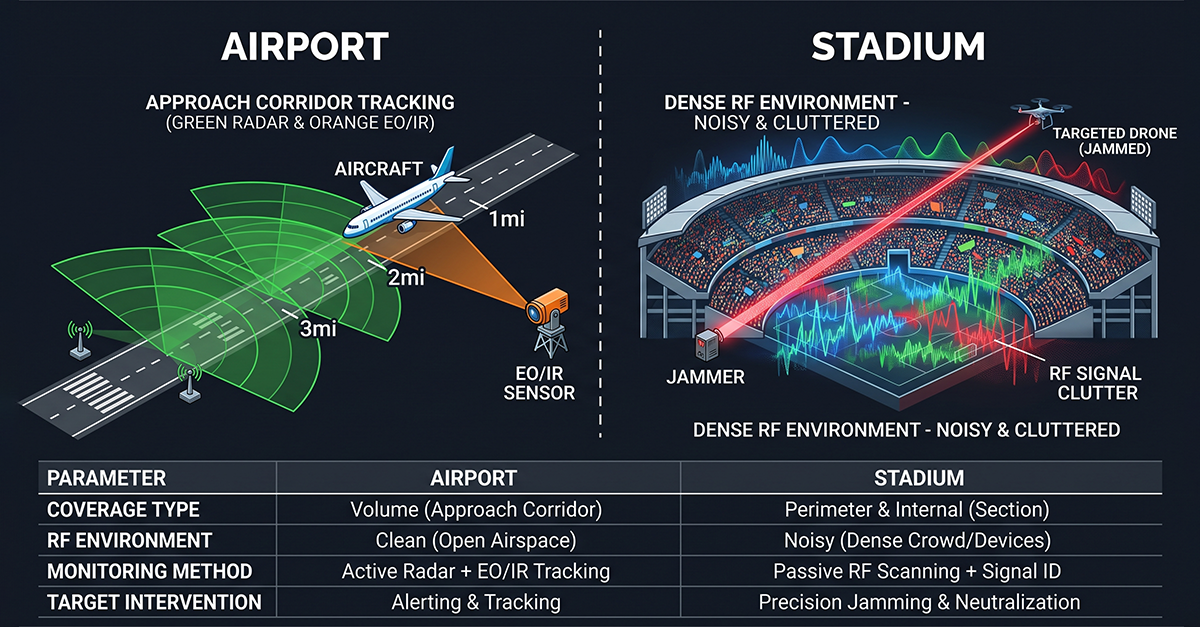
Airports and stadiums both worry about drones, but their detection problems are not the same thing. The differences matter when you are picking hardware.
An airport has approach corridors that stretch miles from the runway. The system has to cover volume, not just a perimeter. A drone at 2,500 feet three miles out on the glide path is a threat. The same drone at 2,500 feet over a stadium is an annoyance looking for a good angle. The sensor layout, the alert thresholds, and the response protocol all change with the geometry.
Stadiums have a different headache: crowd density. A directional jammer inside a stadium has to deal with tens of thousands of phones, broadcast rigs, wireless production gear, all humming in the same frequency bands as drone control links. The RF environment inside a stadium during a match is noisier than an airport tower band on its busiest day. Precision beats raw power every time here.
The World Cup uses different configurations of the same sensor types for both environments. Airports get long-range radar with EO/IR for visual confirmation on approach. Stadiums get shorter-range radar tuned for angular resolution, to pick out targets coming out of urban clutter, paired with RF detection built for high-interference settings.
For sites that fall between these extremes, military bases, ports, large industrial facilities, the modular approach works better. Add sensors as the threat picture changes. Start with RF detection. It covers the most common drone types and does not broadcast anything. Add radar and EO/IR when you need active sensing for autonomous drones that do not emit radio signals.
Why the World Cup model matters for system builders
Motorola and SkySafe are building the World Cup system as an integrated stack under a single prime contract. That approach works when you have nine-figure budgets and one procurement authority. Most counter-drone deployments do not start from that position.
The more common scenario: an airport already runs a perimeter radar from vendor A. They add RF detection from vendor B because that tender came up separately. A year later, they tack on an EO/IR camera from vendor C. Three systems. Three dashboards. Three alert streams. The operator has to fuse the data in their head. That mental fusion step is where protocol-level detection earns its keep.
LZ TECH designed its detection modules and the CCS command platform to drop into existing security stacks. The detection module takes a feed from a third-party radar. The RF identification data feeds into someone else’s C2 platform. The jammer accepts triggers from a different vendor’s detection system. This is not the Motorola single-vendor integration model. It is for adding capability to systems already deployed and already budgeted.
The World Cup proves the architecture works. The next piece is making it modular enough and affordable enough that an airport or stadium operator can adopt it without tearing up their procurement plan.
The detection layer most World Cup stacks are skipping
There is a gap in the World Cup model worth flagging. The detection layer as described, radar plus RF identification, works for commercial drones. It spots DJI, Autel, Parrot. It picks up DIY FPV drones by their video transmission signature. What it does not do is extract the data payload.
Protocol-level detection goes one layer deeper than signal presence. It decodes the communication protocol between the drone and its controller. That gives you the drone’s electronic ID, real-time telemetry including GPS, and in some setups the home point where the operator is standing. You go from ‘there is a drone somewhere in the sector’ to ‘Mavic 3, serial number X, operator northeast parking lot.’
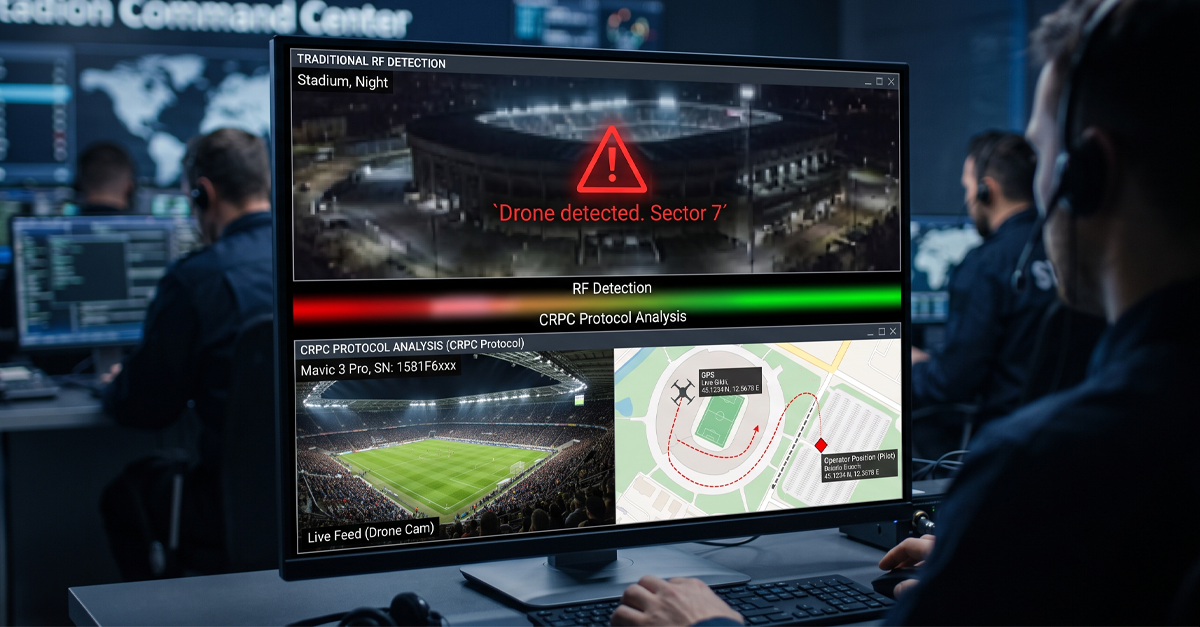
This is what Cognitive Radio Protocol Cracking was built for. Our team developed CRPC to close the gap between passive RF detection and active countermeasures. The engine pulls the ID bitstream from the drone’s control signal and matches it against a fingerprint database. Known drone model? Identified in seconds. Unknown model? The system logs the signal pattern for later analysis and blacklisting.
For a venue running the World Cup detection stack, adding protocol-level intelligence cuts the time from detection to classification. Radar gives early warning. EO/IR gives visual confirmation. Protocol-level RF gives the drone’s identity without waiting for a camera lock. When your response window is seconds, that matters.
Our Detection and Defense System combines passive RF detection with protocol analysis and integrates with phased-array radar where active sensing is needed. The TR100 packages radar and EO/IR into one unit with radar-guided tracking. The VAR300 runs autonomous detection and tracking for sites that need a sensor that works without someone watching the screen. The CRPCS software platform ties detection, classification, and response into one interface.
The Multi-tech Fusion Detection Solution is built on this layered model. No single sensor gives you everything. Radar gives range. EO/IR gives visual ID. RF detection gives signal fingerprinting. Wire them together and you have a system that detects, identifies, tracks, and hands off a target to jamming or spoofing without an operator playing air traffic controller.
For the Ruyi jamming system, CRPC 3.0 adds a capability most venue security plans are not even asking for yet: protocol-level takeover. After identification, Ruyi rebuilds control-layer data streams to send its own flight commands to the target. Redirect. Land. Hold position. No kinetic interception, no debris raining into the stands. For a stadium deployment, that changes the risk calculus entirely.
The bottom line
The World Cup is dropping a quarter-billion dollars on counter-drone security because the threat is not hypothetical anymore. The JetBlue near-miss at JFK is the headline that makes the spending look obvious after the fact. When a passenger jet and a drone share the same 3,000-foot approach corridor, something was already broken before the pilot saw it.
For airports, the lesson from June 2026 is simple: drone detection is infrastructure. Same budget category as runway lighting and perimeter fencing. Not a discretionary line item. The World Cup showed what properly funded deployment looks like. The question is not whether to install counter-drone systems. It is which architecture fits your budget, your airspace shape, and how your ops team works.
For stadiums and large venues, the World Cup is about to become the reference deployment. Your insurance carrier will have read about the JetBlue incident. Your next RFP will cite the World Cup model. The standard is getting set in public, right now, with the stakes higher than ever.
For the C-UAS industry, the window that opens after July 19 is wide. The World Cup proved the architecture: layered detection, networked response, real-time coordination. The next step is making that architecture work for venues that do not have FEMA funding and a Motorola contract. Modular systems, protocol-level intelligence, integrated hardware and software, that is where the real deployment volume lives.
Connect with us
Ready to Secure Your Low-Altitude Airspace?