With operations spanning 60+ countries and a partner network of over 6,000 distributors and integrators, LZ TECH arrives at Farnborough as one of the counter-drone industry’s busiest international operators.
Farnborough 2026: the stage
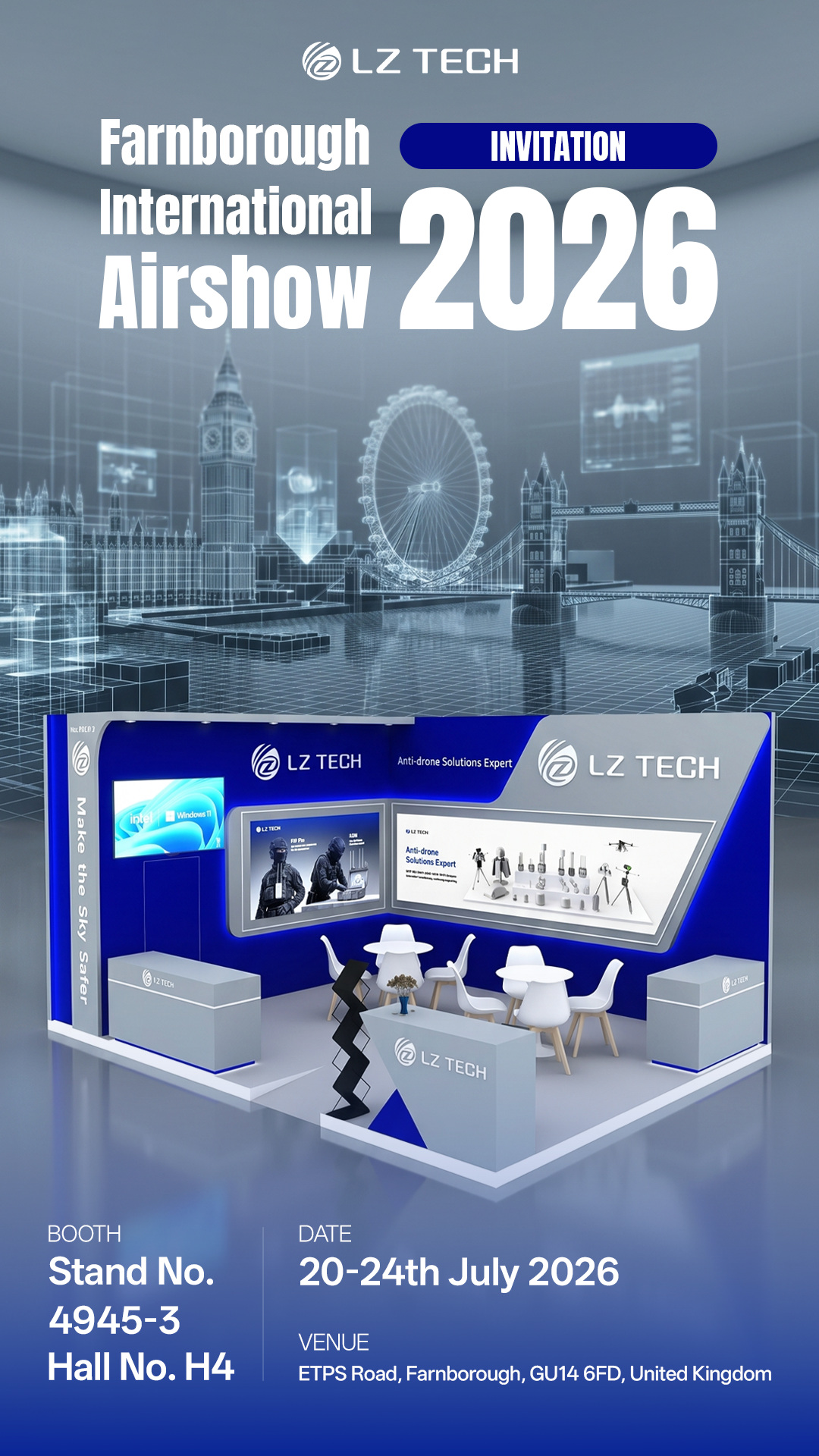
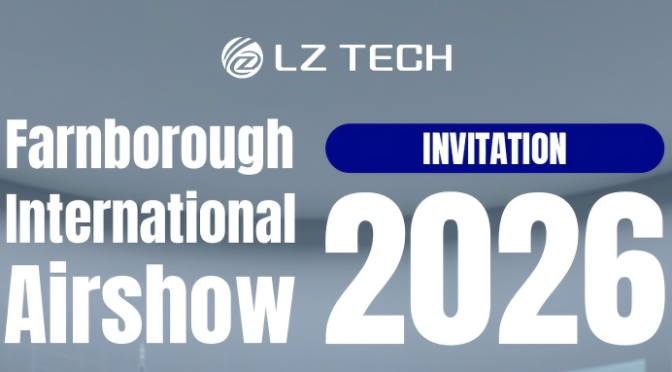
LZ TECH will exhibit at the Farnborough International Airshow from July 20 to 24, 2026, at the Farnborough International Exhibition and Conference Centre in Hampshire, United Kingdom. Held every two years, Farnborough is one of the three largest aerospace and defense trade events globally, alongside Paris and Dubai. The 2026 edition brings together over 1,700 exhibitors and approximately 150,000 trade visitors across five days of exhibits, flight demonstrations, and industry forums covering defense, aerospace, space, and security.
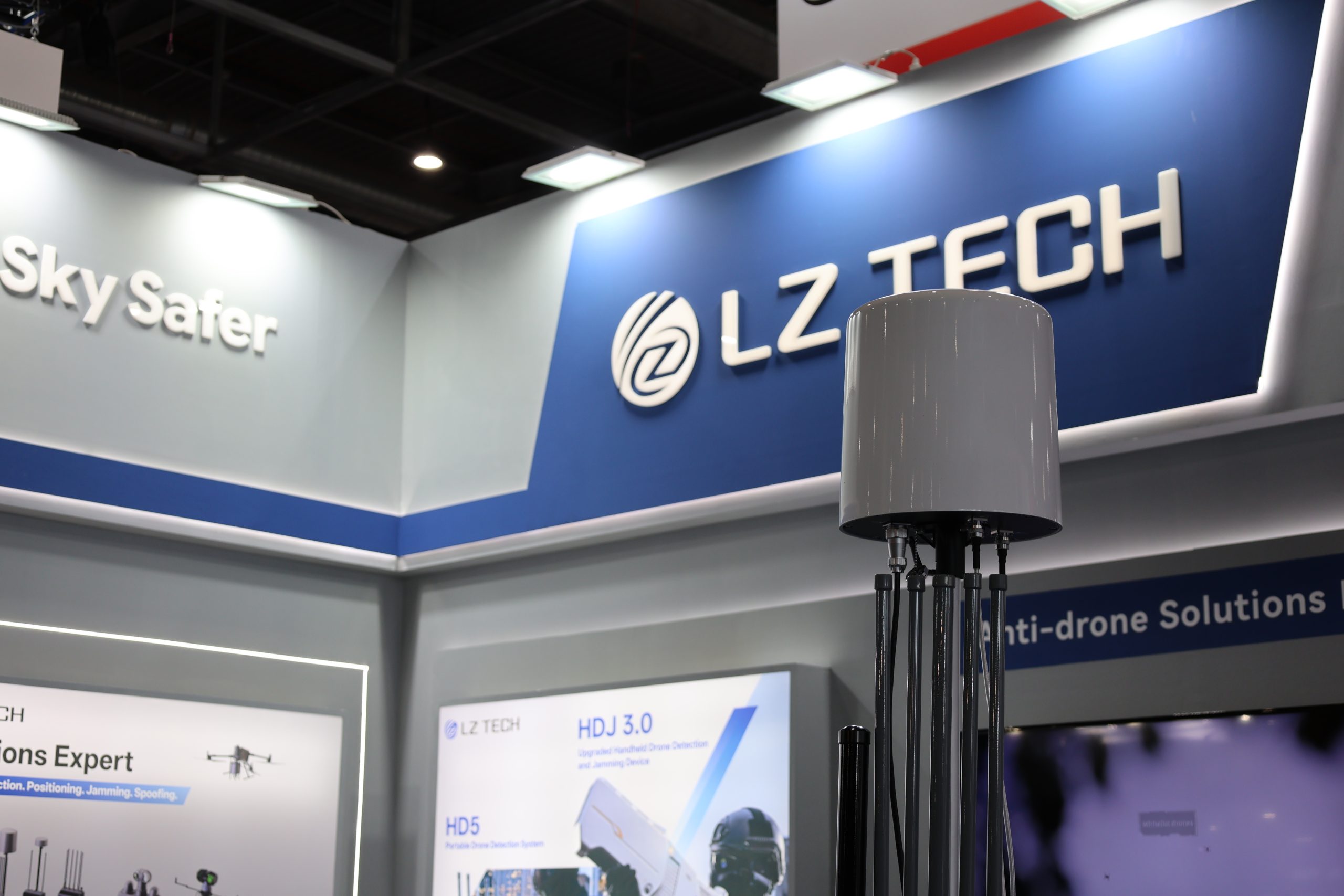
For a counter-UAS company, the attendee mix is what matters. Defense procurement delegations from Europe, the Middle East, and Asia-Pacific attend Farnborough as buyers with budgets, not browsers. Airport operators, border security agencies, and infrastructure protection managers walk the halls alongside air force and army program offices. LZ TECH will have live hardware on display: RF detection, directional jamming, protocol-level identification, and the integrated CRPCS and CCS platform, all running in real time at the booth. The company’s engineering team will run controlled detection-and-response sequences so procurement officers can see the full timeline: signal acquisition, protocol decode, operator location, and neutralization decision, all inside five seconds.
The product demonstrations are structured around specific operational scenarios. An airport perimeter where a drone approaches from outside the fence. A stadium event where multiple consumer drones appear simultaneously. A border crossing where the drone type and origin need to be established before escalation. Each scenario runs on the same hardware stack, configured differently. The point is to show that one architecture can cover multiple mission profiles without procurement teams buying a separate system for each.
Global footprints: 60+ countries, 6,000+ partners
LZ TECH arrives at Farnborough after two years of steady international growth. The company now serves customers in more than 60 countries and regions, backed by a partner network of over 6,000 distributors, system integrators, and resellers. This is not a map of inquiry forms. These are active accounts, with product in the field and local support channels in place.
In the first half of 2026 alone, the company completed large-scale system deliveries across multiple continents. Airports in Southeast Asia. Government facilities in the Middle East. Correctional institutions in South America. Energy infrastructure in Central Asia and even the FIFA security project in Mexico City. Each deployment generates operational data that feeds back into the product cycle. Each region develops its own reference customers, which drives follow-on orders within the same geography.
A delivery to Thailand’s Grand Palace complex shows how this works in practice. The site needed passive detection that would not interfere with tourist mobile networks, portable jammers deployable without permanent installation approvals, and a command interface in the local language. After commissioning, that reference opened conversations with other government sites in the region. At a Canadian energy infrastructure site, the Detection and Defense System was integrated into an existing perimeter security stack. In Malaysia, the national space agency MYSA ran evaluation trials that produced technical feedback now incorporated into the product roadmap. A single airport deployment leads to more. A border installation generates inquiries from neighboring countries with the same threat profile.
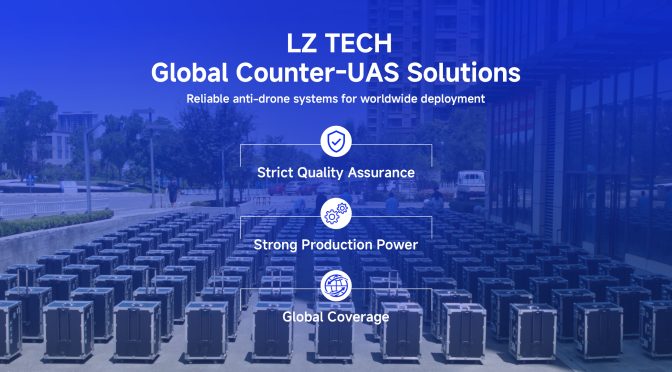
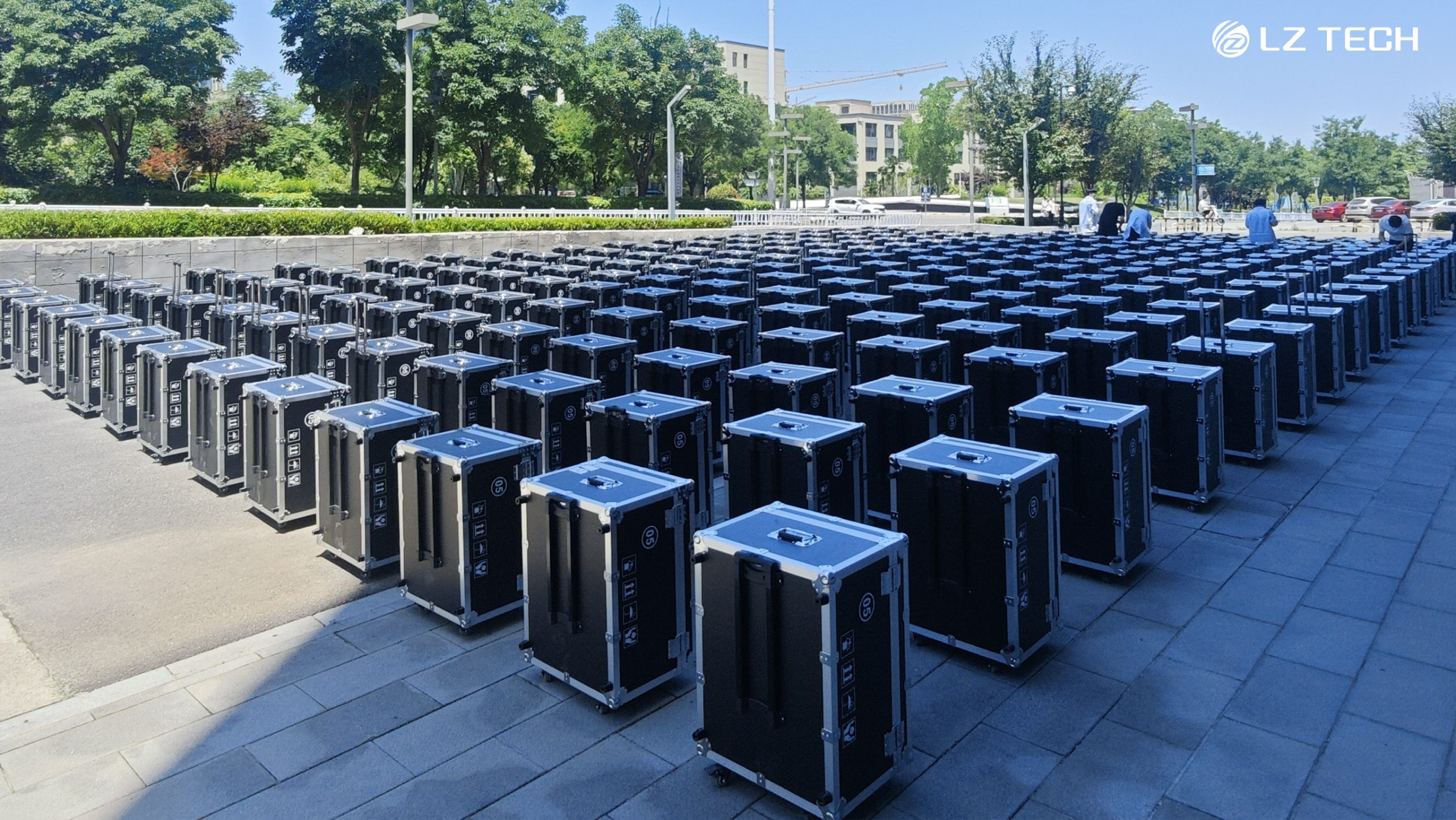
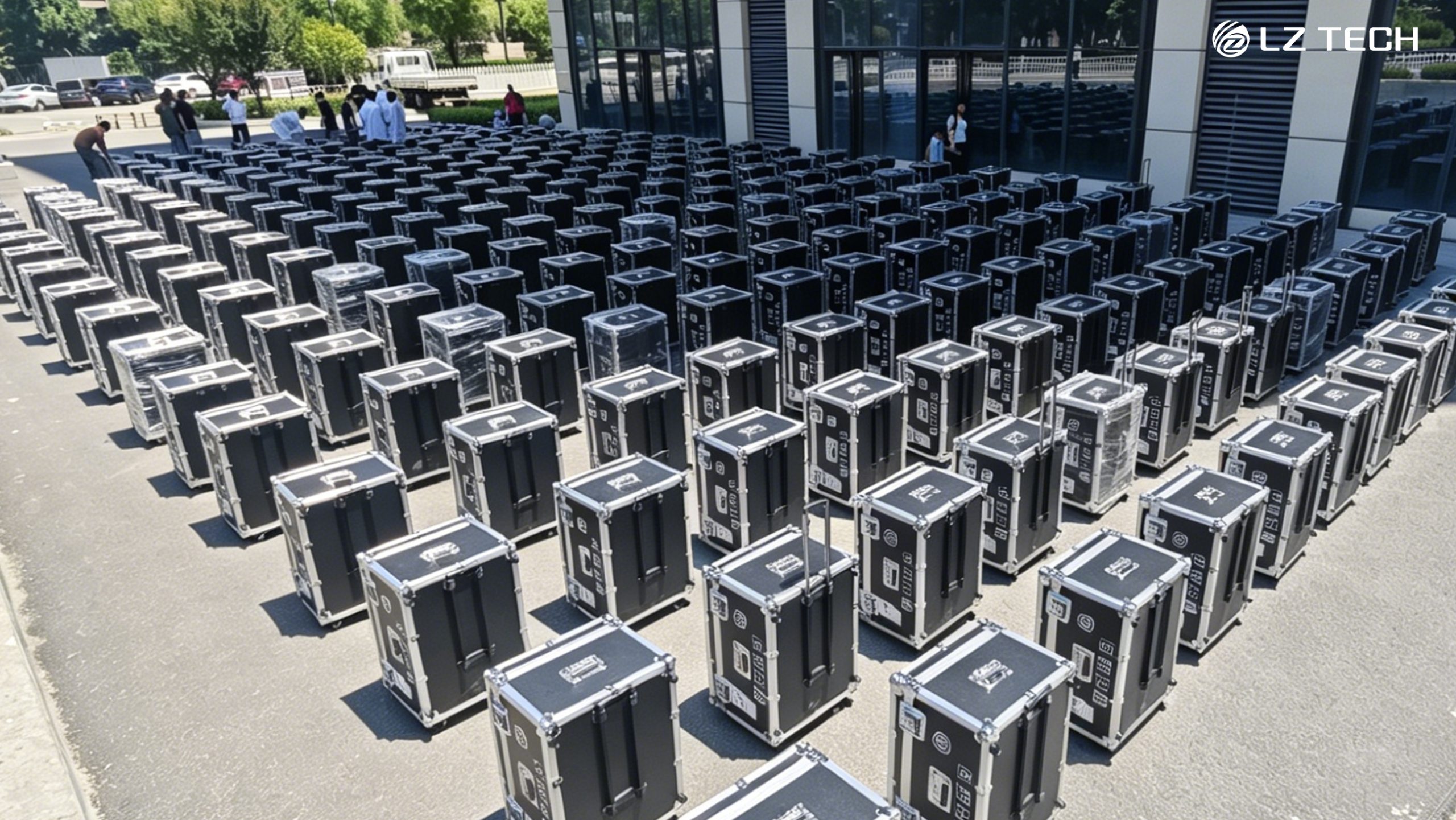
Behind the deployment numbers is a 10,000-square-meter manufacturing and service center, staffed by more than 100 professionals across production, quality assurance, testing, and post-sales support. Every unit shipped goes through four gates before export packaging: burn-in testing for long-term stability, RF performance calibration with signal integrity verification, full-system end-to-end functional testing, and a final quality inspection that checks both hardware and software revision levels.
The tour schedule over the past twelve months reads like a counter-UAS market map. Germany. Turkey. Saudi Arabia. UAE. Brazil. Malaysia, etc. At each stop, the booth generated new distribution agreements, technology integration partnerships, and direct procurement interest from government end-users. The throughline is the same everywhere: demand for counter-drone capability is accelerating, and procurement teams are getting more specific about what they need, which frequencies, which drone types, which integration protocols.
Europe: a channel structured for defense procurement
Europe right now is the most structured counter-drone market anywhere. NATO’s $40 billion C-UAS pledge through 2031. The C-UAS Marketplace certification framework opens 32 national procurement offices to any vendor that passes the certification criteria. A growing number of national programs, German critical infrastructure C-UAS, British Army and Home Office drone defense, Polish border fortification, and Belgium-Netherlands joint air defense procurement. Europe has moved from trials to operational programs, and that changes the kind of company that gets the contract.
LZ TECH has been growing European distribution channels to match that tempo. The network now spans defense integrators, security system resellers, and specialized counter-drone consultants in Germany, the United Kingdom, Turkey, Belgium, the Netherlands, and Poland etc. The model is a local partner plus the LZ TECH technology stack. Partners handle local language, certification paperwork, import logistics, and ongoing customer relationships. LZ TECH provides the detection hardware, the protocol analysis engine, the jammers, the command software, and the integration engineering that gets the system talking to whatever C2 the end-user already runs.
The UK market, in particular, is a strategic focus for channel development. It is one of Europe’s largest defense spenders and one of the most open to counter-drone technology from suppliers outside the traditional European defense primes. Publicly announced programs from the British Army, the Home Office, and multiple airport operators signal sustained procurement demand. For any counter-UAS vendor, the UK is a reference market: systems that earn deployment here tend to see follow-on interest across the Commonwealth and from NATO members that track UK procurement as a benchmark.
Belgium and the Netherlands formalized their joint air defense procurement at the NATO Ankara Summit. Germany is running parallel C-UAS evaluation programs with budgets tied to infrastructure protection. Poland is layering detection and interdiction systems along its eastern border. Each of these programs requires hardware that is locally supported, certifiable, and able to plug into existing command-and-control infrastructure. The European channel is built to deliver that package, not just move boxes across a customs line.
Products on the booth: what is driving demand
LZ TECH brings its full counter-UAS stack to Farnborough. Detection. Identification. Neutralization. Command and control. Fixed-site, vehicle-mounted, portable, and OEM module form factors. Here is what visitors will see running live.
Detection and identification
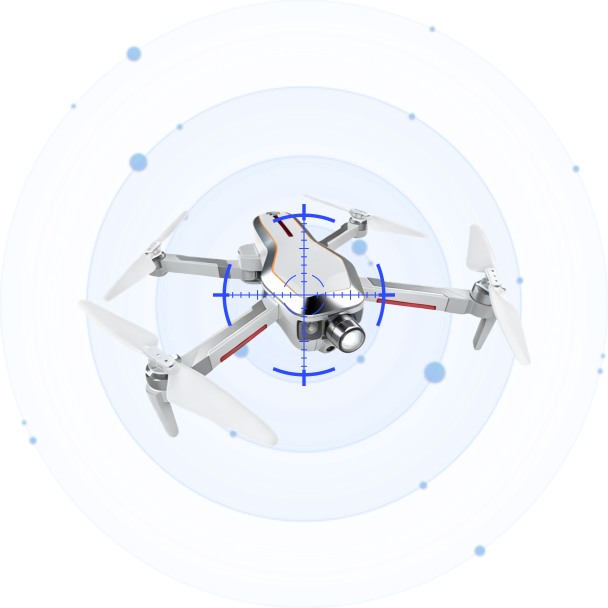
The Detection and Defense System pairs passive RF detection with protocol-level analysis. It detects drone signals without any active emission, identifies the drone model and serial number through a protocol decode of the communication between the drone and its controller, and extracts the operator’s home-point GPS coordinates from the signal stream. The system handles commercial drones, modified consumer platforms, and DIY FPV builds that pure frequency-based detection routinely misses.
For sites that need active sensing, the TR100 combines phased-array radar and EO/IR into one integrated sensor head. Radar detects and tracks the target. The camera slews to the radar track and delivers visual confirmation. The VAR300 handles autonomous detection and tracking for installations that need 24-hour coverage without a full-time operator at the screen.
The protocol analysis engine deserves particular attention. Most RF detection systems tell you a signal is present on a given frequency band. The LZ TECH engine goes further: it decodes the bitstream between the drone and its controller, extracts the serial number and flight parameters, and maps the operator’s home-point GPS location onto the command interface. For law enforcement, that turns a radar blip into an actionable address. For a military base, it turns an unknown contact into a known aircraft model with a known flight mode. The database now covers over 200 drone models across DJI, Autel, Parrot, Hubsan, FIMI, and custom FPV platforms. New signatures are added continuously through the AI-RPC self-learning pipeline, which updates the fingerprint library from field data collected across the deployed fleet.
Neutralization
The DFJ series jammers cover drone control and navigation frequency bands. Directional jamming lets the operator target a single drone while keeping surrounding communications running. At an airport, a prison, or a stadium, that is not a nice-to-have. Emergency services, air traffic control, and civilian mobile networks cannot go dark every time a drone shows up.
For situations where jamming is the wrong tool, the protocol-level takeover system delivers a different option. After the CRPC engine identifies the drone, the system reconstructs control-layer data streams and issues flight commands to the target. Redirect it away from the protected site. Force a controlled landing. Hold it in place until a response team gets eyes on. No kinetic debris. No spectrum damage. European law enforcement agencies that operate in dense urban areas see this as a game-changer for situations where every other response option carries unacceptable collateral risk.
Command and control
CRPCS software ties detection, classification, and response into a single operator interface. The CCS command platform scales that to multi-site monitoring with GIS overlay, sensor health dashboards, alarm timeline, and role-based access control that maps onto civil defense command structures. Both platforms accept third-party sensor inputs. If a customer already has radar from one vendor and cameras from another, CRPCS integrates the feeds instead of forcing a rip-and-replace.
OEM modules: protocol intelligence as a component
The protocol analysis engine ships as a compact OEM module for integration into existing radar, EO/IR, or C2 platforms from other manufacturers. A radar company that sells into NATO can add drone identification to its product line without spinning up a radio protocol analysis team from scratch. A C2 vendor can offer identity-level threat classification without developing signal intelligence expertise in-house. For the European defense market, where procurement preferences often favor existing supplier relationships, the OEM route opens doors that a standalone counter-UAS system cannot reach on its own.
An active player in a market that waits for no one
The counter-UAS industry in mid-2026 is moving at a pace most outside observers underestimate. NATO certification frameworks are being drafted right now. World Cup C-UAS deployments are generating operational data. Airport procurement timelines are compressing from years to quarters. The companies that are not shipping products, exhibiting at shows, signing distribution partners, and deploying systems simultaneously across multiple regions are losing ground.
LZ TECH has been on the move. In the past twelve months, the company exhibited at defense and security trade fairs in Germany, Turkey, Saudi Arabia, the UAE, Brazil, Malaysia, and many other international markets. Each event produced distribution agreements, government contacts, and product feedback that goes straight into the engineering backlog. Farnborough extends that pattern into the largest audience the company has addressed, with defense procurement delegations from every continent in the same halls for five consecutive days.
The delivery pipeline tells the same story. High-volume orders shipped across multiple regions in the first half of 2026. A manufacturing infrastructure that scales from single-unit demonstrations to multi-site operational deployments and still hits the delivery date. A partner network that covers every major counter-drone procurement geography.
The feedback loop from the field shapes what gets built next. European customers want NATO-standard interoperability and spectrum discipline. Middle Eastern customers prioritize detection range and all-weather reliability. Southeast Asian customers need portability and fast deployment. The product line reflects each of those priorities because the engineering team hears it directly from the operators using the systems.
At Farnborough, LZ TECH is showing operational hardware, not a concept deck. The company is showing systems that are already deployed, already shipping, already generating operational data across 60-plus countries. For the buyers walking the halls in July, that is the conversation that matters.
Visit LZ TECH at Farnborough
LZ TECH invites Farnborough attendees to visit the booth for live demonstrations of RF detection, protocol-level identification, directional jamming, and the integrated CRPCS and CCS platform. Product specialists, integration engineers, and regional channel managers will be available for technical discussions and procurement inquiries throughout the show.
To schedule a meeting or reserve a demonstration slot during the event, contact the LZ TECH newsroom or reach out through the company’s official channels.
About LZ TECH
LZ TECH is a counter-UAS and security technology company that provides RF detection, protocol-level identification, jamming, and integrated defense systems for government, infrastructure, airport, and enterprise customers, and so on. The company operates a 10,000-square-meter manufacturing and service center and serves customers in more than 60 countries through a network of over 6,000 partners worldwide.