Vehicle-Mounted Drone Defense: Mobile Protection for Convoys and Temporary Sites

Most counter-drone systems are designed to sit in one place and protect a fixed perimeter. That works for airports, stadiums, prisons, and power plants. It does not work for anything that moves. A VIP convoy is driving between two cities. A temporary command post set up at a disaster response site. A mobile inspection team moving between remote infrastructure locations. In these scenarios, the protected asset does not have a fixed address. The counter-drone system needs to move with it.

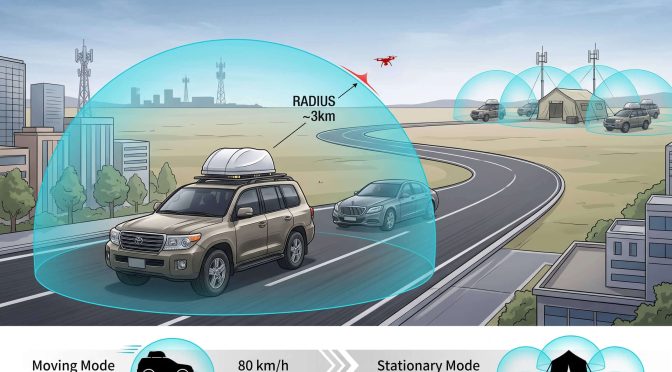
Vehicle-mounted drone defense solves this by putting detection and jamming capability on a vehicle that travels with the asset it protects. The concept is straightforward. A vehicle carries a sensor suite that scans for drone signals, identifies threats, and jams hostile drones, all while moving at highway speeds. The vehicle creates a protection bubble that moves with the convoy. When the vehicle stops, the protection bubble becomes a temporary fixed-site defense. When it moves, the bubble moves.

The physics of detecting drones from a moving vehicle

Detecting a drone from a stationary sensor is hard because of terrain, multipath, and signal attenuation. Detecting a drone from a vehicle moving at 80 kilometers per hour adds two more challenges. First, the vehicle’s own motion shifts the apparent angle of arrival of every signal it receives. The sensor is moving relative to both the drone and the remote controller, so the raw bearing data changes continuously even if the drone is stationary. Second, the vehicle itself is a noise source. Engine electronics, onboard communication systems, and the metal vehicle body all contribute to the electromagnetic environment the sensor must operate within.

The VM system addresses the motion challenge with signal processing that compensates for the vehicle’s movement in real time. It achieves direction-finding accuracy of 3 degrees RMS for a hovering target and 10 degrees RMS for a moving target, even while the vehicle is in motion. For comparison, these are the same accuracy specifications as LZ TECH’s fixed-site DF Series sensors. The vehicle’s speed, measured by its own GPS and inertial sensors, is subtracted from the incoming bearing data so the angle-of-arrival calculation reflects the drone’s true position rather than the sensor’s movement.
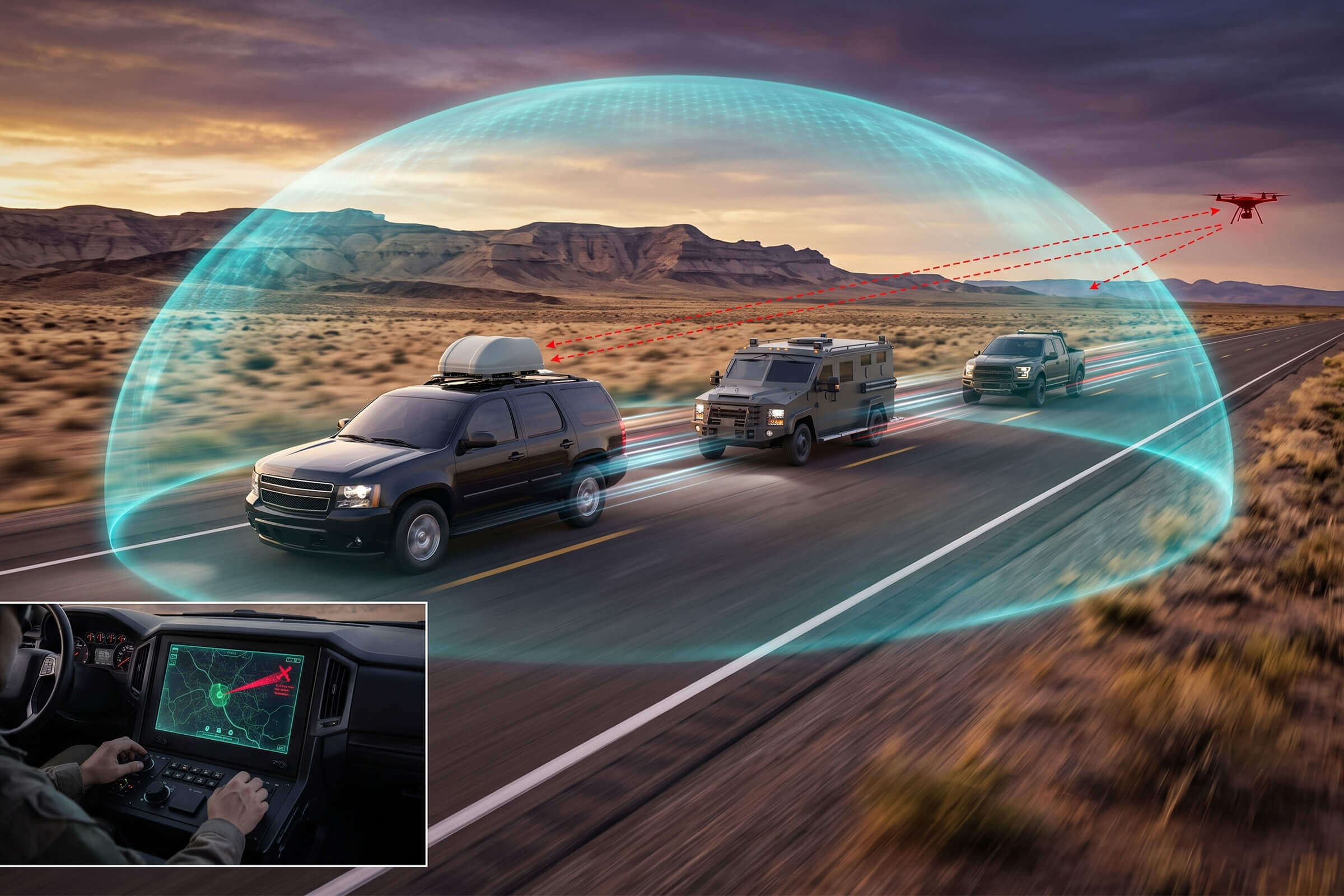
The detection band spans 30 MHz to 6 GHz, covering the same full range as the fixed-site systems. Detection range extends to 3 kilometers from the vehicle’s position. A drone approaching the convoy from 3 kilometers away is detected while the vehicle still has approximately two minutes of driving time before the drone closes the distance, assuming the drone is moving at 20 meters per second and the vehicle is traveling at 80 kilometers per hour.

Creating a moving protection bubble

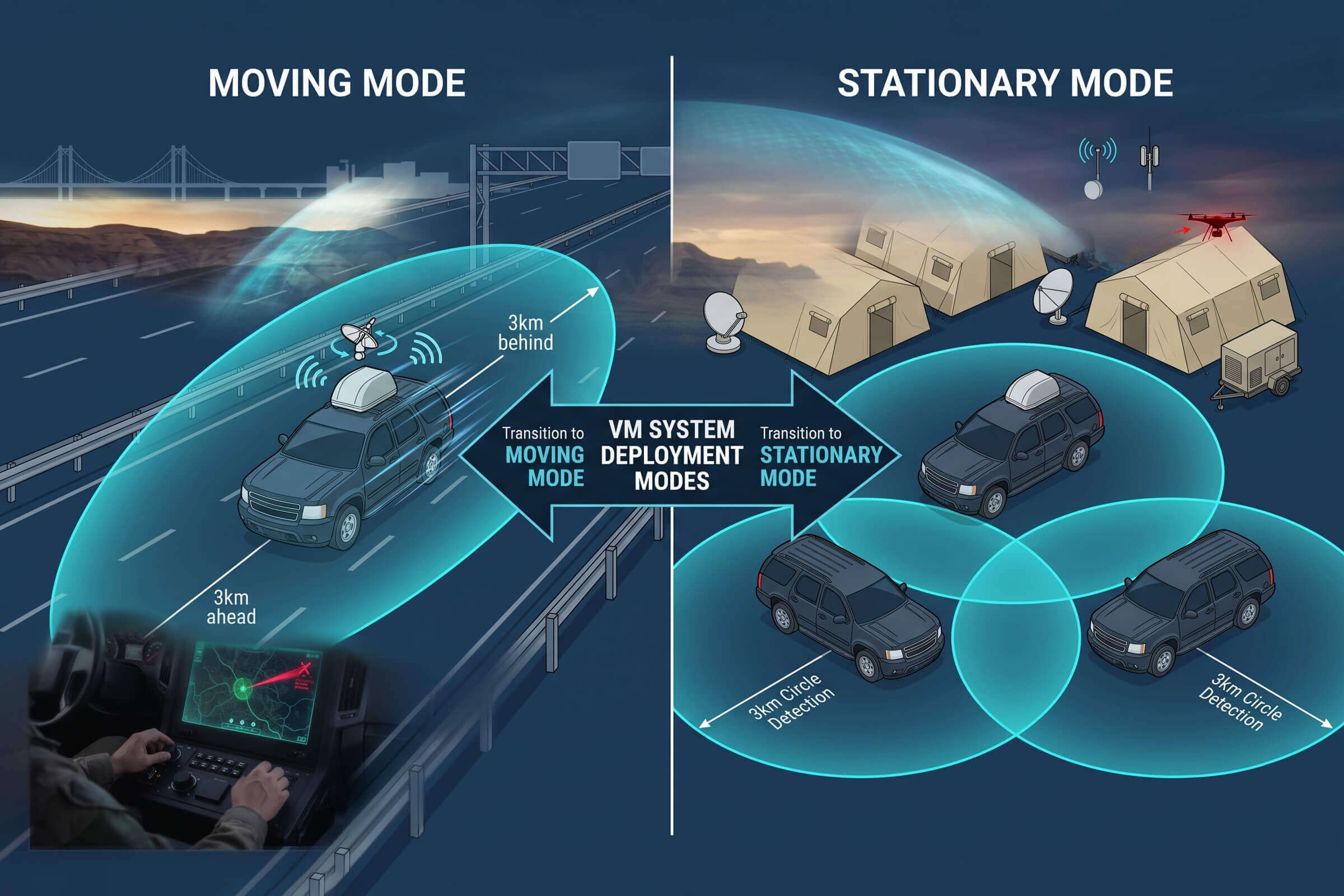
The protection bubble concept describes an area around the vehicle where the VM system detects, identifies, and can jam drones. The size of the bubble varies with speed, terrain, and the type of drone being detected. In open terrain at moderate speed, the detection bubble extends to roughly 3 kilometers. The jamming bubble is smaller, covering the immediate airspace above and around the protected asset. The vehicle’s motion extends the bubble in real time, so a convoy of vehicles with multiple VM systems creates overlapping bubbles that cover the entire convoy length.

The jamming capability is configured for the specific operational environment. The VM system outputs across eight bands: 400 MHz, 800 MHz, 900 MHz, 1.2 GHz, 1.4 GHz, 2.4 GHz, 5.2 GHz, and 5.8 GHz. Each band is individually configurable, so the operator can activate only the frequencies that the detected drone is using while leaving other bands clear for the convoy’s own communications. The jamming is omnidirectional from the vehicle, which means the bubble is a sphere around the vehicle rather than a directional beam. For a convoy moving through open terrain where collateral interference is not a concern, omnidirectional coverage is simpler and more reliable than directional jamming that must be constantly re-aimed as the vehicle turns and changes speed.

From convoy protection to temporary site defense

The same vehicle that protects a moving convoy becomes a fixed-site defense system the moment it parks. At a temporary command post, a disaster response staging area, or a field inspection site, the vehicle stops and the VM system continues operating. The detection bubble now covers a fixed circle around the parked vehicle. Multiple vehicles can be spaced to create overlapping coverage across a temporary site of any size.

This dual-mode capability reduces the logistics burden for organizations that need both mobile and temporary fixed-site protection. Instead of deploying a convoy protection vehicle for the drive and a separate fixed-site system for the destination, the same VM-equipped vehicle covers both phases of the operation. The system transitions from mobile to stationary operation with no reconfiguration. The detection algorithms adjust automatically when the vehicle’s GPS reports zero speed.
The VM system’s environmental specifications support this dual-use profile. It is rated IP66 for protection against dust and high-pressure water jets. The operating temperature range spans -40 to +60 degrees Celsius. These ratings are not marketing specifications. They mean the system can be deployed in desert heat, in heavy rain, and in freezing conditions, without taking the vehicle offline for weather. The same vehicle that drove through a sandstorm at 40 degrees Celsius continues to provide drone detection when it parks.

A typical convoy protection deployment

A representative deployment scenario illustrates how the pieces fit together. A three-vehicle convoy is moving from a headquarters building to a field inspection site 120 kilometers away. The lead vehicle carries a VM system with the detection and jamming suite integrated into a roof-mounted enclosure. The middle vehicle carries the protected principals. The trail vehicle provides rear security.

As the convoy departs the headquarters, the VM system begins scanning the 30 MHz to 6 GHz band. Two minutes into the drive, it detects an unknown drone signal at 2.4 GHz, approximately 2.5 kilometers ahead and slightly to the right of the convoy’s direction of travel. The detection data identifies the drone as a DJI Mavic 3, provides the drone’s GPS coordinates and altitude, and plots the remote controller position on a map. The convoy commander evaluates the information: the drone is at 120 meters altitude and its position suggests it is mapping a construction site adjacent to the highway, not tracking the convoy. The commander logs the detection and continues. The VM system records the encounter for post-mission analysis.

Twenty kilometers from the destination, a second detection appears. A smaller drone, identified as a custom FPV quadcopter, is approaching from the convoy’s left at 15 meters altitude, heading directly toward the middle vehicle. The convoy commander activates the jamming system on the 2.4 GHz and 5.8 GHz bands. The FPV drone loses its video and control link and falls to the ground 800 meters from the convoy. The convoy continues without stopping. The entire sequence, from detection to neutralization, takes under 30 seconds.

Where vehicle-mounted systems fit in the broader C-UAS field

Vehicle-mounted systems do not replace fixed-site installations. They complement them. A permanent facility that needs 24-hour protection is better served by a fixed grid of DF Series sensors, D5-B TDOA nodes, and electro-optical verification systems. A convoy, a temporary site, or a mobile inspection team that has no fixed address needs a system that moves. The VM fills that gap. Its specifications parallel the fixed-site product line in detection range, frequency coverage, and accuracy. The difference is the form factor and the motion compensation that makes mobile operation possible.

For organizations that operate across distributed sites connected by road, the combination of fixed-site protection at each facility and vehicle-mounted protection for the road segments between them closes the coverage gap. The drone threat does not respect the property line between the perimeter fence and the highway. A vehicle-mounted system ensures the protection extends to wherever the asset goes, not just to wherever the asset parks.
Standalone Systems vs. OEM Modules: An Integrator’s Guide to Drone Defense

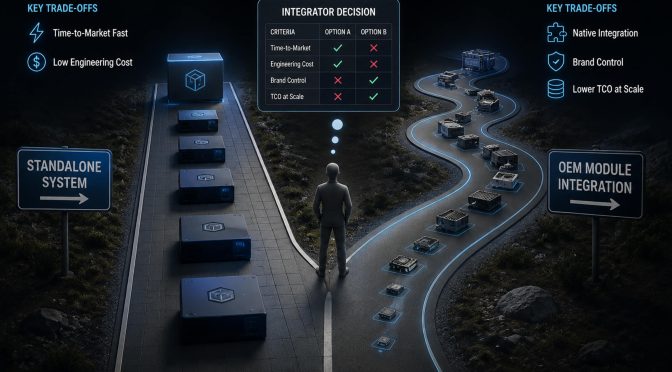
A system integrator adding drone defense to a security platform faces a real fork in the road. One path is to pick a ready-made piece of hardware, plug it in, and hand the end user the controls. The other is to pull the detection engine out of that hardware, embed it inside the integrator’s own platform, and present a unified experience under a single brand. Both paths lead to a working solution. The difference is in who owns the integration, who owns the brand, and what the total cost looks like after the tenth deployment.

This article walks through both paths with concrete product examples. For the standalone path, three LZ TECH systems serve as reference points: the HJ1 handheld unit for portable security, the J3 fixed-site system for permanent installations, and the JV-1 for sites that face a high proportion of FPV and custom-built drones. For the OEM path, the D-MB Mini detection module and its larger siblings in the OEM module family show what embedded integration looks like.

Path A: Pick a product and go

The standalone approach is the simpler starting point. A self-contained drone defense device arrives in a flight case, mounts on a pole or sits in a vehicle, connects to power and network, and begins operating. The integrator does not write code. The end user gets a separate interface for drone defense alongside their existing security platform. Implementation takes days, not months.

Three LZ TECH systems illustrate the range of what a standalone product can look like.

HJ1: Handheld, portable, single-operator

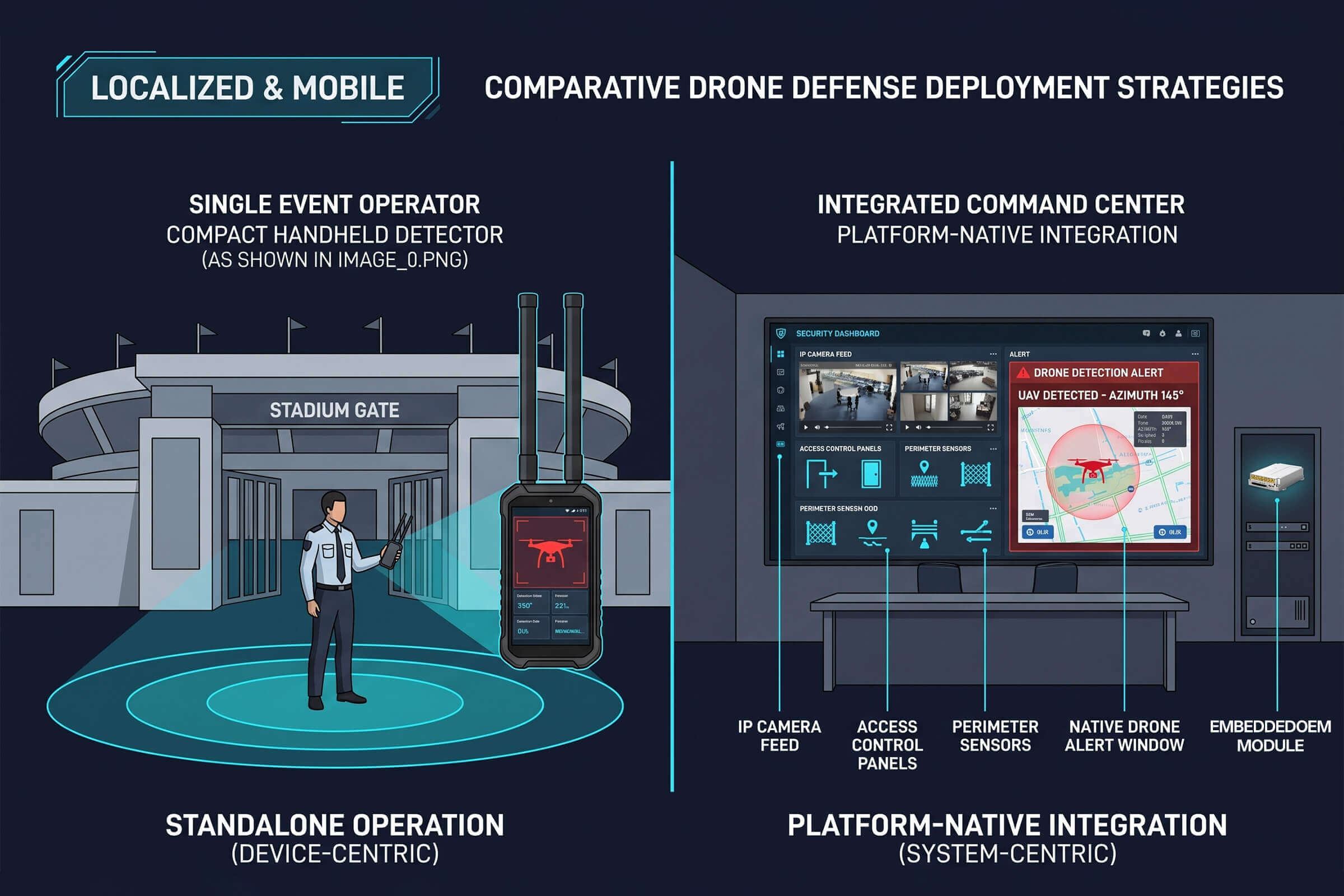
The HJ1 is a handheld drone defense system designed for one person to carry and operate. It weighs 6.5 kilograms with its battery installed, and its built-in handle and strap ports make it practical for a security officer to carry on patrol or deploy at a checkpoint. The device covers six frequency channels spanning the bands most commonly used by commercial drone communication and navigation links, from 800 MHz through 5.8 GHz. Its high-gain directional antenna array focuses its output on the target drone rather than broadcasting across the entire area, which matters when operating near other RF-dependent equipment. Response time from trigger to full output is under five seconds, measured as an RMS value across operational conditions.

The HJ1 is battery-powered with a field-replaceable lithium-ion pack, giving roughly half an hour of continuous operation on a single charge. It charges from zero to full in under two hours. The IP54 rating means it handles dust and splashing water, and it operates from minus 25 to 55 degrees Celsius. For deployments that need detection before action, the HJ1 includes an expansion holder and interface for an external handheld detection module, which adds drone identification and alarm capabilities to the jammer-only baseline.

For an integrator serving event security, VIP protection details, or rural patrol teams, the HJ1 is the kind of device that a single operator can deploy from a vehicle without tools. The integration story is simple: hand the device to the security team, provide basic training, and the capability is live.

J3: Fixed-site, 360-degree, always on

The J3 is a stationary drone defense system built for permanent installation. It uses eight independent channels to cover the full range of frequencies used by commercial drones for video transmission, remote control, and navigation, from 430 MHz through 5.8 GHz. The omnidirectional antenna array covers 360 degrees horizontally and plus or minus 90 degrees vertically. There are no blind spots.

The J3 supports precise selective targeting when paired with an external detection system. It can address a specific threat drone in an airspace that also contains friendly or authorized drones, rather than affecting everything in the sky. It also supports network integration with radar, electro-optical, and RF detection equipment, enabling an unattended detect-and-respond workflow. Response time is under five seconds.

Environmental resilience is one of J3’s stronger design points. IP66 protection keeps out dust and high-pressure water jets. The operating temperature range spans minus 40 to 55 degrees Celsius. It runs on AC power with low standby draw, and the flight-case packaging makes transport and installation straightforward for a fixed-site deployment team. At roughly 35 kilograms for the device itself, the J3 is not portable in a patrol-bag sense. It is meant to be mounted, connected, and left to run.

For an integrator serving airports, correctional facilities, or government buildings, the J3 is the permanent-installation option. Mount it, network it, and it becomes part of the facility’s infrastructure.

JV-1: Purpose-built for FPV and custom drones

The JV-1 addresses a specific problem that generic drone defense systems can miss. FPV racing drones and custom DIY builds often operate on frequency bands outside the standard commercial drone channels. The JV-1 targets these non-standard links specifically: the TBS Crossfire and ExpressLRS protocols at 868 and 915 MHz, analog FPV video feeds at 1.2 GHz, and the wider 5.1 to 5.9 GHz range used by high-power digital video systems. It uses a combination of narrowband and frequency-hopping techniques to match the agile signaling that FPV drones employ.

The JV-1 has a unique capability that is worth noting for integrators who work with security teams that need visual confirmation. When connected to a radio detection system, the JV-1 can display the drone’s first-person camera feed directly in the operator’s software interface. The security officer sees what the drone pilot sees. It can also transmit custom text or image alerts to FPV goggles and video receivers in the area, which has operational utility for communicating with an unknown drone operator.

The JV-1 is a fixed-site device with 360-degree omnidirectional coverage, IP66 protection, and an operating range from minus 40 to 60 degrees Celsius. It weighs under 25 kilograms without its antennas and ships in flight cases. It supports fixed, vehicle-mounted, and mobile deployment configurations. For an integrator whose customer base includes prisons or critical infrastructure sites that have reported FPV drone incursions, the JV-1 is the specialized tool for a specialized threat.

Path B: Embed the detection engine

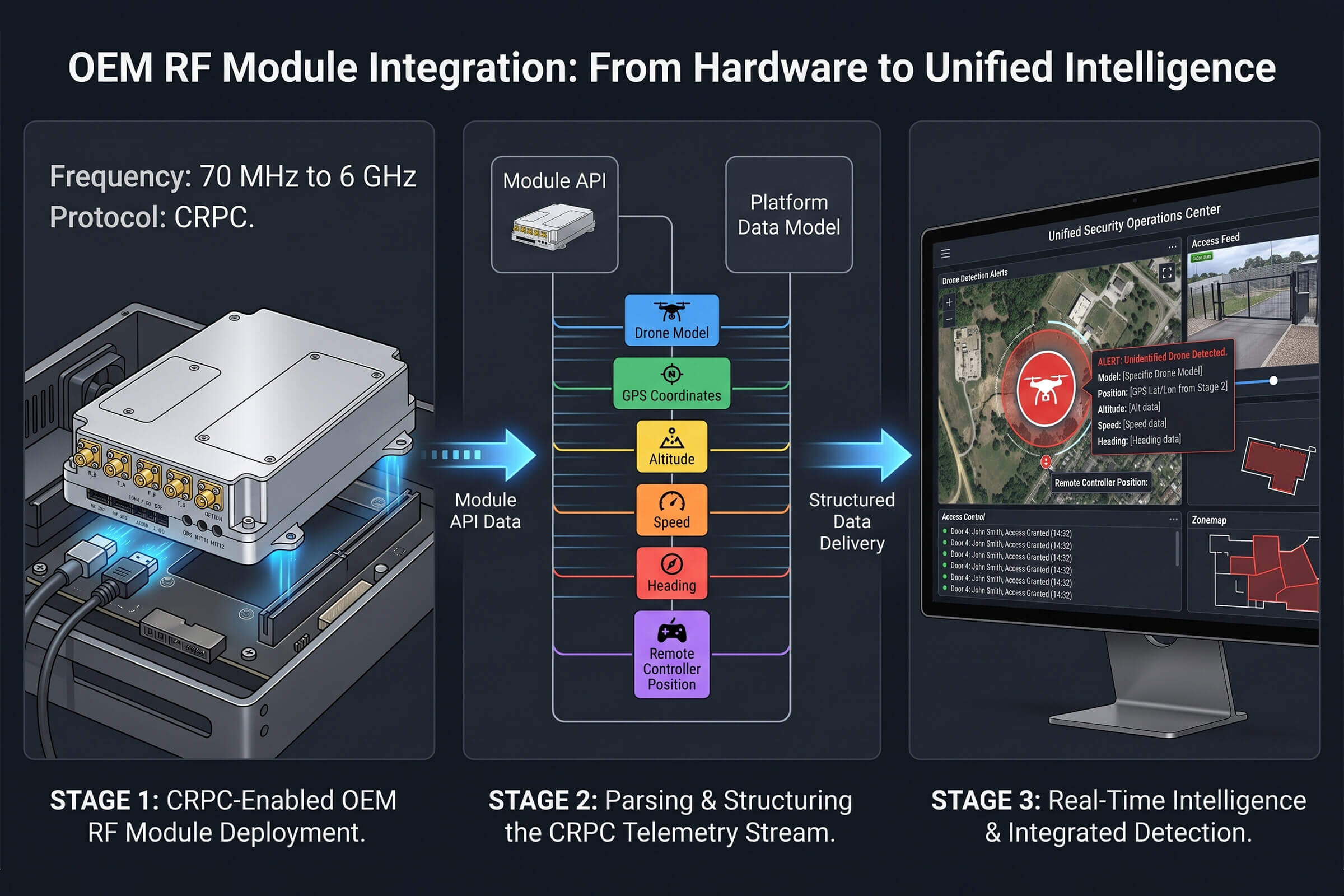
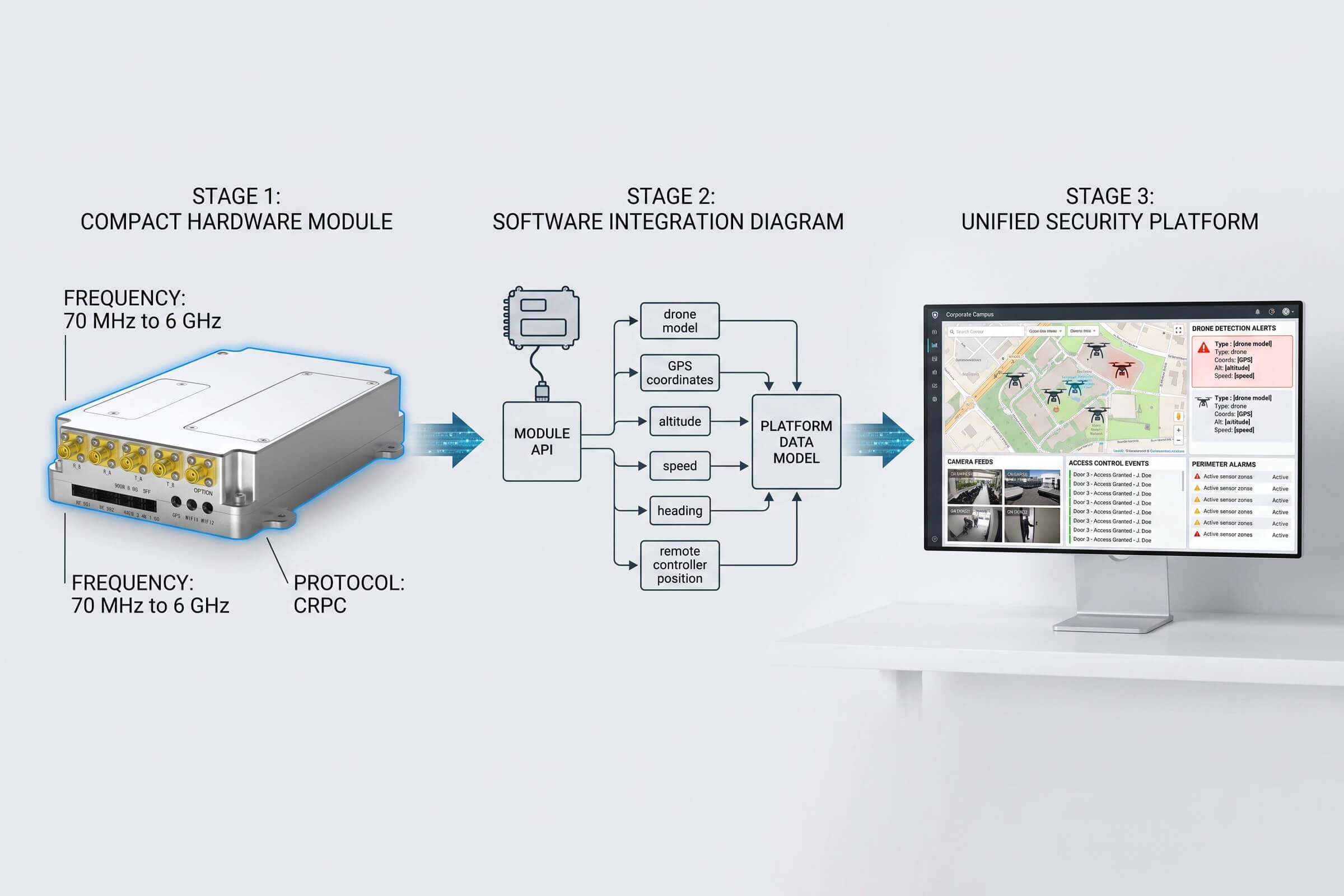
The OEM module path takes a different approach. Instead of buying a complete product, the integrator buys a compact hardware unit that contains an RF front end and an onboard processor running the detection software. The module detects drones, identifies the model and protocol, and outputs structured data through an API. It does not include a case, an antenna array, a user interface, or a dashboard. It provides a data feed and leaves everything else to the integrator’s platform.

LZ TECH’s OEM module family follows this model. The modules cover 70 MHz to 6 GHz, using the CRPC protocol analysis engine to decode drone communication and identification protocols. The structured data output from the module includes the detected drone model, its serial number or identification marker, GPS coordinates, altitude, speed, heading, and the position of the remote controller. The integrator’s software ingests this stream through the API and renders it in whatever form the platform’s interface requires.

The D-MB Mini is the compact entry point in this family. It is designed for space-constrained platforms: portable security devices, compact sensor nodes, and handheld equipment where the module must fit inside an existing chassis. Larger module variants add direction-finding capability for platforms that need bearing data alongside detection, and higher sensitivity for fixed-site installations that require the longest possible detection range. All variants run the same CRPC detection core, so an integrator who qualifies one module can add new deployment profiles by selecting a different module variant rather than starting a new integration project.

The integration investment is front-loaded. The integrator’s development team builds the user interface components, the alerting pipeline, and the data mapping from the module’s API output into the platform’s internal data model. Once complete, adding drone detection to additional deployments is a configuration change, not a hardware procurement. The CRT display, the alert rules, the operator workflow, and the audit trail are all native to the integrator’s platform. It is delivery of a native capability rather than the bolt-on of a third-party product.

How the two paths fit together in practice

A representative deployment shows why the choice between standalone and OEM is not either-or for many integrators. Consider a security company that operates a command-and-control software platform for correctional facilities. They have twenty prison sites under contract. At each site, they need drone detection and defense. They also sell their platform to new customers who have no existing drone security infrastructure.

For the core detection capability that rolls out to all twenty sites and every new customer, the OEM module path makes sense. Embed the detection engine once, spread the integration cost across all deployments, and present a unified interface to every customer. The integrator owns the capability. For the defense hardware at each site, they might deploy a J3 mounted on a watchtower, connected to the platform through the network integration interface. The platform receives detection data from the embedded OEM module, correlates it with the J3’s status, and presents a single workflow to the operator. The detection is native to the platform. The defense layer is a best-in-class standalone system that the platform manages as a networked device.

At a site that reports FPV drone intrusions, they add a JV-1 alongside the J3. The threat profile determines the defense hardware. The integration depth determines the operator experience. Both can be chosen independently.

The decision framework

Five questions cut through the standalone-versus-OEM trade-off. They are the same questions regardless of which specific products the integrator evaluates.

Question one: What is the deployment timeline? A single site going live next month points toward a standalone device like the HJ1 or J3. A platform capability shipping to a growing customer base over years points toward OEM module integration.

Question two: What is the expected deployment volume? Below roughly five to ten sites, the standalone product often wins on total cost because the integration investment has not yet amortized. Above that, the OEM module becomes the lower total cost. The crossover point depends on the integrator’s internal engineering costs, but the logic is the same.

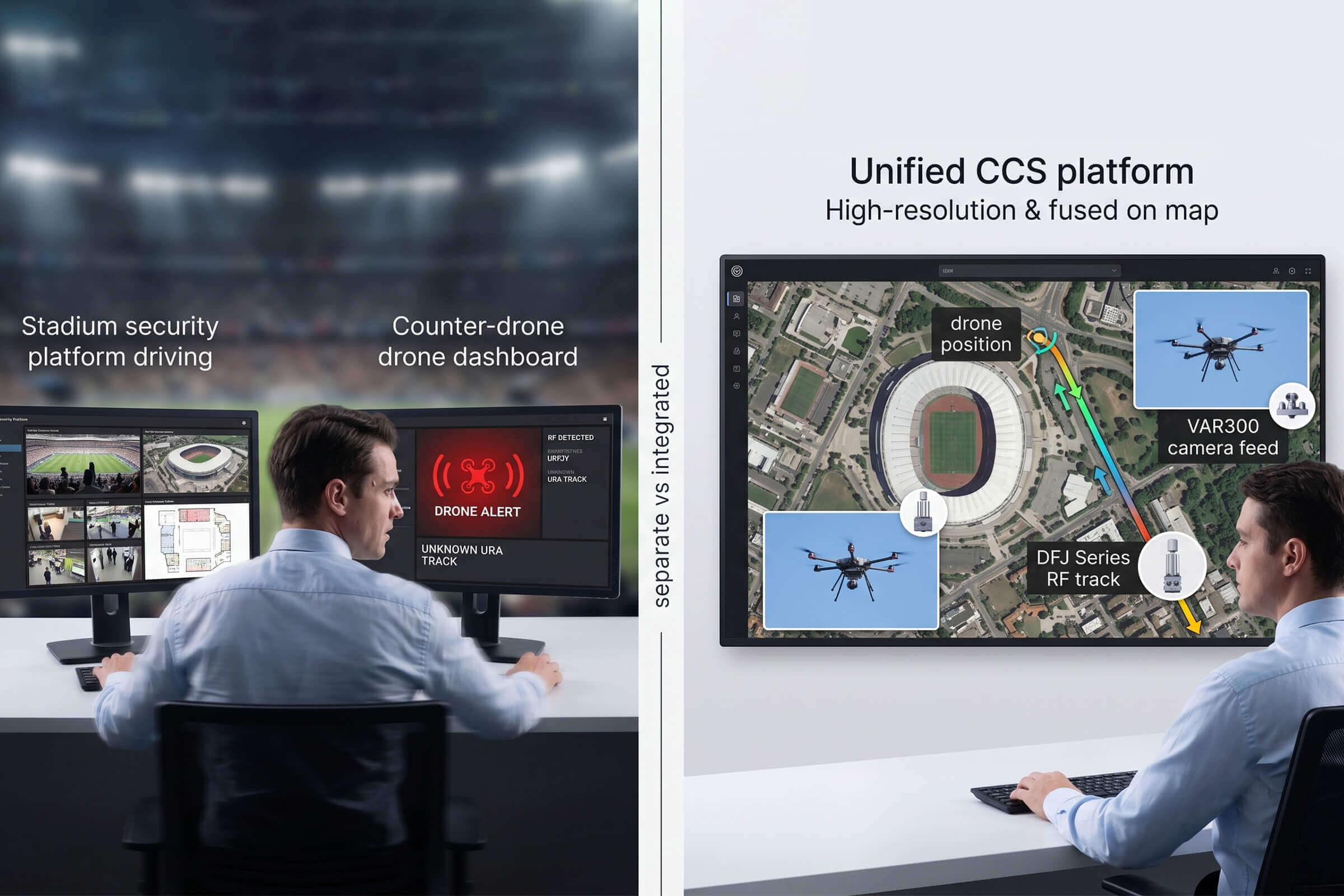
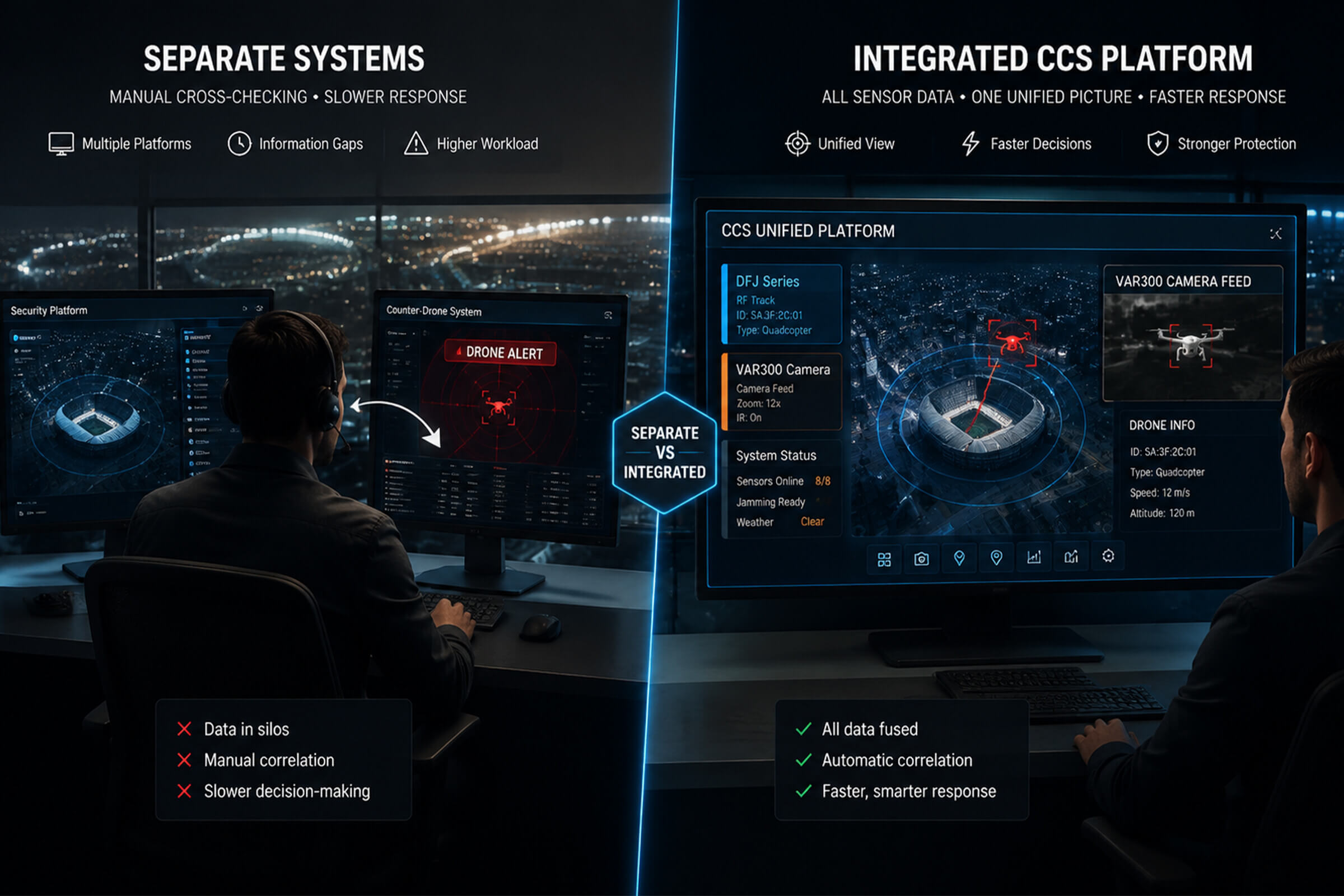
Question three: How tight does the integration need to be? If drone defense alerts must appear on the same map as camera feeds, access control events, and perimeter alarms, the OEM module delivers native integration. A standalone product will always require the operator to look at a separate interface or a separate pane within the platform that was bolted on rather than built in.

Question four: Who owns the end customer? If the integrator’s value proposition depends on single-vendor accountability and consistent brand experience across all security domains, embedding OEM modules keeps everything behind the integrator’s brand. The standalone path puts a visible third-party label on the drone defense capability.

Question five: What is the long-term supplier flexibility requirement? If the integrator needs the ability to swap detection or defense hardware suppliers with minimal end-customer disruption, the OEM module architecture provides that flexibility through a defined API layer. The standalone approach creates a tighter coupling to a specific product’s lifecycle and roadmap.

The products are real. The choice depends on you

The HJ1, J3, JV-1, and the D-MB Mini are not concept designs. They are products with shipping histories, compliance certifications, and field hours. The HJ1 has been carried by security teams at outdoor events and sensitive facilities. The J3 is mounted on rooftops and perimeter walls. The JV-1 addresses a threat category that generic systems miss. The D-MB Mini runs inside partner platforms that bear other companies’ brand names.

The integrator’s job is to match the product to the deployment profile. The handheld for the roving patrol. The fixed site for the permanent perimeter. The FPV specialist for the facility that sees custom drones. The OEM module for the platform that ships to dozens of sites under a single brand. There is no single correct answer across all scenarios. There is a correct answer for each scenario. The framework is the tool for finding it.

Stadium Drone Security: Detection, Identification, and Mitigation for Major Sporting Events

Every summer, the global sporting calendar puts tens of thousands of people in outdoor stadiums. The Olympic Games, the Premier League, the MLB season, the UEFA European tournaments. For security directors at these venues, the checklist is long. Crowd management, access control, perimeter monitoring. One item that used to be near the bottom has been moving up the list fast: drone incursions.

The numbers tell the story. Between 2019 and the end of 2025, the UK AirproX Board recorded over 600 drone-related incidents across the country, many involving large public gatherings. France’s civil aviation authority reported at least 60 confirmed drone sightings over prohibited French airspace during the 2024 Olympic Games period alone. These are not hypothetical scenarios. They are data points from events that already happened.

A drone over a stadium creates three problems at once. First, there is the physical safety risk. An out-of-control drone falling into a crowd is a kinetic event. Second, there is the operational disruption. A confirmed drone sighting during a match forces organizers to decide within seconds whether to pause the event, evacuate sections, or continue and hope. Third, there is the reputational damage. Video of a drone hovering over a packed stadium goes viral before security has even identified the operator. A stadium that cannot secure its airspace is a stadium that loses public trust.

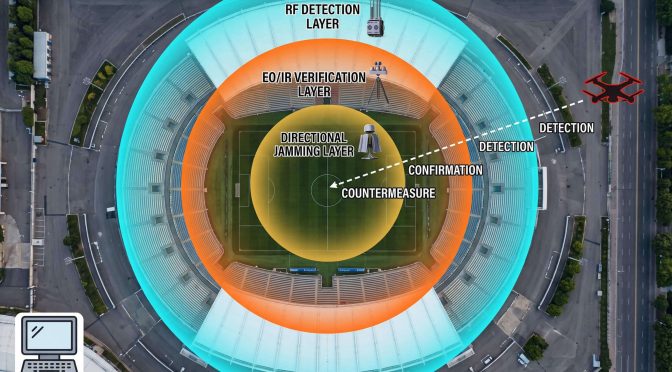
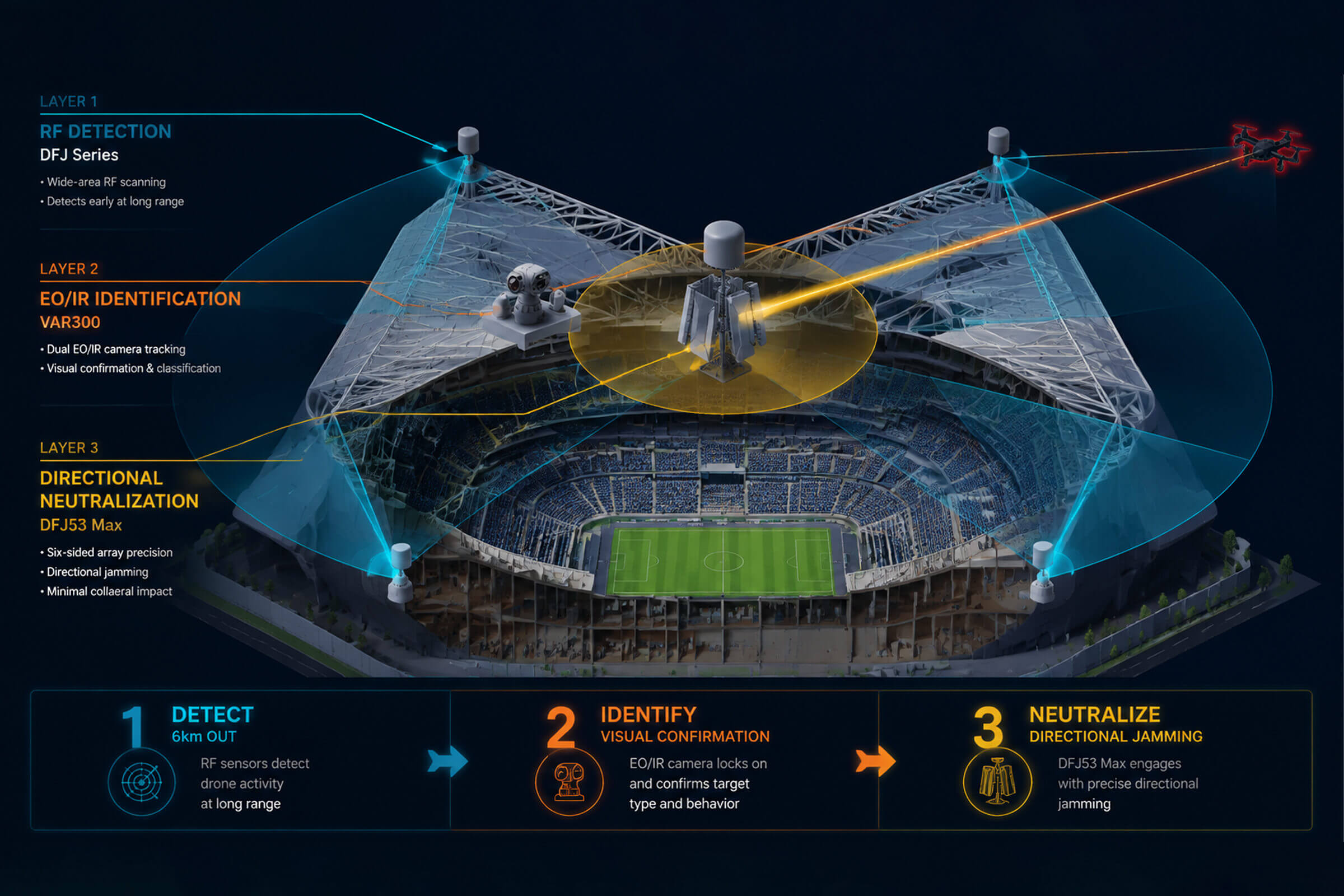
This article walks through a layered approach to stadium drone security: passive detection to find the drone, electro-optical verification to confirm the threat, and directional jamming to neutralize it. The goal is protection without disruption. A full stadium should not have to be empty because one person flew a drone too close.

The stadium detection challenge

Stadiums are among the hardest environments for drone detection. The same characteristics that make a stadium a good venue make it a difficult RF environment. Metal roof structures reflect signals. Tens of thousands of mobile phones create background noise across multiple frequency bands. Broadcast equipment, Wi-Fi networks for press and operations, and public safety radio systems crowd the spectrum. A detection system that works in an open field may struggle in a stadium with a full crowd on game day.

Passive RF detection is the first layer because it addresses the core challenge without adding to it. The DFJ Series is an all-in-one detection and jamming system designed for fixed-site deployment. For stadium use, the DFJ83 model begins with detection across 30 MHz to 6 GHz, covering the frequency bands used by almost all commercial and consumer drones. It identifies the drone model, serial number, GPS coordinates of both the drone and its remote controller, altitude, speed, and heading. All of this happens without the sensor emitting a signal. The drone and its operator have no way of knowing they have been detected.

The DFJ83 achieves direction-finding accuracy of 3 degrees for a hovering drone and 10 degrees for a moving target. In a stadium setting, where seconds matter, that bearing tells the security team roughly where in the sky to look and roughly where the operator is standing. The detection range extends to 8 kilometers. In practice, this means a drone approaching a stadium can be picked up while it is still kilometers away, giving the team several minutes of decision time before it enters the exclusion zone.

For stadium deployments that require 360-degree coverage with zero gaps, the DFJ53 Max is the higher-specification option. Its six-sided high-gain shield array uses adaptive beamforming to create a full-circle defensive perimeter. Detection spans 400 MHz to 6 GHz with a range of up to 5 kilometers. The system detects mainstream UAVs, FPV racing drones, and custom DIY builds. It operates autonomously 24 hours a day, 7 days a week, and integrates its detection and mitigation functions into a single closed loop: identify, track, neutralize. The zero-blind-spot design matters at a stadium where a drone could approach from any direction, and a gap in coverage means a gap in security.

Seeing what RF detects: the VAR300 verification layer

RF detection tells the security team that a drone is out there and gives a bearing and approximate position. For a stadium where the response protocol requires escalation before any disruption to the event, that approximate fix is not enough. The team needs visual confirmation before they act. They need to know the drone is real, what it looks like, and whether it is moving toward the venue or just passing nearby.

The VAR300 is a fixed electro-optical and infrared surveillance system that provides that confirmation. Once an RF sensor hands off a target bearing, the VAR300 slews its dual thermal and visible-light cameras toward the bearing and begins autonomous tracking. In daylight, it detects a DJI Mavic 3 at 1 kilometer or more and maintains tracking beyond 1.5 kilometers. At night, its VOx uncooled infrared detector with 640 by 512 resolution detects the same target at 500 meters and tracks it at 800 meters. The built-in AI recognition engine classifies objects and suppresses false alarms from birds, aircraft, and other moving objects in the sky.

For a stadium security director, the VAR300 solves a specific problem. The clock starts ticking the moment an RF detection alert appears. Without visual confirmation, the only safe option is to treat every alert as a real threat. That leads to unnecessary event pauses and crowd disruption. With visual confirmation from the VAR300, the team can distinguish a real drone incursion from a false alarm in seconds rather than minutes. The camera’s screen shows the captured image, the target similarity score from the AI classifier, and the real-time bearing. The decision to escalate becomes an informed one rather than a reflexive one.

Airborne coverage for stadium blind spots

A stadium’s physical structure creates detection blind spots that ground-based sensors alone cannot resolve. The underside of a roof overhang. The approach corridor is blocked by a neighboring high-rise. The sector is masked by the stadium’s own lighting towers. A drone that comes in low along one of these shadow zones can pass under the beam of every fixed ground sensor on the property.

The D5-Air is an airborne RF detection payload that mounts on a standard commercial UAV platform such as the DJI M400 or M350. From its airborne position, it scans 400 MHz to 6 GHz and achieves a detection range of up to 5 kilometers. It feeds received signal data in real time back to the ground station, where it integrates with the DFJ Series and VAR300 data streams through the CCS command platform. The D5-Air spends its flight time above the stadium periphery, looking down into the zones that ground sensors overlook. When the event ends, it lands. During the event, it fills the gap.

From detection to response: the jamming decision

Not every drone detection requires a jamming response. Some drones are simply passing overhead at altitude with no relation to the event. Some are operated by the media with accreditation. But when a drone is identified as a genuine threat, the response needs to be fast, precise, and contained. A stadium packed with 60,000 people cannot tolerate broadband interference that disrupts mobile phone service, broadcast equipment, or emergency communications.

Directional jamming is the solution to that constraint. The DFJ83 jams drones across bands at 900 MHz, 1.5 GHz, 2.4 GHz, 5.2 GHz, and 5.8 GHz, with each band configurable independently. Its effective jamming range extends to 3 kilometers. The jamming is directional rather than omnidirectional. It targets the specific bearing where the drone and its operator are located. The rest of the stadium, including mobile networks, Wi-Fi, and broadcast frequencies, remains unaffected.

The DFJ53 Max takes directional precision further. Its six-sided high-gain shield array with adaptive beamforming produces 360-degree high-power directional jamming that focuses energy on the threat axis. The beamforming technology steers the jamming signal electronically rather than mechanically, so there are no moving parts to maintain and no lag time while an antenna rotates. The system suppresses the drone’s image transmission, data link, and navigation link simultaneously. The affected area is a narrow cone centered on the drone, not a wide circle around the stadium.

An integrated workflow: from seconds to resolution

The pieces fit together in a sequence that, when rehearsed, takes the security team from detection to resolution with clarity at each step. A drone enters the detection perimeter at 6 kilometers, picked up by a DFJ83 or DFJ53 Max node positioned on the stadium roof. The CCS platform receives the alert and presents the drone’s model, position, altitude, speed, and operator location on a single map. The VAR300 camera slews to the assigned bearing and begins visual tracking. The security director confirms the threat visually on the VAR300 feed. If the drone continues toward the exclusion zone, the jamming system is activated on the specific bearing. The drone loses its control and video link and either returns to its home point or descends immediately. The event continues uninterrupted.

This workflow does not depend on any single product working perfectly. The RF detection system provides range and identification. The electro-optical system provides visual confirmation and AI classification. The airborne sensor covers the blind spots. The directional jamming system provides precision neutralization that respects the electromagnetic environment of a packed stadium. Each layer handles what it handles best. The platform ties them together.

For stadium operators planning their airspace security for the 2026-2027 season, the technology exists. The implementation is a matter of site survey, sensor placement, and integration testing. The season calendar does not wait.