Drone Defense for Flammable Sites: Stopping Drones Without a Spark

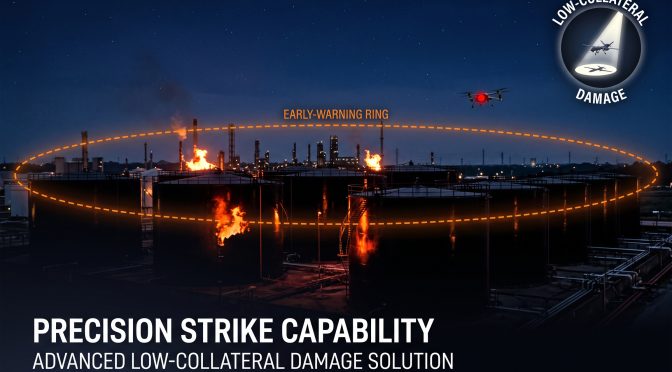
In August 2026, drones struck the Zawiya oil complex in Libya on successive days. One struck a storage tank holding roughly 4.5 million liters of gasoline, which caught fire and collapsed. A nearby power facility was hit by two more, one of them striking the fire-suppression system itself. Days later, a group claimed drone attacks on a refinery at Jazan in Saudi Arabia. None of this was a first. It was the continuation of a pattern energy operators have watched for years, and it frames a problem that is harder than most counter-drone work.

The Stakes at a Flammable Site

An energy facility changes the rules of a drone incident. Over a warehouse or a parking lot, an unauthorized drone is a nuisance. Over a tank farm, a gas processing unit, or a compressor station, the same drone is a potential ignition source. The site is full of materials that burn and full of equipment whose failure carries consequences far beyond the fence line.

That single fact reshapes the whole response. The threat is not only what the drone might carry, but what the site itself will do if something goes wrong. A falling object, a spark, a short circuit, or even a badly chosen countermeasure can all trigger the event the operator is trying to prevent. In a hazard zone, the defense has to be right the first time, because the margin for a wrong call is measured in ignition risk rather than inconvenience.
What the August Attacks Showed

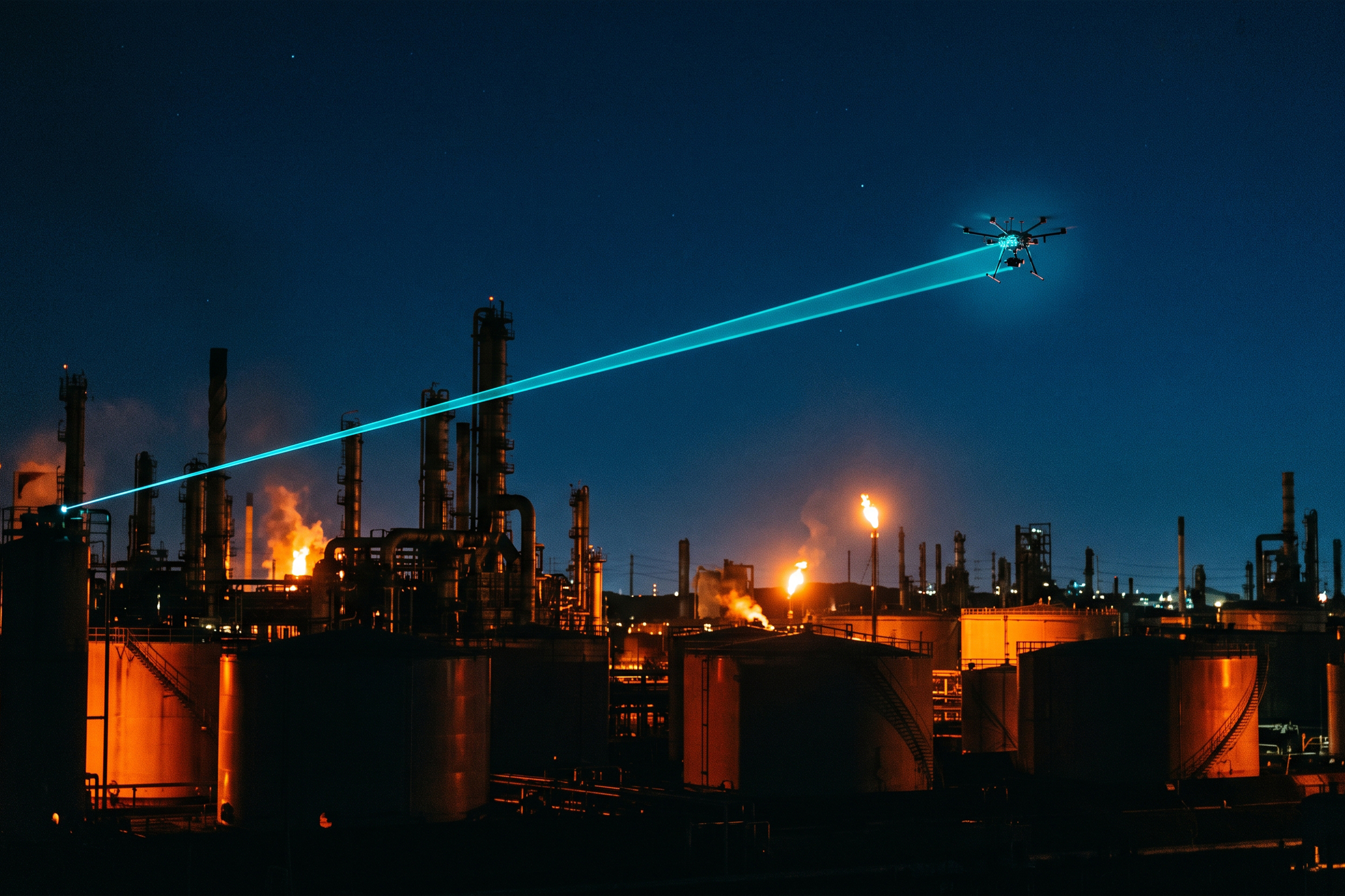
The Zawiya and Jazan incidents carried the same lesson from opposite sides of the energy map. The attackers did not need to breach a perimeter or defeat a defense in depth. They flew a cheap aircraft over the site, released or aimed a small payload, and left the resulting fire to do the damage. The fire-suppression system was itself a target at Zawiya, which tells you the attackers understood the site well enough to aim at the things that would make the damage worse.

The other lesson is about how these events reach the public. Libya’s state oil company warned that continued attacks could force it to declare force majeure, a legal term that stops contractual deliveries and ripples through the market. A drone did not just start a fire. It threatened a production status, a set of contracts, and a country’s export revenue. Energy infrastructure is not simply another customer for drone defense. It is the sector where a single flight can move from a security incident to a market event in hours.

Why Detection Must Come First

In a hazard zone, the most important capability is knowing early that something is approaching. The further out an operator can see, the more time there is to assess, decide, and act before the drone is over something that burns. Detection is also the layer with the fewest constraints. Passive radio frequency sensing does not transmit, does not interfere, and does not introduce any risk of its own, which is exactly what a flammable site needs.

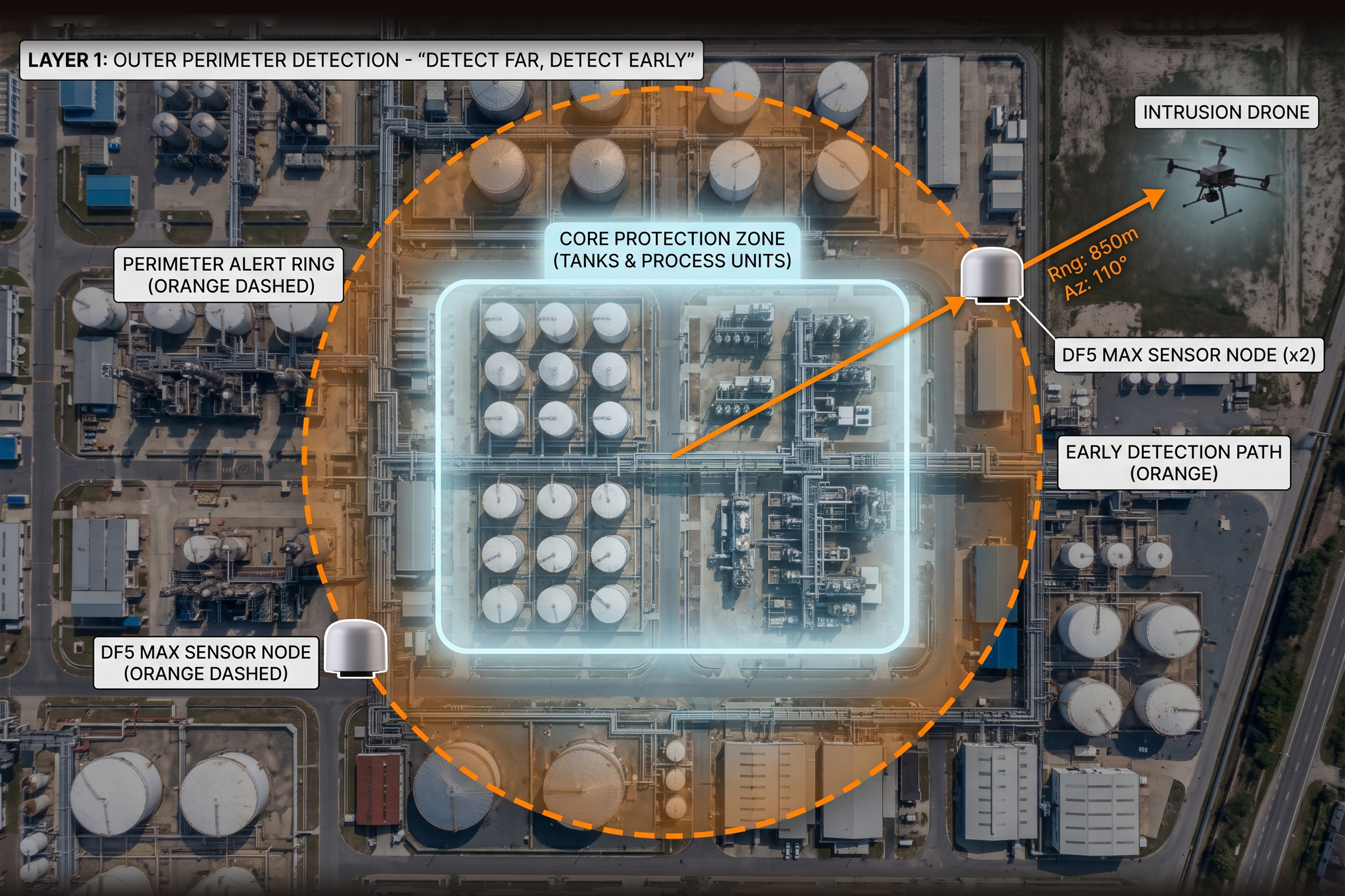
The DF5 Max fits this first layer. It watches the 400 MHz to 6 GHz band, the range where most commercial drones and their control links operate, with a detection distance of up to 5 kilometers and direction-finding out to about 3 kilometers at a ten-degree RMS accuracy. It can track more than thirty aircraft at once, which matters when the threat is not a single drone but a coordinated pattern. Placed around the boundary of a site, these units build a warning ring that buys the response team its most valuable asset: time.

The Hard Part: Response in a Hazard Zone

Detection is the easy half. The hard part is what to do once a drone is confirmed over a site full of flammable material. This is where most generic counter-drone advice fails, because the standard options were not designed for a place where a falling object or an uncontrolled impact can start a fire.

A kinetic response, any effect that physically brings the drone down, is a poor fit. In a hazard zone, you do not want to create a projectile over your own tanks. Even a successful hit leaves debris, and debris falling into the wrong place is the exact outcome the operator is trying to avoid. The same logic rules out any broad-spectrum signal jamming that spills into the site’s own communications, control systems, or safety equipment. In an energy facility, the spectrum is already carrying the signals that keep the plant running.

A Response That Stays Contained

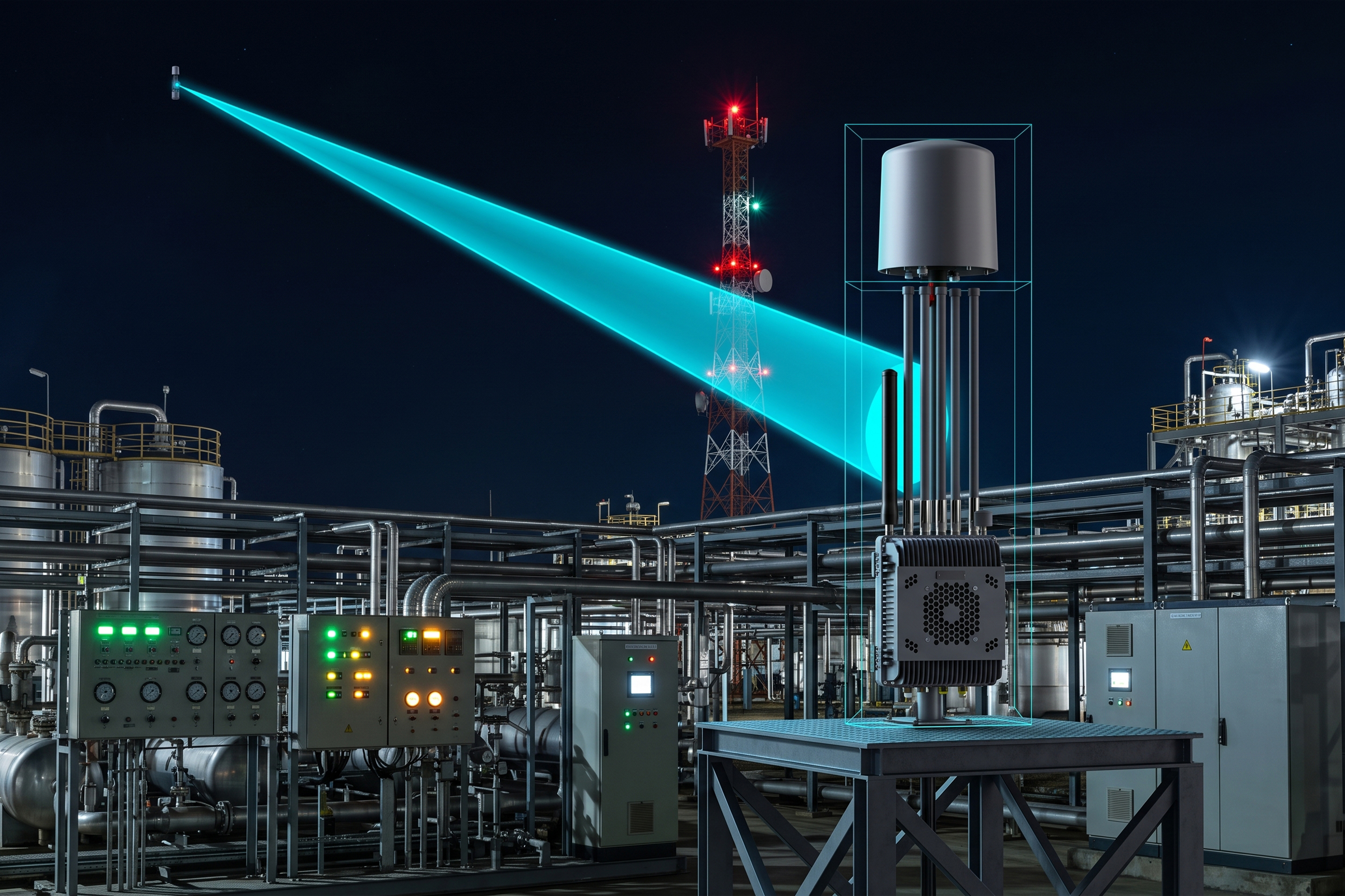
The answer for a hazard zone is a response that is directional and contained. Instead of blanketing the airspace, the intervention aims a narrow, focused beam at the single aircraft and leaves the surrounding spectrum untouched. That precision is what makes the difference between stopping a drone and disrupting the plant you are trying to protect.

The DFJ53 Max is built around this idea. Its multi-face array of high-gain antennas shapes the energy into a focused beam rather than an omnidirectional wash, with full 360-degree coverage so there is no blind angle. The aim is not raw power. It is placement: enough energy aimed precisely at one aircraft to end its flight or force it away, while everything around it, the plant’s radios, its sensors, its safety systems, keeps working.
This is the low-collateral principle in practice. The effect is confined to the threat, which is the only acceptable outcome in a place where collateral means something that catches fire.

Visual Confirmation Before Any Action

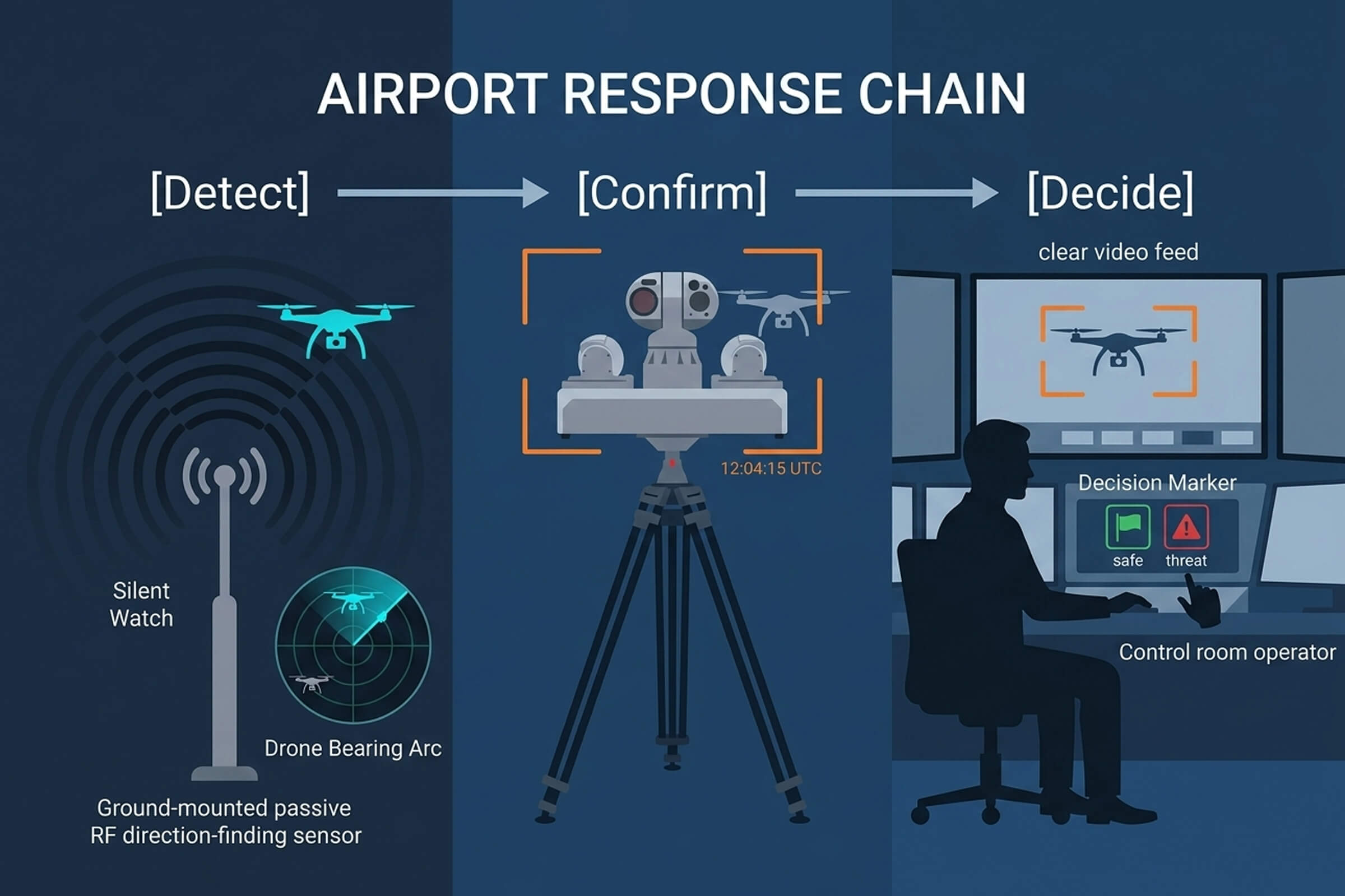
Before any response is taken, an operator in a hazard zone needs to see what they are dealing with. A radio contact could be a delivery drone passing overhead, a survey aircraft, or an actual threat. Acting on the wrong one wastes a response and, in the worst case, creates the incident. Visual confirmation is what separates a measured decision from a guess.

The VAR300 provides that confirmation. It combines electro-optical and infrared imaging to track a detected contact, giving the operator a clear picture of the aircraft in daylight and at night. With daytime detection beyond one kilometer and tracking beyond one and a half kilometers, and infrared coverage that keeps working after dark, it closes the loop between the RF warning and the response decision. In a flammable site, that loop is not a luxury. It is the difference between responding to a drone and responding to a rumor.

The Sequence That Keeps a Site Safe

A flammable site cannot treat detection, confirmation, and response as three separate purchases that happen to share a fence. They are one sequence, and the sequence only works when each step is timed to the last. The warning ring sees the drone while it is still minutes out. The confirmation layer turns the warning into a picture the moment it matters. The contained response is ready but unused until the operator is certain. That timing is the entire discipline of hazard-zone defense.

The alternative, jumping to a response the moment a contact appears, is how a hazard zone gets itself into trouble. A response fired at an unidentified contact over a tank farm is a roll of the dice with the site’s own materials as the stakes. The sequence exists to remove the dice. By the time anything is done, the operator knows what the drone is, where it is, and that acting is safer than waiting. Nothing is aimed at until it is known, and nothing is known until it is seen.

The Cost of Getting It Wrong

It is worth stating the downside plainly, because it is the reason energy operators cannot treat this as a generic security purchase. A mishandled drone incident at an energy site does not end with a report. It ends with a fire, a production stoppage, or an insurance event, and each of those has a price that dwarfs the cost of the defense.

The point of the Zawiya incident is not where to assign blame. A drone reached a storage tank, and the fire did what fires do in a place full of fuel. The operator’s real loss was not the drone that caused it. It was the tank, the product, the production status, and the force majeure risk that followed. Defense spending at a flammable site is not a line item. It is priced against the cost of a single tank going up, and on that comparison, the layered approach is not an extravagance. It is the cheapest option available.

Insurance, Regulation, and the Reason to Start Now

Two forces beyond the immediate threat are quietly pushing energy operators toward drone defense. The first is insurance. Underwriters pricing a refinery or a tank farm increasingly ask what the site does about drone risk, and a site that can show continuous monitoring and a logged detection history negotiates from a stronger position than one that cannot. The second is regulation, as airspace authorities extend drone-safety rules around critical infrastructure and operators face pressure to demonstrate that they monitor low-altitude airspace.

Both forces reward the operator who starts with detection. A warning ring of DF5 Max units, VAR300 confirmation on the critical assets, and a contained DFJ53 Max response are not only the right sequence for safety. It is the sequence that produces the logs, the coverage, and the demonstrated diligence that insurance and regulators want to see. The operator who builds it now is ahead of the requirements that will eventually catch up with everyone in the sector.
A Layered Path for Energy Operators

For an energy operator, the practical sequence runs from the outside in. First, a warning ring of DF5 Max units at the boundary, watching the full band and logging every contact. Second, VAR300 confirmation on the highest-value assets, so that detection is always followed by a clear picture. Third, a contained, directional response capability, the DFJ53 Max, is held in reserve for the confirmed threat that will not turn away.

Each layer is passive or contained by design, and each is usable at a flammable site without introducing a new risk. The operator starts by seeing, then by confirming, and only then by acting, and the action is aimed rather than sprayed. That is the sequence the Zawiya and Jazan incidents argue for: not more force, but the right force, placed precisely, in a place where precision is the only kind that is safe.

Energy infrastructure was one of the first sectors to learn that a cheap drone can reach a multi-billion-dollar asset. The August attacks are a reminder that the lesson is still being written. The operators who answer it will not be the ones with the biggest jammers. They will be the ones who can see early, confirm clearly, and respond without lighting their own fuse.
Border Low-Altitude Surveillance: What the Black Sea Frontier Teaches

A Gap on the Black Sea Frontier

In August 2026, a drone crossed the Romanian border and exploded near Kardam in Bulgaria, roughly a hundred meters from the frontier and a kilometer from a cross-Balkan natural gas compressor station. Neither country detected it in time. Bulgaria responded by shifting some of its border counter-drone assets toward Romania and stating a need for around ten detection-and-neutralization systems. Days later, a drone was spotted flying near the Neptun Deep offshore gas project in Romanian waters.

In the same month, Moldova reported five drones entering its airspace from multiple directions during a large air assault on Ukraine and opened an investigation into fallen debris. None of these were isolated incidents. Together, they describe a border problem that has outgrown the single-sensor, single-point response.

Why Borders Break Single-Point Detection

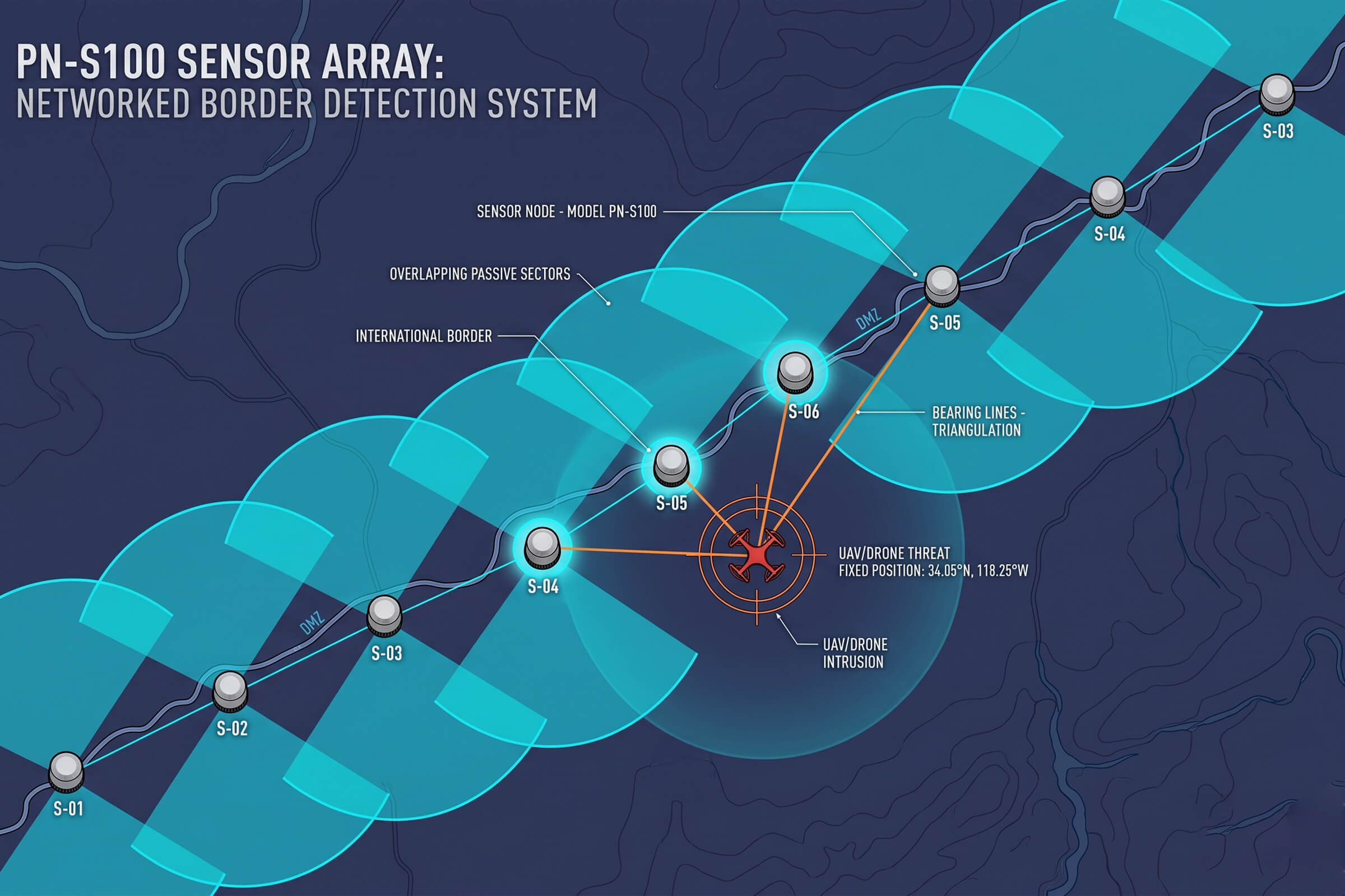
A border is not a facility. It is a line that runs for hundreds of kilometers through terrain, weather, and open sky, and a drone can cross it anywhere. A single detection unit, no matter how sensitive, watches from one fixed point, and its range falls off with distance and terrain. A drone crossing twenty kilometers away is invisible to it.

The consequence is that border airspace is defended in fragments. Each node covers a sector, and between the sectors there are seams, and the seams are where the drones cross. Closing the seams is not about buying a better sensor. It is about buying a network, and about the property that makes a border network different from a facility one: it must be passive.

Why Passive Matters Along a Border

Along a border, the detection layer has to run continuously, often in remote terrain, without touching the radio environment around it. Border regions are full of legitimate traffic: civil aviation, communications, and the systems of neighboring communities. A detection approach that transmits risks interfering with what it is meant to protect, and it reveals its own positions.

Passive detection sidesteps both problems. It emits nothing, so it cannot interfere with legitimate traffic and cannot be found by the operator it is trying to catch. It also runs lean. A passive node drawing tens of watts can be powered in remote terrain far more easily than an active one, and it can watch around the clock without the cost and footprint of a transmitter. For a border, passive is not a preference. It is the condition that makes continuous coverage possible.

Precision Positioning with TDOA

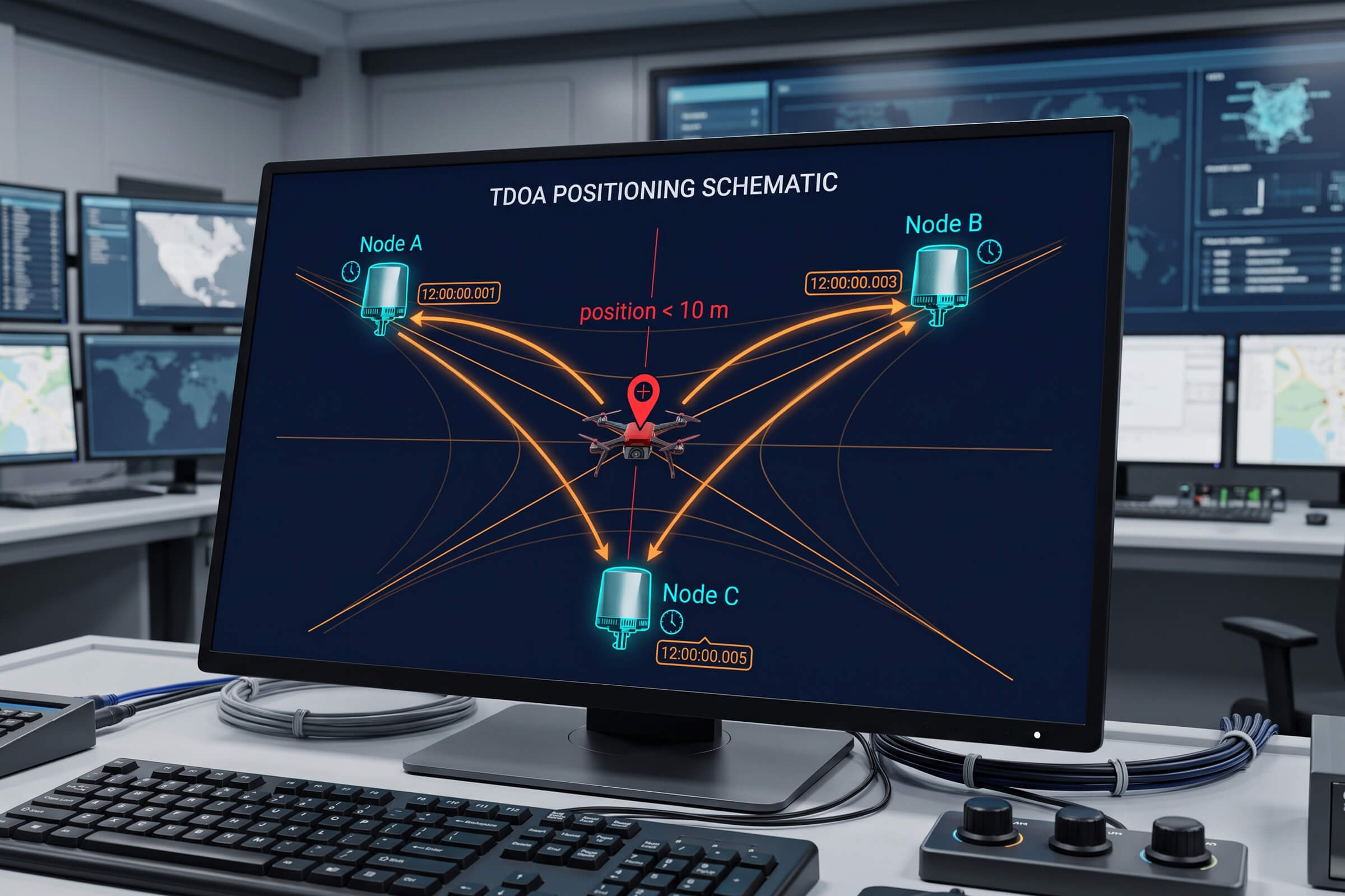
When you network passive sensors along a border, the next question is what each node contributes, and there are two answers. Direction finding measures the angle from which a drone’s signal arrives. Time-difference-of-arrival, or TDOA, measures when that signal reaches different nodes and turns the timing into a position. TDOA is the precise one.

The D5-B is a passive TDOA node built for exactly this role. A single D5-B covers the 30 MHz to 6 GHz band across a full 360 degrees horizontally, detecting a drone out to about three kilometers at altitudes up to one kilometer, and tracking more than thirty drones at once. Its positioning accuracy is better than ten meters RMS, with a response time of about two seconds. At roughly sixty watts and three kilograms, it is small and light enough to be placed where the border needs it and to run there continuously.

The difference between the two techniques matters. Direction finding gives a bearing, and with several units, a rough area. TDOA gives a coordinate. When the question is whether a drone is on your side of the line or the neighbor’s, a coordinate is what settles it, and it is the coordinate that feeds a fast, confident response.

Direction Finding for the First Alert

TDOA is precise, but direction finding is the earlier, wider net. The DF Series units, such as the DFJ83, scan a broad band from 30 MHz to 6 GHz and detect a drone at up to eight kilometers with direction-finding accuracy of three degrees RMS. Deployed along the frontier, they raise the first alert and point the way before the TDOA network has locked a position.

The two techniques are complements, not rivals. Direction finding watches a wide sector and says something is coming from that way. TDOA then places something precisely. Together, they move a border response from a vague warning to a known contact, which is the difference between scrambling to find a drone and already knowing where it is.

Designing the Border Network

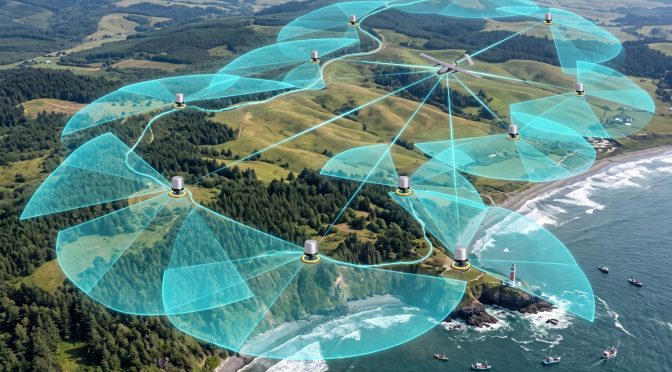
The practical design questions for a border network are spacing, redundancy, and handoff. Spacing is driven by the detection range of each node and the terrain it must cover. A node that sees eight kilometers in open country will see less over hills and forests, and the spacing has to shrink to match. The rule is simple: overlap the coverage so that no seam falls between two nodes.

Redundancy means no single node is critical. If one sensor goes down for maintenance or fails, its neighbors extend to cover the sector until it returns. A network designed with overlap tolerates a loss without opening a gap, which is the difference between a system that degrades gracefully and one that fails at the worst moment.

Handoff is what happens when a drone crosses from one node’s sector into another’s. In a network, the track is passed between nodes so the drone stays following the whole way across. A drone that crosses the line is the one case where handoff matters most, because losing it exactly at the frontier is losing it exactly where the answer matters.

All three constraints point the same way: toward small, passive, low-power nodes that can be placed densely and left to run. That is the physical reality behind the network design, and it is why the border case rewards exactly the kind of system the Black Sea incidents showed was missing.

Then there is power. The points where a border most needs coverage are often the points farthest from the grid. That is the quiet argument for passive, low-power nodes. A sensor drawing tens of watts can run on solar and battery in terrain where a transmitter-heavy design would need a generator and a fuel chain. Off-grid survivability is not a feature on a datasheet. It is what decides whether a node stays online for years or goes dark the first time the fuel runs out.

Weather is the second variable. Rain and fog attenuate radio signals and challenge any optical confirmation layer. A border system cannot count on a clear day. It has to be built around the radio frequency layer first, because that layer works through weather that blinds a camera, and it has to keep working at night when most border crossings happen.

A border network has to survive conditions that a facility network never faces. Mountain passes, dense forest, open plain, and coastal air all change how far a signal carries and where a sensor can be placed. A node that sees eight kilometers on flat ground will see far less through hills, and the design has to account for that by tightening spacing where the terrain closes in.

Terrain, Weather, and the Off-Grid Constraint

The Cross-Border Picture

The Black Sea incidents make a further point. A drone crossing a border is not one country’s problem. It is the shared problem of the country it left, the country it entered, and often the infrastructure near the line. The response is better when the tracks are shared, so that a drone detected on one side is already known to the other before it crosses.

That is why the software layer matters as much as the sensors. A command-and-control platform that fuses the passive nodes, correlates tracks, and presents one picture across the border turns a set of sensors into a shared situation. The hardware sees the drone. The software makes sure everyone who needs to know does so in time to act.

Rapid deployment also closes the gap between an incident and a permanent fix. The first wave of nodes can go in immediately, giving coverage while the full network is designed and funded. Each later phase then extends and hardens what is already watching, rather than starting from zero. That staged approach is how a border gets protected now and better later, which is the only timeline the threat allows.

That is the argument for portable, self-contained nodes. A sensor that is small, light, and low-power can be repositioned by a small team in hours rather than installed by a construction crew over weeks. When the threat moves from one sector to the next, the network moves with it. The border gets a response that tracks the pressure instead of lagging a season behind it.

A border does not wait for a permanent build-out, and neither does the threat. The Black Sea incidents forced an immediate answer, not a multi-year program. Bulgaria moved existing assets toward the affected sector within days, which is the pattern a good border system has to support: a network that can be re-pointed, re-spaced, and reinforced quickly when the pressure shifts.

None of that is satisfied by a bigger single sensor or a more powerful single response. It is satisfied by a network, and by the discipline of building that network from passive, low-power, precisely-positioned nodes that can be placed densely and left to watch. The frontier has already written the requirement. The only remaining question is who builds it.

Taken together, the August events on the Black Sea frontier are a specification in narrative form. They ask for a detection layer that runs continuously and silently, that places a contact precisely enough to know which side of the line it is on, and that can be repositioned when the pressure moves. They ask for a system that survives terrain, weather, and the absence of grid power, and that shares its picture across the border instead of stopping at it.

What the Frontier Asks For

Rapid Deployment for a Moving Frontier

The Bottom Line

A border is where drone detection systems earn their keep, and where weak designs fail first. The sites that get it right treat the border as a network, not a fence. Passive direction finding raises the first alert. TDOA places the contact precisely. A shared command picture makes sure the response crosses the line before the drone does.

The August events on the Black Sea frontier were not a call for a bigger single sensor. They were a call for exactly this: passive, networked, shared low-altitude surveillance that watches the whole line, all the time, without interfering with anything around it.

The Cost-Exchange Problem: Why Layered, Software-Defined Drone Defense Wins

The Arithmetic That Is Breaking the Defense Budget

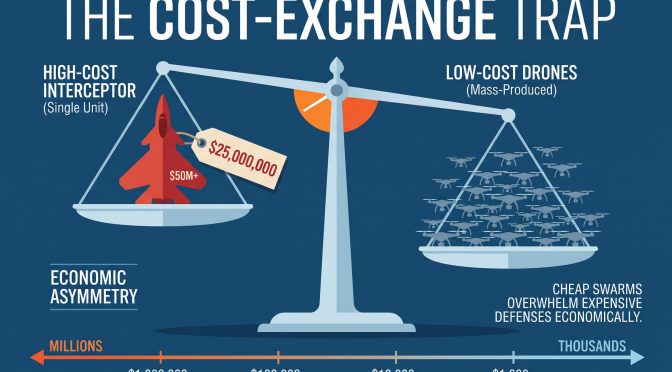
A senior European defense official put it bluntly in late August 2026: using an interceptor that costs millions to stop a drone that costs a few thousand is an arithmetic that cannot hold. It is not a new observation, but it has stopped being a debate and started being a constraint. The drone has become the cheapest way to make the other side spend money, and the counter-drone market is now organized around answering one question: how do you defend against a threat that costs almost nothing without spending a fortune to do it?

The numbers behind the warning are public and consistent. DroneShield reported first-half 2026 revenue up 74 percent year over year, with recurring revenue up 229 percent and now about nine percent of the total. The demand is real, and it is growing. The same half saw a Red Sea port suspend operations after sustained drone pressure, another reminder that the cost of not defending can exceed the cost of defending.

Why the Exchange Ratio Is Getting Worse

The problem is not just that drones are cheap. It is that they are getting cheaper, more capable, and more numerous at the same time. A single drone is a nuisance. A wave of them is a different problem, because every unit in the wave demands a response, and the responses cost money that does not scale down to match.

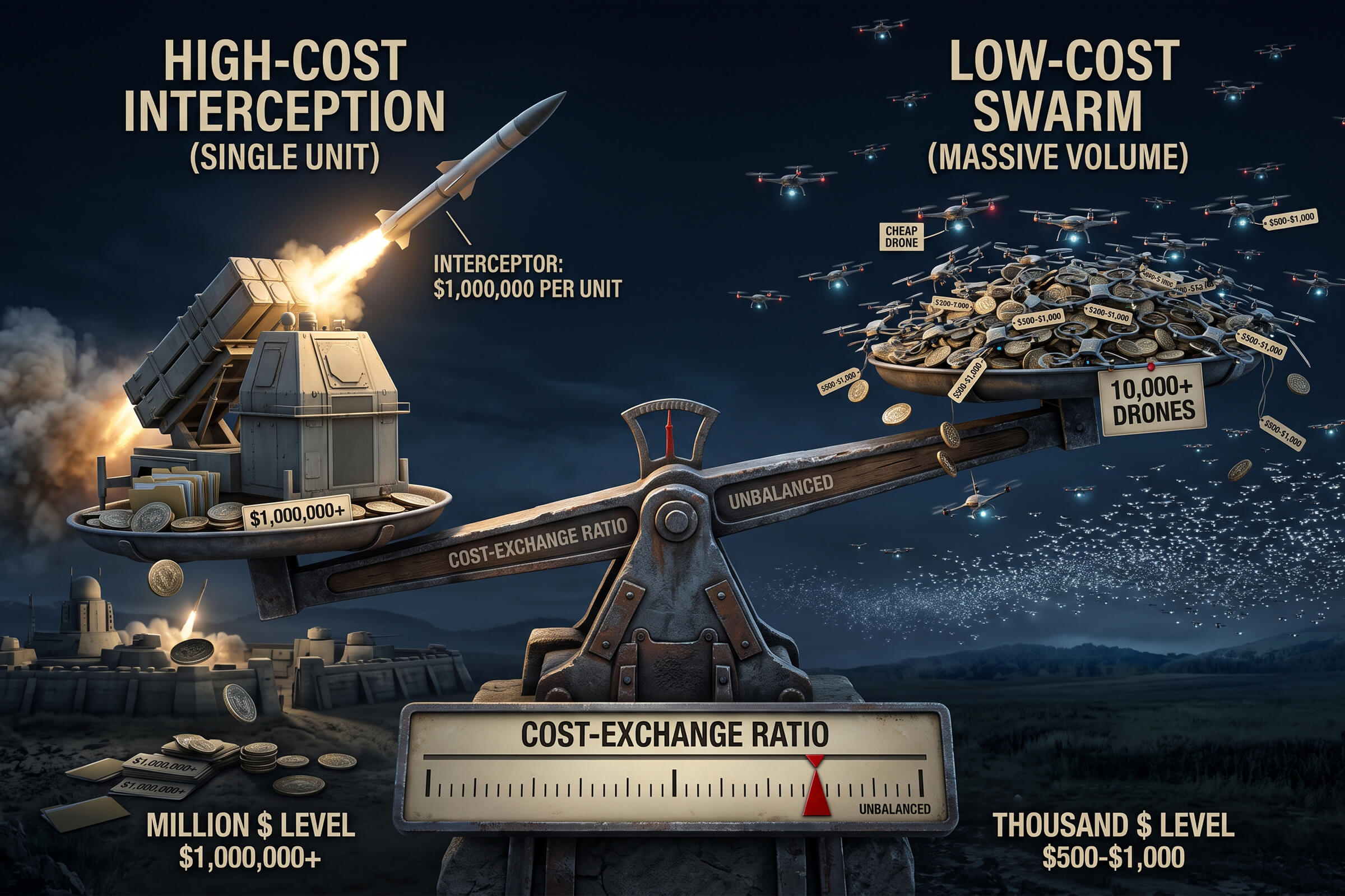
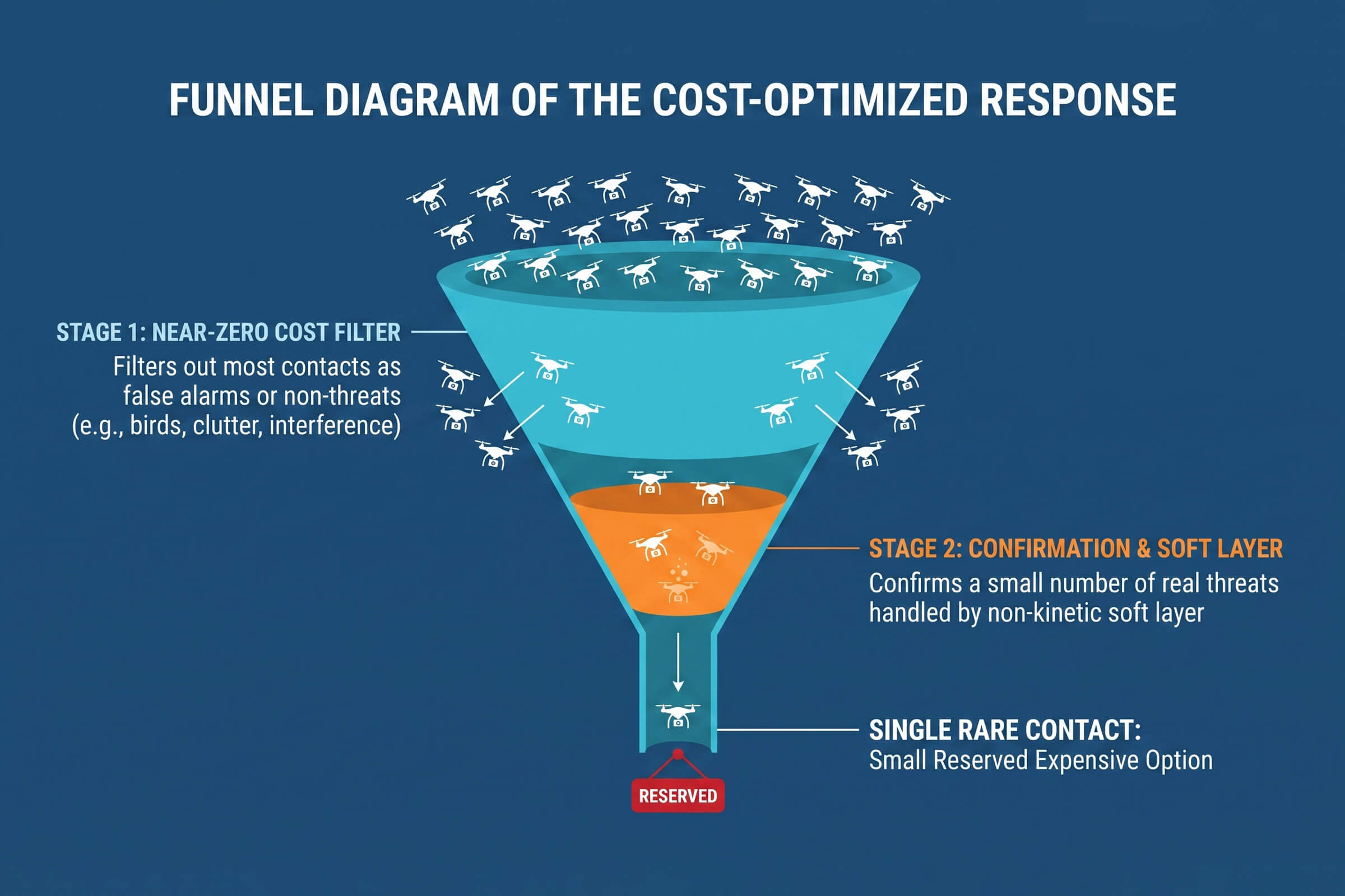
This is the exchange-ratio trap. If a defender answers every drone with an expensive effect, the attacker wins by simply sending more drones than the defender can afford to stop. The defender’s budget becomes the target. The only way out is to make the response cost less than the threat it neutralizes and to reserve the expensive options for the small number of cases that truly need them.

The trap is not theoretical. The same European official pointed to the mismatch directly: an interceptor priced in the millions against a drone priced in the thousands. The arithmetic only breaks one way, and it is not in the defender’s favor. Any strategy built on outspending the threat is a strategy that loses the moment the threat is massed.

The Layered Answer

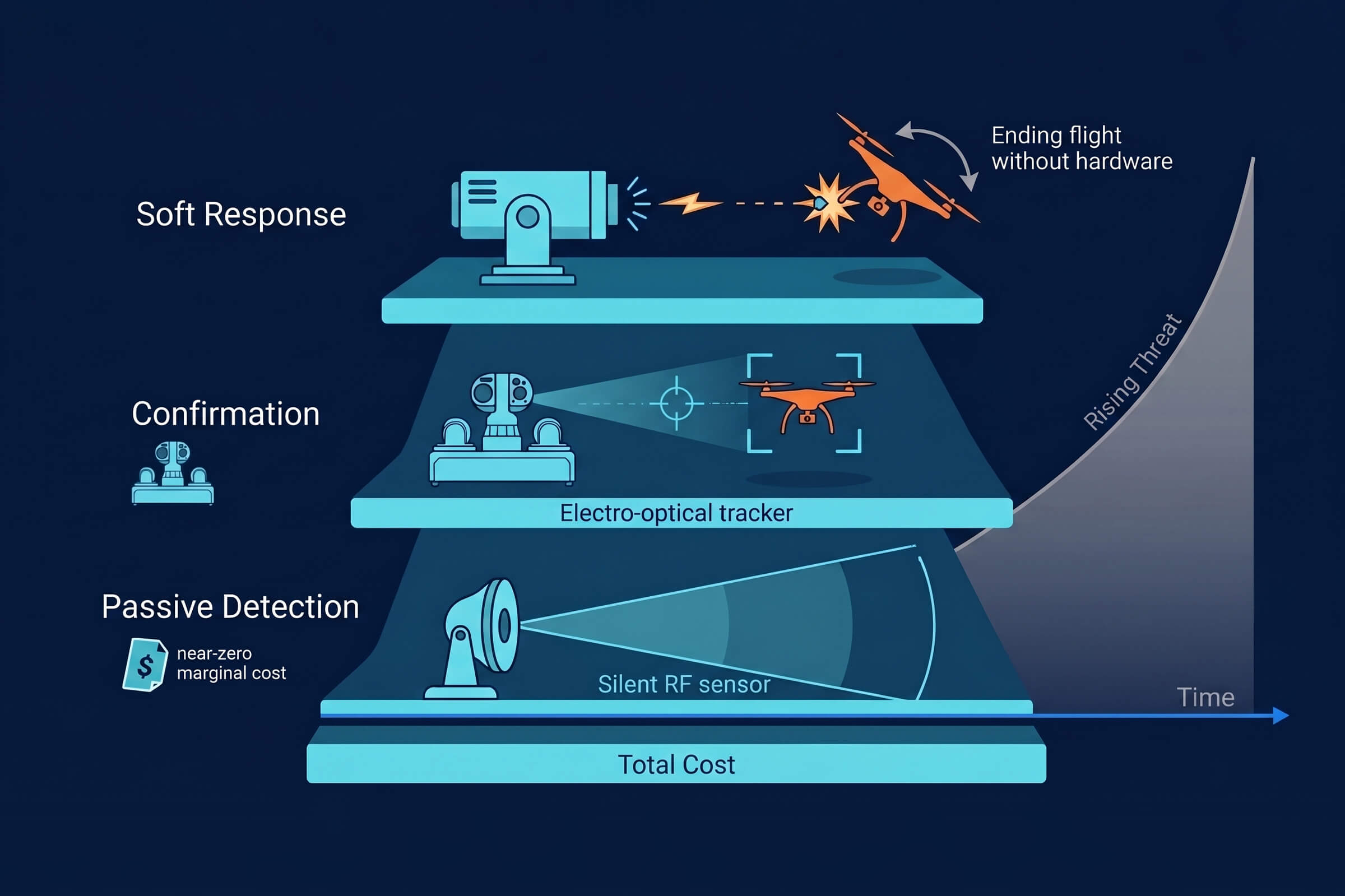
The counter to the exchange-ratio trap is layering, and it follows a simple logic. Detect early with something cheap and always-on. Confirm what you found. Then apply the least expensive effect that solves the problem, saving the costly options for the rare case that justifies them.

Passive radio frequency detection is the foundation because it is cheap to run, emits nothing, and covers a wide area continuously. It does the watching without spending a per-incident cost. Confirmation, whether by electro-optical tracking or by fusing several passive sensors, removes the false alarms that would otherwise waste the response layer. Only then does the question of effect arise, and only for the contacts that are actually threats.

That order of operations is what makes the economics work. Most drone events end at detection and confirmation, at a cost that is effectively fixed rather than per incident. The expensive decisions are reserved for the small fraction of cases that genuinely need them.

The Cost Advantage of the Soft Layer

Within the effect layer, the soft options carry the cost advantage. A radio frequency approach that breaks the link between a drone and its operator, done with a directional beam rather than a broad blast, ends the flight without consuming a physical round. It costs electricity, not hardware, and it can be used again the next minute. That is the property the exchange ratio rewards: a response whose marginal cost is near zero.

This is where a wide-band direction-finding sensor like the DFJ53 Max, with its 360-degree directional array, fits. It finds and localizes the drone first, so the intervention is aimed rather than sprayed. Aimed intervention uses less energy and touches less of the surrounding spectrum, which keeps the response precise and repeatable. Precision is not just a safety property. It is a cost property.

The software layer adds to the same arithmetic. A command-and-control platform that fuses the sensor feeds, correlates tracks, and queues the response removes the human cost that would otherwise sit between detection and action. Fewer operators, faster decisions, fewer wasted responses. Software is how the defense scales without the cost scaling alongside it.

Reserve the Expensive Effect for the Rare Case

None of this means the costly options disappear. There will always be a contact that justifies a hard response, and a layered system should keep that option in reserve. The point of the soft layer is not to replace the hard layer. It is to make sure the hard layer is used rarely enough that the budget survives.

The division is simple in principle. The passive and soft layers handle the routine, the wide, the frequent, at near-zero marginal cost. The expensive effect handles the exceptional, the confirmed, the unavoidable. When the layers are built in that order, the system spends almost nothing most of the time and reserves its budget for the moment it actually needs it. That is what balancing the exchange ratio means in practice.

The practical rule for a buyer follows. Start from the constraint: what can you legally and safely use at your site? In most civilian settings, that constraint leaves you with detection, confirmation, and a precise soft response. Build that well, and you have answered the threat at the lowest cost the constraint allows. The exchange ratio stops being a vulnerability and becomes a design requirement you have already met.

This is why the market is drifting toward it. The same half-year that showed strong revenue growth also showed the recurring, software-driven part of the business growing far faster than the hardware. Buyers are paying for outcomes, for updates, for a system that stays current without being replaced. That is the soft, layered model in its commercial form, and it is where the exchange ratio and the market’s direction point in the same direction.

The soft layer is built for exactly those constraints. A directional radio frequency response ends the flight without a falling object, without a debris field, and without the collateral damage a hard effect carries. It is the option that can actually be used where the demand is, which is what makes it the economic answer and not just a technical one. In civilian airspace, the soft layer is not the cheap alternative. It is often the only alternative.

The exchange ratio is sharpest in the places where counter-drone demand is growing fastest: airports, energy sites, stadiums, correctional facilities. These are civilian settings, and the constraints they impose push hard toward the soft layer. A hard kinetic response in the middle of a city is rarely an option at all. The question is not whether a missile can stop a drone. It is whether any hard effect can be used there without creating a worse problem.

Why Soft-Kill Fits Civilian Sites

What the DroneShield Numbers Actually Say

Read closely, the DroneShield report is less about one company and more about where the market is going. The 74 percent revenue growth says the demand is real and broad. The 229 percent growth in recurring revenue, still only nine percent of the total, says the industry is starting to sell outcomes and updates rather than just boxes, and there is room to grow. The losses posted despite the growth say that scaling a hardware business is expensive, which is itself a signal about what buyers should value.

For a buyer, the takeaway is to pay attention to the total cost of a defense, not the sticker price of a sensor. A system that costs little per incident and gets cheaper as it runs is the one that survives a long engagement. A system that wins every single drone with an expensive effect is a system the budget will eventually refuse to fund. The exchange ratio decides which kind you have bought.

When the full picture is counted, the layered, software-defined stack wins on cost for the same reason it wins on effect. It spends almost nothing on the routine, keeps the expensive options in reserve, and removes the human and hardware waste that inflates the true cost of a defense. That is what balancing the exchange ratio actually looks like on a balance sheet.

There is also the hidden cost of false alarms. Every false positive that reaches an operator consumes attention, and attention is the scarcest resource in any security operation. A system that filters its own false alarms, that confirms before it alerts, is cheaper to run even before the effect layer is considered. Cost is not just what you pay. It is what you spend in people, in fatigue, and in the decisions that follow a bad alert.

A system with a low sticker price and a high per-incident cost is a system that gets expensive the moment it is actually used. A system that consumes a physical round with every engagement is a system whose budget scales with the number of drones the attacker sends, which is exactly the trap the exchange ratio sets. The cheaper system over time is the one whose marginal cost per incident is near zero, because that is the only cost curve that stays flat while the threat grows.

Most procurement asks the wrong question first. The sticker price of a sensor tells you almost nothing about what the system will cost to own and to use over five years. The questions that matter are the ones that follow. What does it cost per incident, not per unit? Does the response consume hardware, or does it run on electricity? How many operators does it take to run a shift, and how much does the software cost to keep current?

How to Read the Cost of a System

Building for the Long Run

The sustainable counter-drone system is the one built around a cheap, passive detection layer, a confirmation layer that protects the operators from false alarms, and a soft effect layer that ends flights without spending hardware. On top of that sits software that ties it together and takes the labor out of the loop. That stack answers a wave of drones at a cost that stays flat, while reserving the costly options for the rare case.

The arithmetic that is breaking defense budgets is not going to reverse. Drones will keep getting cheaper and more numerous. The organizations that stay ahead of it will be the ones that stop trying to outspend the threat and start trying to out-design it. The exchange ratio is the new unit of account, and the soft, layered, software-defined stack is the only answer that balances it.

Airport Drone Defense: Why the Threat Has Escalated, and What Procurement Should Ask

From Disruption to Explosives

Two events in August 2026 mark a change in how airports should think about drones. In the early hours of August 5, German police found a drone carrying an unidentified explosive device near the southern runway of Leipzig/Halle Airport. They defused it, but not before both runways closed and passenger and cargo flights were diverted. One freighter may have touched an unidentified object and suffered minor damage. On August 19, an unauthorized drone near runway 28 at Sao Paulo Guarulhos International Airport halted takeoffs and landings for about thirty minutes, diverting at least ten flights.

Neither event was a first. Guarulhos has seen repeated drone disruptions throughout the year. Rio de Janeiro has recorded at least seven drone-delivered explosive incidents since March 2026, with police confirming that organized groups are now flying larger agricultural drones carrying heavier payloads. But Leipzig was a step change for the aviation sector specifically. The threat at an airport is no longer just a drone straying into protected airspace and forcing a pause. It is now a drone carrying a payload that could damage an aircraft or a terminal. Procurement logic has to catch up with that shift.

The Airport Threat Spectrum

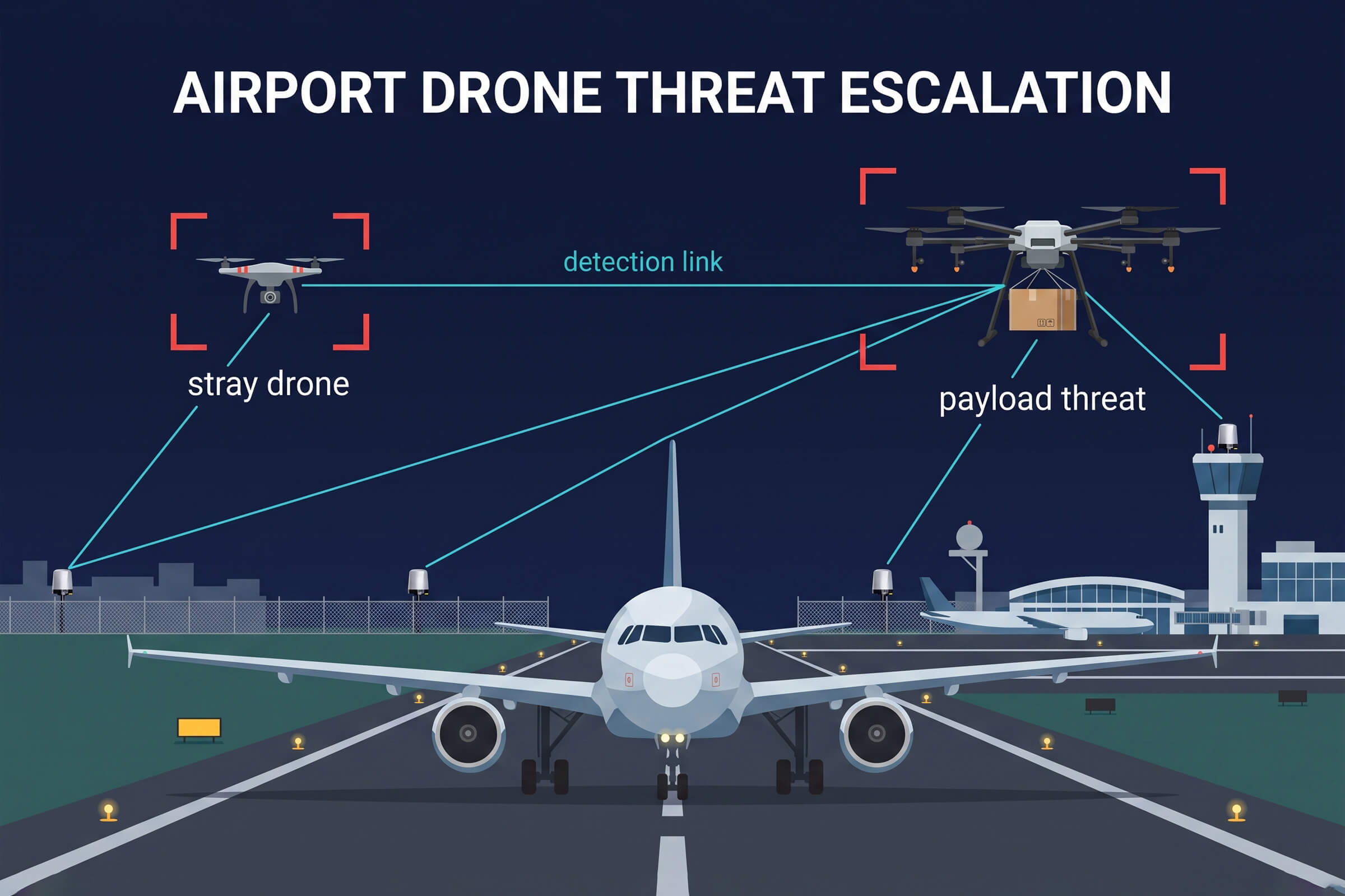
Airports face a range of drone events, and they are not all the same problem. At the low end is the stray drone, an amateur or a careless operator who wanders into protected airspace without intent. It forces a pause but rarely more. In the middle is deliberate disruption, a drone flown into an approach corridor to halt operations, whether as protest, mischief, or coercion. At the high end is the payload-carrying drone, a platform carrying an explosive or another payload intended to damage an aircraft or a building.

The distinction matters because the response is different in each case. A stray drone needs to be found and the operator located. Deliberate disruption needs rapid confirmation so the runway can close and reopen with confidence. A payload-carrying drone needs everything faster and more carefully, because the margin for a wrong call is zero. A system that treats all three the same way will be too slow where it should be quick and too blunt where it should be precise.

Why Airports Cannot React Like Other Sites

Most facilities can respond to a drone by shutting something down. An airport cannot. Every minute of closed runway is a chain of diverted flights, missed connections, and stranded passengers, and the cost compounds fast. The response has to be quick, but it also has to be right. A false alarm that closes a runway is itself an operational event with a price tag.

Airports are also dense electromagnetic environments. Air traffic control, ground operations, navigation aids, and passenger networks all run on radio spectrum that a broad, indiscriminate countermeasure would disturb. Any intervention has to be precise enough to leave the surrounding spectrum intact. That constraint rules out blunt approaches and pushes airports toward detection-first, confirmation-second designs.

Finally, there is the safety floor. Nothing an airport does to address a drone can endanger an aircraft or the people on the ground. That is why the sequence matters as much as the hardware: detect, confirm, then decide, with every step documented. In a setting this regulated, the process is the product.

Three Shifts in What Airports Buy

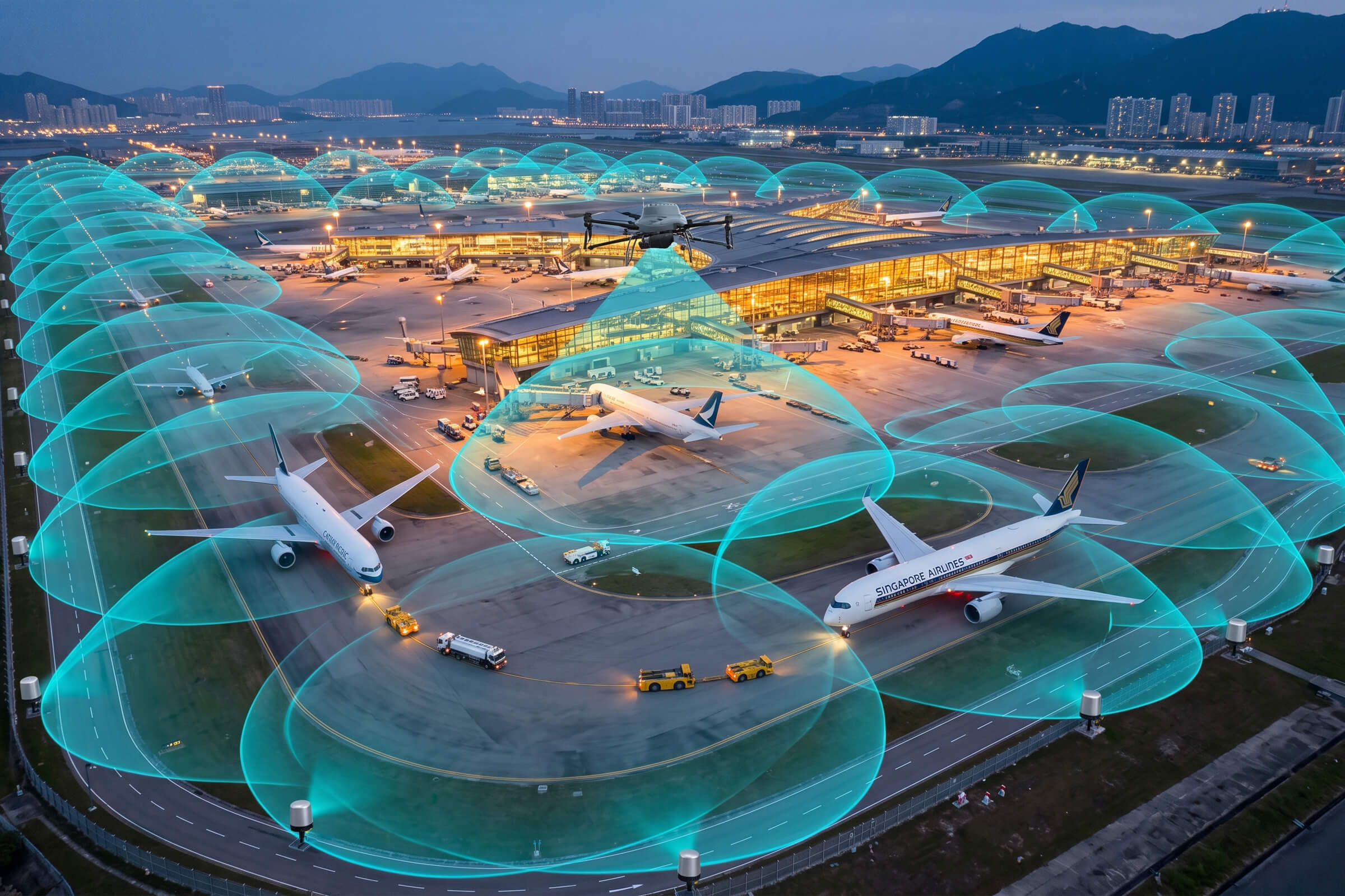
The August events point to three changes in procurement logic. The first is continuous low-altitude coverage. A single detection point leaves gaps, and a drone only needs one gap. Airports are moving toward a detection layer that watches the full perimeter and the approach corridors all the time, not just when an incident is reported.

The second is graded alerting. An airport is surrounded by birds, weather returns, legitimate radio traffic, and commercial aircraft. A system that treats every contact as a drone will cry wolf until the operators stop listening. The value is in a system that tells the difference between a bird, a plane, and a drone, and raises only the alerts that need a human.

The third is a low-collateral response. The days of answering a drone with a broad shutdown of spectrum, or of treating any drone as a shoot-down decision, are over for civil airports. The requirement is a response that stops the threat without stopping the airport, and a record that stands up afterward.

The Detection Layer: RF Direction Finding

The first layer is radio frequency direction finding. A drone is a flying radio, and its command and video links are visible to a passive sensor whether or not the drone is in line of sight. The DF Series units, such as the DFJ83, measure the angle of arrival of a drone’s signal across a wide band from 30 MHz to 6 GHz, detecting a drone at up to eight kilometers with direction-finding accuracy of three degrees RMS on a hovering target.

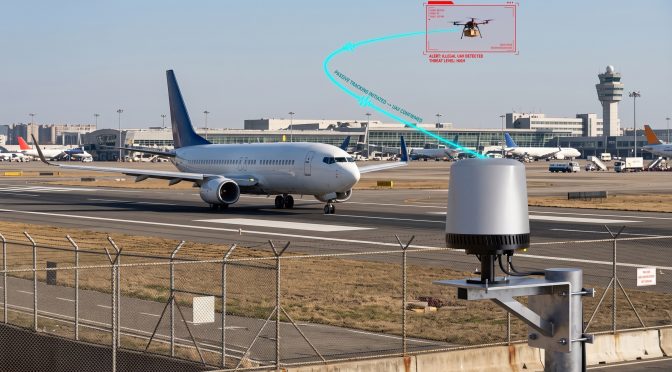
Placed around an airport perimeter, two or three direction-finding units draw intersecting bearings that locate the drone. Because the detection is passive, it emits nothing and interferes with nothing, which is the first requirement for an airport. It watches the spectrum continuously and stays silent, so it can run all day without touching the radio environment the airport depends on.

There is a deeper reason the detection layer leads. In a heavily regulated setting, detection and identification are the capabilities an airport can deploy without licensing friction. They raise no interference concerns and no authorization questions. An airport that builds this layer first is operational on day one, while the harder questions around intervention are still being worked out.

Filling the Gaps: Airborne Coverage

Ground sensors see the world from roughly eye level, and an airport is full of structures that block the view: terminals, hangars, parked aircraft, jet bridges. A drone on the far side of a terminal is invisible to a ground node. That is where an airborne payload helps.

The D5-Air is a drone-mounted detection payload covering the 400 MHz to 6 GHz band with a detection range of up to five kilometers. It watches a full 360 degrees horizontally, which lets a single airborne node cover an area that would take several ground sensors to reach. It is not a replacement for the fixed perimeter layer. It is the tool that fills the shadows, deployed when a specific sector needs a closer look or a gap needs to be closed quickly.

The value of a mobile layer is flexibility. A fixed perimeter cannot be everywhere, and no airport can afford to cover every corner with permanent infrastructure. An airborne node moves to where the gap is, whether that is a temporary construction zone, an event, or a sector the fixed layer cannot see. It turns coverage from something fixed and rigid into something the airport can point to where it is needed.

Visual Confirmation: EO/IR Tracking

Detection tells an operator that something is there. Confirmation tells them what it is, where exactly it is, and what it is doing, and that is what turns an alert into something an airport can act on. The VAR300 is an all-weather electro-optical and infrared tracker built for this. It pairs a 640 by 512 infrared sensor with AI-driven visual tracking, detecting a drone at up to one kilometer in daylight and roughly half a kilometer at night, and holding a track beyond that.

The confirmation layer earns its place in two ways. It filters false alarms, so the runway does not close over a flock of birds. And it produces the evidence. When an incident triggers a report, a review, or a legal process, a time-stamped video of the drone, its path, and its behavior is what holds up. An RF log that says a drone was present is weak by comparison.

Confirmation also connects to the aviation authorities. When an airport reports a drone sighting, the report has weight because it is visual and verifiable. That weight matters because it is what allows a rapid, confident decision to close and reopen a runway, and it is what survives the investigation that follows every incident.

In a city airport, this link to law enforcement is what closes the loop. Detection finds the drone, confirmation records it, and the operator’s location gives the authorities somewhere to go. An airport that only stops the drone is playing defense forever. One that locates the operator starts reducing the number of times it has to play at all.

Direction-finding supports this directly. The same bearings that place the drone point back toward the controller, because the operator’s radio link is part of the same signal exchange the sensor reads. As the drone moves and the operator stays put, the bearings converge on the launch point. That is the lead the police need, and it is generated before the drone even lands.

Stopping the drone is only half the response. The other half is finding the person flying it. A drone that is forced down or turned away leaves an operator who can fly again in minutes, from a different spot, with a different drone. The durable outcome is to locate the operator while the drone is still in the air.

Locating the Operator

The Regulatory Reality

Airport drone defense is not decided by detection range alone. A high-profile airport project in Europe was reworked in 2026 not over a failed test but over how the system was classified, how it was licensed, and who was authorized to operate it. The lesson travels: before a system is bought, the procurement team has to map the legal path. Is it approved for civil use? Who is permitted to operate it? How is the data handled?

That is why graded configuration matters. A well-designed airport deployment can start with passive detection and visual confirmation, which raise no interference concerns, and add a carefully scoped intervention layer only where regulation and licensing allow. The system should be able to operate in detect-and-alert mode today and step up to a fuller response where the legal space exists. Buying for that flexibility is what keeps an airport compliant and effective at the same time.

The Bottom Line

The drone threat at airports has changed, and the procurement playbook has to change with it. Continuous low-altitude coverage, graded alerting, and a low-collateral, well-documented response are now the baseline. Passive RF direction finding finds the drone, airborne coverage closes the gaps, and EO/IR confirmation turns an alert into evidence.

An airport that builds that chain, in that order, gets a system that can stop a drone without stopping the operation. That is the only kind of airport drone defense worth buying.